

Selecting the Best Knee Surgeons and Best Hospitals in India for Knee Surgery as an Australian Patient
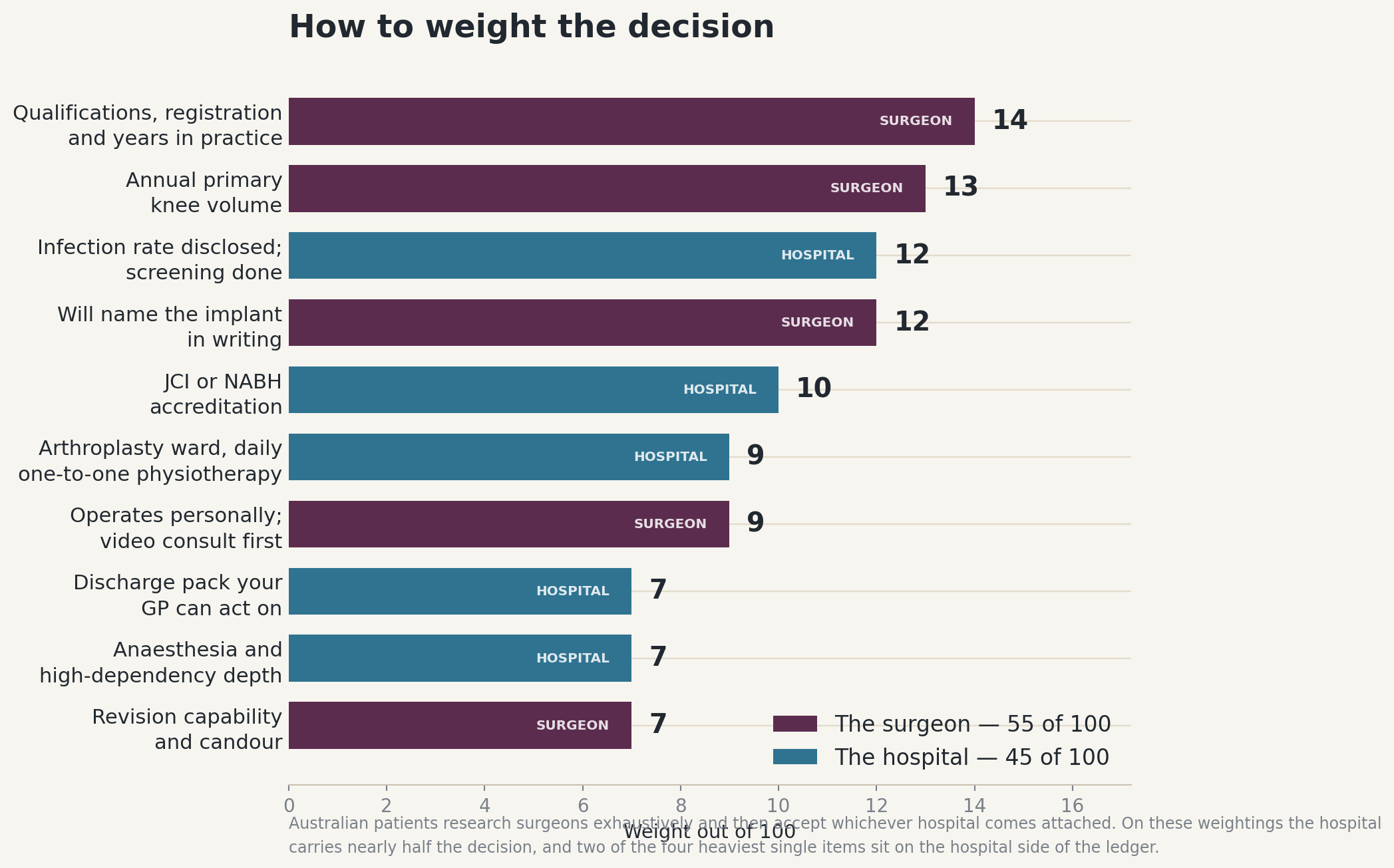
Ten criteria, weighted, and split deliberately in two — because you will research the surgeon thoroughly and then accept whichever hospital comes attached, and that is the wrong way round.
Australians research surgeons obsessively and hospitals barely at all. They will read a dozen profiles, compare fellowships, ask about technique — and then accept whichever institution the surgeon happens to operate in, as though it were a waiting room rather than the place where infection, anaesthesia and the first forty-eight hours will actually decide how this goes. In 24 years of guiding international patients into Indian hospitals, that single habit has caused more disappointment than any other. This briefing splits the decision deliberately in two, because both halves need judging and only one of them usually gets it.
Healing Journeys of Australian Patients


Key Takeaways
- Australian patients considering knee replacement in India should evaluate the surgeon and hospital separately, because surgeon expertise alone does not determine infection control, anaesthesia safety, rehabilitation quality or the standard of immediate postoperative care.
- The guide identifies MS (Orthopaedics) or DNB (Orthopaedics) as the key specialist qualifications, while MCh, DrNB or a dedicated arthroplasty fellowship represents additional sub-specialty training relevant to joint replacement.
- For a straightforward primary knee replacement, the guide suggests completed specialist training, a formal arthroplasty fellowship and approximately 8–10 years of independent operating experience. Complex and revision knee cases should generally involve considerably greater experience.
- Patients should ask how many primary total knee replacements the surgeon personally performed during the previous year, rather than relying on hospital volumes, career totals or combined joint-replacement figures.
- Australian patients should obtain the proposed knee implant details in writing, including the brand and model of the femoral and tibial components, bearing type, fixation method and whether the patella will be resurfaced.
- The proposed implant can then be checked against the Australian Orthopaedic Association National Joint Replacement Registry, which publishes implant survivorship information. The guide's page 4 chart illustrates an approximately threefold spread in cumulative revision performance at ten years between better- and poorer-performing implant combinations.
- Hospital assessment should include the disclosed surgical-site infection rate for primary knee arthroplasty, preoperative screening, independently verifiable JCI or NABH accreditation, a dedicated arthroplasty ward, daily one-to-one physiotherapy and appropriate high-dependency care.
- The cost chart on page 1 shows approximately Approximately $15,000 all-in for knee replacement in India, including surgery, flights and a three-week stay, compared with approximately Approximately $28,000 for self-funded private treatment in Australia. These are indicative July 2026 figures.
- Australian patients should generally plan around three weeks in India for a single knee replacement rather than returning after ten days. A documented fit-to-fly assessment and written thromboprophylaxis plan covering the long-haul flight are recommended.
- Before travelling, patients should arrange Australian GP follow-up and physiotherapy. They should return with the operation note, implant identification card and lot number, postoperative films, culture results where applicable, anticoagulation plan and written rehabilitation protocol.
Quick Facts
- Conditions/Health Factors Covered
- Knee joint disease requiring primary total knee replacement, complex knee arthroplasty and revision knee replacement
- Procedures Mentioned
- Primary total knee replacement, knee arthroplasty and revision knee replacement
- Target Audience
- Australian patients considering elective knee replacement surgery in India
- Author/Advisor
- Dr. Dheeraj Bojwani, Independent Medical Travel Advisor, 24 years of experience guiding international patients
- Surgeon Qualification Highlights
- MS (Orthopaedics) or DNB (Orthopaedics), with MCh, DrNB or a dedicated arthroplasty fellowship providing additional sub-specialty training
- Experience Recommended
- Approximately 8–10 years of independent operating experience after specialist training for a straightforward primary knee replacement; considerably more for complex or revision cases
- Surgeon Selection Highlights
- Annual personal primary knee replacement volume, joint-replacement-focused practice, exact implant disclosure, direct video consultation with the operating surgeon, personal surgeon involvement and revision capability
- Implant Information to Obtain
- Femoral component brand and model, tibial component brand and model, bearing type, cemented or cementless fixation and whether the patella will be resurfaced
- Implant Verification
- The guide recommends checking the proposed implant combination against the Australian Orthopaedic Association National Joint Replacement Registry.
- Hospital Selection Highlights
- Disclosed surgical-site infection rate, preoperative joint-surgery screening, independently verifiable JCI or NABH accreditation, dedicated arthroplasty ward, daily one-to-one physiotherapy, consultant anaesthetic review and high-dependency care
- Indicative Cost
- Approximately $15,000 all-in for knee replacement in India, including surgery, flights and a three-week stay. The page 1 chart compares this with approximately Approximately $28,000 for self-funded private treatment in Australia and Approximately $3,500 as an indicative gap for an appropriately privately insured Australian patient.
- Discharge Documentation
- Operation note, implant identification card with lot number, postoperative films, culture results where applicable, anticoagulation plan and written rehabilitation protocol
- Accreditation Discussed
- JCI and NABH
- Partner Hospital Cities
- Specific partner hospital cities are not provided in the guide and therefore should not be added as source-derived information.
In Brief
Australian patients considering total knee replacement in India should assess the surgeon, knee implant and hospital as separate parts of the decision. The guide recommends an MS/DNB-qualified orthopaedic surgeon with dedicated arthroplasty training, substantial annual primary knee volume and transparent revision experience. Patients should obtain the exact implant specifications in writing and compare them with Australia's national joint replacement registry. Hospital selection should independently consider infection rates, JCI or NABH accreditation, dedicated arthroplasty rehabilitation, anaesthetic support and high-dependency care. Australian follow-up should be arranged before departure, with approximately three weeks in India planned for a single knee replacement before the return flight, subject to medical clearance.
Before you choose anyone: should you be choosing at all?
Australia performs knee replacement extremely well. Its surgeons are excellent, its hospitals are safe, and its national joint registry is among the finest in the world. Nothing in this report suggests otherwise, and if you can be treated promptly at home you should be.
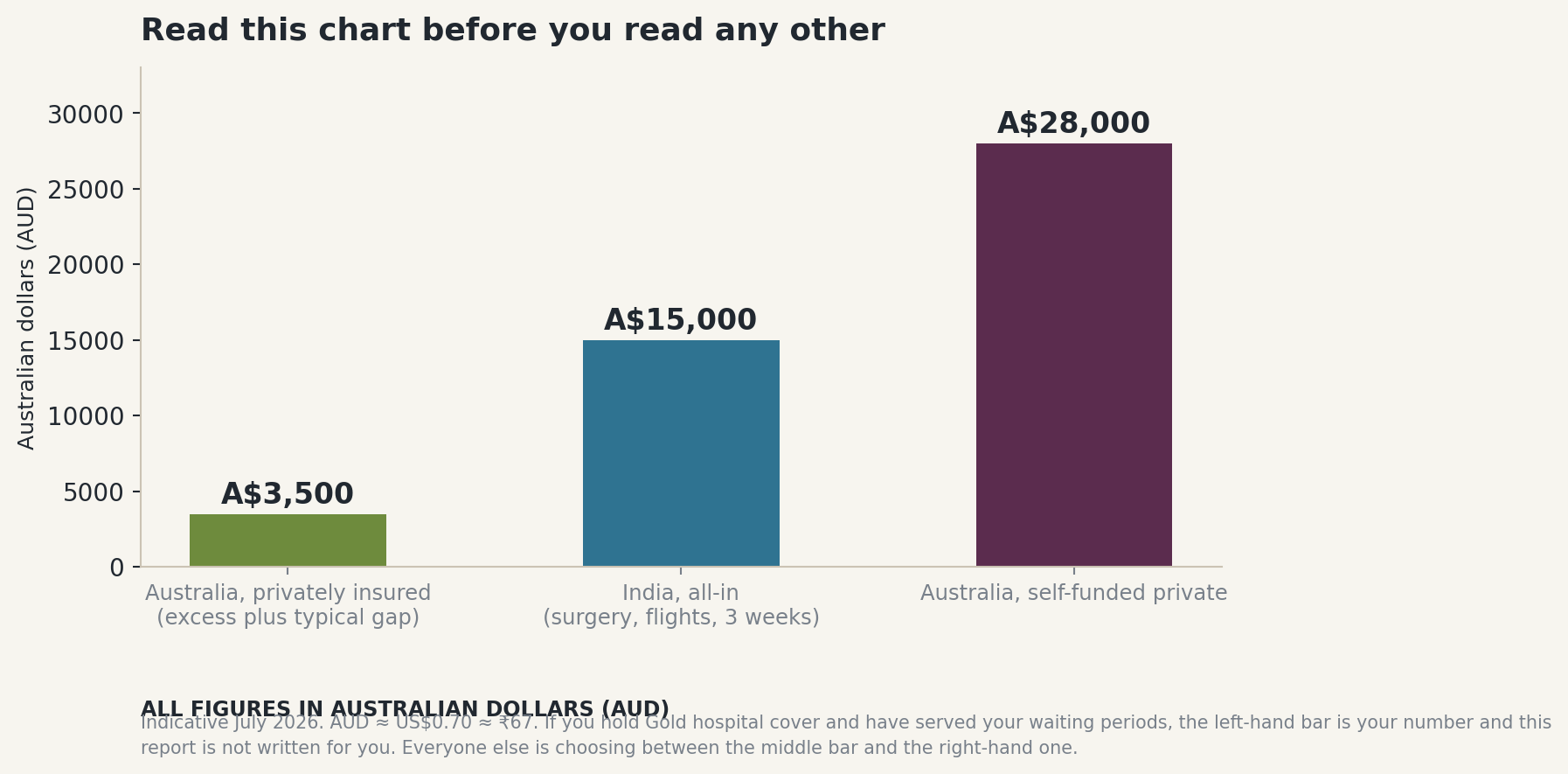
If you hold Gold hospital cover and have served your waiting periods, you will be admitted privately within weeks and your fund absorbs most of the bill. Stop reading. Travelling makes no sense for you and anyone who tells you otherwise is not being straight.
This is written for the Australians outside that: those with no private cover, those whose policy excludes joint replacement, and those who took out Gold cover after the knee began to fail and now face a twelve- month pre-existing condition wait. For them the choice is a five-figure private bill, most of a year on a public list, or a properly chosen unit overseas. That last option is only as good as the choosing, which is what the rest of this is about.
Part one: judging the surgeon
1. The letters after his name, and how to read them. An Australian can size up an Australian surgeon almost unconsciously — MBBS, FRACS, FAOrthA and you know roughly where you stand. Faced with an Indian profile reading MBBS, MS (Orth), DNB, MCh, FIACS, you have no such instinct, and the temptation is either to be impressed by the sheer length of the string or to ignore it altogether. Both are mistakes. The Indian qualification ladder is perfectly legible once somebody sets it out.
| Qualification | Length | What it actually means |
|---|---|---|
| MBBS | 5½ years | The basic medical degree, comparable in standing to an Australian MBBS or MD. It is a licence to practise medicine, not a specialist qualification. On its own it is not enough. |
| MS (Orthopaedics) or DNB (Orthopaedics) | 3 years | This is the one that matters. MS is awarded by a university, DNB by the National Board of Examinations. The National Medical Commission treats them as equivalent, and either represents completed specialist training in orthopaedics. |
| D.Ortho | 2 years | A diploma rather than a specialist degree, and a rung below MS or DNB. Many surgeons hold it on the way to something higher. Standing alone, it should prompt a question. |
| MCh, DrNB, or a dedicated arthroplasty fellowship | 1–3 years | Sub-specialty training beyond the specialist degree. For knee replacement this is what you actually want: a formal joint replacement fellowship, ideally served at a high-volume unit. |
| FRCS (Tr & Orth), FRACS, or an overseas fellowship | Varies | International training, common among senior Indian arthroplasty surgeons and worth asking about — though what he does every week now matters more than where he trained in 2004. |
And read the experience figure correctly. “Twenty-five years of experience” on a profile is usually counted from MBBS, which quietly inflates the number by the five or six years he spent still in training. Ask instead for the year he completed his MS or DNB, the year he became an independent consultant, and how long he has been doing joint replacement specifically. For a straightforward primary knee I would want completed specialist training, an arthroplasty fellowship, and something in the order of eight to ten years operating independently. For a complex or revision knee, considerably more.
2. Annual primary knee volume. Ask for the number of primary total knee replacements he performed personally last year — not the hospital’s figure, not his career total, not joints in general. Volume is among the more reliable predictors of outcome in arthroplasty, and a surgeon who does knees daily is operating in a different register from one who does them between other work. A confident answer arrives immediately. Hesitation is itself information.
Ask this of three units rather than one. Shortlisting is the cheapest quality control available to you: three sets of answers to identical questions separate the serious from the promotional faster than any amount of website reading, and it costs three emails.
3. Whether he will name the implant in writing. This is the criterion that gives Australians an advantage almost no other medical traveller has, and it is startling how few use it. Ask for the brand and model of the femoral and tibial components, the bearing type, whether fixation is cemented or cementless, and whether the patella will be resurfaced. Then look that combination up in the Australian Orthopaedic Association National Joint Replacement Registry, which publishes survivorship by implant.
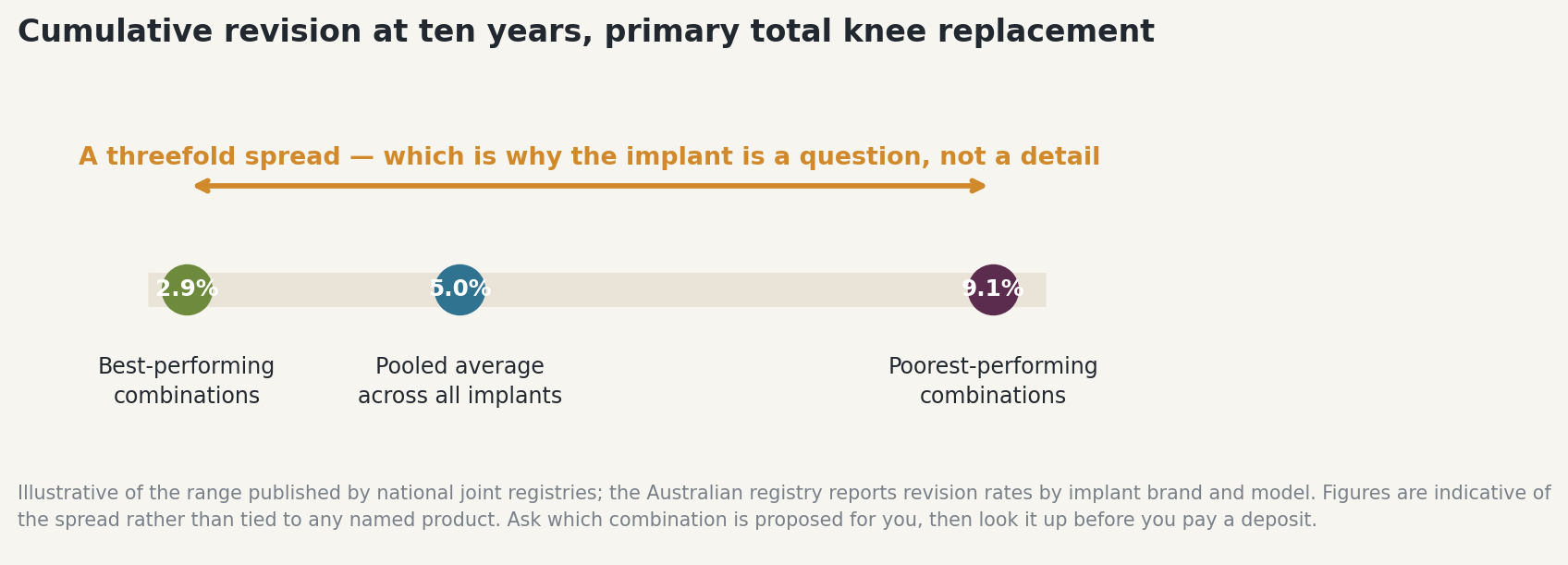
Implants are not interchangeable. The gap between the better-performing combinations and the poorer ones is roughly threefold at ten years, which is why this is a question rather than a detail. A surgeon who answers with model numbers and a reason for the choice has chosen deliberately. One who offers reassurance about “imported American implants” has not, and you should press until you have specifics or a reason to walk.
4. Whether he operates personally, and speaks to you first. Ask what proportion of his operating list is joint replacement rather than general orthopaedics; you want a practice built on hips and knees. Then insist on a video consultation with the surgeon who will hold the saw — not a coordinator, not a colleague — before any deposit moves. Ask directly: will you perform this operation yourself, from start to finish, and who assists? In large units it is not unusual for a senior name to attract cases and a junior to perform them. That may be perfectly safe. You are simply entitled to know.
5. Revision capability and candour. Ask what he does when a knee stiffens, when a case proves more complex than the films suggested, and how many revisions he performs. A surgeon who describes his complications without defensiveness is telling you he has enough of a practice to have seen them and enough security to discuss them. One who implies complications do not occur in his hands is either inexperienced or not being frank, and neither helps you.
Part two: judging the hospital
6. The infection rate, disclosed rather than described. Prosthetic joint infection is the complication that matters in knee replacement anywhere on earth. Ask the unit for its surgical site infection rate for primary knee arthroplasty, and whether it screens patients before joint surgery. Strong centres share these figures readily and are not offended by the question. Ask also that any wound swab or culture result be given to you in writing, and tell your Australian GP on return that you have had surgery overseas so a screening swab can be considered — this is a sensible precaution rather than an accusation, and your GP will raise it anyway.
7. Accreditation you can verify yourself. JCI is the international arm of the body that accredits hospitals across the United States; NABH is India’s national equivalent, recognised by the same global standards authority. Either means an external inspector has audited infection control, surgical checklists, medication safety and record-keeping against a published standard. Check it on the accrediting body’s own site rather than accepting the logo on the hospital’s.
8. A dedicated arthroplasty ward and daily one-to-one physiotherapy. This is the difference Australians notice most and expect least. You should be walking under supervision on day two, working individually with a physiotherapist every day of your stay, and reviewed throughout by the surgeon who operated — not discharged at forty-eight hours to arrange your own rehabilitation. Ask how many physiotherapy sessions are included and whether they are one-to-one or group.
9. Anaesthetic and high-dependency depth. Most knee patients are in their sixties and seventies and arrive with something else — hypertension, diabetes, a cardiac history. Ask whether a consultant anaesthetist reviews you before surgery, whether high-dependency care is available in the same building, and who manages your medical problems if they misbehave. A hospital with physicians on site is a materially different proposition from a stand-alone surgical centre.
10. The discharge pack, and whether your GP could act on it. Before you leave you should be handed the operation note, the implant identification card with lot number, post-operative films, any culture results, your anticoagulation plan and a written rehabilitation protocol. This is not paperwork. It is the document set that determines whether your Australian GP and physiotherapist can confidently take over your care or are left guessing. Ask to see a sample discharge pack before you commit — a good unit will send one without hesitation.
What the quote should say, and what it usually omits
In 24 years I have found that disputes almost never concern the quoted price. They concern what the quote silently omitted.
Insist on a written, itemised, all-inclusive figure that states the implant by name, the number of inpatient nights included, the physiotherapy sessions included, post-operative imaging, and — critically — the cost of each additional night if you stay longer. Ask what the hospital covers if you need a return to theatre during your admission. Ask whether the surgeon’s fee, the anaesthetist’s fee and the assistant’s fee sit inside the number or beside it.
Understand too what does not travel with you. Medicare pays nothing for treatment received overseas, your health fund rebate applies to Australian admissions, and standard travel insurance excludes planned surgery and its complications. That is the shape of the decision rather than a hidden trap, but it means the written quote is the only protection you have, and it should be obtained before any money moves.
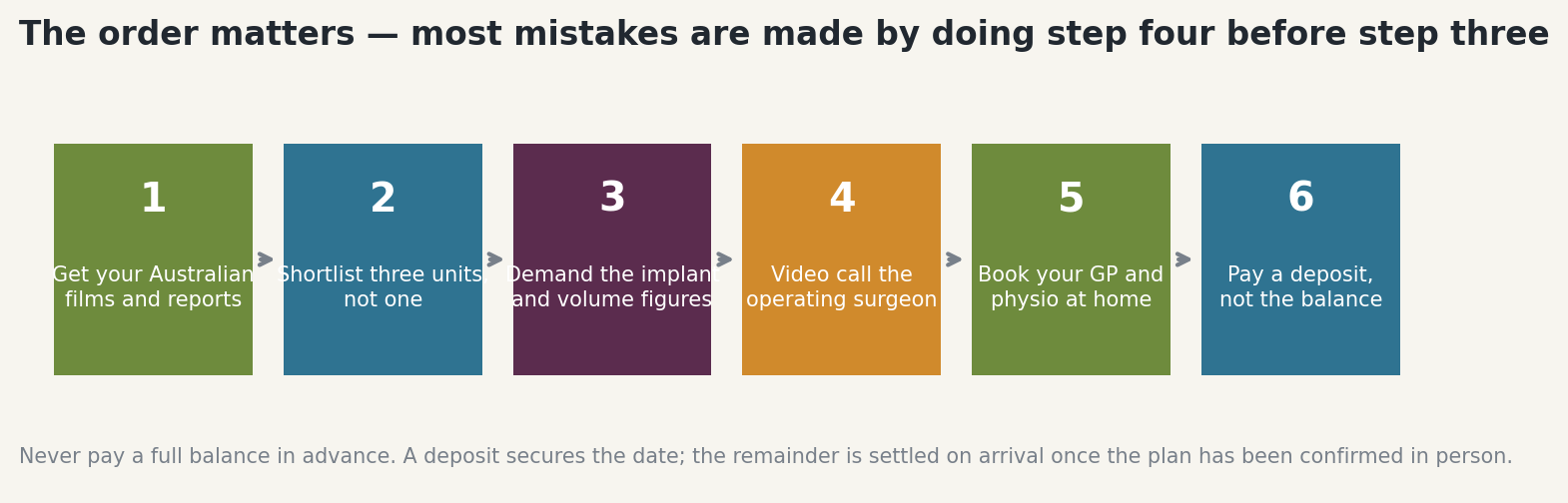
One further rule, and it is not negotiable: pay a deposit to secure the date, never the full balance in advance. The remainder is settled on arrival, after the surgeon has examined you and confirmed in person that the plan in the quote is still the plan. A unit that insists on full pre-payment is asking you to surrender the only leverage you have at precisely the moment you might need it.
Four Signals that Should Make You Pause
1. A price quoted before your films have been reviewed. Nobody can price a knee they have not seen. A number that arrives within an hour of your first email is a marketing figure, not a quote.
2. Refusal, or vagueness, about the implant. You have a national registry. A unit unwilling to tell you what it intends to put in your leg has failed the easiest test in this process.
3. A coordinator who will not put you through to the surgeon. Enthusiasm about airport transfers and hotel packages, combined with difficulty arranging fifteen minutes of clinical conversation, tells you where the institution’s attention sits.
4. Silence about your dental health, your HbA1c or your weight. Each materially affects prosthetic joint infection risk. A unit that raises them is prioritising your knee over its booking; a
unit that never mentions them is doing the reverse.
Australia-specific considerations most patients miss
Arrange your follow-up before you leave, not after you land. Some Australian GPs and orthopaedic surgeons are reluctant to take on the routine follow-up of elective surgery performed overseas. You will never be refused emergency care, but wound review and rehabilitation can meet friction. Speak to your GP, give them the dates, and book your physiotherapy course in Australia in advance. If your GP is unwilling, find one who is willing while you still have time to look. This single step separates the patients who do well from those who struggle.
Treat the flight as a clinical matter. Sydney or Melbourne to Delhi is a long sector, usually with one stop, and the risk of venous thromboembolism stays elevated for weeks after knee arthroplasty. Plan three weeks in India for a single knee rather than ten days, book a changeable return, and ask for a documented fit-to- fly assessment and a written thromboprophylaxis plan covering the flight itself. A unit that proposes putting you on a plane on day ten deserves a second conversation.
Send the study, not the report. Weight-bearing knee X-rays are what the surgeon needs to plan and template; a typed report alone will simply generate a request for the films.
Apply for both visas together. Australian passport holders are eligible for India’s electronic medical visa, issued against a formal invitation letter from the treating hospital, with an e-medical attendant visa for whoever travels with you. Apply for both in the same batch rather than sequentially.
Consider who travels with you. The attendant visa exists for a reason. A second set of ears in the pre- operative consultation, and a second pair of hands in the first week after surgery, is worth more than any brochure.
Ask what happens if you need to come back. A small proportion of knees stiffen and require manipulation under anaesthetic in the months after surgery, and a smaller proportion develop problems requiring further intervention. Establish before you travel what the unit does in that situation, whether it charges for it, and whether it requires you to return to India. Ask the same question of your Australian surgeon: would he manage a stiff knee operated on overseas? The answers to those two questions, taken together, tell you a great deal about how comfortable this decision should feel.
| The Questions, in the Order You Should Ask Them | |
|---|---|
| Of the surgeon | Of the hospital |
|
|
A closing word
Knee replacement is one of the most successful operations in modern surgery, and choosing well overseas is entirely achievable — but it is a process rather than a purchase, and the order of the steps matters more than most patients realise. Settle the surgeon and the hospital separately. Get the implant in writing and check it against your own registry. Book your Australian follow-up before you fly. Pay a deposit, never a balance. If you would like a second opinion on your imaging, or a review of a quote you are already holding, send the films and the written quote and I will look at them properly — including telling you to wait for your place on an Australian list, or that your case is complex enough to be done at home, if that is what I think.
Sources
- 🌐 Australian Orthopaedic Association National Joint Replacement Registry, Annual Report , on survivorship by implant brand and model
- 🌐 Australian Institute of Health and Welfare, Elective surgery waiting times , 2024–25
- 🌐 Australian private hospital and health fund published pricing and pre-existing condition waiting periods, 2026
- 🌐 Joint Commission International and National Accreditation Board for Hospitals and Healthcare Providers, accreditation registers
- 🌐 High Commission of India, e-Visa categories and eligibility
Frequently Asked Questions by Australians about Knee Surgeons and Best Hospitals in India
How should Australian patients choose the best knee replacement surgeon in India?
Australian patients should evaluate the surgeon’s orthopaedic qualifications, annual primary knee replacement volume, implant choice, personal involvement in surgery and revision experience. The guide recommends comparing at least three units and arranging a direct video consultation with the surgeon who will actually perform the operation before paying a deposit.
What qualifications should Australian patients look for in a knee surgeon in India?
The guide identifies MS (Orthopaedics) or DNB (Orthopaedics) as the specialist qualifications that matter most. MCh, DrNB or a dedicated arthroplasty fellowship provides additional sub-specialty training. For a straightforward primary knee replacement, the guide suggests completed specialist training, an arthroplasty fellowship and around 8–10 years of independent operating experience.
How can Australians check a knee surgeon’s experience before travelling to India?
Patients should ask how many primary total knee replacements the surgeon personally performed in the previous year. The guide advises against relying on the hospital's overall figure, the surgeon's career total or a combined number for different joint procedures. Asking the same questions of three shortlisted units can make comparison easier.
Why should Australian patients ask which knee implant will be used in India?
The guide recommends obtaining the brand and model of the femoral and tibial components, bearing type, fixation method and whether the patella will be resurfaced. Australians can then check the proposed implant combination against the Australian Orthopaedic Association National Joint Replacement Registry. The guide's chart illustrates that implant revision performance can vary substantially over ten years.
How much does knee replacement in India cost for Australian patients?
The cost chart on page 1 provides an indicative figure of approximately Approximately $15,000 all-in for India, including knee replacement surgery, flights and a three-week stay. It compares this with approximately Approximately $28,000 for self-funded private treatment in Australia and an indicative Approximately $3,500 gap for an appropriately privately insured Australian patient. The figures are indicative as of July 2026 and should be re-verified before treatment.
What hospital safety factors should Australians check before knee replacement in India?
Patients should ask for the hospital's surgical-site infection rate for primary knee arthroplasty and whether preoperative screening is performed. The guide also recommends independently verifying JCI or NABH accreditation and checking for a dedicated arthroplasty ward, daily one-to-one physiotherapy, consultant anaesthetic review and on-site high-dependency care.
How long should Australian patients stay in India after knee replacement?
The guide recommends planning approximately three weeks in India for a single knee replacement rather than ten days. Because venous thromboembolism risk remains elevated for weeks after knee arthroplasty, patients should have a documented fit-to-fly assessment and written thromboprophylaxis plan covering the return flight.
What should be included in a knee replacement quotation from an Indian hospital?
The written quotation should identify the implant by name, number of inpatient nights, included physiotherapy sessions, postoperative imaging and cost of additional hospital nights. Patients should also ask whether surgeon, anaesthetist and assistant fees are included and what happens financially if a return to theatre is required during the admission.
What warning signs should Australian patients watch for when choosing knee surgery in India?
The guide identifies four major warning signs: receiving a price before the patient's films have been reviewed, refusal or vagueness about the proposed implant, difficulty obtaining direct access to the operating surgeon, and no discussion of dental health, HbA1c or weight, which can influence prosthetic joint infection risk.
What documents should Australian patients bring home after knee replacement in India?
Patients should obtain their operation note, implant identification card with lot number, postoperative films, relevant culture results, anticoagulation plan and written rehabilitation protocol. Australian GP follow-up and physiotherapy should also be organised before travelling so that postoperative care can continue after the patient returns home.
Page Summary
This guide explains how Australian patients can select knee replacement surgeons and hospitals in India using ten weighted criteria divided between surgeon and hospital factors. The weighting chart on page 2 assigns 55 points to surgeon factors and 45 to hospital factors, reinforcing the guide's central argument that the hospital should be assessed independently rather than simply accepted because a preferred surgeon operates there. Surgeon assessment covers qualifications, annual primary knee volume, exact implant selection, personal involvement and revision capability. Hospital assessment covers infection rates, accreditation, arthroplasty rehabilitation, anaesthetic and high-dependency support, and discharge documentation. The guide also addresses itemised quotations, Australian follow-up, long-haul flight safety, thromboprophylaxis, e-medical visas and warning signs patients should recognise before committing to treatment.
Citation Block
| Topic | Information |
|---|---|
| Topic Information | Selecting the Best Knee Surgeons and Best Hospitals in India for Knee Surgery as an Australian Patient |
| Procedure | Total Knee Replacement / Knee Arthroplasty |
| Country | India |
| Intended Audience | Australian Patients |
| Conditions Covered | Knee Joint Disease Requiring Primary Replacement, Complex Knee Arthroplasty and Revision Knee Cases |
| Procedures | Primary Total Knee Replacement, Knee Arthroplasty and Revision Knee Replacement |
| Typical Stay | Approximately 3 Weeks in India for a Single Knee Replacement |
| Hospital Stay | Not Specifically Stated; Written Quote Should Specify Included Inpatient Nights |
| Recovery | Procedure-Dependent; VTE Risk Remains Elevated for Weeks and Medical Clearance Is Recommended Before Flying |
| Indicative Cost | Approximately $15,000 All-In for Knee Replacement in India, Including Surgery, Flights and a 3-Week Stay |
| Author | Dr. Dheeraj Bojwani |
| Experience | 24 Years Guiding International Patients |


Our Mission Statement
Our mission is to place patients at the centre of every healthcare decision by providing trustworthy, evidence-based, and unbiased medical information. We believe that informed patients make better decisions. Backed by personalised guidance from our experienced advisory team, we help patients understand their treatment options, compare them objectively, and confidently choose the path that best suits their medical needs and personal circumstances.
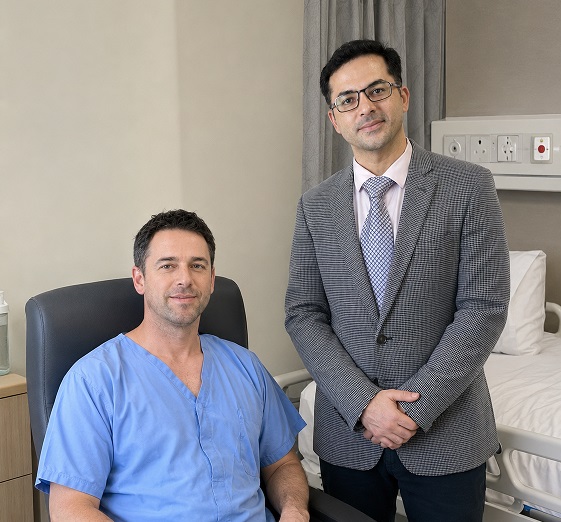
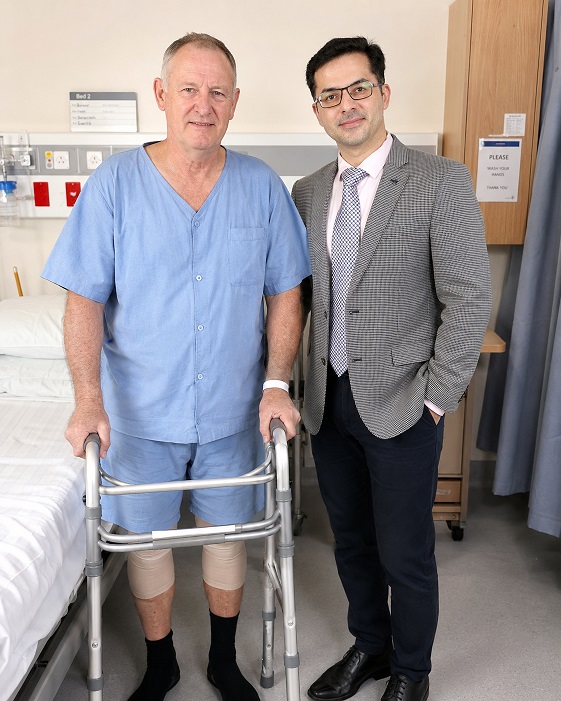
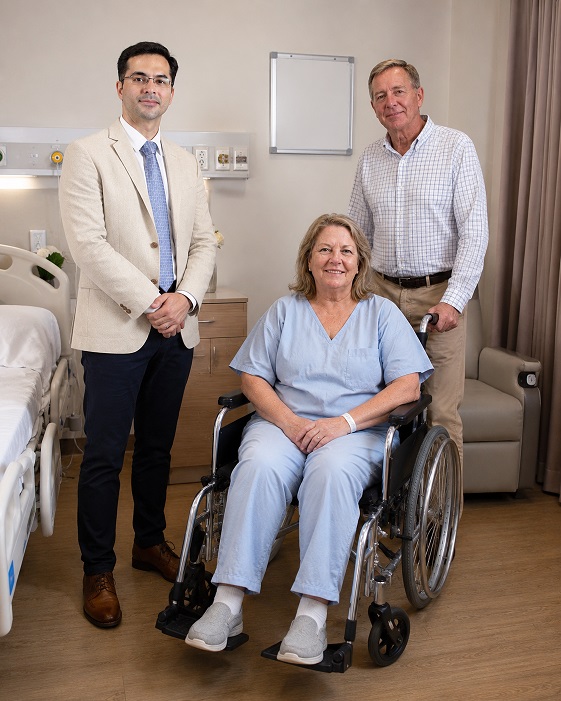
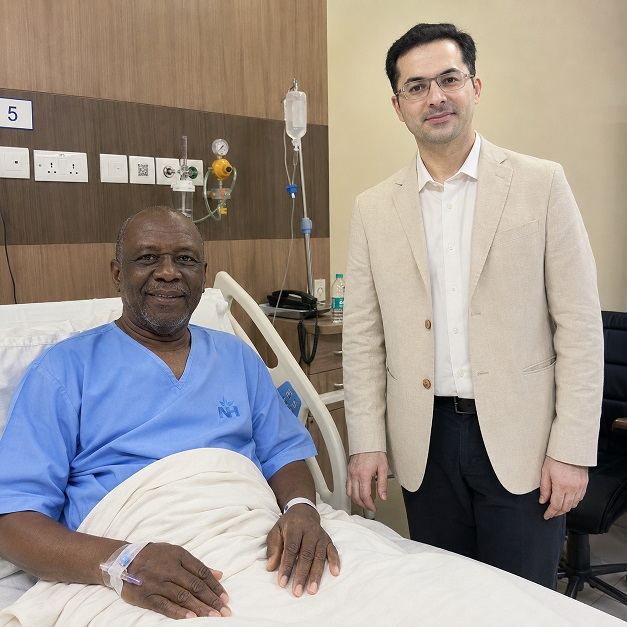
Patient Testimonials from Australia
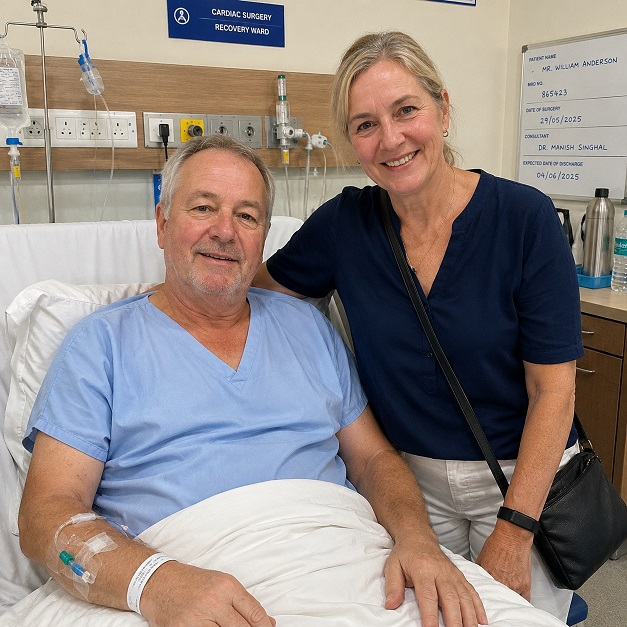
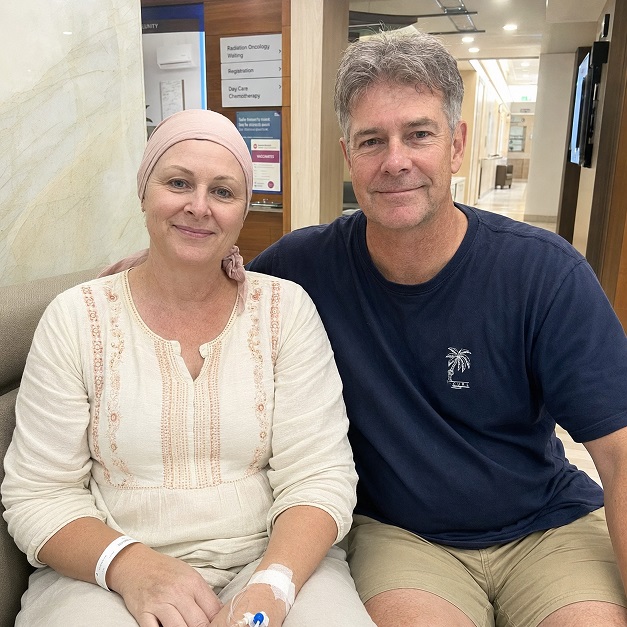




Ready to Take the First Step?
Share your Medical Reports with our Healthcare Managers Today and Get a FREE CONSULTATION, a Personalized Treatment Plan, and Complete Support from Arrival to Recovery.
Get Your Free ConsultationAreas We Serve
This resource has been thoughtfully prepared for patients from Australia who are considering medical treatment in India. We also welcome patients from the wider region in the countries mentioned below-
We regularly assist patients from:
- Fiji
- Vanuatu
- Samoa
- Tonga
- Kiribati
- Nauru
- Tuvalu
- New Zealand
- Solomon Islands
- Papua New Guinea
Many of the insights, treatment pathways, hospital recommendations, travel guidance, and patient support services described here are equally relevant and may be used as a reference when planning treatment in India.
From Australia to India: Your Complete Patient Support Guide
- Cancer Treatment in India for Australian Patients: PBS Gap & Drug Costs
- Cardiac Surgery in India for Australian Patients: TAVI Access & Costs
- Dental Treatment & Surgery in India for Australian Patients
- Hip Surgery in India for Australian Patients: Costs, Waits & Implant Choice
- Knee Surgery in India for Australian Patients: Costs, Waits & Implants
- Neurosurgery in India for Australian Patients: Volume, Costs & When Not to Travel
- Spine Surgery in India for Australian Patients: Costs, Indications & Second Opinions (2026)
- Best Bariatric & Weight Loss Surgeons in India for Australian Patients
- Best Cancer Surgeons & Hospitals in India for Australian Patients
- Best Cardiac Surgeons & Hospitals in India for Australian Patients
- Best Cosmetic Surgeons & Hospitals in India for Australian Patients
- Best Dental Surgeons & Clinics in India for Australian Patients
- Best Hip Surgeons & Hospitals in India for Australian Patients
- Best Knee Surgeons & Hospitals in India for Australian Patients
- Best Scoliosis Surgeons & Hospitals in India for Australian Patients
- Best Spine Surgeons & Hospitals in India for Australian Patients
- Selecting the Best Urosurgery and Reconstructive Urology Centres in India for Australian Patients
- Selecting the Best Bone Marrow Transplant Centres in India for Australian Patients