

Dental Treatment and Surgery in India for Australian Patients
Medicare pays nothing towards your teeth, and your extras cover will not come close. This is the clearest case for travelling in the whole series — and the one where the treatment plan, not the dentistry, is what you have to get right.
A 52-year-old bookkeeper in Ballarat. Years of patching a failing upper jaw have run out of road, and the plan she has been handed is a full arch of implants for $26,000, with the lower jaw to follow. Her extras cover will pay $1,500 of it this year. She has been quoted $8,900 by a clinic in Bali that can do the whole thing in nine days, and she is about to book it, because the alternative is to keep the failing teeth. She is right that she needs treatment. She is about to make a decision she cannot reverse, on a timeline that cannot work.
Healing Journeys of Australian Patients


Key Takeaways
- Australian patients considering dental treatment in India should focus on clinical quality, appropriate treatment planning and long-term maintainability, rather than selecting a clinic on price alone.
- The guide covers common treatments sought by Australian patients in India, including dental implants, full-arch implant rehabilitation, crowns, bridges, root canal treatment and procedures that may require bone grafting.
- For complex implant treatment, the proposed plan should clearly state the implant system, restoration material, number and position of implants, whether bone grafting is required, and what is included in the quoted cost.
- Full-arch implant treatment should not normally be viewed as a single-trip procedure. The guide explains a two-trip pathway, allowing time between implant placement and the final restoration for healing and osseointegration.
- Patients should understand that being suitable for immediate temporary teeth does not necessarily mean the permanent final restoration should be completed immediately after implant placement.
- Bone quality and available bone volume can materially affect an implant treatment plan. Some patients may require bone grafting or other preparatory procedures, which can change both treatment duration and overall cost.
- Australian patients should request an itemised written quotation before travelling so they can understand the treatment cost, inclusions, exclusions and possible additional charges.
- Clinic selection should consider the qualifications and experience of the treating dental team, sterilisation standards, implant systems, laboratory arrangements, treatment documentation and the clinic's approach to complications and warranties.
- Long-term planning is particularly important for Australian patients because dental implants and prosthetic restorations may require maintenance, adjustment or replacement after returning to Australia.
- Patients should return home with complete treatment documentation so that their Australian dentist can understand what was performed in India and provide appropriate ongoing dental care.
Quick Facts
- Conditions/Treatment Areas Covered
- Missing teeth, extensively damaged teeth, dental problems requiring restorative treatment, insufficient bone for straightforward implant placement and complex full-arch dental rehabilitation
- Procedures Mentioned
- Dental implants, full-arch implant rehabilitation, crowns, bridges, root canal treatment, bone grafting and restorative dental procedures
- Target Audience
- Australian patients considering dental treatment or dental surgery in India
- Author/Advisor
- Dr. Dheeraj Bojwani, Independent Medical Travel Advisor, 24 years of experience guiding international patients
- Treatment Highlights
- Dental implants, complex implant rehabilitation, restorative dentistry, treatment planning, staged implant care and long-term dental follow-up
- Implant Planning
- Patients should understand the implant system being proposed, the location and number of implants, restoration material and whether additional procedures such as bone grafting are required.
- Full-Arch Treatment
- Complex full-arch implant rehabilitation may require staged treatment rather than completion during a single short visit.
- Two-Trip Rule
- Implant placement is performed during the initial treatment stage, followed by a healing period before the patient returns for the permanent final restoration.
- Temporary vs Final Teeth
- Immediate temporary teeth, where clinically appropriate, should not be confused with delivery of the definitive permanent restoration.
- Bone Grafting
- Bone grafting may be required where available bone volume or quality is insufficient for the planned implant placement.
- Treatment Cost
- Costs vary according to the number of implants, implant system, restoration material, bone grafting requirements, laboratory work and complexity of treatment. Patients should obtain an itemised written quotation.
- Australian Follow-Up
- Ongoing dental review and maintenance in Australia should be considered before travelling, especially for complex implant and full-arch rehabilitation.
- Treatment Documentation
- Complete records of the dental procedures and implant-related information should be obtained before returning to Australia.
- Medical Travel Planning
- Treatment scheduling should allow sufficient time for the clinical stages of care rather than compressing implant treatment solely to reduce travel duration.
In Brief
Australian patients considering dental treatment in India should assess more than the headline treatment price. For dental implants and full-arch rehabilitation, the treatment plan should identify the proposed implant system, restoration material, implant positions, need for bone grafting and the stages of treatment. Complex implant rehabilitation commonly requires a two-trip approach, with healing and osseointegration occurring before the permanent final restoration is delivered. Patients should also evaluate clinical qualifications, sterilisation, laboratory standards, warranties and long-term maintainability in Australia before proceeding.
This is the one where Australians have a genuine grievance
Medicare will pay for a knee replacement, a cardiac stent and an MRI of your brain. It will not pay a dentist to take out an infected tooth. Dental was deliberately excluded when Medicare was established and has stayed excluded ever since, so for most Australian adults the entire cost of dentistry is personal.
The consequences are measurable. Around three in ten Australians delay or avoid dental treatment because of what it costs, and out-of-pocket dental spending runs to billions of dollars a year. Private extras cover softens the edges of a check-up and a filling; it does almost nothing against a treatment plan of any size.
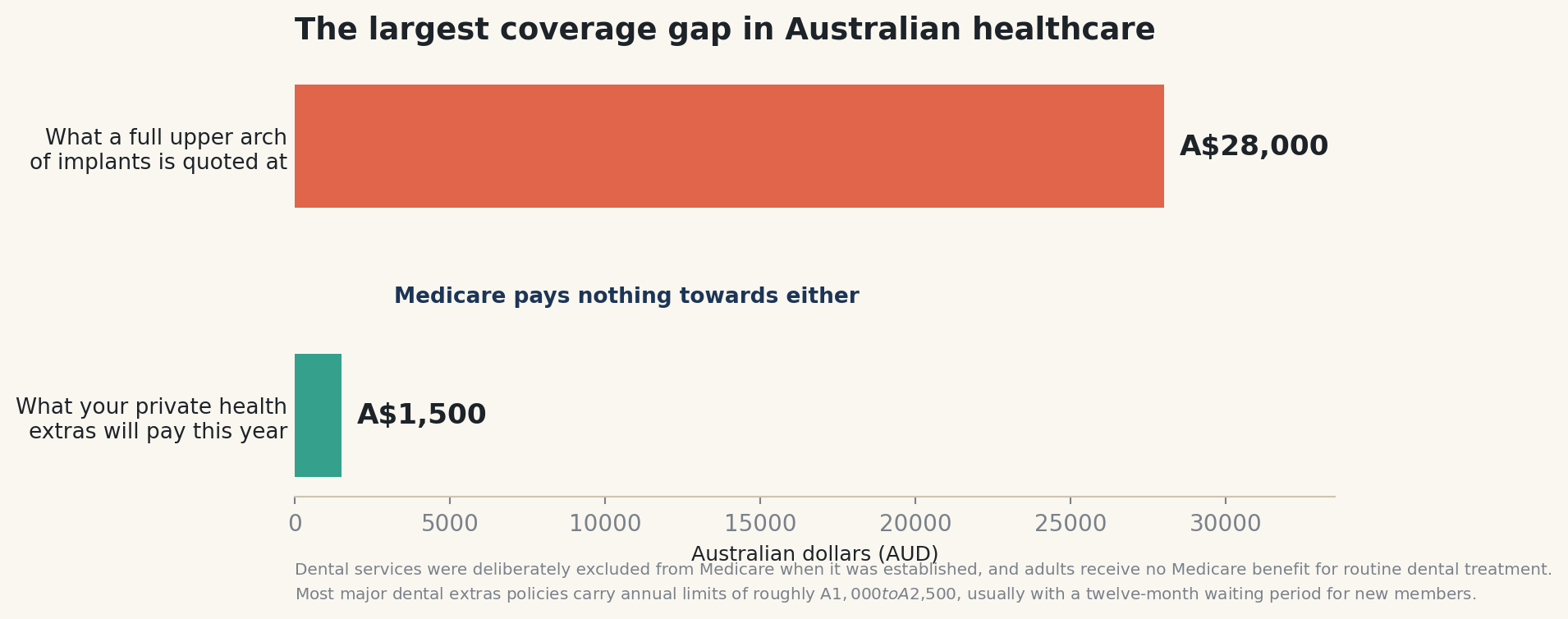
In 24 years of guiding international patients I have never met a group with a clearer case for looking abroad than Australians needing major dental work. There is no waiting list argument to make and no quality argument to make, because Australian dentistry is excellent. There is simply a bill that nobody helps you with.
| 3 in 10 | $0 | ~⅔ |
|---|---|---|
| Australian adults delay or avoid dental care because of the cost | the Medicare benefit for adult dental treatment | less for the same treatment at an accredited Indian clinic |
The dentistry is not the risk. The plan is.
This is the part I most want you to read, because it is where dental tourism goes wrong, and it is almost never the drilling that fails.
Dentistry is the one field of medical travel where the patient can be sold far more than they need, and where the extra treatment is irreversible. A crown requires the tooth beneath it to be cut down. A veneer requires enamel to be removed permanently. A full-arch bridge requires the remaining teeth to be extracted. None of these can be undone, in any country, by anyone.
The pattern is consistent and easy to recognise once you know it. A patient arrives needing two crowns and a bridge, is examined for twenty minutes, and leaves with a plan for sixteen veneers or a full-mouth reconstruction. Sometimes the work is beautifully executed. It is still the wrong work.
There is a structural reason this happens abroad more than at home, and it has nothing to do with dishonesty. Your dentist in Ballarat sees you every six months for twenty years and carries the consequences of over-treating you. A clinic seeing you once, for nine days, does not. That asymmetry is worth holding in mind, and it applies in Bali and Bangkok exactly as it applies in Delhi.
So the single most valuable thing you can do is have your treatment plan settled and second-opinioned
a clinic worth attending. A clinic that presents a larger plan when you are already in the chair, jet-lagged, with a flight home booked, is doing something you should recognise for what it is.
The corollary is a genuinely useful test: send your X-rays to two clinics and compare the plans. Where they agree, you can be confident. Where one proposes twice the work, you have learned something valuable for the price of an email.
Which Dental Patient are You?
| Restorative and routine | Implants and full-arch | Cosmetic-led |
|---|---|---|
| Crowns, bridges, root canals, extractions, cleaning and gum treatment. Straightforward, well-evidenced, and completable in one visit of about a week. This is the lowest-risk and often the best-value reason to travel. | The largest saving and the largest planning burden. Requires a CBCT scan, a written plan and, in almost every case, two visits several months apart. Worth doing well, and disastrous when rushed. | Veneers, smile makeovers, whitening-plus. Tread carefully. This is where overtreatment concentrates, because the work is elective, the enamel loss is permanent, and the sales pressure is highest. Get a second opinion at home first. |
Five Things that Should End the Conversation
A treatment plan produced without a CBCT scan. No one can plan implants responsibly from photographs and a panoramic film alone. If a clinic quotes for implants before imaging your bone, it is guessing.
Permanent teeth promised in a single visit. A temporary bridge fitted on the day is legitimate and common. A final, permanent full-arch bridge delivered before the implants have integrated with bone is not, and no amount of technology changes the biology.
A plan that grows once you are in the chair. Two crowns becoming sixteen veneers is not a clinical discovery. Decline, and ask for the original plan.
Any proposal to extract teeth that can be saved. Extraction to simplify a full-arch case is the most consequential thing that can happen to you on this trip. Ask specifically which teeth are being removed and why each one cannot be kept.
No written warranty, or one you cannot read. Ask what happens if a crown fails in eight months, who pays for the remake, and whether it requires you to fly back.
The two-trip rule
Implants work by fusing to bone, and bone takes three to six months to do it. That is not a scheduling preference, it is physiology, and it is the reason the honest answer to “can I have this done in one trip?” is usually no.
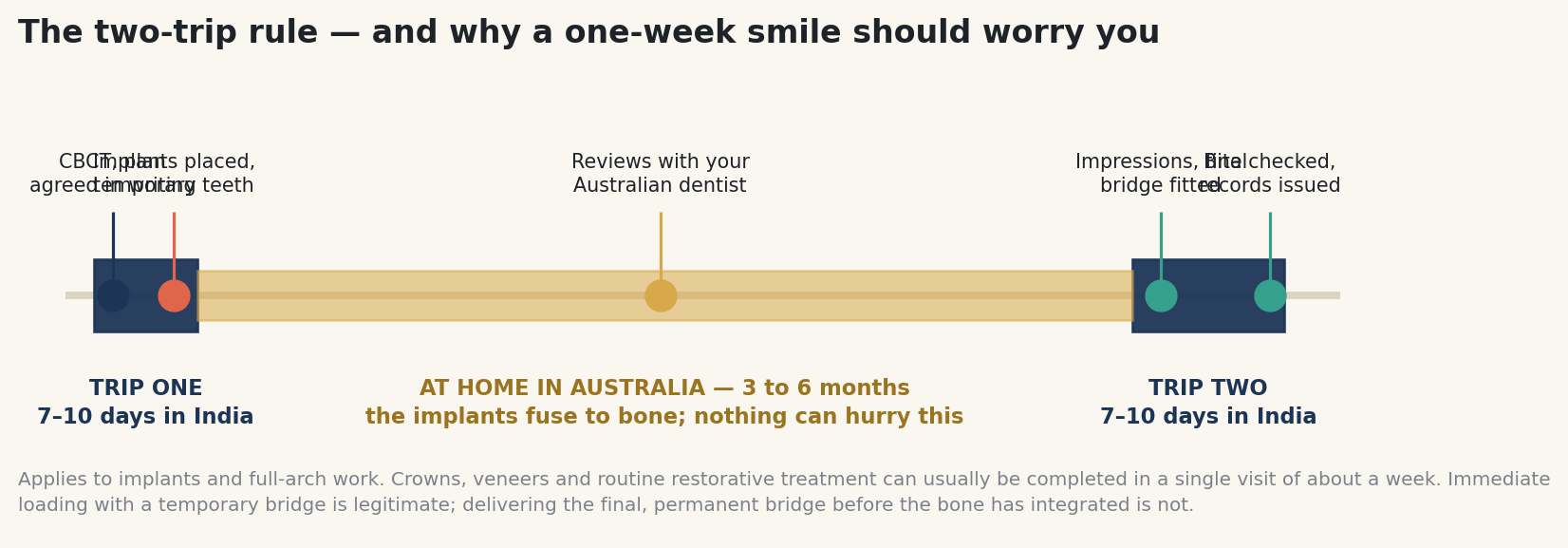
Trip one places the implants and fits a temporary. You go home, live normally, and see your Australian dentist for reviews. Trip two, three to six months later, delivers the final restoration. It is two lots of airfares, and it is still substantially cheaper than doing it in Australia.
In 24 years I have seen more dental disappointment caused by compressed timelines than by poor workmanship, and the two are often confused. When a full-arch case fails eighteen months later, the cause is frequently that everything was delivered in nine days because that was the length of the holiday.
Routine work is different. Crowns, bridges, root canals and extractions can be completed comfortably in a single visit of about a week, and if that is what you need, one trip is the right answer.
The graft that removes an entire surgery — and an entire trip
If a dentist has ever told you that you do not have enough bone for implants, go back and ask again, because the sequence that answer was based on has changed and a great many Australians are still carrying a refusal that is out of date.
For years, a patient with a resorbed ridge or a dropped sinus floor faced a three-stage ordeal. Graft the bone. Wait six to nine months for it to mature. Return, open the site again, and place the implants. Wait again. Only then restore. Three operations, three journeys, and the better part of eighteen months of your life spent waiting between them.
Deproteinised bovine bone mineral grafts — Bio-Oss being by far the most documented — used with a resorbable collagen membrane, collapsed that sequence. The graft now goes in during the same operation as the implants themselves. The sinus is lifted, the deficient ridge is built up, and the fixtures are placed at the same appointment, in the same sitting, under the same anaesthetic. One surgery instead of two. One journey struck off the schedule outright, and the better part of a year returned to you. Nor is this something novel being tried out on you. Bio-Oss carries decades of published clinical follow-up — the material has been studied for longer than most implant systems have existed — and that maturity is precisely why serious units reach for it rather than for something newer and thinner on evidence. It is also why a clinic that cannot tell you which graft material it uses, and why, is telling you something about itself. What it does not do is hurry the bone. Your implants still need their three to six months to fuse, and a grafted site sometimes wants a little longer rather than less. But that is the point worth grasping: you now spend those months living your ordinary life in Australia, seeing your own dentist, instead of making a third trip. For the patient who was previously told the whole thing was impossible, this is not a marginal improvement. It is the difference between a plan and a refusal.
What the money actually looks like
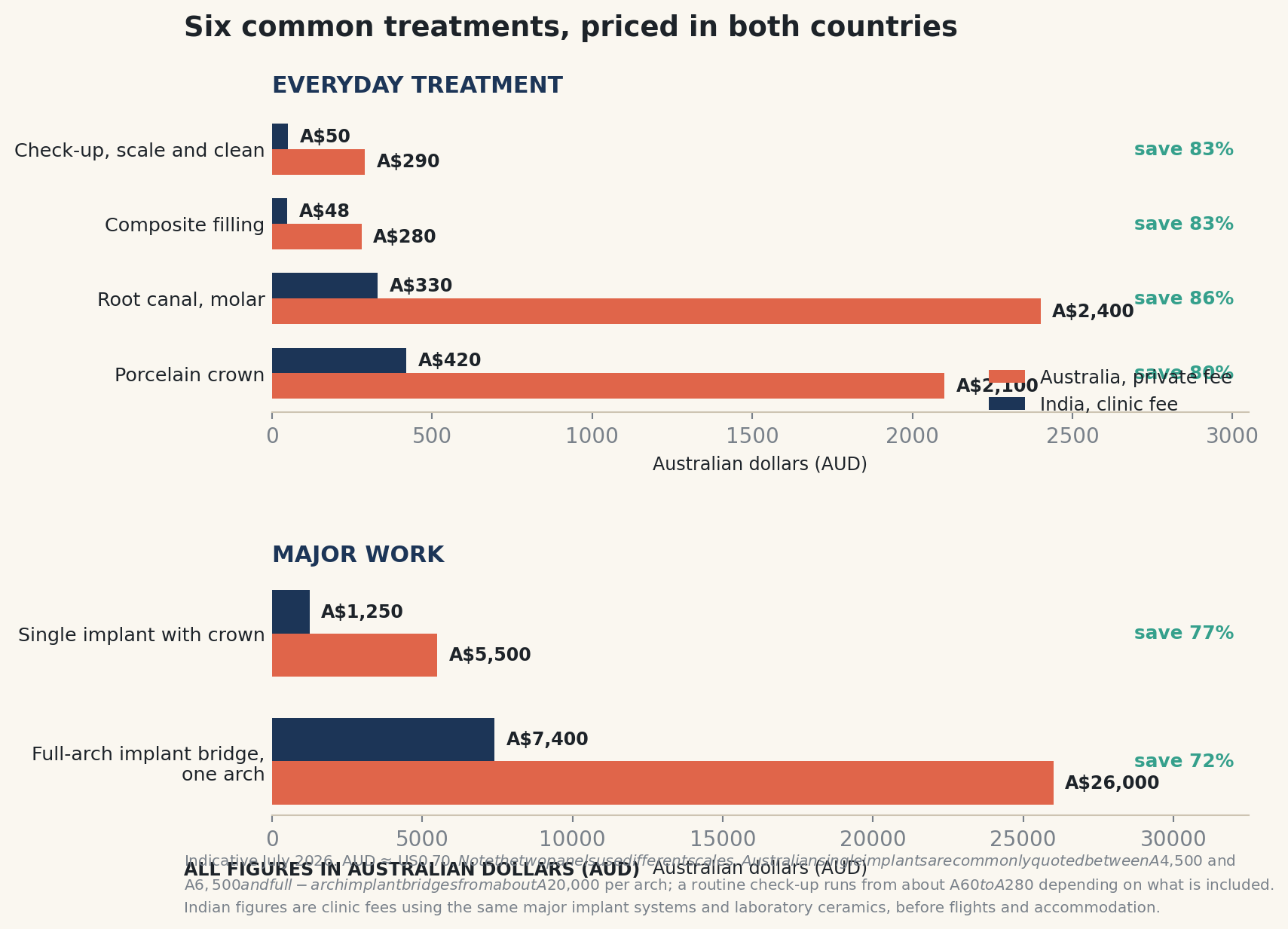
Two things are worth drawing out of that chart. The first is that the proportional saving is remarkably consistent across the whole range — roughly three-quarters off, whether the item is a two-hundred-dollar clean or a twenty-six-thousand-dollar arch. The second is that the two panels are drawn to different scales, because a check-up and a full arch cannot honestly share an axis.
A single implant with its crown is commonly quoted between $4,500 and $6,500 in Australia, and a full- arch implant bridge from about $20,000 per arch. The same treatment at an accredited Indian clinic, using the same major implant systems and the same laboratory ceramics, typically costs around two-thirds to three-quarters less. Surgical removal of a wisdom tooth, not shown above, follows the same pattern — commonly $400 to $900 per tooth in Australia against a fraction of that in India.
But notice what the everyday panel also tells you: on a single filling or a clean, the saving is real in percentage terms and trivial in dollars. Nobody should fly to India for a check-up. The arithmetic only starts to justify a journey somewhere around the root canal and crown line, and it becomes overwhelming at implants.
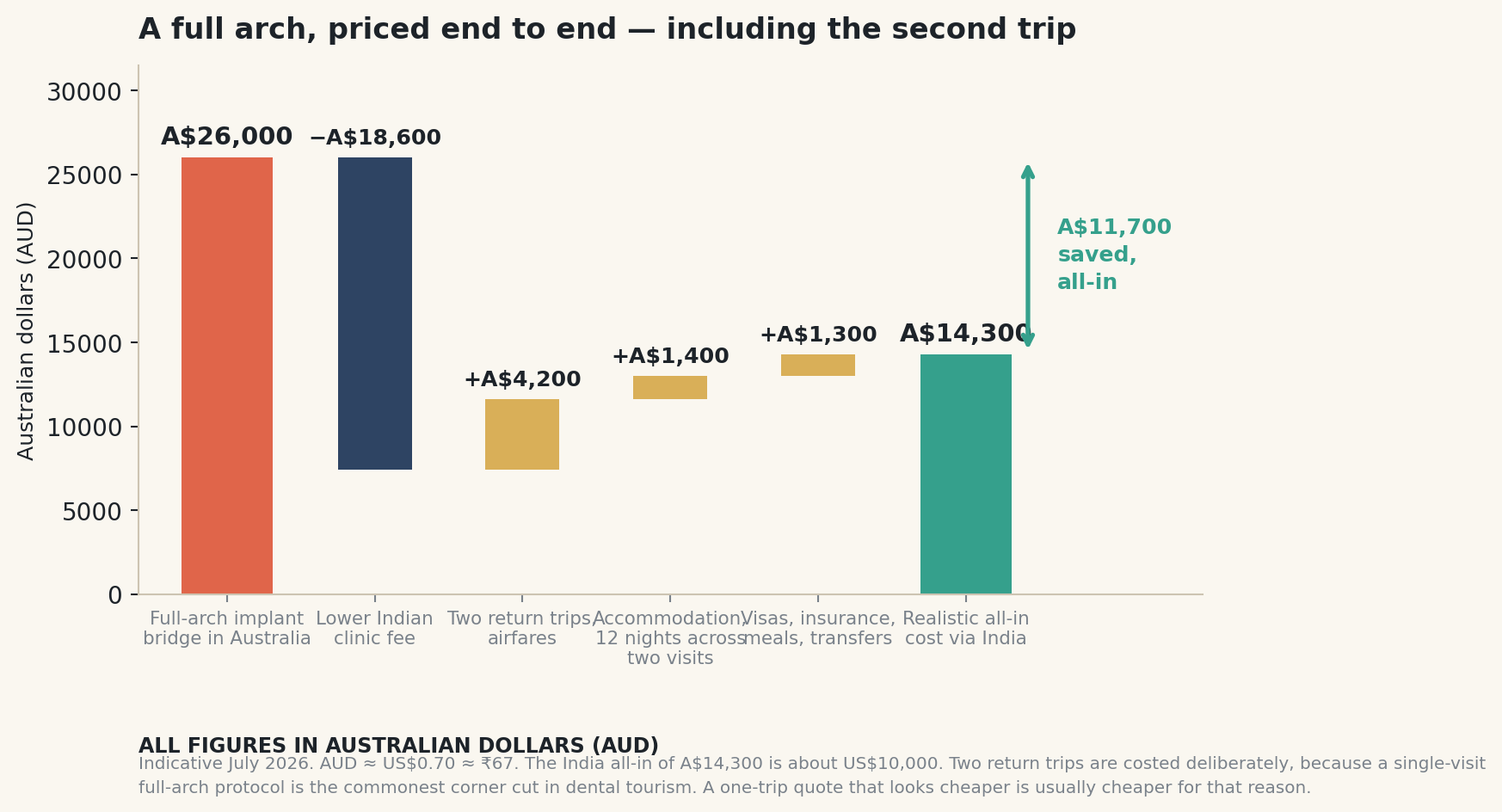
Note what that waterfall includes: two return trips, because that is the honest way to price a full arch. Even carrying both journeys, the whole undertaking comes to roughly $14,300 — about US$10,000 — against Approximately $26,000 in Australia. A one-trip quote that looks cheaper than this is usually cheaper for a reason, and the reason is the part of the treatment that has been left out.
Two things worth checking before you spend anything. First, ask your health fund exactly what it will pay towards treatment performed overseas, because most extras policies pay nothing at all. Second, if the treatment is medically necessary and you are in genuine difficulty, early release of superannuation on compassionate grounds is a legitimate avenue in Australia and worth investigating before you assume you cannot afford treatment at home.
Your options, side by side
| Australian private | Public dental | India | |
|---|---|---|---|
| Full arch of implants | $20,000–$30,000 | Not provided | About $14,300 all-in (US$10,000, two trips) |
| Medicare benefit | Nil | Concession holders only | Nil |
| Extras rebate | $1,000–$2,500 a year | — | Usually nothing overseas |
| Wait | Days | Often years | 1–3 weeks |
| Written plan before you commit | Usually | Usually | Insist, tooth by tooth |
| If something fails | Return to your dentist | Rejoin the list | Check the warranty terms first |
All dollar figures are Australian dollars (AUD) unless marked US$. Costs indicative, July 2026.
How do you judge a dental clinic from ten thousand kilometres away?
By asking a handful of specific questions, and noticing which ones produce a straight answer.
Ask who is actually treating you, and what they specialise in. A full-arch case ideally involves an oral surgeon or periodontist placing the implants and a prosthodontist designing and fitting the bridge. One general dentist doing everything is common and not automatically wrong, but you should know which you are getting.
Ask for the implant system and the ceramic by name. Major international implant systems can be serviced anywhere in the world, including by your dentist at home. Unbranded or locally exclusive systems cannot, and that becomes your problem years later rather than now.
Ask about sterilisation in concrete terms — autoclave class, whether instruments are individually pouched and dated, and whether handpieces are sterilised between patients. A good clinic answers this immediately and often with some pride.
Ask whether the laboratory is in-house or external, and where the ceramics are made. Turnaround time and remake policy both depend on the answer.
Ask for the written plan tooth by tooth, using notation rather than description, with a price against each item and a statement of what is not included. A plan that reads “upper arch rehabilitation, $X” is not a plan.
Why India rather than Bali, Phuket or Ho Chi Minh City?
This is the honest competitive question, because Australians going abroad for dentistry mostly go to Southeast Asia, not India, and it is worth saying why India deserves the look.
The first reason is that dentistry in Bali and Phuket is built substantially around holiday timelines, and holiday timelines are exactly what damages implant work. A destination that expects you to be there for nine days will tend to offer you a nine-day plan.
The second is depth. India’s larger dental hospitals run specialist departments — oral and maxillofacial surgery, periodontics, prosthodontics, endodontics — rather than a single dentist attempting everything, and a complex full-arch case genuinely benefits from a surgeon placing implants and a prosthodontist restoring them. Bone grafting and sinus lifts, which many full-arch cases require, sit comfortably inside that setting.
The third is cost, which remains lower than Thailand and comparable to or below Bali for the same materials. And the fourth is language: the entire clinical record, including your written plan and warranty, is produced in English, so your dentist in Ballarat can read it without difficulty rather than working from a translated summary.
None of this means Southeast Asia is a poor choice; there are excellent clinics in all three countries and many Australians have had good outcomes. It means the question worth asking is not which country but which protocol — and a destination four hours from Perth that promises a one-visit full arch is offering you convenience at the cost of the thing you are actually buying.
What happens if something fails?
Something eventually will, in any country. Crowns chip, screws loosen, and a small proportion of implants do not integrate. What matters is what has been agreed in advance.
Get the warranty in writing, and read it for the part everyone misses: whether a remake requires you to return, and who pays the airfare. Ask for the implant system by brand and the batch details, because a widely used international system can be serviced by an Australian dentist while an obscure one often cannot. Ask for your CBCT, your treatment records and your laboratory specifications in digital form before you leave.
Then do the thing most patients skip: tell your Australian dentist what you are planning, before you go. Many will review the plan for a modest fee, and a dentist who has been consulted beforehand is far more willing to help afterwards than one presented with a fait accompli.
Practicalities for Australians
Australian passport holders are eligible for India’s electronic medical visa, issued against a letter from the treating clinic or hospital, with an attendant visa for whoever travels with you. Send your existing X-rays and any CBCT you already have before you go, and ask for the written plan to be issued in advance rather than on arrival.
Do not book a flight for the day after surgery. Allow at least forty-eight hours after extractions, implant placement or a sinus lift before flying, because pressure changes and bleeding risk are real considerations, and longer if a graft has been done. Tell the clinic in advance about blood thinners, bisphosphonates or denosumab for osteoporosis, diabetes and any heart valve or joint prosthesis, because each changes the plan — bisphosphonates in particular carry a specific jaw complication risk that must be discussed before any extraction.
Before you come home, collect your final treatment record, the implant identification cards, the warranty document, post-operative instructions and a recommended review schedule. Book a review with your Australian dentist for a few weeks after you land, and ask the clinic for a named contact and an email address that a dentist can write to directly. If a problem arises at month nine, the difference between a clinic that answers professional correspondence and one that does not is the whole of your recourse.
A closing word
Dental is the one area where I think Australians are straightforwardly badly served, and where travelling is not a compromise but a sensible response to a gap nobody has closed for you. But it is also the area where I see the most avoidable regret, and it comes from the same two places every time: a plan that grew, and a timeline that could not work. Settle the plan before you fly, insist on the second trip if implants are involved, and refuse to expand the work in the chair. Send me your X-rays and whatever quote you are holding and I will tell you what I think you actually need, which is sometimes rather less than you have been offered.
Sources
- 🌐 Australian Institute of Health and Welfare, Oral Health and Dental Care in Australia , on cost-related delay and avoidance of dental care
- 🌐 Health Insurance Act 1973 and the exclusion of dental services from Medicare
- 🌐 Australian Government Services Australia, Child Dental Benefits Schedule and public dental eligibility
- 🌐 Australian Taxation Office, early release of superannuation on compassionate grounds
- 🌐 Australian private dental fee surveys and health fund extras limits, 2026
- 🌐 High Commission of India, e-Visa categories and eligibility
Frequently Asked Questions by Australian Patients about Dental Treatment and Surgery in India
Why do Australian patients consider travelling to India for dental treatment?
Australian patients may consider India for procedures such as dental implants, full-arch rehabilitation, crowns, bridges and root canal treatment, particularly when comparing treatment options and costs. The guide stresses that cost should be considered alongside clinical quality, treatment planning and the ability to maintain the dental work after returning to Australia.
How should Australian patients choose a dental clinic in India?
Patients should assess the qualifications and experience of the treating dental team, sterilisation standards, implant systems, laboratory arrangements, written treatment planning, warranties and complication management. A clinic should also be willing to provide clear documentation before the patient commits to treatment.
Can Australian patients complete full-arch dental implant treatment in one trip to India?
The guide explains that complex full-arch implant rehabilitation commonly follows a two-trip treatment pathway. Implant placement takes place during the first stage, followed by a healing and osseointegration period before the patient returns for the definitive final restoration. A shorter schedule should not be chosen simply to reduce travel time.
Are temporary teeth the same as the final teeth after dental implants?
No. Where clinically appropriate, temporary teeth may be provided during the initial implant stage, but these should not be confused with the permanent final restoration. The definitive restoration is generally planned after sufficient healing and implant integration have occurred.
What affects the cost of dental implants in India for Australian patients?
The total cost can vary according to the number of implants, implant system, restoration material, complexity of treatment, laboratory work and whether additional procedures such as bone grafting are required. The guide recommends obtaining an itemised written quotation so that inclusions, exclusions and possible additional costs are clear before travelling.
Can Australian patients need bone grafting before dental implants in India?
Yes. Bone quality and available bone volume can affect whether straightforward implant placement is possible. Where there is insufficient bone for the proposed implant, bone grafting or another preparatory procedure may be required, potentially changing the treatment stages, recovery period and overall cost.
What should Australians ask about the dental implant system before treatment in India?
Patients should understand which implant system is being proposed, along with the number and planned position of implants and the material intended for the final restoration. This information is particularly important for Australians because the implants may require future maintenance or treatment after they return home.
What should be included in a dental treatment quotation from an Indian clinic?
The guide recommends obtaining an itemised written quotation that makes the proposed treatment and associated costs clear. Australian patients should pay particular attention to whether implant components, temporary restorations, final restorations, laboratory work, bone grafting and other additional procedures are included or charged separately.
What should Australian patients check about dental warranties and aftercare in India?
Before proceeding, patients should understand the clinic's written warranty and complication policy, including what happens if an implant, prosthetic restoration or laboratory component requires attention after treatment. They should also consider how ongoing maintenance and adjustments will be handled once they are back in Australia.
What records should Australian patients bring home after dental treatment in India?
Patients should obtain complete documentation of the dental treatment performed and relevant implant information before leaving India. These records are important because an Australian dentist may need to understand the procedures, implant components and restorations used in order to provide appropriate long-term maintenance and follow-up care.
Can I really have a full arch of implants done in one trip?
You can have implants placed and a temporary bridge fitted in one trip. The final bridge should wait three to six months for the implants to fuse with bone. Any clinic offering permanent teeth in nine days is compressing biology to fit a holiday.
Will my extras cover pay anything towards overseas dental work?
Usually nothing. A small number of policies have limited overseas provisions, so ask your fund in writing before you assume either way.
How do I know the implants are a reputable brand?
Ask for the manufacturer and system name in writing before you commit, and check that it is one of the major international systems. Ask for the implant identification cards when you leave. This matters because it determines whether an Australian dentist can service the work later.
My Australian dentist says I need sixteen veneers. Should I get a second opinion?
Yes — and that advice applies equally in Australia and abroad. Veneers remove enamel permanently. Any large cosmetic plan deserves a second clinical opinion before a deposit is paid anywhere.
How long after dental surgery can I fly?
At least forty-eight hours after extractions or implant placement, and longer after bone grafting or a sinus lift. Ask the treating clinic for a specific clearance rather than assuming.
I was told years ago that I do not have enough bone for implants. Is that still true?
Very possibly not. Modern grafting with deproteinised bovine bone mineral and a collagen membrane allows the bone to be built up during the same operation in which the implants are placed, including sinus lifts, which removes an entire surgery and an entire trip from the old staged sequence. Send your imaging and have the question asked again.
I take blood thinners and osteoporosis medication. Does that change things?
Yes, materially. Anticoagulants affect bleeding during extractions, and bisphosphonates or denosumab carry a specific risk to the jaw after extraction that must be assessed before any surgery. Tell the clinic well before you travel and expect the plan to be adjusted.
Is it cheaper to just get it done in Australia on a payment plan?
Sometimes, and it is worth pricing properly rather than dismissing. Compare the total interest against the all-in travel cost, and check whether early release of superannuation on compassionate grounds might apply to you.
Page Summary
This guide explains what Australian patients should consider when planning dental treatment in India, with particular attention to dental implants and complex full-arch rehabilitation. It discusses treatment planning, costs, implant selection, bone grafting, temporary versus final teeth and the importance of respecting the staged nature of implant treatment. The guide highlights the two-trip approach for complex implant rehabilitation and explains why adequate healing and osseointegration should not be sacrificed simply to shorten an overseas visit. It also addresses how patients can evaluate dental clinics, understand written quotations and warranties, and prepare for long-term maintenance after returning to Australia. The overall focus is on helping Australian patients compare dental treatment in India using clinical quality and long-term outcomes alongside cost.
Citation Block
| Topic | Information |
|---|---|
| Topic Information | Dental Treatment and Dental Surgery in India for Australian Patients |
| Procedure | Dental Treatment & Dental Surgery |
| Country | India |
| Intended Audience | Australian Patients |
| Conditions Covered | Missing Teeth, Damaged Teeth, Restorative Dental Problems, Bone Deficiency and Full-Arch Rehabilitation Needs |
| Procedures | Dental Implants, Full-Arch Implant Rehabilitation, Crowns, Bridges, Root Canal Treatment and Bone Grafting |
| Typical Stay | Procedure-Dependent; Complex Implant Treatment May Require Two Separate Trips |
| Hospital Stay | No Standard Inpatient Hospital Stay Specified |
| Recovery | Procedure-Dependent; Implant Treatment Requires Healing and Osseointegration Before Definitive Restoration |
| Cost | Varies According to Implant Number and System, Restoration Material, Bone Grafting, Laboratory Work and Treatment Complexity |
| Author | Dr. Dheeraj Bojwani |
| Experience | 24 Years Guiding International Patients |


Our Mission Statement
Our mission is to place patients at the centre of every healthcare decision by providing trustworthy, evidence-based, and unbiased medical information. We believe that informed patients make better decisions. Backed by personalised guidance from our experienced advisory team, we help patients understand their treatment options, compare them objectively, and confidently choose the path that best suits their medical needs and personal circumstances.
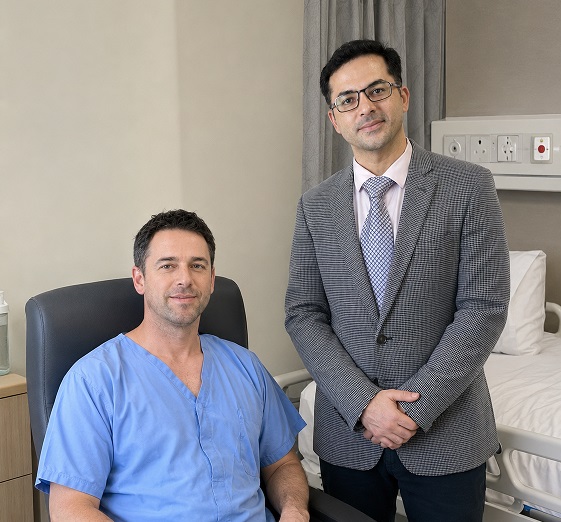
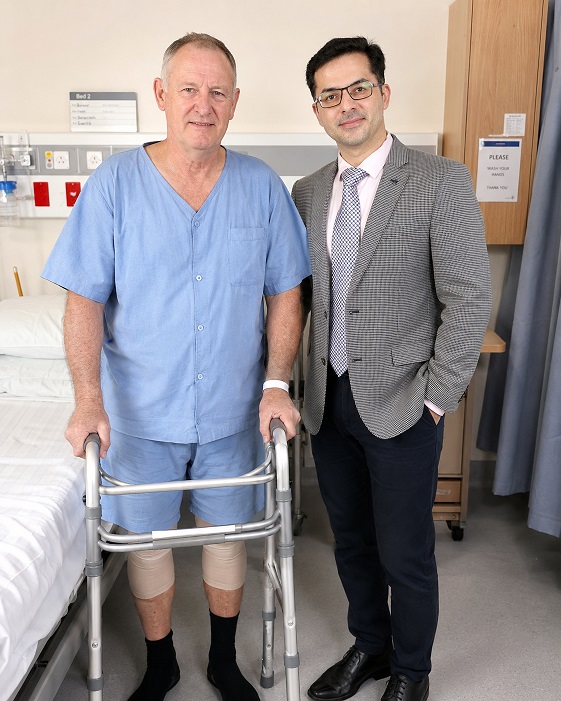
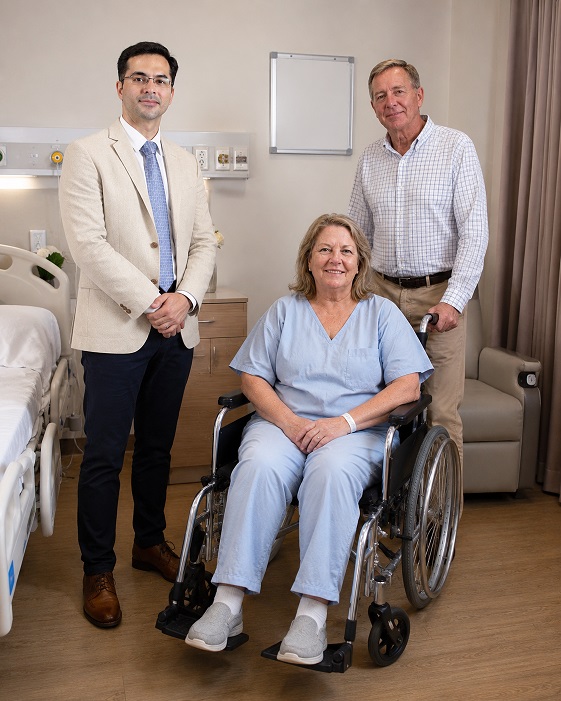
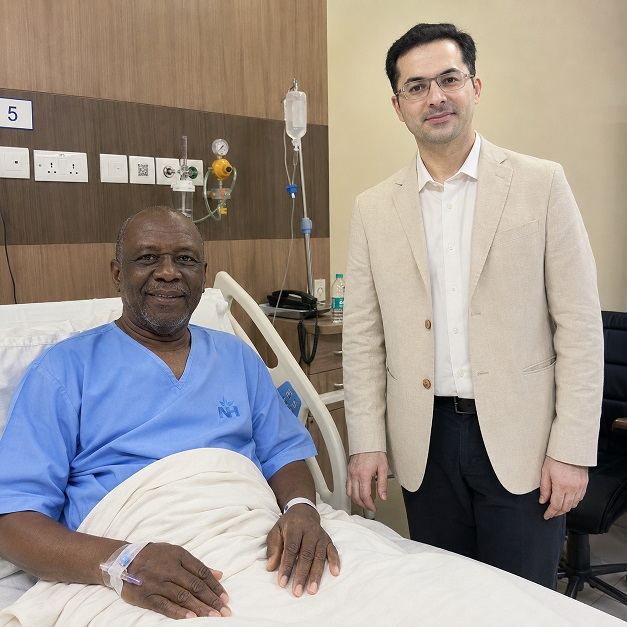
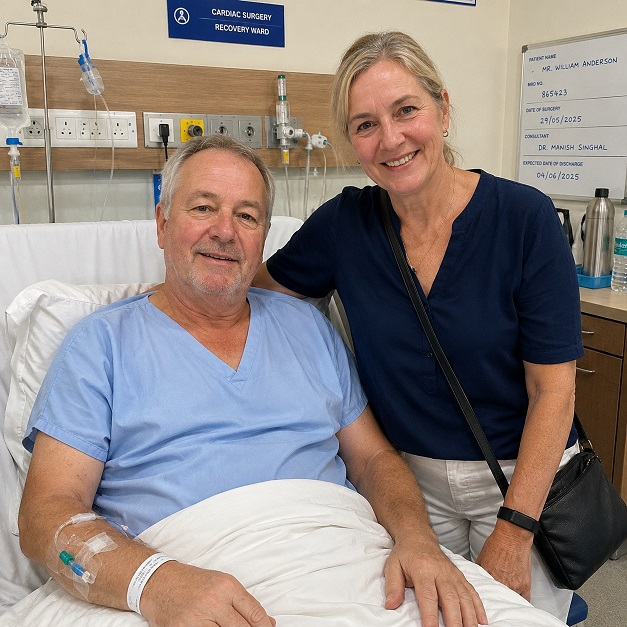
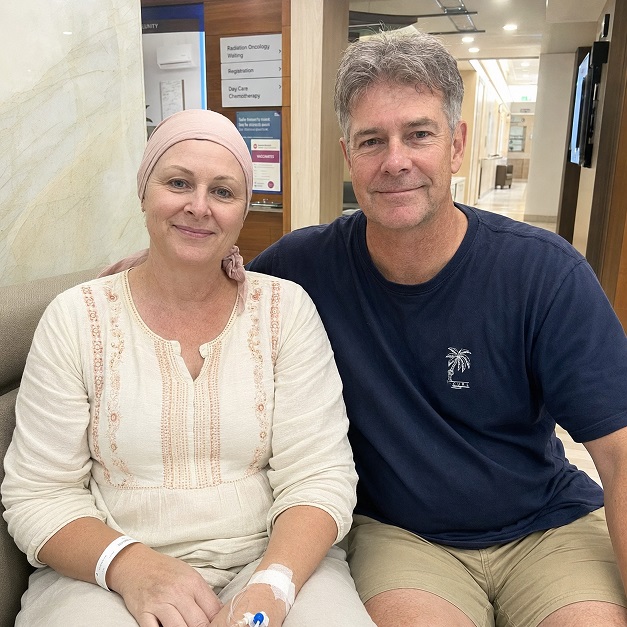
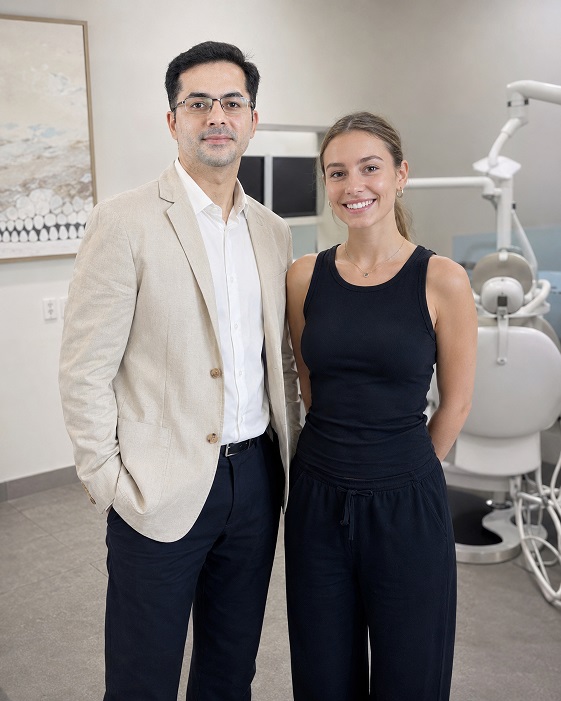
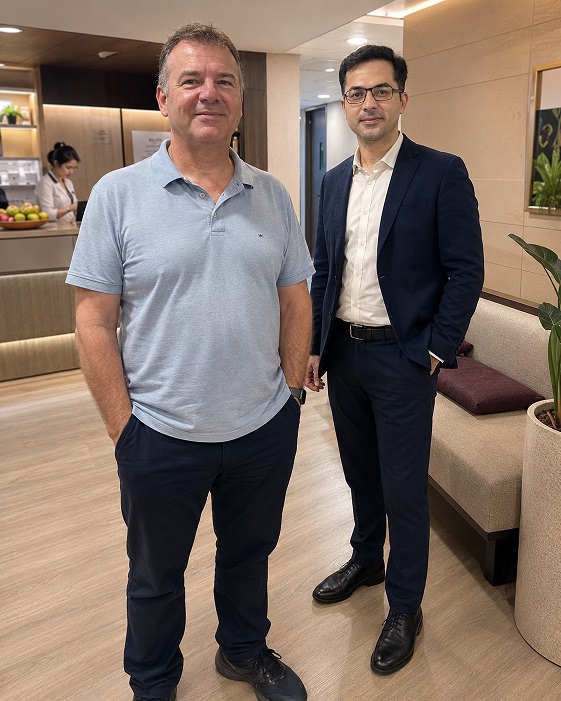
Patient Testimonials from Australia
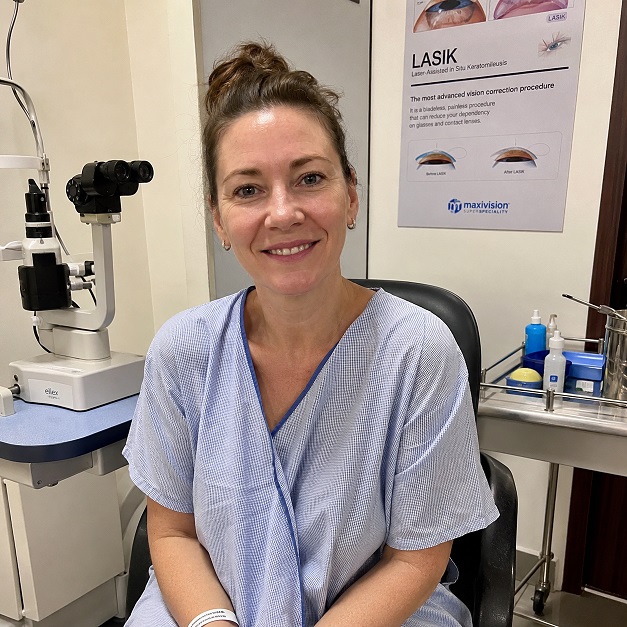
Ready to Take the First Step?
Share your Medical Reports with our Healthcare Managers Today and Get a FREE CONSULTATION, a Personalized Treatment Plan, and Complete Support from Arrival to Recovery.
Get Your Free ConsultationAreas We Serve
This resource has been thoughtfully prepared for patients from Australia who are considering medical treatment in India. We also welcome patients from the wider region in the countries mentioned below-
We regularly assist patients from:
- Fiji
- Vanuatu
- Samoa
- Tonga
- Kiribati
- Nauru
- Tuvalu
- New Zealand
- Solomon Islands
- Papua New Guinea
Many of the insights, treatment pathways, hospital recommendations, travel guidance, and patient support services described here are equally relevant and may be used as a reference when planning treatment in India.
From Australia to India: Your Complete Patient Support Guide
- Cancer Treatment in India for Australian Patients: PBS Gap & Drug Costs
- Cardiac Surgery in India for Australian Patients: TAVI Access & Costs
- Dental Treatment & Surgery in India for Australian Patients
- Hip Surgery in India for Australian Patients: Costs, Waits & Implant Choice
- Knee Surgery in India for Australian Patients: Costs, Waits & Implants
- Neurosurgery in India for Australian Patients: Volume, Costs & When Not to Travel
- Spine Surgery in India for Australian Patients: Costs, Indications & Second Opinions (2026)
- Best Bariatric & Weight Loss Surgeons in India for Australian Patients
- Best Cancer Surgeons & Hospitals in India for Australian Patients
- Best Cardiac Surgeons & Hospitals in India for Australian Patients
- Best Cosmetic Surgeons & Hospitals in India for Australian Patients
- Best Dental Surgeons & Clinics in India for Australian Patients
- Best Hip Surgeons & Hospitals in India for Australian Patients
- Best Knee Surgeons & Hospitals in India for Australian Patients
- Best Scoliosis Surgeons & Hospitals in India for Australian Patients
- Best Spine Surgeons & Hospitals in India for Australian Patients
- Selecting the Best Urosurgery and Reconstructive Urology Centres in India for Australian Patients
- Selecting the Best Bone Marrow Transplant Centres in India for Australian Patients