

Hip Surgery in India for Australian Patients
The operation is available at home. The date is not, the gap is five figures, and if you are under sixty the implant matters more than anyone has told you.
A 54-year-old landscape gardener outside Perth. Groin pain for three years, now waking him most nights; the X-ray shows the joint space essentially gone. His public list in Western Australia is among the longest in the country. The private quotes he has been given run to $29,000, because the cover he cancelled in 2020 would now impose a twelve-month wait on a pre-existing condition. He is eleven years from the pension and cannot stop working. What he needs is not a cheaper hip. It is a hip that will still be in place when he is eighty.
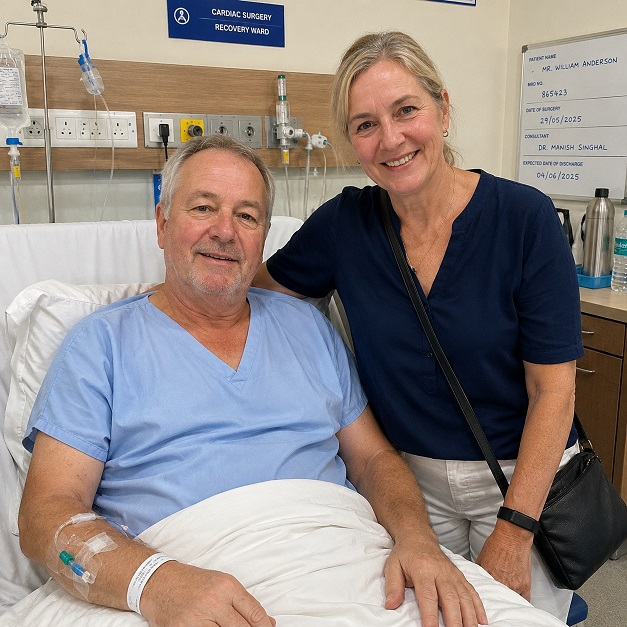
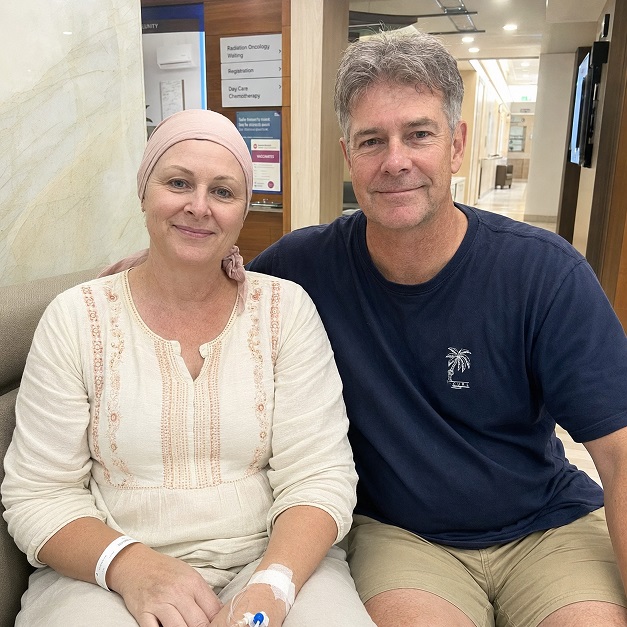
Healing Journeys of Australian Patients


Key Takeaways
- Total hip replacement is widely performed in Australia, but the briefing reports a median public waiting time of approximately 152 days, with some patients waiting considerably longer depending on their state and circumstances.
- For younger patients, implant longevity becomes particularly important. The briefing cites an approximate 30% lifetime revision risk for men having their first hip replacement at ages 50–54, compared with low single-digit risk for patients undergoing their first replacement after age 75.
- The Australian Orthopaedic Association National Joint Replacement Registry is an important resource for checking the performance and revision history of specific hip implant brands and models.
- Before surgery, patients should obtain five implant details in writing: the acetabular cup brand and model, femoral stem brand and model, bearing combination, femoral head diameter, and whether fixation will be cemented, cementless, or hybrid.
- The briefing states that a self-funded private hip replacement in Australia is commonly quoted at approximately Approximately $22,000–$33,000, while its representative all-in India journey is approximately Approximately $14,700, including indicative travel-related expenses.
- Leading Indian arthroplasty centres may provide high-volume hip surgery, computer navigation or robotic assistance, accredited hospital care, and daily supervised physiotherapy.
- The briefing recommends approximately 21 days in India for a single hip replacement, rather than flying home soon after surgery, because venous thromboembolism and early dislocation risks remain relevant during recovery.
- Australian GP follow-up and physiotherapy should be arranged before departure, and patients should return home with complete surgical, implant, anticoagulation, imaging, and rehabilitation documentation.
Quick Facts
- Conditions covered
- Advanced hip arthritis, severe joint-space loss, hip degeneration, dysplastic hip, protrusio, and post-traumatic hip deformity
- Procedure mentioned
- Total hip replacement / total hip arthroplasty
- Target audience
- Australian patients considering elective hip replacement surgery in India
- Author/Advisor
- Dr. Dheeraj Bojwani, Independent Medical Travel Advisor, 24+ years of experience
- Treatment highlights
- High-volume arthroplasty surgeons, implant selection, computer navigation or robotic assistance, accredited hospitals, daily one-on-one physiotherapy, pre-operative optimisation, and fit-to-fly assessment
- Australian public waiting time
- Approximately 152 days median for hip replacement in the 2024–25 figures cited in the briefing
- Indicative Australian self-funded cost
- Approximately $22,000–$33,000
- Indicative India all-in cost
- Approximately $14,700, or about US$10,300, in the briefing's representative comparison
- Treatment access in India
- Approximately 1–3 weeks from confirmed treatment date
- Typical stay in India
- Approximately 21 days for a single hip replacement
- Implant details to confirm
- Acetabular cup, femoral stem, bearing combination, femoral head diameter, and fixation method
- Medical travel preparation
- Imaging review, implant documentation, surgeon consultation, itemised quotation, medical visa, thromboprophylaxis plan, hip precautions, and Australian follow-up arrangements
- Follow-up
- GP review and physiotherapy in Australia should ideally be booked before travelling
- Important travel consideration
- Long-haul flying should follow a documented fit-to-fly assessment, with thromboprophylaxis and hip precautions addressed in writing.
In Brief
India may be considered by Australian patients who face extended public waiting times or substantial self-funded private costs for total hip replacement. The briefing places particular emphasis on younger patients, for whom the lifetime risk of revision makes implant selection especially important. Australian patients are advised to obtain the exact cup, stem, bearing, head diameter, and fixation method in writing and check the implant against the Australian Orthopaedic Association National Joint Replacement Registry. High-volume Indian arthroplasty centres may also offer navigation or robotic assistance and supervised physiotherapy. The briefing recommends planning approximately three weeks in India for a single hip replacement and arranging Australian GP and physiotherapy follow-up before travelling.
Hips are the good news story, and the wait is still five months
Total hip replacement is among the most successful operations medicine has ever devised. Australian surgeons do it superbly, and in 24 years of guiding international patients into Indian hospitals I have never told an Australian that their own system lacks the skill. What their system lacks is capacity. On the 2024– 25 national figures the median public wait for a hip replacement is around 152 days — better than the knee list, and still five months of a joint that hurts when you sleep.
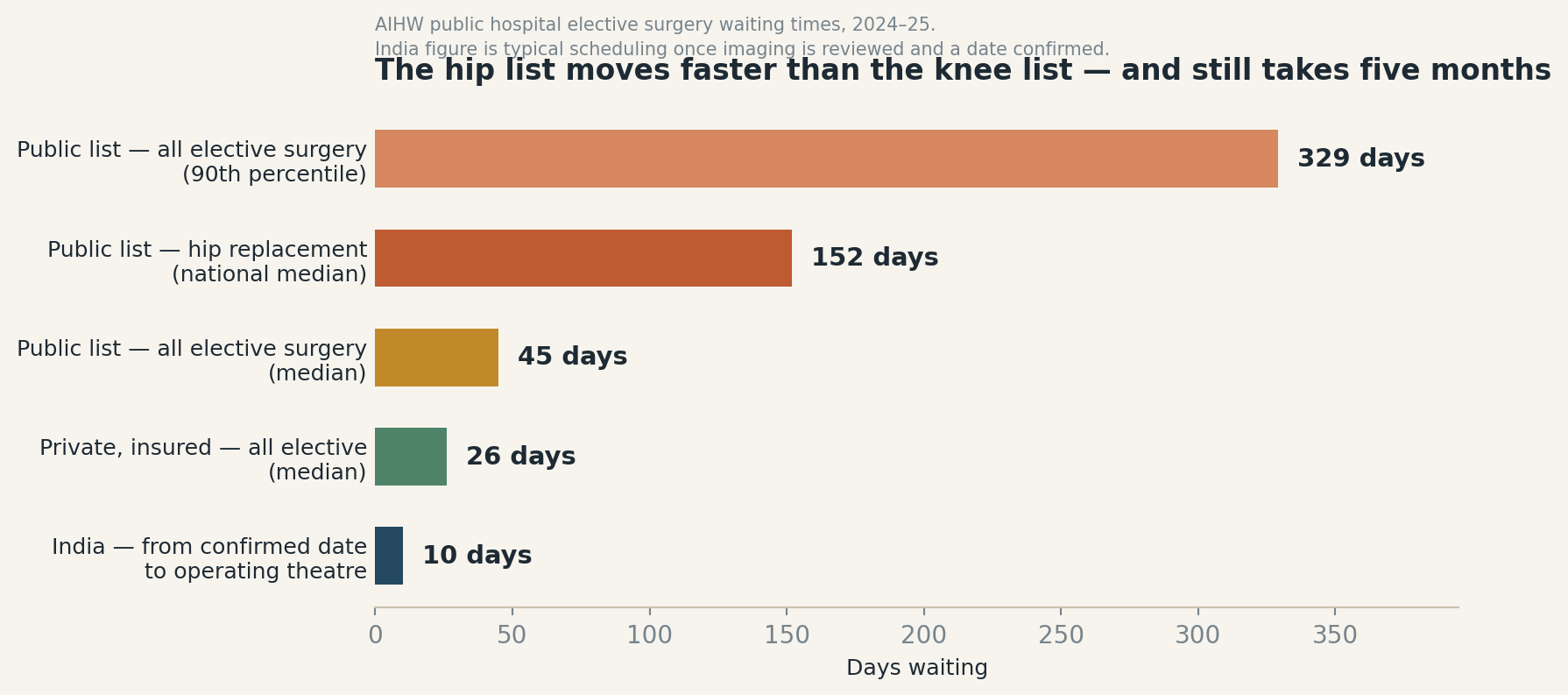
That median hides the tail. Across elective surgery, one patient in ten waits beyond 329 days, and Western Australia and Tasmania sit at the long end. If you hold Gold hospital cover and have served your waiting periods, you will be admitted privately within weeks and none of this applies. This briefing is for Australians outside that: no cover, a policy that excludes joint replacement, or cover taken out after the hip began to fail.
| 152 | ~¾ | 21 |
|---|---|---|
| days — median public wait for a hip replacement in Australia | less for the surgery itself at an accredited Indian hospital | days in India, with daily one-on-one physiotherapy throughout |
The one number that should shape your whole decision
Hip replacement patients are younger than knee replacement patients, and that single fact changes everything about how you should choose. If you are having your first hip at 52, you are not asking whether the operation works. You are asking whether the implant will outlive you.
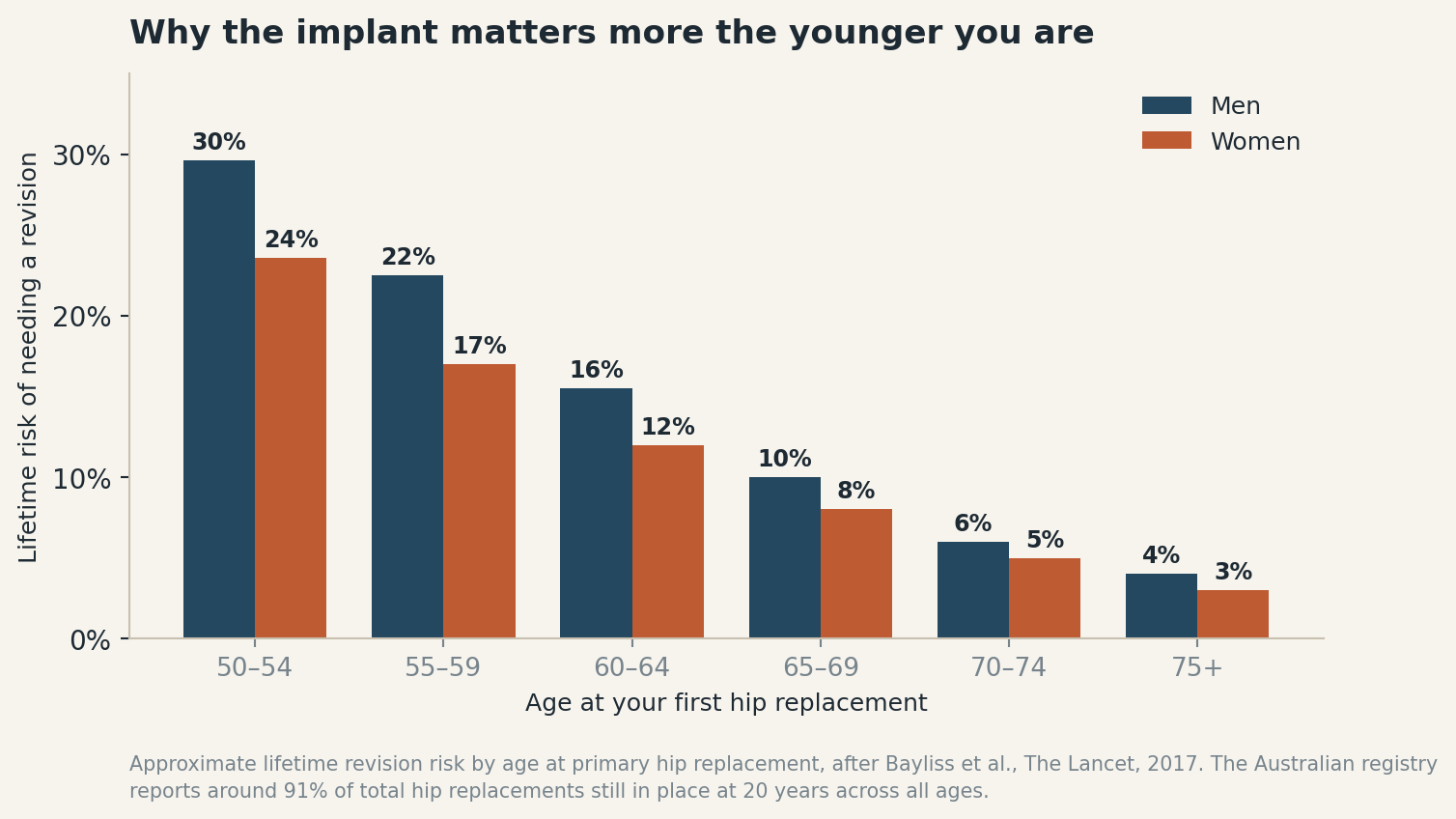
The published lifetime risk of needing a revision approaches 30 per cent for a man having his first hip in his early fifties, and falls to low single figures for someone having it after 75. The Australian registry reports that around 91 per cent of total hip replacements are still in place at twenty years across all ages — an excellent figure — but averages conceal exactly the group most likely to be reading this.
The practical consequence is simple and almost nobody says it plainly: the younger you are, the more the specific implant matters, and the less you should accept a surgeon who will not discuss it. Bearing surface, head size, cup design and fixation are not technicalities. For a fifty-four-year-old they are the difference between one operation and two.
Which Hip Patient are You?
| Under 60 | 60 to 75 | Over 75 |
|---|---|---|
| Longevity dominates. Ceramic-on- | The sweet spot. Almost any well- | Bone quality and fracture risk lead. |
| cross-linked-polyethylene, a larger head where the anatomy allows, and cementless fixation are the usual answer. Ask about bearing wear specifically. Rule out joint-preserving options first if the joint space is not yet gone. | performing modern combination will comfortably see you out. Choose on surgeon volume and unit quality rather than agonising over hardware. | Cemented femoral fixation is often preferred, because periprosthetic fracture rather than wear is the thing most likely to bring you back to theatre. Medical optimisation matters more than implant choice. |
The registry your country built, and why it is your single best tool
Australia runs the Australian Orthopaedic Association National Joint Replacement Registry, which has tracked essentially every joint replacement performed here for over two decades. It is not a bureaucratic curiosity. It is the instrument that helped identify the failure of metal-on-metal hip designs years before the problem was widely accepted, and it publishes revision rates by implant brand and model that anyone can read.
So before you pay a deposit anywhere — Perth, Bangkok or Delhi — ask for five specifics in writing: the brand and model of the acetabular cup, the brand and model of the femoral stem, the bearing combination, the femoral head diameter, and whether fixation is cemented, cementless or hybrid. Then look the combination up in your own registry. A good surgeon answers this in one email and is glad to be asked, because the choice was deliberate.
In 24 years I have not met a patient group better equipped to audit its own hardware than Australians. Very few use the instrument sitting in their own country — and it turns the decision from an act of trust into an act of verification.
What the money actually looks like
A self-funded private hip replacement in Australia is commonly quoted between $22,000 and $33,000 once hospital, theatre, prosthesis, surgeon, anaesthetist and inpatient physiotherapy are counted. The same operation, by a fellowship-trained arthroplasty surgeon at an accredited Indian hospital using an implant from the same global manufacturer, typically costs around three-quarters less. Even after airfares, three weeks of accommodation, visas and transfers, the whole undertaking comes to roughly $14,700 — about
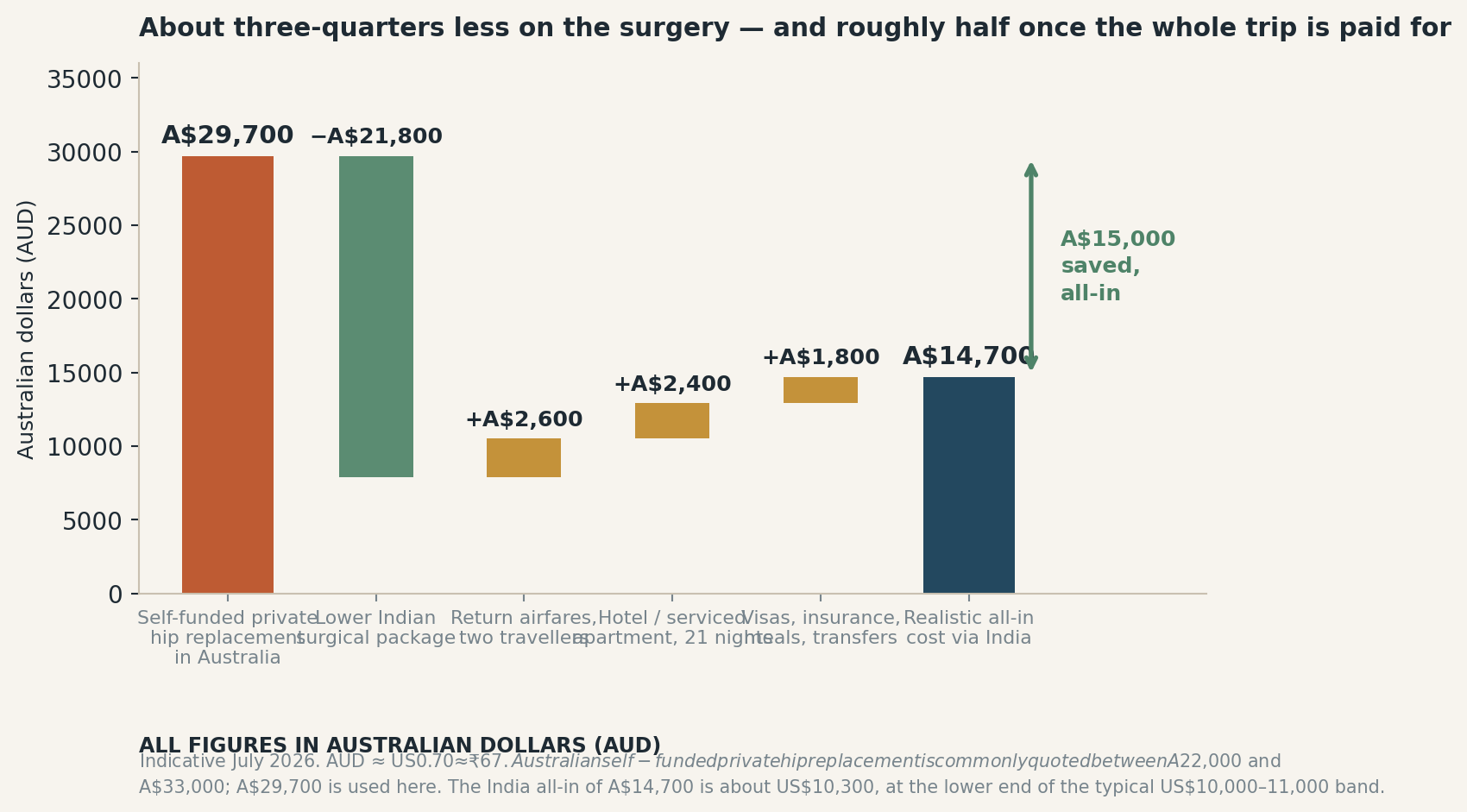
US$10,300 — which is close to half the Australian self-funded figure.
What the Indian package usually includes that an Australian quote itemises separately
- Surgeon, anaesthetist and assistant fees
- The implant, specified by brand and model before you arrive
- Every inpatient night, stated up front
- Daily one-on-one physiotherapy until discharge
- Post-operative imaging, blood work and medication
- Airport transfers and accommodation coordination
What does not travel with you is reimbursement: Medicare does not pay for treatment overseas, and fund rebates apply to Australian admissions. That is the shape of the decision rather than a hidden trap, and it is why you should insist on a written, itemised, all-inclusive quote before any deposit moves.
Your four options, side by side
| Public list | Private, insured | Private, self-funded | India | |
|---|---|---|---|---|
| Time to surgery | 5–11 months | 2–6 weeks | 2–6 weeks | 1–3 weeks |
| Your out-of-pocket | Nil | Excess plus gap (US$10,300) | $22,000–$33,000 | About $14,700 all-in |
| Choice of surgeon | No | Yes | Yes | Yes |
| Choice of implant | Rarely discussed | Sometimes | Sometimes | Specified in writing |
| Physiotherapy | Bought separately | Bought separately | Bought separately | Daily, included |
| Navigation / robotics | Uncommon | Often an extra | Often an extra | Widely available |
| Follow-up at home | Built in | Built in | Built in | Arrange before you fly |
All dollar figures are Australian dollars (AUD) unless marked US$. Times and costs indicative, July 2026.
What you are actually getting for it
Volume, and the sub-specialisation that follows. Leading Indian arthroplasty centres perform hip replacement in numbers few individual hospitals anywhere can match, and their senior surgeons frequently do nothing else, many holding fellowships from the United Kingdom, Australia or the United States. Volume is among the more reliable predictors of outcome in joint surgery, and it is why these units treat dysplastic hips, protrusio and post-traumatic deformity as routine rather than exceptional.
Cup position, which is where hips are won or lost. Dislocation and edge wear both trace back to how accurately the acetabular component is placed. Computer navigation and robotic assistance are widely available in Indian centres and generally included rather than charged as an upgrade, where in Australia they are often an out-of-pocket extra.
Accreditation that means something specific. JCI is the international arm of the body accrediting hospitals across the United States; NABH is India’s national equivalent, recognised by the same global standards authority. When a hospital holds either, an external inspector has audited its infection control, surgical checklists and record-keeping against a published standard, and you can verify it independently.
Rehabilitation that is genuinely supervised. Most hip patients are standing within a day and walking with a frame almost immediately. In India you do that under supervision, working one-on-one with a physiotherapist daily and reviewed throughout by the surgeon who operated, rather than being discharged to organise your own.
Optimisation before the knife. A quality unit insists on dental clearance, checks your HbA1c and discusses weight before booking a theatre date, because each materially affects prosthetic joint infection risk. When a hospital raises these things it is not obstructing you — it is the clearest signal that it is prioritising your hip over its booking.
Why India rather than Bangkok, Kuala Lumpur or Istanbul
Australians exploring medical travel are usually shown Thailand, Malaysia and Turkey first, because those destinations market hard here. India competes on substance: the volumes, the sub-specialised surgeons, and serious revision capability standing behind the primary operation. Its entire medical record is produced in English, so nothing needs translating before your GP can read it. Its costs remain the lowest of the serious destinations. And a large, settled Indian community at home means family, language and familiarity are closer to India than to anywhere else on that list.
Two questions everyone asks, answered properly
Who looks after me when I get home? Arrange it before you go rather than after you land. Speak to your GP, give them the dates, book your Australian physiotherapy course in advance. Most GPs are willing once brought in early and given a proper handover, and the discharge pack described below is what makes that handover easy.
What about infection? Prosthetic joint infection is the complication that matters in hip replacement anywhere in the world, and good units manage it actively rather than hope. Ask for the unit’s surgical site infection rate for primary hip arthroplasty and whether it screens patients before joint surgery; strong centres share these figures readily. Ask for any culture result in writing, and tell your Australian GP on return that you have had surgery overseas. Handled this way it is a managed variable, not a reason to stay home.
What to say to your family
The objection nobody writes about is not clinical. It is the phone call in which you tell your daughter you are having surgery in India, and the pause that follows. That pause has changed more minds than any medical argument, so prepare for it.
What settles it is specifics rather than reassurance. Name the hospital and its accreditation and invite her to look it up. Name the surgeon, his training and his annual hip volume. Name the cup, the stem and the bearing, and show her the Australian registry entry. Explain that you are staying three weeks precisely so nothing is rushed, and that your GP already has the dates. Families do not object to India; they object to the sense that a relative is taking an unresearched gamble with something irreversible. Show them the research and the objection generally dissolves. Better still, bring one of them — the attendant visa exists for this, and a second set of ears is worth more than any brochure.
Three supervised weeks
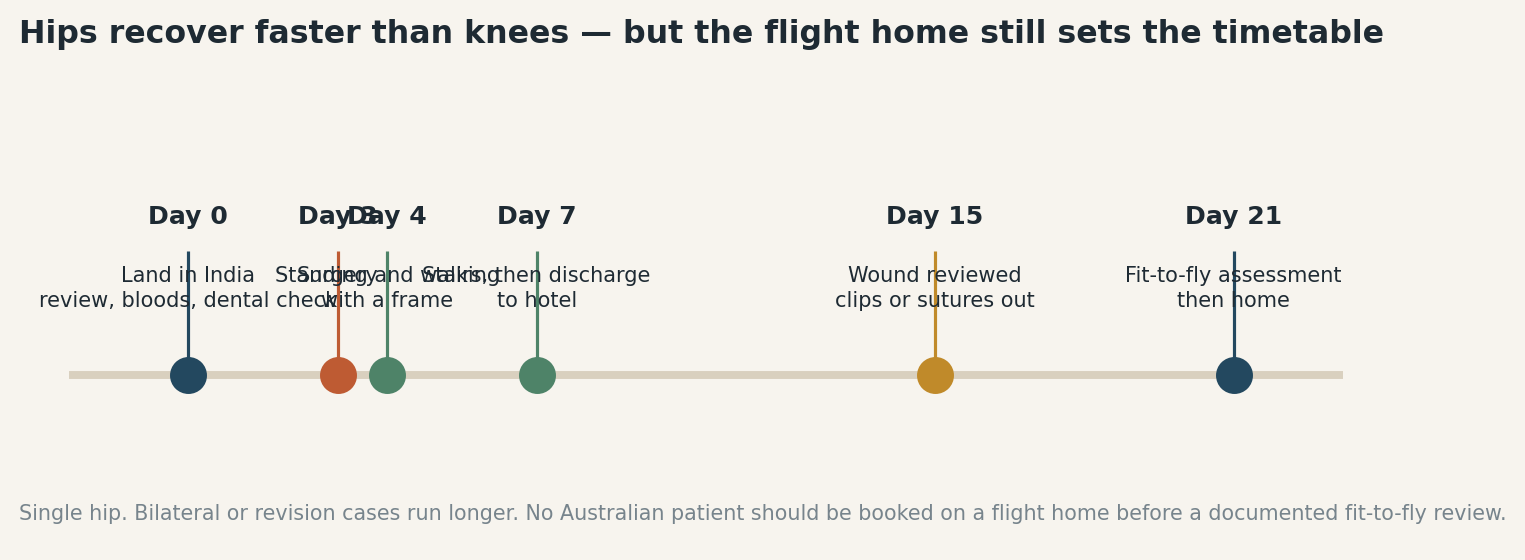
Hips recover faster than knees. Most patients are upright within twenty-four hours and managing stairs within a few days, which is why the temptation to book an early flight is strong. Resist it. Plan three weeks for a single hip.
Venous thromboembolism risk stays elevated for weeks after hip arthroplasty and long-haul immobility compounds it, while the early dislocation risk is highest in the first six weeks — which makes a cramped seat, an awkward transfer and a rushed airport the wrong combination on day ten. Book a changeable return, ask for a written thromboprophylaxis plan covering the flight, request the unit’s hip precautions in writing, take an aisle seat and move regularly.
Six Things to Have in Writing Before You FLY
1. The implant, fully specified. Cup, stem, bearing combination, head diameter and fixation — the five answers that let you check the most important choice in the operation against your own registry.
2. An itemised, all-inclusive price, with physiotherapy, imaging and inpatient nights clearly inside or outside the number, and the cost of extra nights stated.
3. The named operating surgeon, and a video consultation with them — not a coordinator, and before any deposit.
4. Their annual primary hip volume, and who assists if the case proves complex.
5. What the hospital covers if you need a return to theatre during your stay.
6. Your Australian follow-up, already booked: a GP review and physiotherapy course confirmed before you leave.
Practicalities for Australians
Australian passport holders are eligible for India’s electronic medical visa, issued against an invitation letter from the hospital, with an e-medical attendant visa for whoever travels with you — apply for both in the same batch. Send the imaging study itself, not only the radiologist’s report: a standing AP pelvis and lateral are what the surgeon needs to template the implant. Before flying home, collect a discharge pack — operation note, implant identification card with lot numbers for both components, post-operative films, culture results, anticoagulation plan, hip precautions and rehabilitation protocol. That pack is what lets your GP and physiotherapist pick up your care confidently, and it is far easier to assemble in the hospital corridor than by email from Perth.
A closing word
A hip replacement done well is close to a restoration. For an Australian facing five months to a year on a list, or a quote of $29,000 to $30,000 they cannot fund, having it done promptly at a high-volume Indian centre is a thoroughly reasonable decision — provided the implant is chosen deliberately and the follow-up is arranged before departure. If you would like a second opinion on your films, or a review of a quote you already hold, send the imaging and I will look at it properly.
Sources
- 🌐 Australian Institute of Health and Welfare, Elective surgery waiting times , 2024–25
- 🌐 Australian Orthopaedic Association National Joint Replacement Registry, Annual Report , 2025
- 🌐 Bayliss et al., “The effect of patient age at intervention on risk of implant revision after total replacement of the hip or knee”, The Lancet , 2017
- 🌐 Australian private hospital and health fund published pricing, 2026
- 🌐 High Commission of India, e-Visa categories and eligibility
Frequently Asked Questions by Australian Patients about Hip Surgery in India
Why do Australian patients consider hip replacement surgery in India?
Australian patients may consider India when public waiting times are lengthy or self-funded private treatment is expensive. The briefing cites a median public hip replacement wait of approximately 152 days and Australian self-funded costs commonly ranging from Approximately $22,000 to Approximately $33,000.
How much does hip replacement surgery in India cost for Australian patients?
The briefing uses a representative all-in India cost of approximately Approximately $14,700 (about US$10,300), including the lower Indian surgical package plus indicative return airfares, accommodation, visas, insurance and transfers. Actual costs vary according to the hospital, surgeon, implant and individual treatment requirements.
Why is implant choice especially important for younger hip replacement patients?
Younger patients have more years in which an implant may wear or require revision. The briefing cites an approximate 30% lifetime revision risk for men receiving their first hip replacement at ages 50–54, compared with low single-digit risk after age 75.
What implant information should Australian patients obtain before surgery?
The briefing recommends obtaining five details in writing: the brand and model of the acetabular cup, brand and model of the femoral stem, bearing combination, femoral head diameter, and whether fixation is cemented, cementless or hybrid. These details can then be checked against Australia's joint replacement registry.
How long do hip replacement implants last?
The briefing states that Australian registry data show approximately 91% of total hip replacements are still in place at 20 years across all ages. Individual implant longevity varies considerably, particularly according to the patient's age at the first operation.
Is the anterior approach better than the posterior approach for hip replacement?
The briefing does not recommend insisting on either approach. Both can produce excellent outcomes in experienced hands. While the anterior approach may provide somewhat faster recovery during the first few weeks, the difference is described as largely disappearing by around three months. Surgeon experience and accurate component positioning are considered more important.
How long should Australian patients stay in India after hip replacement?
The briefing recommends approximately three weeks (21 days) for a single hip replacement. Most patients may be upright within 24 hours and managing stairs within several days, but an early long-haul flight is discouraged because thrombosis and early dislocation risks remain relevant.
Can both hips be replaced during the same trip to India?
According to the briefing, simultaneous bilateral hip replacement may be reasonable for appropriately selected, medically fit patients without significant cardiac or respiratory disease. Suitability must be assessed individually by the treating surgical team.
Will Medicare or Australian private health insurance reimburse hip surgery in India?
The briefing states that Medicare does not cover treatment overseas, while health-fund hospital benefits generally apply to Australian admissions. Some corporate or international policies may provide overseas benefits, so patients are advised to confirm their individual coverage in writing.
What should patients arrange before returning to Australia?
Patients should have Australian GP follow-up and physiotherapy arranged before departure. Before leaving India, the briefing recommends collecting the operation note, implant identification card with lot numbers, post-operative imaging, relevant culture results, anticoagulation plan, hip precautions and rehabilitation protocol. A documented fit-to-fly assessment should also be completed before the return journey.
Anterior or posterior approach — which should I insist on?
Neither, and be wary of anyone selling one as revolutionary. Both give excellent results in experienced hands; the anterior approach may recover marginally faster in the first weeks, with the difference largely gone by three months. Surgeon volume and accurate component positioning matter far more than the incision.
Will Medicare or my health fund reimburse any of this?
No — Medicare does not cover treatment overseas and fund hospital benefits apply to Australian admissions. A small number of corporate and international policies carry overseas benefits, so ask your fund in writing rather than assuming.
How long before I can fly home?
About three weeks for a single hip, on a changeable ticket. The decision should follow a documented fit- to-fly assessment rather than a date booked in advance.
Can both hips be done on the same trip?
For fit patients without significant cardiac or respiratory disease this is often reasonable and is one of the real advantages of travelling — one anaesthetic, one rehabilitation period, one trip. A good unit examines that question with you rather than simply agreeing.
I am 53. Should I wait a few years so the implant lasts long enough?
Usually not. Waiting costs you years of function and does not reduce lifetime revision risk as much as people assume. The better response to being young is to be exacting about the implant and the surgeon, which is precisely what the Australian registry allows you to be.
Page Summary
This guide explains hip surgery in India for Australian patients, focusing on public waiting times, self-funded costs and implant longevity. The median Australian public wait is approximately 152 days, against self-funded Australian treatment of Approximately $22,000–$33,000 versus a representative all-in India journey of approximately Approximately $14,700. Because lifetime revision risk rises when the first replacement is performed young, patients are encouraged to obtain exact implant specifications and check them against Australia's joint replacement registry, alongside surgeon volume, accreditation and rehabilitation. For a single hip replacement, approximately three supervised weeks in India is recommended, followed by fit-to-fly clearance and continued Australian follow-up.
Citation Block
| Topic | Information |
|---|---|
| Topic Information | Details |
| Procedure | Total Hip Replacement / Total Hip Arthroplasty |
| Country | India |
| Intended Audience | Australian Patients |
| Conditions Covered | Advanced Hip Arthritis, Joint-Space Loss, Hip Degeneration, Dysplastic Hip, Protrusio, Post-Traumatic Deformity |
| Procedures | Total Hip Replacement, Selected Bilateral Hip Replacement |
| Typical Stay | Approximately 21 Days for a Single Hip |
| Hospital Stay | Depends on Procedure and Individual Recovery |
| Recovery | Early mobilisation followed by supervised physiotherapy and continued rehabilitation |
| Australian Median Public Wait | Approximately 152 Days |
| Australian Self-Funded Cost | Approximately $22,000–$33,000 |
| Treatment Access in India | Approximately 1–3 Weeks |
| Author | Dr. Dheeraj Bojwani |
| Experience | 24+ Years as a Medical Travel Advisor |


Our Mission Statement
Our mission is to place patients at the centre of every healthcare decision by providing trustworthy, evidence-based, and unbiased medical information. We believe that informed patients make better decisions. Backed by personalised guidance from our experienced advisory team, we help patients understand their treatment options, compare them objectively, and confidently choose the path that best suits their medical needs and personal circumstances.
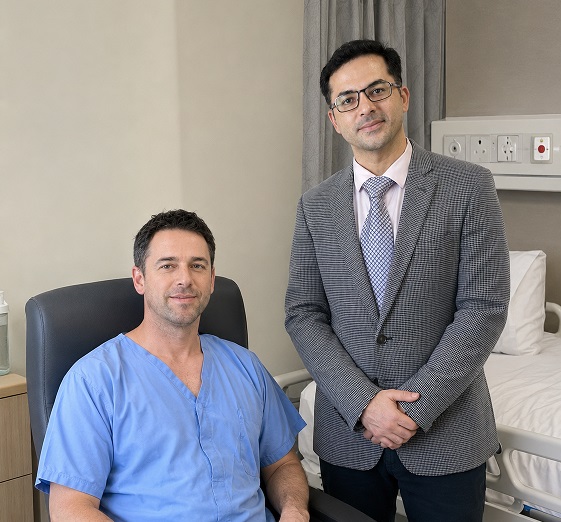
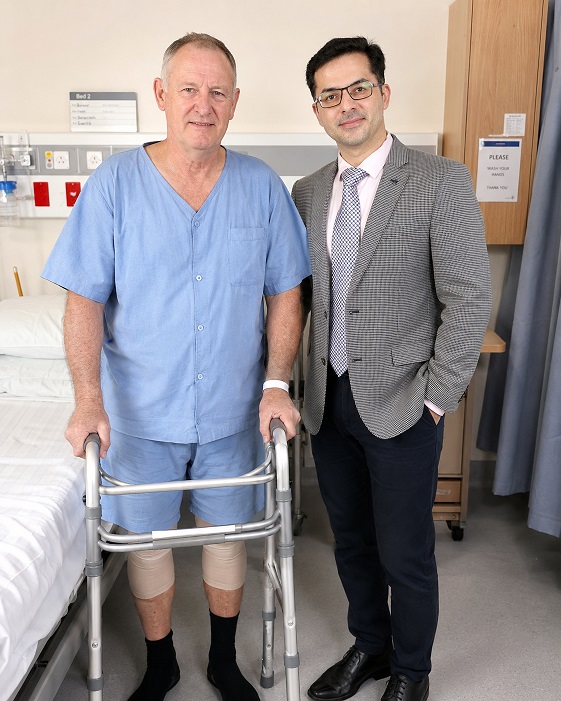
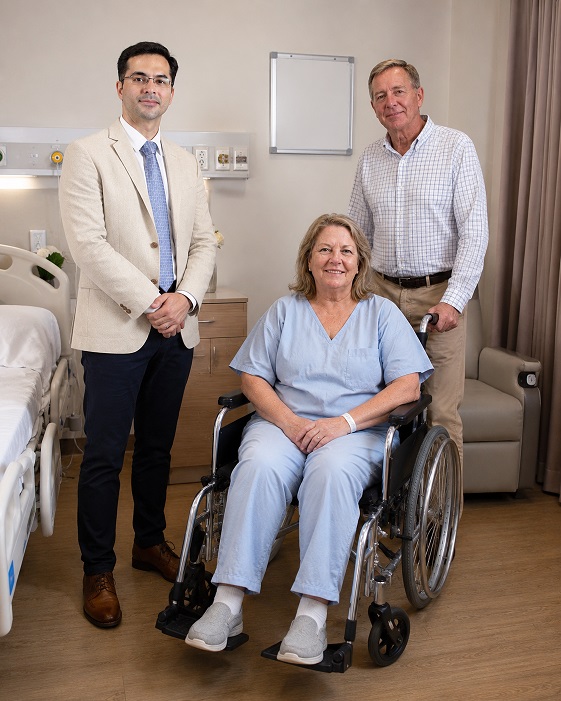
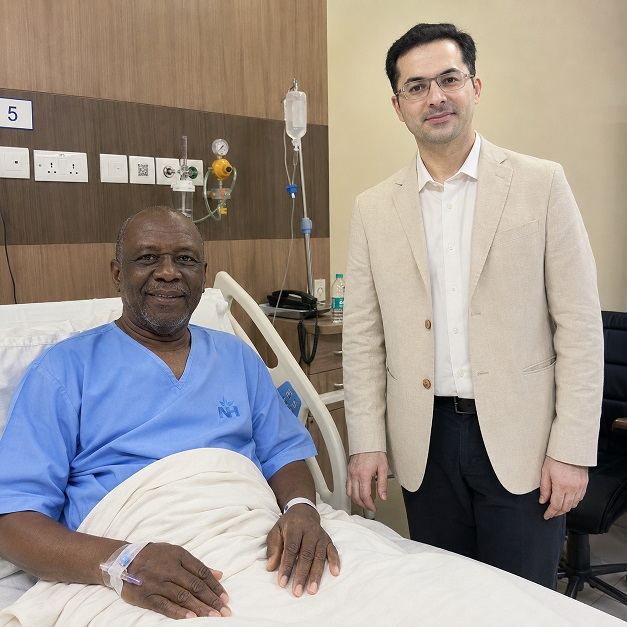
Patient Testimonials from Australia




Ready to Take the First Step?
Share your Medical Reports with our Healthcare Managers Today and Get a FREE CONSULTATION, a Personalized Treatment Plan, and Complete Support from Arrival to Recovery.
Get Your Free ConsultationAreas We Serve
This resource has been thoughtfully prepared for patients from Australia who are considering medical treatment in India. We also welcome patients from the wider region in the countries mentioned below-
We regularly assist patients from:
- Fiji
- Vanuatu
- Samoa
- Tonga
- Kiribati
- Nauru
- Tuvalu
- New Zealand
- Solomon Islands
- Papua New Guinea
Many of the insights, treatment pathways, hospital recommendations, travel guidance, and patient support services described here are equally relevant and may be used as a reference when planning treatment in India.
From Australia to India: Your Complete Patient Support Guide
- Cancer Treatment in India for Australian Patients: PBS Gap & Drug Costs
- Cardiac Surgery in India for Australian Patients: TAVI Access & Costs
- Dental Treatment & Surgery in India for Australian Patients
- Hip Surgery in India for Australian Patients: Costs, Waits & Implant Choice
- Knee Surgery in India for Australian Patients: Costs, Waits & Implants
- Neurosurgery in India for Australian Patients: Volume, Costs & When Not to Travel
- Spine Surgery in India for Australian Patients: Costs, Indications & Second Opinions (2026)
- Best Bariatric & Weight Loss Surgeons in India for Australian Patients
- Best Cancer Surgeons & Hospitals in India for Australian Patients
- Best Cardiac Surgeons & Hospitals in India for Australian Patients
- Best Cosmetic Surgeons & Hospitals in India for Australian Patients
- Best Dental Surgeons & Clinics in India for Australian Patients
- Best Hip Surgeons & Hospitals in India for Australian Patients
- Best Knee Surgeons & Hospitals in India for Australian Patients
- Best Scoliosis Surgeons & Hospitals in India for Australian Patients
- Best Spine Surgeons & Hospitals in India for Australian Patients
- Selecting the Best Urosurgery and Reconstructive Urology Centres in India for Australian Patients
- Selecting the Best Bone Marrow Transplant Centres in India for Australian Patients