

Selecting the Best Scoliosis Surgeons and Scoliosis Surgery Hospitals in India for Australian Patients
Two things decide this more than anything else: whether the curve has genuinely earned an operation, and whether the spinal cord will be watched, continuously, for every minute of the surgery. Everything else in this guide sits beneath those two.
Scoliosis surgery is judged on two things above every other factor in this series, and neither of them is what most families ask about first. The first is whether the curve has actually earned an operation. The second, once it has, is whether the spinal cord will be watched continuously, in real time, for every minute the surgeon is working beside it. In 24 years of guiding international patients into Indian hospitals, scoliosis is the specialty where I most often find families a step ahead of where they need to be — researching surgeons for a curve that a specialist has not yet confirmed needs surgery at all. Get that settled first. Everything below assumes it has been.
Healing Journeys of Australian Patients


Key Takeaways
- Australian patients and families considering scoliosis surgery in India should first establish whether the curve has genuinely reached the threshold for surgery before comparing surgeons, hospitals or treatment costs.
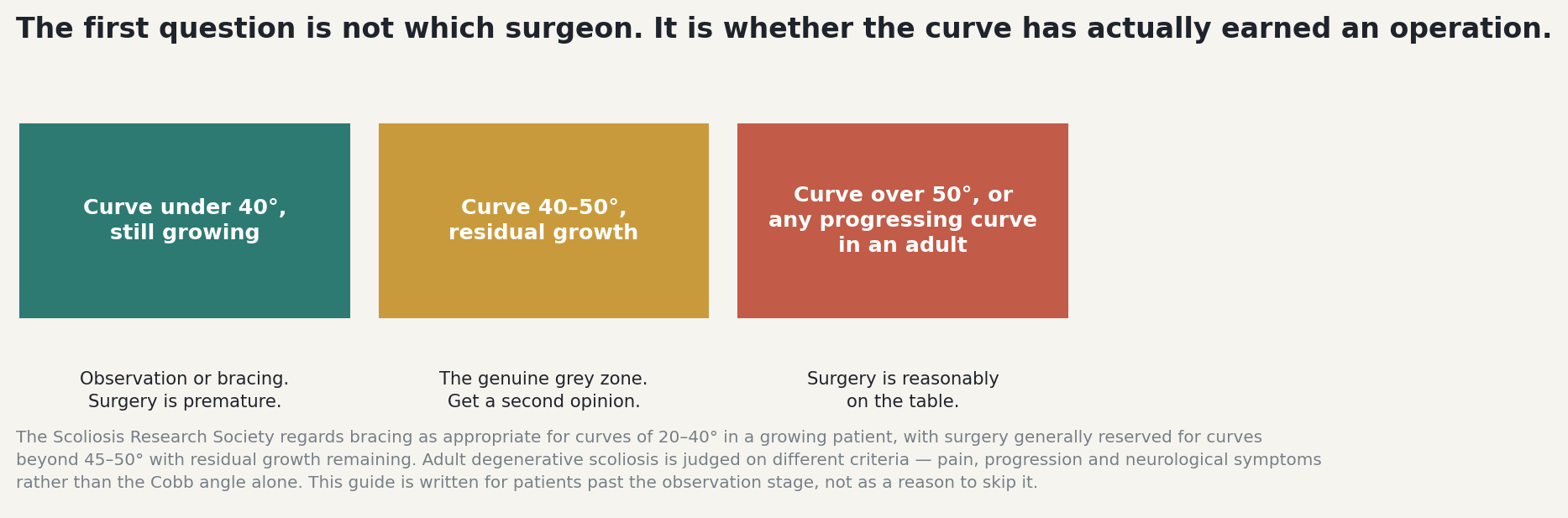
- For a growing adolescent, the guide describes bracing as appropriate for curves around 20–40 degrees, with surgery generally reserved for curves beyond approximately 45–50 degrees when significant growth remains. For adults, pain, neurological symptoms and documented progression matter more than Cobb angle alone.
- A second independent specialist opinion is recommended before committing to surgery. A single Cobb-angle measurement is only one data point; serial X-rays showing documented progression provide a stronger basis for deciding whether correction is necessary.
- Surgeon selection should focus heavily on annual volume in complex spinal deformity correction, specifically for the patient's curve type—adolescent idiopathic, adult degenerative, neuromuscular or congenital scoliosis—rather than general spine surgery volume.
- Relevant specialist pathways include MS/DNB in Orthopaedics or MCh/DrNB in Neurosurgery, followed by dedicated spine fellowship training and meaningful deformity-specific experience.
- Continuous intraoperative neuromonitoring is described as non-negotiable. The guide recommends confirming that somatosensory and motor evoked potentials will be monitored throughout the entire operation by a dedicated neurophysiologist.
- Hospital assessment should also include blood conservation and transfusion protocols, access to an experienced paediatric or spinal intensive care unit, independently verifiable JCI or NABH accreditation, and a committed long-term follow-up plan.
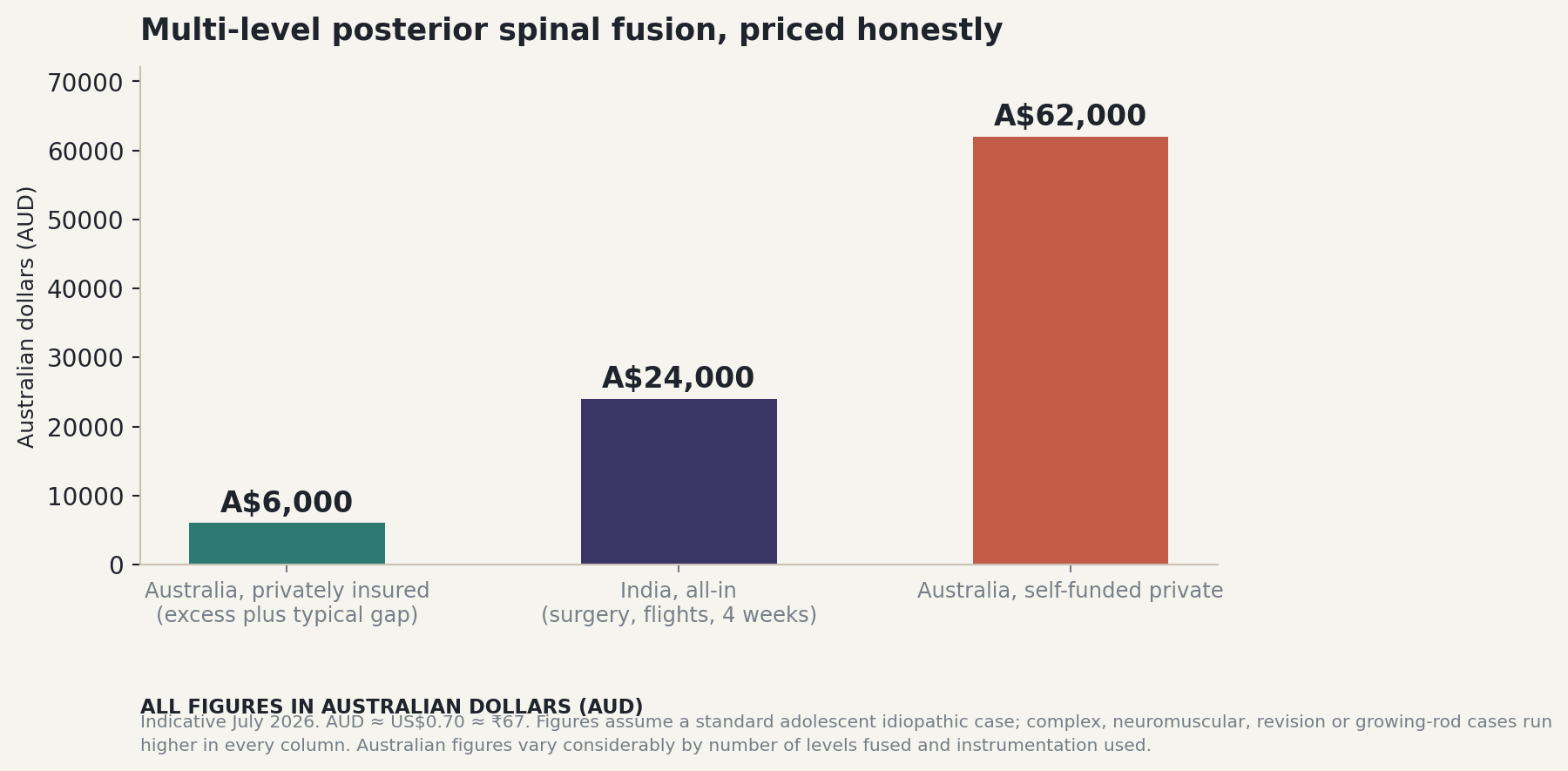
- The cost chart on page 2 gives an indicative figure of approximately Approximately $24,000 all-in for multi-level posterior spinal fusion in India, including surgery, flights and a four-week stay, compared with approximately Approximately $62,000 for self-funded private treatment in Australia.
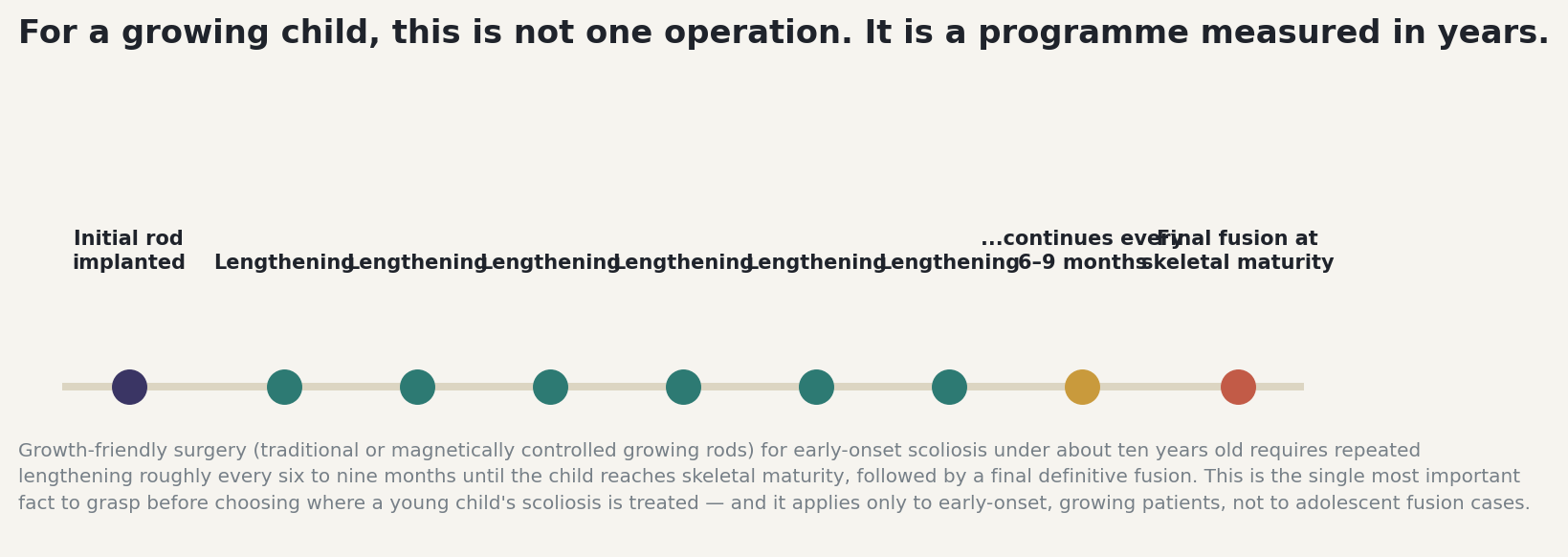
- For early-onset scoliosis in a young child, growth-friendly surgery should be viewed as a multi-year programme rather than a single operation. The page 5 timeline shows repeated lengthenings approximately every six to nine months until skeletal maturity, followed by definitive fusion.
- Australian patients undergoing a standard posterior fusion should generally allow approximately four weeks in India, longer for complex or revision cases, and should obtain a documented fit-to-fly assessment before returning home.
Quick Facts
- Conditions Covered
- Adolescent idiopathic scoliosis, adult degenerative scoliosis, neuromuscular scoliosis, congenital scoliosis and early-onset scoliosis
- Procedures Mentioned
- Scoliosis correction, multi-level posterior spinal fusion, growth-friendly surgery, traditional growing rods, magnetically controlled growing rods and definitive spinal fusion
- Target Audience
- Australian patients and families considering elective scoliosis or spinal deformity surgery in India
- Author/Advisor
- Dr. Dheeraj Bojwani, Independent Medical Travel Advisor, 24 years of experience guiding international patients
- Surgical Indication Highlights
- Growing adolescents with curves around 20–40° are generally considered for observation or bracing; approximately 40–50° represents a grey zone; surgery is generally considered beyond approximately 45–50° when significant growth remains. Adult decisions depend more on pain, neurological symptoms and documented progression.
- Surgeon Qualification Highlights
- MS/DNB Orthopaedics or MCh/DrNB Neurosurgery followed by a dedicated spine fellowship and meaningful deformity-specific training or experience
- Surgeon Selection Highlights
- Annual deformity-specific surgical volume, experience with the patient's exact curve type, independent confirmation that surgery is indicated, personal performance of the operation, direct preoperative consultation and transparent discussion of neurological complications and revision rates
- Hospital Selection Highlights
- Continuous intraoperative neuromonitoring, dedicated neurophysiologist, blood conservation and transfusion protocol, experienced paediatric or spinal intensive care, independently verified JCI or NABH accreditation and long-term follow-up planning
- Neuromonitoring
- Continuous somatosensory and motor evoked potential monitoring throughout scoliosis correction is treated as a non-negotiable requirement in the guide.
- Indicative Cost
- Approximately $24,000 all-in for multi-level posterior spinal fusion in India, including surgery, flights and a four-week stay. The page 2 chart compares this with approximately Approximately $62,000 for Australian self-funded private treatment and Approximately $6,000 for an indicative privately insured Australian excess plus typical gap.
- Typical Stay in India
- Around 4 weeks for a standard posterior spinal fusion; longer for complex or revision cases
- Quote Requirements
- Levels to be fused, instrumentation, ICU nights, ward nights, additional-night costs, return-to-theatre coverage, neuromonitoring costs and blood-conservation costs should be stated in writing.
- Accreditation Discussed
- JCI and NABH
- Long-Term Follow-Up
- Particularly important because scoliosis surgery has a follow-up period measured in years, while growth-friendly surgery can involve repeated procedures over a multi-year period.
In Brief
Australian patients considering scoliosis surgery in India should first confirm through independent specialist assessment that the curve genuinely requires surgery. Once the indication is established, the guide places greatest emphasis on choosing a surgeon with substantial deformity-specific experience and a hospital providing continuous intraoperative neuromonitoring throughout the correction. Additional considerations include deformity fellowship training, blood conservation, experienced paediatric or spinal intensive care, independently verified accreditation and long-term follow-up. For young children requiring growing rods, families should recognise that treatment may involve repeated lengthenings every six to nine months over several years rather than a single overseas operation.
Before you choose anyone: has the curve earned an operation?
For an adolescent still growing, the Scoliosis Research Society regards bracing as appropriate for curves between 20 and 40 degrees, with surgery generally reserved for curves beyond 45 to 50 degrees where significant growth remains. Below that threshold, observation and bracing are the standard of care, not a lesser option while waiting for something better. For an adult, the calculus is different again — pain, neurological symptoms and documented progression matter more than the Cobb angle in isolation.
This is not a reason to delay a genuinely indicated operation. It is a reason to have the indication itself confirmed by a second, independent specialist before you spend a dollar anywhere, India included. A curve measured once, by one clinician, is a data point. A curve tracked over serial X-rays, with a documented progression rate, is a decision.
The reason this matters more here than almost anywhere else in this series is that scoliosis correction is irreversible in a specific way most other elective surgery is not: it permanently fixes a portion of the spine, trading motion for correction. That trade is worthwhile when the curve genuinely threatens function or will keep progressing. It is a much harder trade to justify for a curve that bracing, exercise or simple observation would have managed perfectly well.
Should you be choosing at all?
Australia treats scoliosis to a high standard, with excellent paediatric and adult deformity units in the major cities. If you can be seen and treated promptly at home you generally should be, and if you hold Gold hospital cover with your waiting periods served, your fund absorbs most of the cost of a private admission.
This guide is for Australians facing a large self-funded gap, long waits for a paediatric deformity slot in the public system, or families who want a second opinion on a proposed correction before committing to it anywhere.
Part one: judging the surgeon
1. Volume in complex deformity correction, specifically. This is the heaviest criterion in the guide. Scoliosis correction is among the most technically demanding operations in all of spine surgery, and outcomes are strongly linked to how often a surgeon performs it, particularly for larger curves, revision cases, and neuromuscular or congenital deformity. Ask for his annual volume in deformity correction specifically, not general spine surgery, and ask separately about his experience with your curve type — adolescent idiopathic, adult degenerative, neuromuscular or congenital are genuinely different operations wearing the same name.
Ask this of three units, not one, and be specific about the comparison you are making. A surgeon with an excellent general spine practice who occasionally corrects scoliosis is a meaningfully different proposition from one whose caseload is built around deformity, even if both describe themselves the same way on a website.
2. Qualifications and a genuine spine deformity fellowship. As with the general spine pathway, entry runs through either orthopaedic surgery (MS or DNB in Orthopaedics) or neurosurgery (MCh or DrNB in Neurosurgery), and neither parent specialty trains a deformity surgeon on its own. What matters is a dedicated spine fellowship, and beyond that, specific additional training or a substantial personal caseload in deformity correction — not every spine fellowship spends meaningful time on scoliosis, which tends to concentrate in a smaller number of high-volume centres even within spine surgery itself. Ask directly where the deformity-specific experience was gained.
3. Whether he will independently confirm the curve has earned surgery. Ask him to explain, in his own words, why this curve at this stage meets the threshold for operating rather than continued observation or bracing. A surgeon who engages seriously with that question, and can point to documented progression, is behaving like a deformity specialist. One who moves straight to correction technique without addressing it has skipped the most important step in the whole process.
4. Whether he operates personally, and speaks to you first. Insist on a video consultation with the surgeon who will actually perform the correction, before any deposit moves. For paediatric cases, insist on speaking with whoever will manage the child’s care specifically, not a general spokesperson for the unit.
5. Complication and revision candour. Ask about his rate of neurological complications, his revision rate, and what happens if intraoperative neuromonitoring signals change during the case. A surgeon who discusses this without defensiveness has enough of a practice to have managed it and enough security to talk about it plainly.
Read the years-of-experience figure with the same care worth applying anywhere in this series. A headline number counted from MBBS quietly folds in the years spent completing MS or MCh, and further years spent in fellowship. Ask for the year deformity-specific practice actually began, rather than a career total that includes training.
Part two: judging the hospital
6. Continuous intraoperative neuromonitoring — non-negotiable. This is the heaviest single hospital- side criterion, and it deserves to be treated as an absolute requirement rather than a preference. Somatosensory and motor evoked potential monitoring throughout the operation is the standard of care in scoliosis correction worldwide, because it is how a surgical team detects a developing spinal cord problem in time to act on it, before it becomes permanent. Ask explicitly whether continuous neuromonitoring will be used for the entire case, by a dedicated neurophysiologist, and treat any hesitation as a reason to look elsewhere immediately.
7. Blood conservation and a clear transfusion protocol. Deformity correction carries genuine blood loss, particularly for larger curves and longer constructs. Ask about cell salvage technology, the unit’s typical transfusion rate for a case similar to yours, and whether pre-donation or other blood conservation strategies are used where appropriate.
8. A dedicated paediatric or spinal intensive care unit. For paediatric cases particularly, ask whether post-operative care is delivered in a unit experienced specifically with children recovering from major spinal surgery, rather than a general surgical ward or adult ICU adapted for the purpose.
9. Accreditation you can verify yourself. JCI is the international arm of the body accrediting hospitals across the United States; NABH is India’s national equivalent, recognised by the same global standards authority. Check either on the accrediting body’s own site rather than accepting the logo on the hospital’s.
10. A committed long-term follow-up plan, agreed before you travel. Scoliosis surgery has a follow-up tail measured in years for adolescents and adults, and in the case of growth-friendly surgery, in repeated procedures. Establish precisely what this looks like for your situation before you commit to anyone.
If your child is not yet skeletally mature: read this before anything else
Early-onset scoliosis in a child under roughly ten years old is managed completely differently from an adolescent curve near skeletal maturity, and the distinction changes everything about where treatment should happen. Growth-friendly surgery — traditional or magnetically controlled growing rods — is not a single operation. It is a programme of repeated lengthening procedures roughly every six to nine months, for years, until the child reaches skeletal maturity, followed by a final definitive fusion. Magnetically controlled rods allow some lengthenings to be performed non-invasively in clinic rather than under anaesthesia, which meaningfully reduces the total number of surgical episodes, but the multi-year commitment does not disappear. This changes the entire question for a family considering travel. It is one thing to travel for a single, well- planned operation with defined follow-up. It is a different undertaking altogether to commit a young child to a years-long programme delivered thousands of kilometres from home, with lengthening procedures needed on a fixed schedule regardless of school terms, family circumstances or anything else. Ask, with complete honesty, whether this is genuinely practical for your family before any other criterion in this guide matters at all. Many families in this situation are better served having the growing-rod phase managed in Australia, close to home, and considering overseas options only for the eventual definitive fusion if that later becomes the right path.
What the quote should say, and what it usually omits
In 24 years I have found that disputes almost never concern the quoted price. They concern what the quote silently omitted.
Insist on a written, itemised figure naming the levels to be fused, the instrumentation to be used, the number of ICU and ward nights assumed, and the explicit cost of exceeding them. Ask what the hospital covers if a return to theatre is needed, and confirm neuromonitoring and blood conservation costs are included rather than billed as extras. For growth-friendly cases, ask what a single lengthening procedure costs and whether a package price exists for a defined number of them.
Understand what does not travel with you. Medicare pays nothing for treatment received overseas, your health fund rebate applies to Australian admissions, and standard travel insurance excludes planned surgery and its complications. One rule is not negotiable: pay a deposit to secure the date, never the full balance in advance. The remainder is settled on arrival, once the surgeon has examined the patient and confirmed the plan in person.
Four Signals that Should Make You Pause
1. A recommendation for surgery without a documented, progressing curve. Ask to see the serial measurements. A single X-ray is not evidence of progression.
2. Any hesitation about continuous neuromonitoring. This is the one item on this entire list with no acceptable substitute.
3. Vagueness about deformity-specific volume. General spine surgery experience is not the same as deformity correction experience, and the two should never be presented as interchangeable.
4. No serious conversation about the long-term follow-up commitment , particularly for a growing child. If nobody raises it, ask directly.
Australia-specific considerations most patients miss
Get the independent second opinion at home first, where Medicare covers it. A consultation with another Australian spine or paediatric orthopaedic specialist, focused specifically on whether surgery is indicated, is the single highest-value step available to you and costs a fraction of the operation.
Arrange follow-up imaging and review before you travel. Confirm which Australian specialist will review post-operative X-rays and monitor for curve correction loss or instrumentation issues over the following years, and give them the operative details in advance.
Treat the flight as a clinical matter. Allow around four weeks in India for a standard posterior fusion, longer for complex or revision cases, and do not travel until a documented fit-to-fly assessment has been completed. Long-haul seating after major spinal instrumentation deserves the same caution given to any major spinal surgery.
Apply for both visas together. Australian passport holders are eligible for India’s electronic medical visa, issued against an invitation letter from the treating hospital, with an e-medical attendant visa for whoever travels with the patient — essential rather than optional for a child.
Ask what happens if a revision is needed years later. Instrumentation can occasionally require adjustment or removal after the original surgery. Establish before you travel whether the unit expects to manage this remotely through imaging review, whether it would require a return trip, and what an Australian spine surgeon would be willing to take on if a local revision became necessary.
| The Questions, in the Order You Should Ask Them | |
|---|---|
| Of the surgeon | Of the hospital |
| 1. Why does this curve, at this stage, meet the threshold for surgery? | 1. Will continuous neuromonitoring be used throughout, by a dedicated neurophysiologist? |
| 2. How many deformity corrections, in my specific curve type, did you perform last year? | 2. What is your blood conservation approach, and typical transfusion rate? |
| 3. Where did you complete your spine deformity fellowship or additional training? | 3. Is post-operative care delivered in a unit experienced with major spinal cases? |
| 4. Will you perform the operation yourself? | 4. Which accreditation do you hold, and when was it last inspected? |
| 5. What is your neurological complication rate, and your revision rate? | 5. For a growing child, what does the full multi-year plan actually involve? |
| 6. What happens if neuromonitoring signals change during the operation? | 6. May I see a sample discharge and follow-up plan before I commit? |
A closing word
Scoliosis surgery rewards precision at every stage: confirming the curve has earned an operation, choosing a surgeon who corrects deformity routinely rather than occasionally, and insisting on continuous neuromonitoring without exception. For a growing child, it also rewards complete honesty about what a multi-year programme actually asks of a family before any other decision is made. If you would like a second opinion on imaging, or a review of a quote you are already holding, send it to me and I will look at it properly — including telling you if I think surgery is premature, which for scoliosis is a more common answer than families expect.
Sources
- 🌐 Scoliosis Research Society, indications for bracing and surgical treatment in adolescent idiopathic scoliosis
- 🌐 Weinstein et al., “Effects of bracing in adolescent idiopathic scoliosis”, New England Journal of Medicine , 2013 (BRAIST trial)
- 🌐 Published literature on magnetically controlled and traditional growing rod lengthening intervals in early-onset scoliosis
- 🌐 Australian private hospital and health fund published procedure costs, 2026
- 🌐 Joint Commission International and National Accreditation Board for Hospitals and Healthcare Providers, accreditation registers
- 🌐 High Commission of India, e-Visa categories and eligibility
Frequently Asked Questions by Australians about Scoliosis Surgeons and Scoliosis Surgery Hospitals in India
How should Australian patients choose the best scoliosis surgeon in India?
Australian patients should first confirm that the curve genuinely requires surgery. Once the indication is independently established, the guide recommends evaluating the surgeon’s annual volume in complex deformity correction, experience with the patient's specific scoliosis type, deformity-specific training, personal involvement in the operation, and transparency about neurological complications and revision rates.
When is scoliosis surgery generally considered for an Australian patient?
For an adolescent who is still growing, the guide describes bracing as appropriate for curves between approximately 20 and 40 degrees, with surgery generally reserved for curves beyond 45–50 degrees where significant growth remains. The page 1 chart identifies 40–50 degrees as a genuine grey zone. For adults, pain, neurological symptoms and documented progression matter more than Cobb angle alone.
What qualifications should Australians look for in a scoliosis surgeon in India?
The guide describes two entry pathways: MS/DNB in Orthopaedics or MCh/DrNB in Neurosurgery. However, these qualifications alone do not establish deformity expertise. Patients should look for a dedicated spine fellowship plus additional deformity-specific training or a substantial personal caseload in scoliosis correction.
Why is intraoperative neuromonitoring important during scoliosis surgery in India?
The guide treats continuous intraoperative neuromonitoring as non-negotiable. Somatosensory and motor evoked potentials should be monitored throughout the operation so the surgical team can detect a developing spinal cord problem in time to respond. Australian patients should specifically confirm that monitoring will continue throughout the entire procedure under a dedicated neurophysiologist.
How much does scoliosis surgery in India cost for Australian patients?
The cost chart on page 2 provides an indicative figure of approximately Approximately $24,000 all-in for multi-level posterior spinal fusion in India, including surgery, flights and a four-week stay. It compares this with approximately Approximately $62,000 for self-funded private treatment in Australia and Approximately $6,000 for an indicative privately insured Australian excess plus typical gap. The figures are indicative as of July 2026.
How long should Australian patients stay in India after scoliosis surgery?
The guide recommends allowing approximately four weeks in India after a standard posterior spinal fusion, with a longer stay for complex or revision cases. Patients should not take the long-haul return flight until a documented fit-to-fly assessment has been completed.
Is growing-rod scoliosis treatment in India practical for young Australian children?
Families should consider this particularly carefully. As illustrated by the timeline on page 5, growth-friendly surgery for early-onset scoliosis is not a single operation. Traditional or magnetically controlled growing rods may require repeated lengthenings approximately every six to nine months for years, followed by definitive fusion at skeletal maturity. The guide explicitly notes that some Australian families may be better served having the growing-rod phase managed closer to home.
What hospital facilities should Australians check before scoliosis surgery in India?
The hospital should provide continuous neuromonitoring, a clear blood-conservation and transfusion protocol, and appropriate postoperative intensive care. For children, the guide recommends confirming that postoperative care is delivered in a unit experienced with children recovering from major spinal surgery. JCI or NABH accreditation should also be independently verified.
What warning signs should Australian families watch for when choosing scoliosis surgery in India?
The guide identifies four major warning signs: a surgical recommendation without documented curve progression, any hesitation about continuous neuromonitoring, vague answers about the surgeon’s deformity-specific volume, and no serious discussion about long-term follow-up—particularly when the patient is a growing child.
What follow-up should Australian patients arrange after scoliosis surgery in India?
Follow-up should be planned before travelling. The guide recommends identifying an Australian specialist who will review postoperative X-rays and monitor curve correction and instrumentation over subsequent years. Patients should also establish in advance what would happen if instrumentation required adjustment or revision later, including whether this could be managed in Australia or would require returning to India.
Page Summary
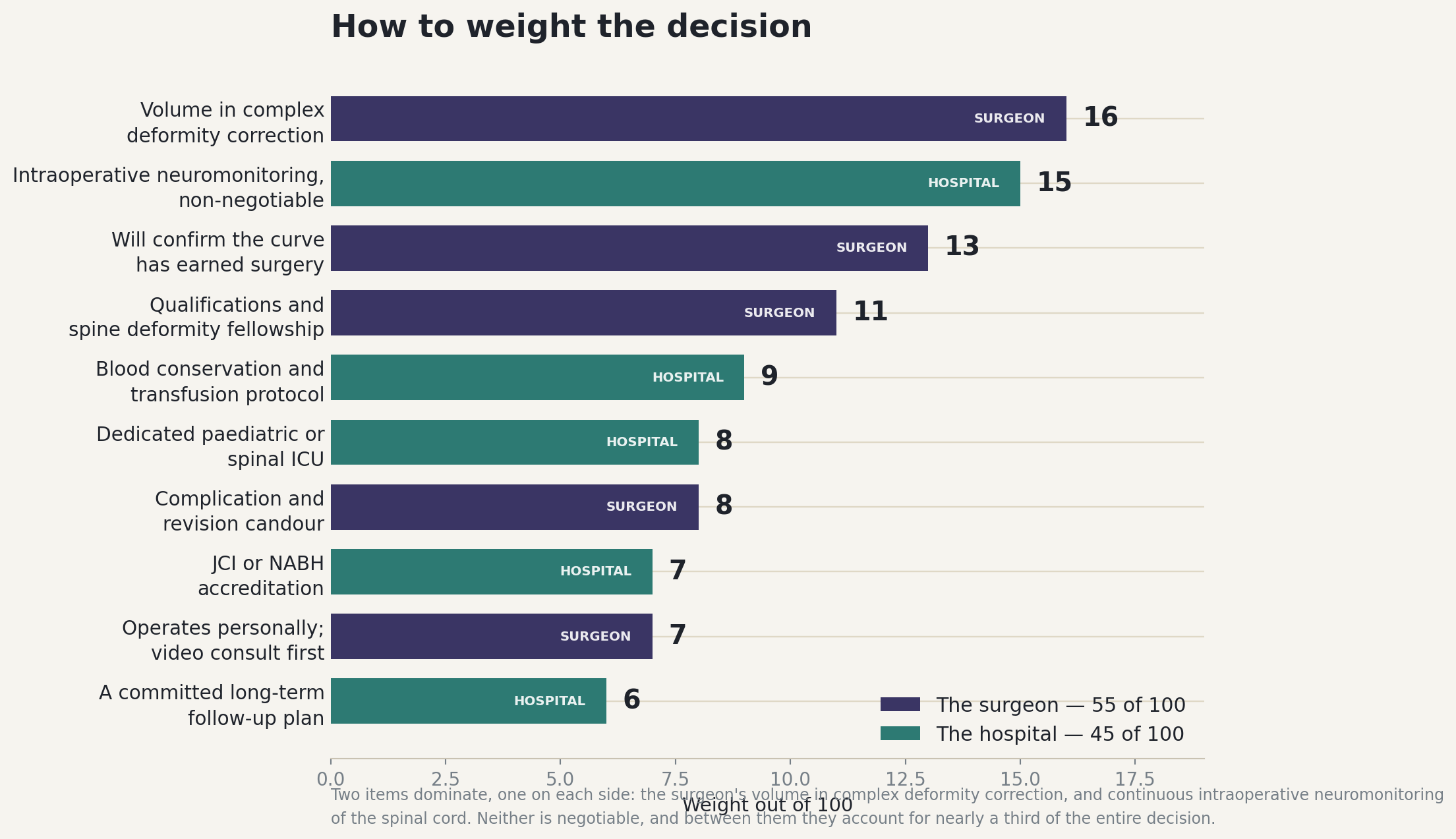
This guide explains how Australian patients and families can evaluate scoliosis surgeons and hospitals in India, placing surgical indication before surgeon selection — distinguishing observation or bracing for lower curves from a genuine grey zone around 40–50 degrees where surgery becomes appropriate. Once surgery is confirmed, it weighs surgeon factors at 55 points and hospital factors at 45, with deformity-specific surgical volume and continuous intraoperative neuromonitoring weighted most heavily, alongside fellowship training, complication transparency and accreditation. A dedicated section highlights that growing-rod treatment for early-onset scoliosis is a multi-year commitment involving repeated lengthenings approximately every six to nine months, making the practicality of overseas treatment particularly important for Australian families.
Citation Block
| Topic | Information |
|---|---|
| Topic Information | Selecting the Best Scoliosis Surgeons and Scoliosis Surgery Hospitals in India for Australian Patients |
| Procedure | Scoliosis & Spinal Deformity Surgery |
| Country | India |
| Intended Audience | Australian Patients and Families |
| Conditions Covered | Adolescent Idiopathic Scoliosis, Adult Degenerative Scoliosis, Neuromuscular Scoliosis, Congenital Scoliosis and Early-Onset Scoliosis |
| Procedures | Scoliosis Correction, Multi-Level Posterior Spinal Fusion, Growing-Rod Surgery and Definitive Spinal Fusion |
| Typical Stay | Approximately 4 Weeks in India for Standard Posterior Fusion; Longer for Complex or Revision Cases |
| Hospital Stay | Not Specifically Stated; Quote Should Specify ICU and Ward Nights |
| Recovery | Procedure-Dependent; Documented Fit-to-Fly Assessment Recommended Before Returning to Australia |
| Indicative Cost | Approximately $24,000 All-In for Multi-Level Posterior Spinal Fusion in India, Including Surgery, Flights and a 4-Week Stay |
| Author | Dr. Dheeraj Bojwani |
| Experience | 24 Years Guiding International Patients |

Our Mission Statement
Our mission is to place patients at the centre of every healthcare decision by providing trustworthy, evidence-based, and unbiased medical information. We believe that informed patients make better decisions. Backed by personalised guidance from our experienced advisory team, we help patients understand their treatment options, compare them objectively, and confidently choose the path that best suits their medical needs and personal circumstances.
Patient Testimonials from Australia
Ready to Take the First Step?
Share your Medical Reports with our Healthcare Managers Today and Get a FREE CONSULTATION, a Personalized Treatment Plan, and Complete Support from Arrival to Recovery.
Get Your Free ConsultationAreas We Serve
This resource has been thoughtfully prepared for patients from Australia who are considering medical treatment in India. We also welcome patients from the wider region in the countries mentioned below-
We regularly assist patients from:
- Fiji
- Vanuatu
- Samoa
- Tonga
- Kiribati
- Nauru
- Tuvalu
- New Zealand
- Solomon Islands
- Papua New Guinea
Many of the insights, treatment pathways, hospital recommendations, travel guidance, and patient support services described here are equally relevant and may be used as a reference when planning treatment in India.
From Australia to India: Your Complete Patient Support Guide
- Cancer Treatment in India for Australian Patients: PBS Gap & Drug Costs
- Cardiac Surgery in India for Australian Patients: TAVI Access & Costs
- Dental Treatment & Surgery in India for Australian Patients
- Hip Surgery in India for Australian Patients: Costs, Waits & Implant Choice
- Knee Surgery in India for Australian Patients: Costs, Waits & Implants
- Neurosurgery in India for Australian Patients: Volume, Costs & When Not to Travel
- Spine Surgery in India for Australian Patients: Costs, Indications & Second Opinions (2026)
- Best Bariatric & Weight Loss Surgeons in India for Australian Patients
- Best Cancer Surgeons & Hospitals in India for Australian Patients
- Best Cardiac Surgeons & Hospitals in India for Australian Patients
- Best Cosmetic Surgeons & Hospitals in India for Australian Patients
- Best Dental Surgeons & Clinics in India for Australian Patients
- Best Hip Surgeons & Hospitals in India for Australian Patients
- Best Knee Surgeons & Hospitals in India for Australian Patients
- Best Scoliosis Surgeons & Hospitals in India for Australian Patients
- Best Spine Surgeons & Hospitals in India for Australian Patients
- Selecting the Best Urosurgery and Reconstructive Urology Centres in India for Australian Patients
- Selecting the Best Bone Marrow Transplant Centres in India for Australian Patients