

Spine Surgery in India for Australian Patients
Before you compare destinations, compare diagnoses. In spine surgery the operation you are offered matters more than the country you have it in — and in Australia, what you are offered can depend on who is paying.
A 47-year-old warehouse supervisor in Newcastle. Four years of back pain, and for the last eight months a burning pain down the outside of the right calf that stops him after two hundred metres. The MRI shows degenerative change at three levels and a clear L5 nerve root compression at one of them. He has been quoted $55,000 for a two-level fusion. Nobody has yet explained to him that the leg pain and the back pain have different causes, different treatments and very different odds.
Healing Journeys of Australian Patients


Key Takeaways
- In spine surgery, the most important decision is not the destination but whether the proposed operation is actually justified by the patient’s symptoms and imaging.
- The briefing stresses that spinal surgery is generally more reliable for leg-dominant symptoms caused by nerve compression than for back-dominant pain without a clear matching nerve problem.
- Microdiscectomy for a herniated disc and decompression for spinal stenosis have clearer indications when sciatica, numbness, weakness or neurogenic claudication correspond with imaging findings.
- Fusion requires more careful evaluation, particularly for back-dominant pain. The briefing recommends an independent second spinal opinion before committing to fusion in Australia or India.
- Australian data cited in the briefing show a substantial difference between privately and publicly funded spinal fusion rates in New South Wales. By 2020, the privately funded rate was close to nine times the public rate, reinforcing the value of independently verifying the indication.
- There is no mature Australian spine registry equivalent to the national joint replacement registry used for hip and knee implants. Instead, patients should verify the diagnosis by having the actual MRI images independently reviewed and correlating the findings with their symptoms.
- The cost chart on page 5 compares several procedures. Indicative Indian surgical packages are Approximately $5,200 for microdiscectomy, Approximately $6,600 for lumbar decompression, Approximately $11,300 for single-level fusion and Approximately $15,400 for two-level fusion.
- The briefing estimates an all-in single-level fusion journey in India at Approximately $18,900 (US$13,200) compared with around $48,000 for self-funded surgery in Australia.
- Patients should allow approximately four weeks in India after instrumented fusion and around two weeks after microdiscectomy or simple decompression, followed by a documented fit-to-fly assessment.
- Cauda equina symptoms—including bladder or bowel disturbance, saddle-area numbness or progressive neurological weakness—require immediate emergency assessment in Australia rather than planned overseas travel.
Quick Facts
- Conditions covered
- Herniated disc, sciatica, lumbar spinal stenosis, neurogenic claudication, nerve-root compression, spondylolisthesis, spinal instability, deformity, fracture, infection and tumour
- Procedures mentioned
- Microdiscectomy, lumbar decompression, single-level spinal fusion, two-level spinal fusion and selected disc replacement
- Target audience
- Australian patients considering elective lumbar spine surgery in India
- Author/Advisor
- Dr. Dheeraj Bojwani, Independent Medical Travel Advisor, 24+ years of experience
- Primary clinical principle
- Confirm whether surgery is genuinely indicated before comparing destinations
- Best-supported symptom profile
- Leg-dominant pain, numbness or weakness associated with matching nerve compression
- Greater-caution symptom profile
- Back-dominant pain without clear nerve compression matching the symptoms
- NSW fusion pattern
- By 2020, the privately funded spinal fusion rate was close to nine times the publicly funded rate
- Indicative India single-level fusion package
- Approximately $11,300
- Indicative Australian self-funded single-level fusion
- Approximately $40,000–$60,000
- Indicative India single-level fusion all-in cost
- Approximately $18,900 / US$13,200
- Typical stay in India
- Approximately four weeks for instrumented fusion and two weeks for microdiscectomy or simple decompression
- Treatment highlights
- Spine-focused surgeons, intraoperative neuromonitoring, navigation, accredited hospitals, supervised daily physiotherapy and pre-operative optimisation
- Follow-up
- Australian GP review and physiotherapy should be booked before departure
- Emergency warning
- Cauda equina symptoms require immediate assessment in Australia and should not be managed through planned medical travel.
In Brief
Spine surgery in India may be considered by Australian patients once the diagnosis and surgical indication have been independently confirmed. The briefing’s central principle is “indication before destination” because spinal operations differ substantially in both purpose and expected outcome. Surgery is generally more predictable for leg-dominant symptoms caused by identifiable nerve compression than for back-dominant pain without a clear structural explanation. Before travelling, patients should obtain an independent review of their actual imaging, confirm the exact spinal levels and procedure, understand which symptom the operation is intended to improve, and receive an itemised quotation. For a single-level fusion, the briefing estimates an all-in India journey of Approximately $18,900 compared with around $48,000 self-funded in Australia.
The first question in spine surgery is not where. It is whether.
Every other briefing I write begins with the calendar, because for hips and knees the operation is settled and only the date is in doubt. Spine is different, and pretending otherwise would not serve you. In 24 years of guiding international patients into Indian hospitals, the single most valuable thing I have done for spinal patients is not to find them a surgeon. It is to help them establish whether the operation they have been offered is the operation their scan actually justifies.
That is not a comment on Australian surgeons, who are among the best trained anywhere. It is a comment on a procedure where the evidence is genuinely contested, where imaging findings and symptoms often do not line up, and where the same MRI can honestly generate different recommendations from different specialists.
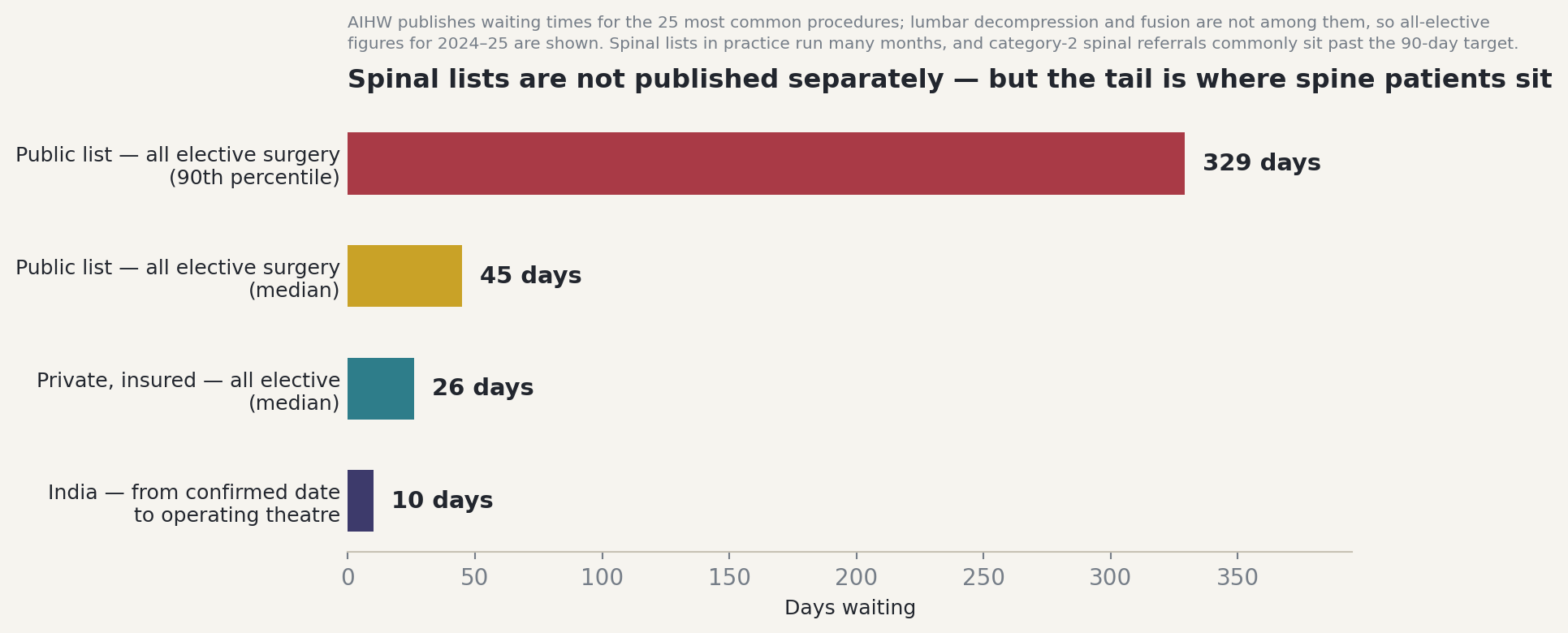
Waiting is still real. The AIHW does not publish spinal procedures among its twenty-five most common surgeries, so no clean national median exists, but public spinal lists run to many months and a category-2 referral routinely sits well past its ninety-day target. Meanwhile the nerve stays compressed. Once you have a confirmed diagnosis and a clear indication, delay is not neutral.
| 9× | ~⅔ | 31% |
|---|---|---|
| the privately funded spinal fusion rate versus the public rate in NSW by 2020 | less for the surgery itself at an accredited Indian hospital | of NSW spinal fusions judged inappropriate in one published analysis |
The Australian pattern nobody puts in front of you
Between 2001 and 2020, the rate of privately funded spinal fusion for degenerative conditions in New South Wales rose from 26.6 to 109.5 per 100,000 insured adults. Over the same two decades the publicly funded rate moved from 5.6 to 12.4. By the end of that period an insured Australian was having spinal fusion at close to nine times the rate of a public patient with, presumably, much the same spines.
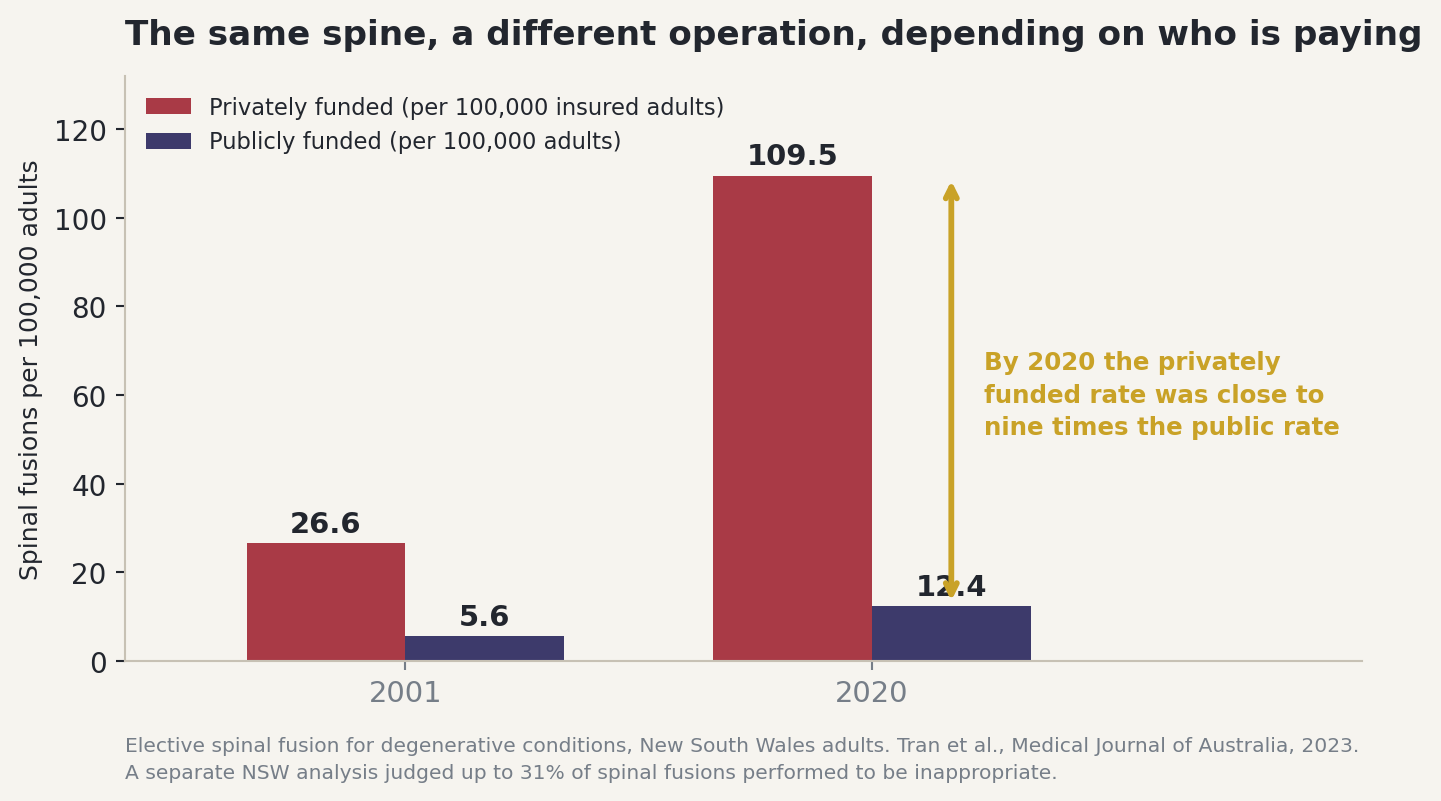
A separate New South Wales analysis judged that up to 31 per cent of the spinal fusions performed were inappropriate. I am not asking you to conclude that anyone acted badly. I am asking you to notice that in spine surgery, more than in any other elective operation, what you are offered can depend on how the operation is funded — and that this is the strongest possible argument for getting a second opinion on the indication before you spend a dollar anywhere, including in India.
| Which Spine Patient are You? | ||
|---|---|---|
| Leg-dominant pain | Back-dominant pain | Instability or red flags |
| Sciatica or neurogenic claudication, with pain, numbness or weakness below the knee that is worse than your back pain. This is the group surgery serves best. Microdiscectomy for a herniated disc and decompression for stenosis have good, well-evidenced results. If your leg is the problem, you are in the right place. | Pain mostly in the back, worse with activity, without a clear nerve compression that matches it. This is the group where fusion evidence is weakest and where structured exercise, weight management and pain physiology often outperform surgery. Be cautious, and be especially cautious of a large multi-level quote. | Spondylolisthesis with movement on flexion-extension films, deformity, fracture, infection, tumour, or any bladder or bowel disturbance. Here surgery may be genuinely necessary and sometimes urgent. Cauda equina symptoms are an emergency — go to a hospital today, do not plan a trip. |
What the operation can and cannot do
The most useful sentence in spinal surgery is this: the operation is far better at fixing leg pain than back pain. Decompressing a trapped nerve reliably relieves the symptom that nerve is producing. Fusing a painful segment to abolish back pain is a much less certain proposition, which is precisely why the evidence for it is contested and the rates vary so widely between funding systems.
Outcome data underline the point. In an Australian workers’ compensation cohort, two years after surgery only 19 per cent of fusion patients had returned to work at full capacity, against 39 per cent after decompression alone, and 19 per cent of patients had undergone further spinal surgery within two years.
That population is not representative — compensable patients do worse than the general population everywhere in the world — but the direction is instructive, and no one selling you a fusion is likely to mention it.
None of this is an argument against travelling. It is an argument for arriving with the right operation already agreed. The patient who flies to India for a single-level decompression that his symptoms and his scan both support is making an excellent decision. The patient who flies for a three-level fusion nobody has questioned is taking an expensive risk in any country.
There is no spine registry — so use a different instrument
For hips and knees I tell Australians to look their implant up in the national joint registry. Spine has no equivalent of comparable maturity, so that tool is not available to you. Use these instead, all of which cost far less than the surgery.
What the money actually looks like
“Spine surgery” is not one price, because it is not one operation. The difference between a microdiscectomy and a two-level fusion is the difference between a mid-size car and a deposit on a house, and it is the first thing to establish about any quote you are holding.
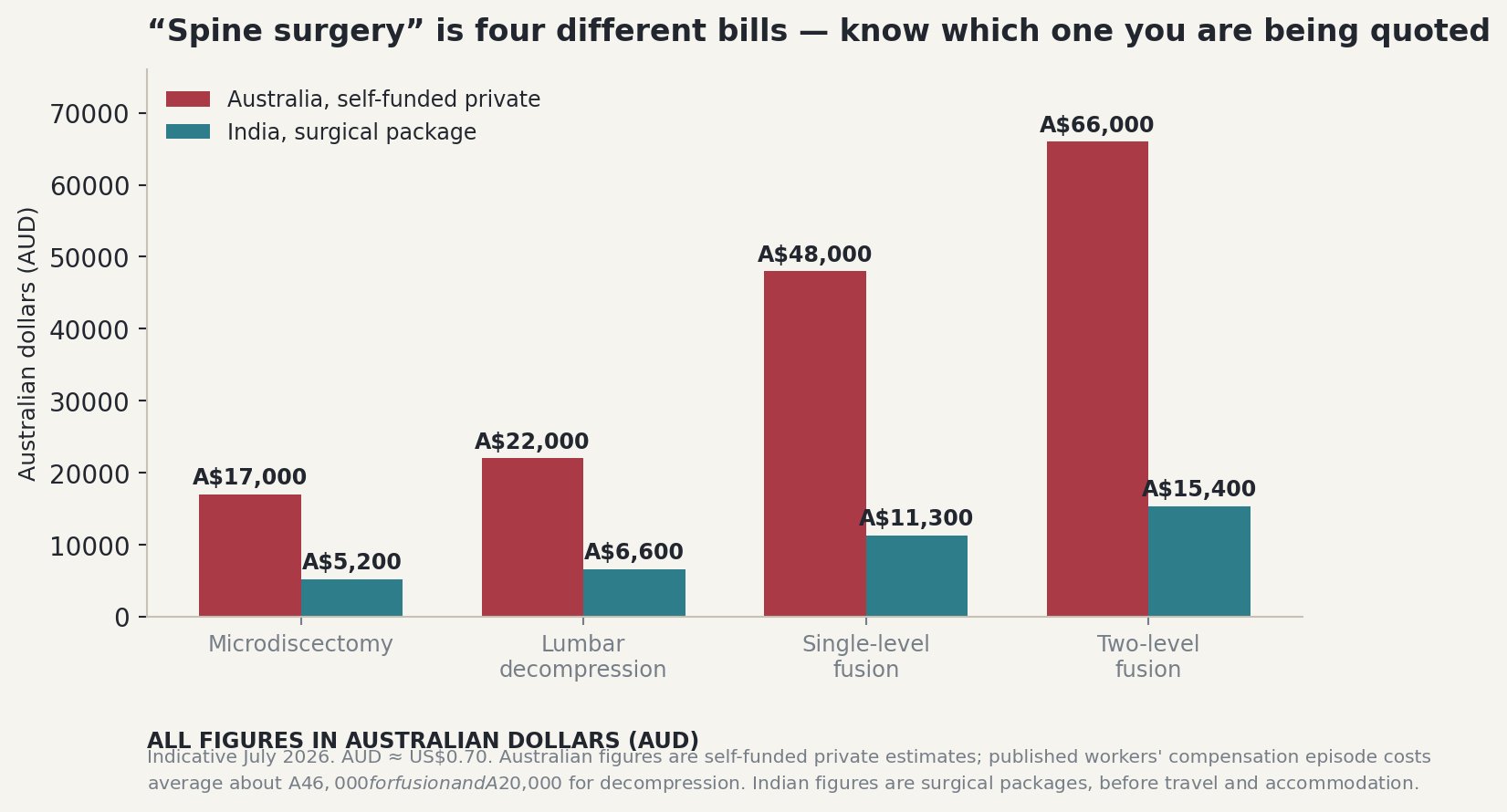
A self-funded single-level lumbar fusion in Australia is commonly quoted between $40,000 and $60,000; published workers’ compensation data put the average episode cost at about $46,000 for fusion and $20,000 for decompression. The same single-level fusion at an accredited Indian hospital, performed by a fellowship-trained spinal surgeon using implants from the same global manufacturers, typically costs around three-quarters less.
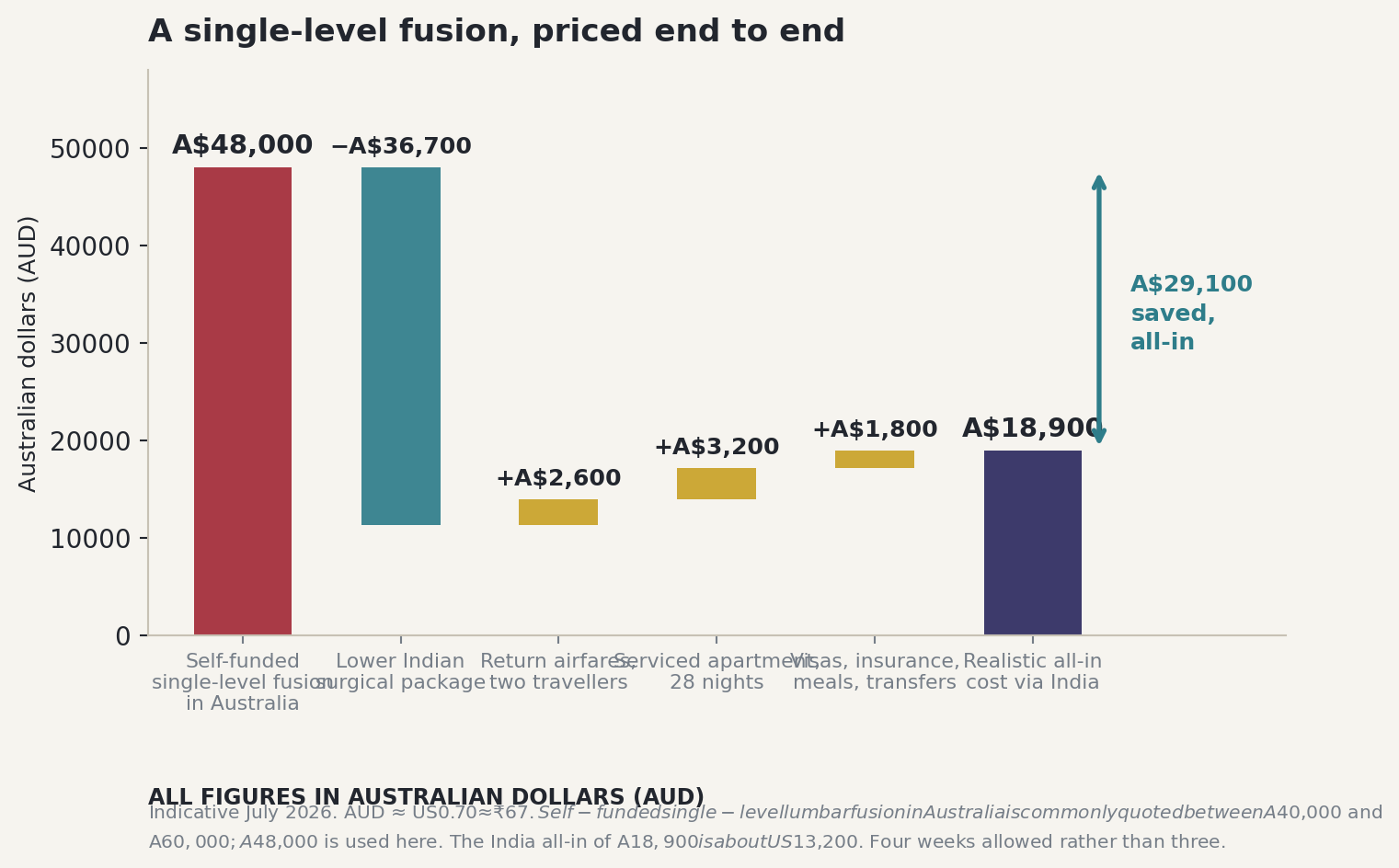
Even after airfares, four weeks of accommodation, visas and transfers, the whole undertaking comes to roughly $18,900 — about US$13,200 — against Approximately $48,000 at home. What does not travel with you is reimbursement: Medicare does not pay for treatment overseas and fund rebates apply to Australian admissions, which is why you should insist on a written, itemised, all-inclusive quote naming the exact levels and implants before any deposit moves.
Your four options, side by side
| Public list | Private, insured | Private, self-funded | India | |
|---|---|---|---|---|
| Time to surgery | Many months | 2–8 weeks | 2–8 weeks | 1–3 weeks |
| Out-of-pocket, single-level fusion | Nil | Excess plus gap | $40,000–$60,000 | About $18,900 all-in (US$13,200) |
| Second opinion on the indication | Rarely offered | Rarely offered | Rarely offered | Arrange it first |
| Choice of surgeon | No | Yes | Yes | Yes |
| Levels and implants specified | Sometimes | Sometimes | Sometimes | In writing, before you fly |
| Physiotherapy | Bought separately | Bought separately | Bought separately | Daily, included |
| Follow-up at home | Built in | Built in | Built in | Arrange before you fly |
All dollar figures are Australian dollars (AUD) unless marked US$. Times and costs indicative, July 2026.
What you are actually getting for it
Volume, and genuine sub-specialisation. Leading Indian spinal units operate in numbers few individual hospitals anywhere can match, with surgeons who do spine exclusively rather than spine among other things, many holding fellowships from the United Kingdom, Australia or the United States. In a field where technique and judgement carry so much weight, that concentration matters.
Intraoperative neuromonitoring and navigation as standard. Nerve monitoring during decompression and image guidance for pedicle screw placement are routine in good Indian units and generally included rather than billed as an upgrade. Ask explicitly whether both will be used; the answer tells you a great deal.
Accreditation that means something specific. JCI is the international arm of the body accrediting hospitals across the United States; NABH is India’s national equivalent, recognised by the same global standards authority. Either means an external inspector has audited infection control, surgical checklists and record-keeping against a published standard, and you can verify it independently.
Rehabilitation that is genuinely supervised. Spinal recovery is largely a rehabilitation problem, and this is where the trip earns its keep. You work one-on-one with a physiotherapist daily for weeks, reviewed throughout by the surgeon who operated, rather than being discharged at forty-eight hours to arrange your own.
Optimisation before the knife. A quality unit will check your HbA1c, insist on dental clearance, discuss weight and ask about smoking — which matters more in spine than almost anywhere, because nicotine measurably impairs fusion. A hospital that raises these things is prioritising your spine over its booking.
Why India rather than Bangkok, Kuala Lumpur or Istanbul
Australians exploring medical travel are shown Thailand, Malaysia and Turkey first, because those destinations market hard here. India competes on substance: the volumes, the exclusively spinal surgeons, and deep revision capability behind the primary operation. Its entire medical record is produced in English, so nothing needs translating before your GP or physiotherapist can read it. Its costs remain the lowest of the serious destinations. And a large, settled Indian community at home means family, language and familiarity are closer to India than to anywhere else on that list.
Two questions everyone asks, answered properly
Who looks after me when I get home? Arrange it before you go rather than after you land. Speak to your GP, give them the dates, and book your Australian physiotherapy course in advance — for spine this matters more than for any other operation, because the rehabilitation runs for months, not weeks. Most GPs are willing once brought in early and given a proper handover.
What about infection? Deep infection after instrumented spinal surgery is the complication that matters, and good units manage it actively rather than hope. Ask for the unit’s surgical site infection rate for instrumented spinal cases and whether it screens patients beforehand; strong centres share these figures readily. Ask for any culture result in writing, and tell your Australian GP on return that you have had surgery overseas.
What to say to your family
The objection nobody writes about is not clinical. It is the phone call in which you tell your daughter you are having spinal surgery in India, and the pause that follows. That pause has changed more minds than any medical argument, so prepare for it.
What settles it is specifics rather than reassurance. Name the hospital and its accreditation. Name the surgeon, his training and his annual case volume. Tell her which levels are being operated on, which symptom the operation is meant to fix, and that a second specialist has independently agreed the indication. Explain that you are staying four weeks precisely so nothing is rushed, and that your GP already has the dates. Families do not object to India; they object to the sense that a relative is taking an unresearched gamble with something irreversible. Show them the work and the objection generally dissolves. Better still, bring one of them — the attendant visa exists for this.
Four weeks, not two
Spinal patients are usually up and walking within a day, which makes the temptation to fly home early strong. Resist it. Allow four weeks for an instrumented fusion and around two for a microdiscectomy or simple decompression.
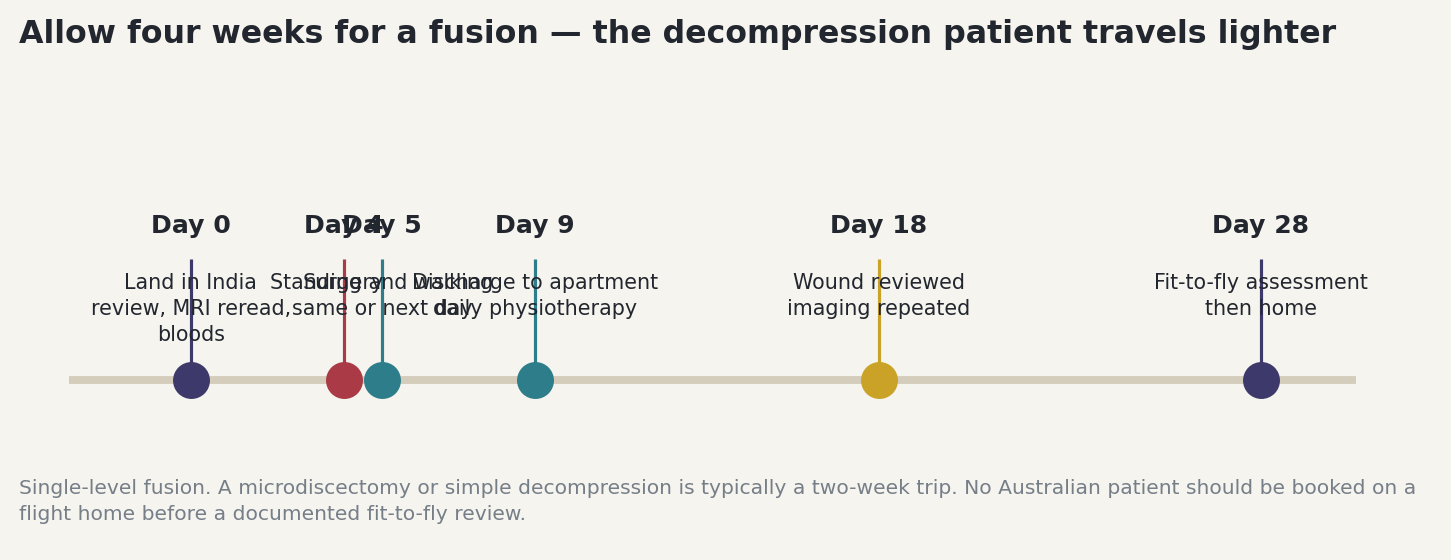
Venous thromboembolism risk is elevated after major spinal surgery and long-haul immobility compounds it, while sitting for fourteen hours in a fixed seat is precisely the posture most patients are told to limit in the early weeks. Book a changeable return, ask for a written thromboprophylaxis plan covering the flight and a documented fit-to-fly assessment, request an aisle seat and stand regularly, and ask the unit for its post-operative movement restrictions in writing before you leave.
Six Things to Have in Writing Before You Fly
1. An independent opinion on the indication. A second spinal surgeon who has seen your imaging and your symptoms, and agrees this operation is the right one. Nothing else on this list matters as much.
2. The exact levels and the exact procedure. “L4/5 decompression” is a plan; “lumbar spine surgery” is not. Get the implant brands too if instrumentation is involved.
3. An itemised, all-inclusive price, with physiotherapy, imaging and inpatient nights clearly inside or outside the number, and what a second level would add.
4. The named operating surgeon, and a video consultation with them — not a coordinator, and before any deposit.
5. Confirmation that neuromonitoring and navigation will be used, and what the hospital covers if a return to theatre is needed during your stay.
6. Your Australian follow-up, already booked: a GP review and a physiotherapy course confirmed before you leave.
Practicalities for Australians
Australian passport holders are eligible for India’s electronic medical visa, issued against an invitation letter from the hospital, with an e-medical attendant visa for whoever travels with you — apply for both in the same batch. Send the imaging study itself rather than the radiologist’s report: the surgeon needs the MRI sequences, and standing and flexion-extension X-rays if instability is in question. Before flying home, collect a discharge pack — operation note naming the levels, implant identification cards with lot numbers, post-operative imaging, culture results, anticoagulation plan, movement restrictions and a written rehabilitation protocol staged over three months. Spinal rehabilitation is long, and your Australian physiotherapist will need that protocol more than any other document.
A closing word
Spinal surgery rewards precision in the decision more than in any other elective operation. Get the diagnosis right, match the operation to the symptom, and a well-chosen procedure at a high-volume Indian unit is excellent value and often available months sooner than at home. Get it wrong, and no amount of saving will compensate. If you would like a second opinion on your imaging, or a review of a quote you are holding, send the study itself along with the written quote and I will look at it properly — including telling you if I think the operation should not happen at all.
Sources
- 🌐 Tran et al., “Elective spinal surgery in New South Wales adults, 2001–20, by procedure funding type”, Medical Journal of Australia , 2023
- 🌐 New South Wales analysis of appropriateness of spinal fusion, reported 2020
- 🌐 BMC Health Services Research , 2021, on workers’ compensation spinal surgery costs, return to work and reoperation
- 🌐 Australian Institute of Health and Welfare, Elective surgery waiting times , 2024–25
- 🌐 Australian Department of Health and private health fund published procedure costs, 2023– 24 and 2026
- 🌐 High Commission of India, e-Visa categories and eligibility
Frequently Asked Questions by Australian Patients about Spine Surgery in India
Why should Australian patients get a second opinion before spine surgery?
The briefing considers an independent second opinion on the surgical indication the most important step before travelling. Spine imaging and symptoms do not always match, and different specialists can reasonably recommend different treatments from the same MRI. The second surgeon should review the actual imaging study and correlate it with the patient's symptoms.
Is spine surgery more effective for leg pain or back pain?
According to the briefing, spinal surgery is generally more reliable at relieving leg pain caused by a compressed nerve than back pain itself. Patients with sciatica, numbness or weakness that corresponds with clear nerve compression on imaging tend to have a stronger surgical indication.
How much does spine surgery in India cost for Australian patients?
Costs depend heavily on the operation. The chart on page 5 lists indicative Indian surgical packages of Approximately $5,200 for microdiscectomy, Approximately $6,600 for lumbar decompression, Approximately $11,300 for single-level fusion and Approximately $15,400 for two-level fusion.
How much does spinal fusion in India cost compared with Australia?
The briefing states that self-funded single-level lumbar fusion in Australia is commonly quoted at around $40,000–$60,000. Its representative comparison estimates Approximately $18,900 all-in (US$13,200) for treatment in India, including indicative airfare, accommodation, visas and transfers.
When is spinal fusion more likely to be necessary?
The briefing identifies clearer surgical situations such as spondylolisthesis with movement on flexion-extension imaging, spinal instability, deformity, fracture, infection or tumour. For back-dominant pain without clear matching nerve compression or instability, it recommends greater caution before proceeding with fusion.
What should Australian patients confirm before travelling for spine surgery?
The six-point checklist on page 8 recommends having an independent opinion on the indication, exact spinal levels and procedure, an itemised all-inclusive price, the named operating surgeon and a pre-deposit video consultation, confirmation of neuromonitoring and navigation, and Australian GP and physiotherapy follow-up already booked.
How long should Australian patients stay in India after spine surgery?
The briefing recommends approximately four weeks after an instrumented spinal fusion and around two weeks after microdiscectomy or simple decompression. The timeline on page 8 places the fit-to-fly assessment at around day 28 after a single-level fusion.
Is disc replacement better than spinal fusion?
Not necessarily. The briefing says disc replacement can preserve motion and may reduce stress on adjacent spinal levels in carefully selected patients with single-level disease and preserved facet joints. However, the selection criteria are narrow, and disc replacement should not be viewed as a universal upgrade over fusion.
Will Medicare or Australian private health insurance cover spine surgery in India?
The briefing states that Medicare does not cover overseas treatment, and Australian health-fund hospital benefits apply to Australian admissions. Some corporate or international policies may provide overseas benefits, so patients are advised to ask their insurer for written confirmation.
When should a spine patient avoid travelling to India and seek emergency treatment in Australia?
New or progressive weakness, numbness around the saddle area, or bladder or bowel disturbance may indicate cauda equina syndrome. The briefing specifically identifies these as emergency symptoms requiring immediate assessment in Australia rather than planned medical travel.
I have been offered a fusion. Should I get another opinion before travelling anywhere?
Yes, and it is the most valuable thing you can do. Fusion rates vary enormously between funding systems, and one Australian analysis judged up to 31 per cent of fusions inappropriate. A second specialist opinion on the indication costs a fraction of the surgery and occasionally saves you from it entirely.
Will surgery fix my back pain?
It is far more reliable at relieving leg pain caused by a compressed nerve than at relieving back pain itself. If your leg symptoms dominate and your scan matches them, the odds are good. If back pain dominates without clear nerve compression, be cautious.
Will Medicare or my health fund reimburse any of this?
No — Medicare does not cover treatment overseas and fund hospital benefits apply to Australian admissions. A small number of corporate and international policies carry overseas benefits, so ask your fund in writing.
How long before I can fly home?
About four weeks after an instrumented fusion and around two after a microdiscectomy, on a changeable ticket, following a documented fit-to-fly assessment.
Is disc replacement better than fusion?
For carefully selected patients with single-level disease and preserved facet joints it can preserve motion and may reduce adjacent-level stress, but the selection criteria are narrow and it is not a universal upgrade. Ask specifically why it is or is not being proposed in your case.
Page Summary
This guide explains spine surgery in India for Australian patients, centred on one principle: the surgical indication should be independently verified before the destination is chosen. It distinguishes leg-dominant symptoms, where microdiscectomy or decompression have clearer indications, from back-dominant pain, where fusion evidence is less certain — noting that privately funded NSW fusion rates ran nearly nine times public rates by 2020, with up to 31% judged inappropriate in a separate analysis. Indicative India costs range from Approximately $5,200 for microdiscectomy to Approximately $15,400 for two-level fusion, with an all-in single-level fusion journey around Approximately $18,900 against Approximately $48,000 self-funded in Australia. Patients should independently review their imaging, confirm the exact levels and procedure, and arrange Australian follow-up before travelling.
Citation Block
| Topic | Information |
|---|---|
| Topic Information | Details |
| Procedure | Lumbar Spine Surgery |
| Country | India |
| Intended Audience | Australian Patients |
| Conditions Covered | Herniated Disc, Sciatica, Spinal Stenosis, Nerve Compression, Spondylolisthesis, Spinal Instability |
| Procedures | Microdiscectomy, Lumbar Decompression, Single-Level Fusion, Two-Level Fusion |
| Typical Stay | Approximately 4 Weeks for Instrumented Fusion; 2 Weeks for Microdiscectomy/Decompression |
| India Single-Level Fusion All-In Cost | Approximately $18,900 / US$13,200 |
| Australian Self-Funded Single-Level Fusion | Approximately $40,000–$60,000 |
| Author | Dr. Dheeraj Bojwani |
| Experience | 24+ Years as a Medical Travel Advisor |


Our Mission Statement
Our mission is to place patients at the centre of every healthcare decision by providing trustworthy, evidence-based, and unbiased medical information. We believe that informed patients make better decisions. Backed by personalised guidance from our experienced advisory team, we help patients understand their treatment options, compare them objectively, and confidently choose the path that best suits their medical needs and personal circumstances.
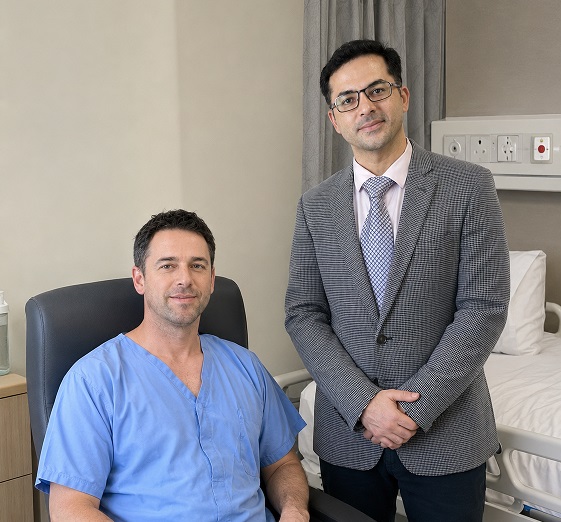
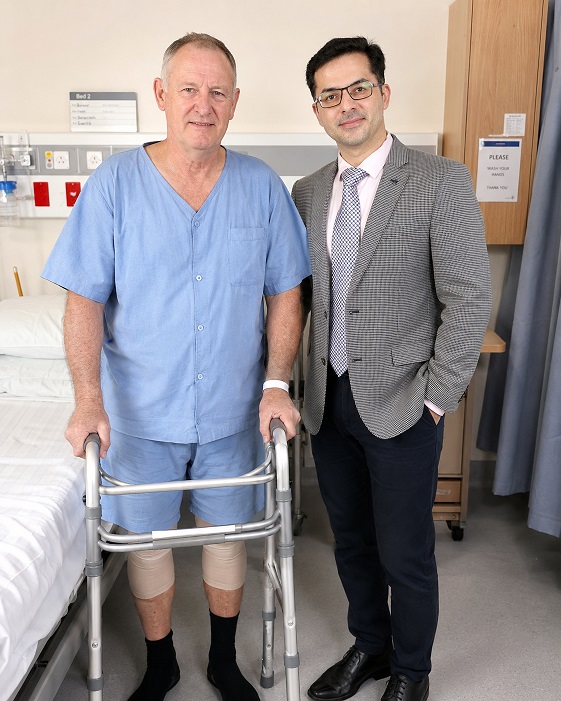
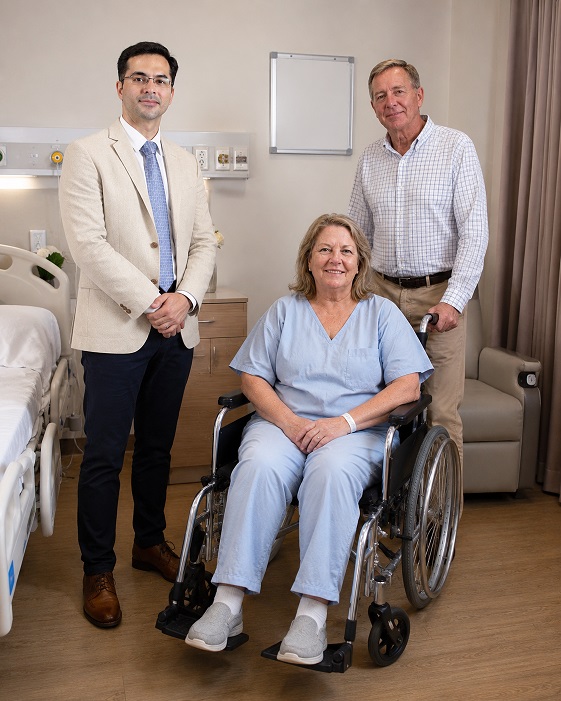
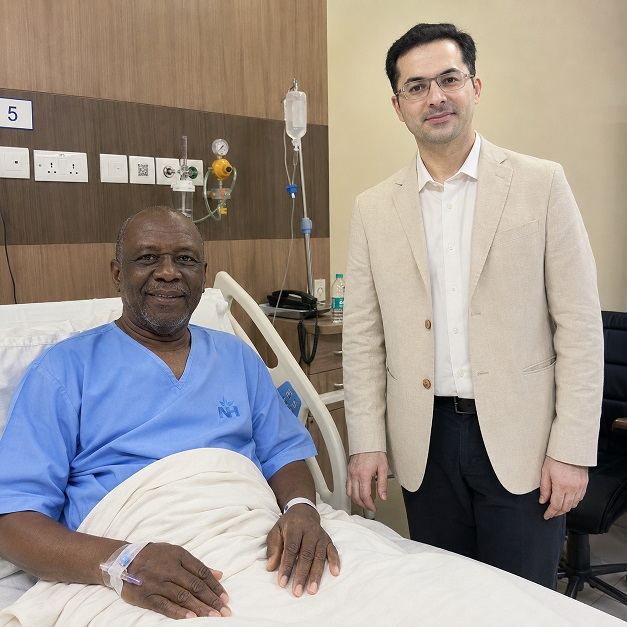
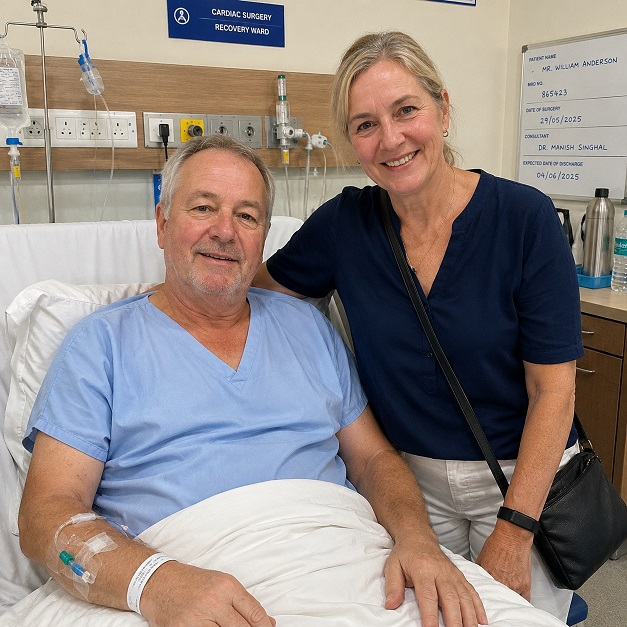
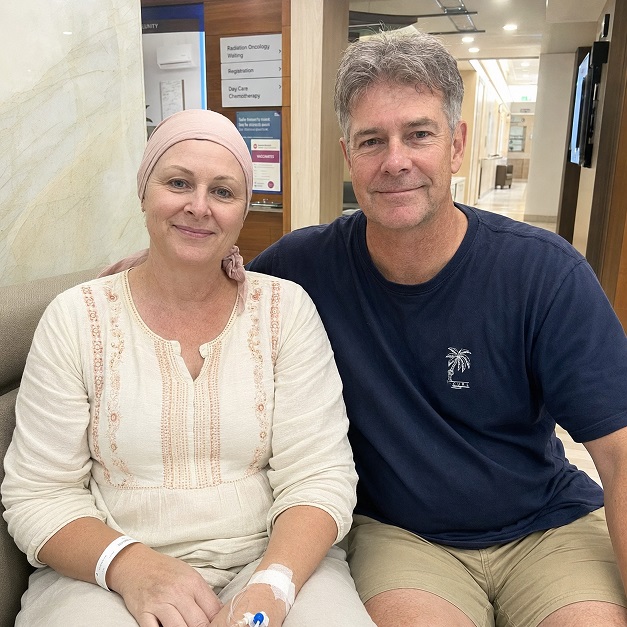
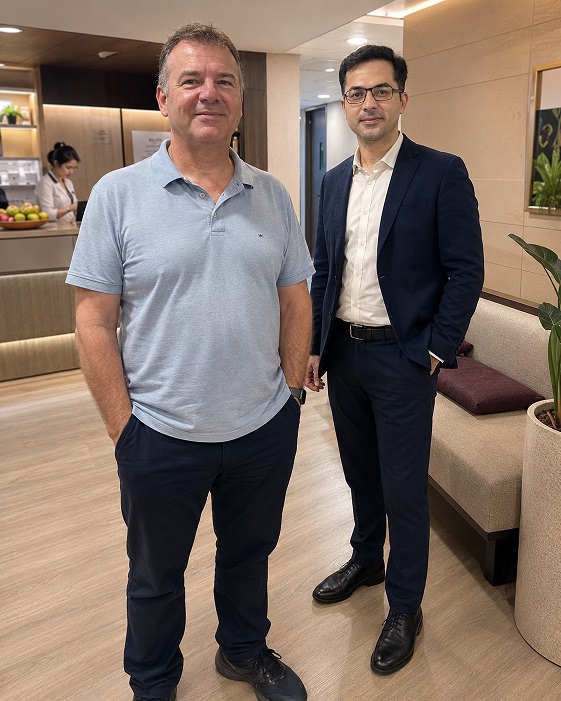
Patient Testimonials from Australia



Ready to Take the First Step?
Share your Medical Reports with our Healthcare Managers Today and Get a FREE CONSULTATION, a Personalized Treatment Plan, and Complete Support from Arrival to Recovery.
Get Your Free ConsultationAreas We Serve
This resource has been thoughtfully prepared for patients from Australia who are considering medical treatment in India. We also welcome patients from the wider region in the countries mentioned below-
We regularly assist patients from:
- Fiji
- Vanuatu
- Samoa
- Tonga
- Kiribati
- Nauru
- Tuvalu
- New Zealand
- Solomon Islands
- Papua New Guinea
Many of the insights, treatment pathways, hospital recommendations, travel guidance, and patient support services described here are equally relevant and may be used as a reference when planning treatment in India.
From Australia to India: Your Complete Patient Support Guide
- Cancer Treatment in India for Australian Patients: PBS Gap & Drug Costs
- Cardiac Surgery in India for Australian Patients: TAVI Access & Costs
- Dental Treatment & Surgery in India for Australian Patients
- Hip Surgery in India for Australian Patients: Costs, Waits & Implant Choice
- Knee Surgery in India for Australian Patients: Costs, Waits & Implants
- Neurosurgery in India for Australian Patients: Volume, Costs & When Not to Travel
- Spine Surgery in India for Australian Patients: Costs, Indications & Second Opinions (2026)
- Best Bariatric & Weight Loss Surgeons in India for Australian Patients
- Best Cancer Surgeons & Hospitals in India for Australian Patients
- Best Cardiac Surgeons & Hospitals in India for Australian Patients
- Best Cosmetic Surgeons & Hospitals in India for Australian Patients
- Best Dental Surgeons & Clinics in India for Australian Patients
- Best Hip Surgeons & Hospitals in India for Australian Patients
- Best Knee Surgeons & Hospitals in India for Australian Patients
- Best Scoliosis Surgeons & Hospitals in India for Australian Patients
- Best Spine Surgeons & Hospitals in India for Australian Patients
- Selecting the Best Urosurgery and Reconstructive Urology Centres in India for Australian Patients
- Selecting the Best Bone Marrow Transplant Centres in India for Australian Patients