

Selecting the Best Neurosurgeons and Neurosurgery Hospitals in India for Australian Patients
Ten criteria, weighted — but first, a triage. In no other specialty in this series does the wrong first question matter as much as it does here.
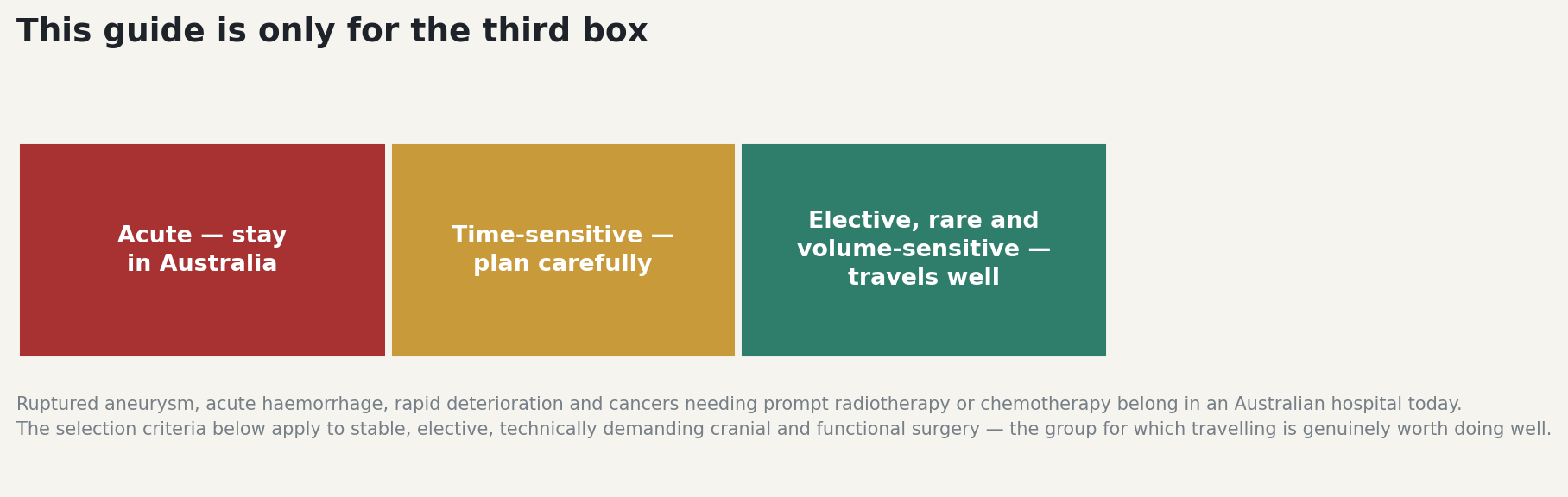
Every other guide in this series begins with cost. This one begins with a triage, because in neurosurgery the wrong first question is not “which surgeon?” but “should this leave Australia at all?” Get that wrong and no amount of due diligence on the surgeon will save you. Get it right, and the selection criteria that follow matter more than in any other specialty in this series. In 24 years of guiding international patients into Indian hospitals, neurosurgery is the specialty in which I have most often advised people to stay exactly where they are. Ruptured aneurysm, acute haemorrhage, rapid neurological deterioration, and cancers requiring surgery followed promptly by radiotherapy and chemotherapy all belong in an Australian hospital, near your family and your existing team. If that is your situation, stop reading and go to your nearest emergency department. What follows is for the other group: stable, elective, technically demanding cranial and functional surgery, where Australia’s limitation is not skill but population — and where choosing well is unusually consequential, because the margin for error in cranial surgery is measured in millimetres.
Healing Journeys of Australian Patients


Key Takeaways
- The guide begins with an important triage principle: urgent neurosurgical conditions should generally remain in Australia. Ruptured aneurysm, acute haemorrhage, rapid neurological deterioration and cancers requiring prompt integrated radiotherapy or chemotherapy are specifically identified as situations where patients should seek immediate Australian hospital care rather than plan overseas treatment.
- For stable, elective and technically demanding cranial or functional surgery, exact procedure volume is the most important selection factor. The page 2 chart compares an illustrative typical Australian unit performing about 12 vestibular schwannoma operations annually, a published 25-case volume threshold, and a high-volume international skull-base centre performing 220+ cases.
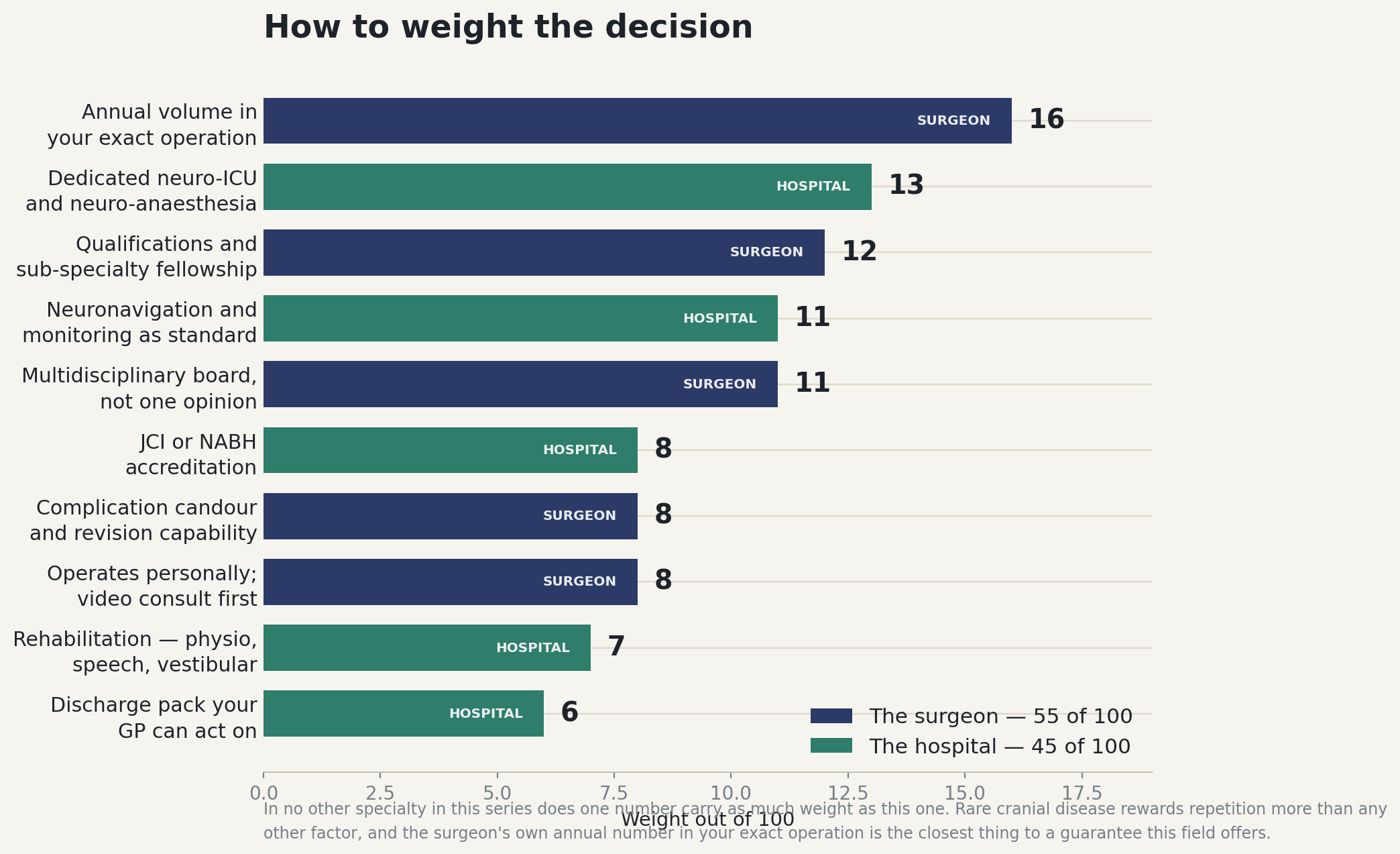
- The page 2 weighting chart gives 55% to the surgeon and 45% to the hospital. The heaviest criterion is the surgeon's annual volume in the exact operation required, followed by dedicated neuro-anaesthesia/neuro-ICU support, subspecialty fellowship, neuronavigation and monitoring, multidisciplinary review, accreditation, complication and revision capability, personal video consultation, rehabilitation and discharge planning.
- Check MCh/DrNB Neurosurgery as the baseline specialist qualification and then look for a relevant 1–2 year subspecialty fellowship in areas such as skull base, functional/stereotactic, neuro-oncology or paediatric neurosurgery. A claimed “20 years of experience” may include years of general medical training, so ask when the surgeon completed specialist and subspecialty training.
- Hospital assessment focuses on a dedicated neurosurgical ICU, routine neuronavigation and intraoperative neurophysiological monitoring, independently verifiable JCI or NABH accreditation and appropriate rehabilitation services such as speech and vestibular therapy.
- Four major warning signs: a price quoted before imaging is formally reviewed, no multidisciplinary board review, vagueness about the surgeon's own annual procedure volume and no plan if histology differs from the working diagnosis.
- For Australian patients, continuity of care after returning home matters particularly. Follow-up with an Australian neurologist or GP should be arranged before travel; DBS patients should confirm that the proposed device can be programmed by Australian clinics; and patients should not book a fixed return date without a documented fit-to-fly assessment.
Quick Facts
- Author
- Dr. Dheeraj Bojwani
- Experience
- 24+ Years
- Treatment
- Cranial & Functional Neurosurgery
- Patients
- Australian Patients
- Key Specialist
- Neurosurgeon with Relevant Subspecialty Fellowship
- Selection Weighting
- 55% surgeon / 45% hospital
- Key Principle
- Exact procedure volume
- Volume Check
- Ask for the surgeon's personal cases from the previous year
- Key Training
- MCh/DrNB Neurosurgery + relevant subspecialty fellowship
- Board Review
- Multidisciplinary tumour board or movement-disorders panel
- Technology
- Neuronavigation and intraoperative monitoring
- ICU Check
- Dedicated neurosurgical intensive care
- Accreditation
- JCI or NABH, independently verified
- Rehabilitation
- Speech and vestibular therapy where required
- Records
- Operative note, histology, imaging and device details
- Follow-Up
- Australian neurologist, neurosurgeon or GP
- DBS Check
- Confirm Australian programming compatibility
- Key Warning
- Price before imaging review or vague surgeon-specific volume
- Decision Principle
- Choose the surgeon who performs your exact operation frequently and can provide safe continuity of care.
In Brief
For Australian patients considering elective neurosurgery in India, the guide recommends focusing first on whether travel is appropriate at all, and then on the surgeon's personal experience with the exact operation. A high-volume, subspecialty-trained surgeon, multidisciplinary review, dedicated neuro-ICU, modern monitoring and a clear Australian follow-up plan are presented as key safeguards.
Before you choose anyone: why volume dominates every other factor
Rare cranial disease rewards repetition more than any other quality in medicine. Take vestibular schwannoma as the clearest example. It occurs in roughly three people per 100,000 each year, which across Australia’s 27 million people amounts to some eight hundred diagnoses annually — and only a minority proceed to microsurgery, divided among the country’s neurosurgical units. Published work has identified twenty-five cases a year as a hospital volume threshold below which outcomes measurably suffer.
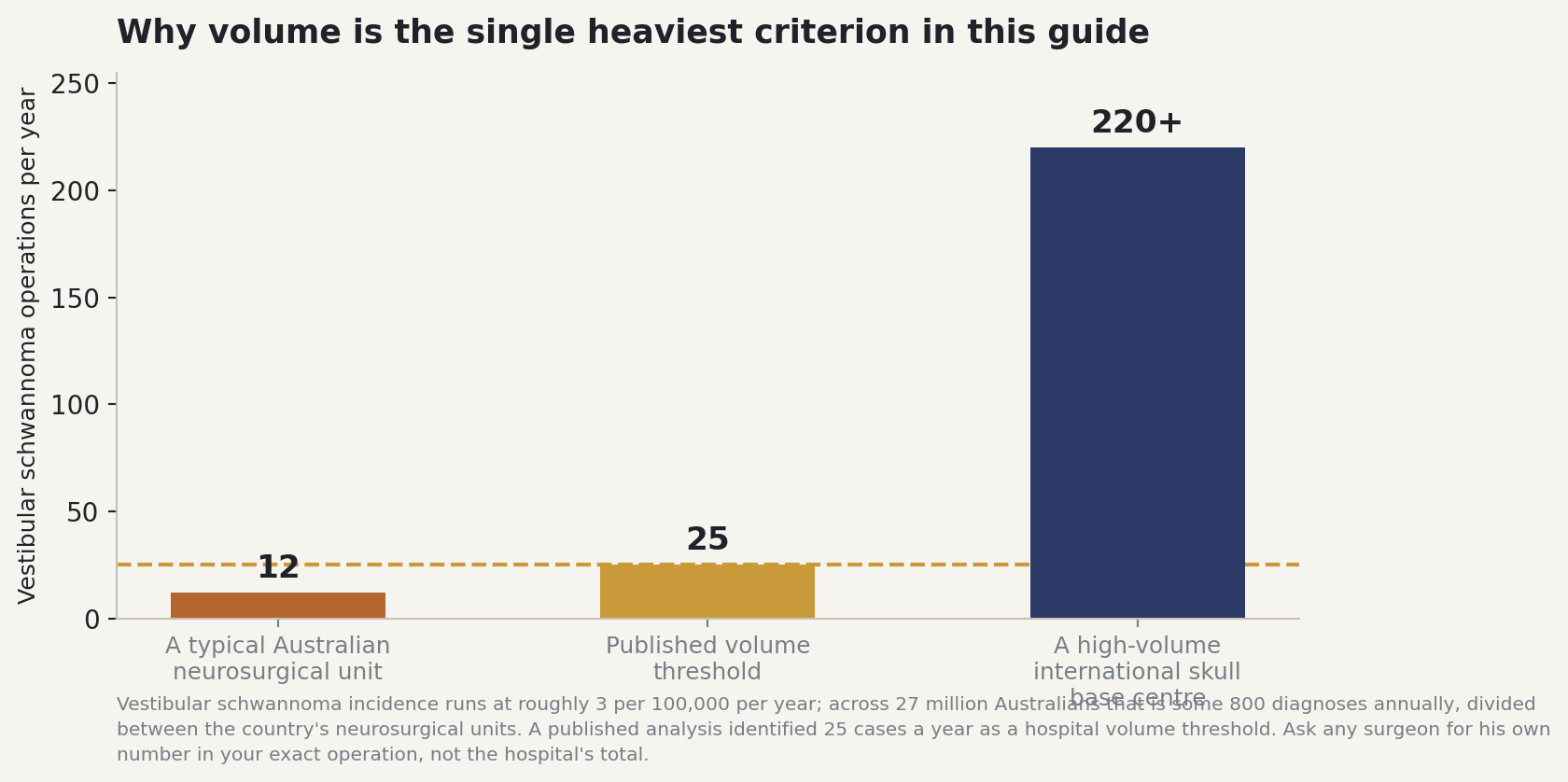
A high-volume international skull base centre, drawing on a catchment of hundreds of millions, performs the same operation several times a week. This is why the criteria below are weighted the way they are, and why the single heaviest item in the whole guide is not a qualification or an accreditation. It is a number: how many of your exact operation did this surgeon personally perform last year.
Part one: judging the surgeon
1. Annual volume in your exact operation. Not cranial cases in general, not the hospital’s total — his own number, in the specific procedure you need, last year. A surgeon who does twelve vestibular schwannomas a year and a surgeon who does two hundred are not offering variations on the same service; for facial nerve preservation and hearing preservation, which turn on millimetres and on having seen this exact anatomy many times before, the difference is close to the whole of the matter. Ask this of three units rather than one before you commit to any of them.
Apply the same discipline whatever the operation. For pituitary surgery, ask how many endoscopic endonasal cases he performs annually and what proportion achieve gross total resection for tumours similar to yours. For deep brain stimulation, ask how many implantations he has done and whether he places the leads himself or hands that stage to a colleague. For microvascular decompression, ask his outcome rate for pain relief at one year. Each operation has its own meaningful number, and a confident, specific unit gives it without being asked twice.
2. Qualifications and sub-specialty fellowship. Neurosurgery in India runs a single, direct pathway rather than the two parallel routes you will find in spine.
| Qualification | Length | What it actually means |
|---|---|---|
| MBBS | 5½ years | The basic medical degree, comparable in standing to an Australian MBBS or MD. A licence to practise, not a specialist qualification. |
| MCh (Neurosurgery) or DrNB (Neurosurgery) | 3 years, direct entry after MBBS or after MS (General Surgery) | This is the specialist qualification. MCh is awarded by a university, DrNB by the National Board of Examinations, and the National Medical Commission treats them as equivalent. Completion of one of these is the baseline requirement for practising neurosurgery independently. |
| Sub-specialty fellowship — skull base, functional/stereotactic, neuro-oncology, paediatric neurosurgery | 1–2 years, after MCh/DrNB | This is what determines fit for your operation. A general neurosurgeon and a skull base fellowship-trained neurosurgeon are not interchangeable for a cerebellopontine angle tumour, any more than a general orthopaedic surgeon is interchangeable with an arthroplasty specialist for a hip. Ask specifically which fellowship, and where. |
| FRCS (SN), board certification, or an overseas fellowship | Varies | International training, common among senior Indian neurosurgeons and worth asking about — though current practice pattern matters more than where he trained fifteen years ago. |
Read the experience figure with the same care you would apply anywhere else. “Twenty years of experience” usually counts from MBBS, which quietly folds in the better part of a decade of training. Ask for the year he completed his MCh or DrNB, the year he finished his sub-specialty fellowship, and how long he has practised that sub-specialty independently — not neurosurgery in general.
3. Multidisciplinary board review, not one surgeon’s opinion. Ask specifically whether your case will go before a tumour board or a movement disorders panel — a group including radiology, pathology and, where relevant, oncology and neurology — and ask for that confirmation in writing before you travel. A unit offering only a single surgeon’s recommendation on a cranial tumour or a DBS candidacy is telling you something about how it makes decisions.
4. Whether he operates personally, and speaks to you first. Insist on a video consultation with the surgeon who will actually operate, not a coordinator, before any deposit moves. Ask directly whether he performs the operation himself from start to finish and who assists if the anatomy proves more complex than the imaging suggested.
5. Complication candour and revision capability. Ask what his facial nerve outcomes look like for schwannoma surgery, what his complication rate is for the specific operation you need, and what happens if the histology differs from the working diagnosis. A surgeon who discusses this without defensiveness has enough of a practice to have seen it and enough security to talk about it plainly.
Ask too what proportion of his practice is genuinely sub-specialised, as against general neurosurgery carrying occasional skull base or functional cases. There is no single correct answer, but a surgeon who cannot describe his practice pattern confidently is telling you that your operation is one of several things he does, rather than the thing he does.
Part two: judging the hospital
6. A dedicated neurosurgical intensive care unit. The first seventy-two hours after cranial surgery determine a great deal, and a unit staffed by neurointensivists and neuro-trained nursing is a materially different proposition from a general ICU attached to a surgical hospital. Ask specifically whether the ICU is neurosurgical, not simply whether an ICU bed exists, and ask who leads neuro-anaesthesia for cranial cases.
7. Neuronavigation and intraoperative monitoring as standard, not an upgrade. Image-guided navigation and intraoperative neurophysiological monitoring should be routine for tumour and functional cases, not billed separately or offered only on request. For pituitary work ask specifically about the endoscopic platform; for tumours near eloquent cortex ask whether awake craniotomy with cortical mapping is available when indicated. This is one of the most revealing single questions you can put to a neurosurgical hospital.
8. Accreditation you can verify yourself. JCI is the international arm of the body accrediting hospitals across the United States; NABH is India’s national equivalent, recognised by the same global standards authority. Either means an external inspector has audited infection control, surgical checklists and record-keeping against a published standard. Check it on the accrediting body’s own site rather than accepting the logo on the hospital’s.
9. Rehabilitation depth — physiotherapy, speech therapy, vestibular rehabilitation. Cranial recovery is rarely just physical. Ask whether speech and language therapy and vestibular rehabilitation are available under the same roof, staffed daily, rather than referred out. For a patient recovering hearing or facial function, this is not a peripheral service; it is a significant part of the outcome.
10. A discharge pack your Australian team can act on. Before you leave you should hold the operation note, histology report, any implant or device identification card with serial numbers and programming parameters, post-operative imaging, the anticonvulsant plan and duration, driving restrictions, and a surveillance imaging schedule. Ask to see a sample discharge pack before you commit — a good unit sends one without hesitation.
What the quote should say, and what it usually omits
In 24 years I have found that disputes almost never concern the quoted price. They concern what the quote silently omitted.
Insist on a written, itemised figure naming the number of intensive care days assumed and the cost of exceeding them, the device or implant where relevant, and what the plan becomes if the histology or intraoperative findings differ from expectation. Ask what the hospital covers if a return to theatre is needed during your admission.
Understand too what does not travel with you. Medicare pays nothing for treatment received overseas, your health fund rebate applies to Australian admissions, and standard travel insurance excludes planned surgery and its complications. One rule is not negotiable: pay a deposit to secure the date, never the full balance in advance. The remainder is settled on arrival, once the surgeon and the board have confirmed the plan in person.
Four Signals That Should Make You Pause
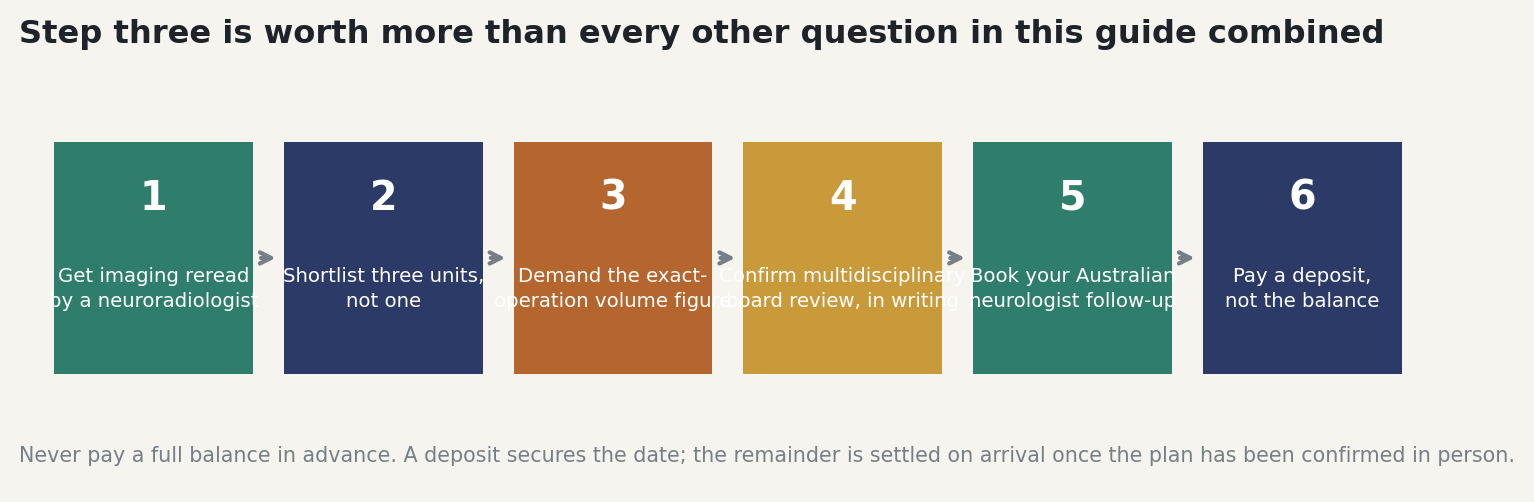
1. A price quoted before your imaging has been formally reread. Nobody can price cranial surgery from a typed report alone. A number arriving within an hour of your first email is a marketing figure, not a quote.
2. A single surgeon’s opinion with no board review offered. Rare cranial disease deserves more than one clinician’s view. A unit that does not raise multidisciplinary review unprompted is telling you how it actually operates.
3. Vagueness about the surgeon’s own annual volume. The hospital’s total case count is not an answer to this question. Hesitation on the individual number is itself information.
4. No plan for what happens if the histology surprises everyone. A presumed meningioma is occasionally something else. A unit that has not thought about this has not thought hard enough about your case.
Australia-specific considerations most patients miss
Arrange your neurological follow-up before you leave, not after you land. Cranial and functional neurosurgery carries a follow-up tail measured in years, not months. Speak to your Australian neurologist or GP early, give them the dates, and confirm who will review your surveillance imaging and on what schedule. If radiotherapy or chemotherapy may follow, get your oncologist’s agreement in advance — this is not a detail to sort out after surgery.
If DBS is being considered, ask the device-compatibility question before implantation, not after. Confirm in writing which manufacturer’s system is proposed and whether Australian clinics can program that specific model. This single question, asked at the wrong time, is the one most likely to leave an Australian patient stranded with a device nobody at home can adjust.
Do not book a fixed return. Flying after craniotomy carries specific considerations around intracranial air, seizure risk and pressure changes, and the decision to fly should follow a documented fit-to-fly assessment rather than a ticket bought months in advance. Allow four to six weeks for an elective craniotomy, longer for DBS because of programming sessions, and around two weeks for stereotactic radiosurgery, which involves no craniotomy at all.
Send the full imaging history, not just the latest scan. For a suspected tumour, growth rate over time changes the recommendation as much as the current size does. If you have earlier scans, send them.
Ask what happens if you need to return. A small proportion of cranial cases require a further procedure — a wound complication, a shunt revision, a device adjustment. Establish before you travel what the unit does in that situation and whether it involves further cost. Ask an Australian neurosurgeon the parallel question: would he manage a complication from surgery performed overseas? Both answers, taken together, tell you how comfortable this decision should feel.
Ask for a written seizure-precaution and driving-restriction statement. Australian licensing authorities will want it, and it is far easier to obtain from the treating unit before you leave than to reconstruct from home afterwards.
| The Questions, in the Order You Should Ask Them | |
|---|---|
| Of the surgeon | Of the hospital |
| 1. How many of my exact operation did you personally perform last year? | 1. Is the intensive care unit specifically neurosurgical? |
| 2. Which sub-specialty fellowship did you complete, and where? | 2. Will neuronavigation and intraoperative monitoring be used, and are they included? |
| 3. Will my case go before a multidisciplinary board, and may I see that in writing? | 3. Which accreditation do you hold, and when was it last inspected? |
| 4. Will you perform the operation yourself, and who assists? | 4. Are speech therapy and vestibular rehabilitation available on site? |
| 5. What is your complication rate for this specific operation? | 5. For DBS: which manufacturer, and can Australian clinics program this device? |
| 6. What happens if the histology differs from what we expect? | 6. May I see a sample discharge pack before I commit? |
A closing word
Neurosurgery rewards two things above all others: choosing the right operation, and choosing someone who has done it many times. For urgent disease and for cancers needing integrated treatment, stay in Australia and let its excellent system do what it does well. For rare, elective, technically demanding cranial and functional surgery, the honest answer is that a high-volume centre elsewhere may have performed your operation two hundred times this year against a handful at your local unit — and the ten criteria above exist to help you find that centre and verify it properly, rather than take it on trust. If you would like a second opinion on your imaging, or a review of a quote you are already holding, send the study itself and I will look at it properly — including telling you that you should not travel at all, if that is what I think.
Sources
- 🌐 Epidemiological reviews of vestibular schwannoma incidence, Acta Neurochirurgica and related literature
- 🌐 Published analysis identifying a 25-case annual hospital volume threshold for vestibular schwannoma surgery
- 🌐 National Medical Commission, recognised postgraduate medical qualifications in neurosurgery
- 🌐 Australian private hospital and health fund published procedure costs, 2026
- 🌐 Joint Commission International and National Accreditation Board for Hospitals and Healthcare Providers, accreditation registers
- 🌐 High Commission of India, e-Visa categories and eligibility
Frequently Asked Questions by Australians about Neurosurgeons and Neurosurgery Hospitals in India
Should every Australian neurosurgery patient travel to India?
No. The guide specifically advises patients with ruptured aneurysm, acute haemorrhage, rapid neurological deterioration or cancers requiring urgent integrated treatment to remain in Australia. India is considered primarily for stable, elective and technically demanding cases.
What is the most important question to ask a neurosurgeon?
Ask: “How many of my exact operation did you personally perform last year?” The guide considers exact procedure volume more meaningful than total cranial or neurosurgical case numbers.
Why is exact procedure volume so important?
Rare cranial procedures require repeated exposure to the same anatomy and technical challenges. The page 2 chart illustrates this with vestibular schwannoma volumes ranging from approximately 12 cases at a typical Australian unit to 220+ at a high-volume international centre.
What neurosurgical qualifications should I check?
Look for MCh or DrNB Neurosurgery as the specialist qualification and then a relevant subspecialty fellowship, such as skull base, functional/stereotactic or neuro-oncology training.
Should my case be reviewed by a multidisciplinary team?
Yes. The guide recommends asking whether the case will be reviewed by a tumour board or movement-disorders panel, involving relevant radiology, pathology, oncology and neurology specialists.
What hospital facilities are particularly important?
A dedicated neurosurgical ICU, neuro-trained intensive-care staff, neuronavigation and intraoperative monitoring are key considerations for cranial and functional procedures.
What should I check before DBS surgery?
Confirm the manufacturer and exact device system and ask whether Australian clinics can program that specific device after you return home.
What should the discharge pack contain?
The guide recommends obtaining the operative note, histology report, post-operative imaging, implant or device identification, medication plan, seizure precautions, driving restrictions and surveillance-imaging schedule.
What are the main warning signs?
Be cautious if the centre quotes a price before reviewing imaging, cannot provide the surgeon's own annual case volume, offers no multidisciplinary review or has no clear plan if the final histology differs from the original diagnosis.
When should I plan my return to Australia?
Do not book a fixed return date solely for convenience. The guide recommends a documented fit-to-fly assessment after surgery; it gives approximately four to six weeks as a planning allowance after elective craniotomy, with longer periods potentially required for DBS.
Page Summary
This guide helps Australian patients evaluate neurosurgeons and neurosurgery hospitals in India for stable, elective cranial and functional procedures. The page 2 weighting chart gives 55% importance to the surgeon and 45% to the hospital, with exact procedure volume carrying the greatest individual weight. The guide also stresses multidisciplinary review, dedicated neuro-ICU care, modern monitoring, verifiable accreditation and a structured Australian follow-up plan.
Citation Block
| Field | Information |
|---|---|
| Topic | Selecting the Best Neurosurgeons & Neurosurgery Hospitals in India for Australian Patients |
| Treatment | Cranial & Functional Neurosurgery |
| Patients | Australian Patients |
| Key Specialist | Neurosurgeon with relevant subspecialty fellowship |
| Selection Weighting | 55% surgeon / 45% hospital |
| Key Decision Factor | Personal annual volume in the exact operation |
| Specialist Qualification | MCh/DrNB Neurosurgery |
| Subspecialty Training | Skull base, functional/stereotactic, neuro-oncology or paediatric neurosurgery fellowship |
| Board Review | Multidisciplinary tumour board or movement-disorders panel |
| Personal Involvement | Confirm the operating surgeon performs the procedure personally |
| Outcome Check | Procedure-specific complication and revision rates |
| ICU Requirement | Dedicated neurosurgical intensive care |
| Technology | Neuronavigation and intraoperative neurophysiological monitoring |
| Accreditation | Verifiable JCI or NABH accreditation |
| Rehabilitation | Speech, physiotherapy and vestibular rehabilitation where required |
| Discharge Records | Operative note, histology, imaging, device details and medication plan |
| Cost Assessment | Itemised quote including ICU, devices and possible additional surgery |
| Australian Follow-Up | Neurologist, neurosurgeon or GP arranged before travel |
| DBS Consideration | Confirm device compatibility with Australian programming services |
| Warning Signs | Early pricing, no board review, vague personal volume or no contingency plan |
| Author | Dr. Dheeraj Bojwani |
| Experience | 24 Years Guiding International Patients |

Our Mission Statement
Our mission is to place patients at the centre of every healthcare decision by providing trustworthy, evidence-based, and unbiased medical information. We believe that informed patients make better decisions. Backed by personalised guidance from our experienced advisory team, we help patients understand their treatment options, compare them objectively, and confidently choose the path that best suits their medical needs and personal circumstances.
Patient Testimonials from Australia
Ready to Take the First Step?
Share your Medical Reports with our Healthcare Managers Today and Get a FREE CONSULTATION, a Personalized Treatment Plan, and Complete Support from Arrival to Recovery.
Get Your Free ConsultationAreas We Serve
This resource has been thoughtfully prepared for patients from Australia who are considering medical treatment in India. We also welcome patients from the wider region in the countries mentioned below-
We regularly assist patients from:
- Fiji
- Vanuatu
- Samoa
- Tonga
- Kiribati
- Nauru
- Tuvalu
- New Zealand
- Solomon Islands
- Papua New Guinea
Many of the insights, treatment pathways, hospital recommendations, travel guidance, and patient support services described here are equally relevant and may be used as a reference when planning treatment in India.
From Australia to India: Your Complete Patient Support Guide
- Cancer Treatment in India for Australian Patients: PBS Gap & Drug Costs
- Cardiac Surgery in India for Australian Patients: TAVI Access & Costs
- Dental Treatment & Surgery in India for Australian Patients
- Hip Surgery in India for Australian Patients: Costs, Waits & Implant Choice
- Knee Surgery in India for Australian Patients: Costs, Waits & Implants
- Neurosurgery in India for Australian Patients: Volume, Costs & When Not to Travel
- Spine Surgery in India for Australian Patients: Costs, Indications & Second Opinions (2026)
- Best Bariatric & Weight Loss Surgeons in India for Australian Patients
- Best Cancer Surgeons & Hospitals in India for Australian Patients
- Best Cardiac Surgeons & Hospitals in India for Australian Patients
- Best Cosmetic Surgeons & Hospitals in India for Australian Patients
- Best Dental Surgeons & Clinics in India for Australian Patients
- Best Hip Surgeons & Hospitals in India for Australian Patients
- Best Knee Surgeons & Hospitals in India for Australian Patients
- Best Scoliosis Surgeons & Hospitals in India for Australian Patients
- Best Spine Surgeons & Hospitals in India for Australian Patients
- Selecting the Best Urosurgery and Reconstructive Urology Centres in India for Australian Patients
- Selecting the Best Bone Marrow Transplant Centres in India for Australian Patients