

Dental Implants and Dental Surgery in India: A Decision Briefing for Australian Patients
The real arithmetic of what Medicare and private insurance actually cover, and why India's leading dental implant centres offer a credible, well-evidenced, dramatically faster-funding alternative.
Dental implants have a genuinely excellent, well-established track record as the modern standard for replacing missing teeth, and this briefing sets out the real cost picture most patients only discover after committing to treatment, alongside why India's leading centres are a credible, well-evidenced option. It's worth being precise about who this is for. This briefing is written for anyone comparing the genuine, out-of-pocket Australian cost against the option of treatment abroad, whether that's a single tooth or a full-mouth restoration.
Healing Journeys of Australian Patients


Key Takeaways
- This briefing is designed for Australian patients comparing the genuine out-of-pocket cost of dental implants with treatment in India. Medicare provides no general adult coverage for dental implants, while even top-tier private extras policies usually leave patients paying a substantial portion of the cost themselves.
- Private insurance may provide approximately $500–$2,500 per implant, depending on the policy, while crowns may fall under separate limits. Bone grafting and sinus lifts may also be excluded or separately capped. Even with strong private cover, approximately 75% of a single implant's real cost may remain the patient's responsibility.
- Full-mouth treatment can be financially stretched across several years in Australia. Annual dental limits can accumulate over three years while a treatment plan costing more than AUD $6,000 remains only partly funded, creating a financial timeline much longer than the actual clinical treatment requirement.
- A genuine dental implant is generally a two-visit process. After implant placement, the jawbone needs several months for osseointegration before the permanent crown can be fitted, with the second visit typically occurring around 3–6 months later, making coordination for international patients particularly important.
- India's leading dental implant centres are presented as having substantial implant volumes, experience across internationally recognised implant systems, CT-guided digital planning, English-speaking specialists and internationally accredited hospital infrastructure. Patients should identify the exact implant brand and dentist's specific implant-placement experience rather than relying on general dental claims.
- The cost comparison gives an illustrative private cost of approximately AUD $1,200 in India versus AUD $5,500 in Australia for a single implant, abutment and crown. Patients should obtain an itemised quote that clearly identifies the implant brand, crown material, bone grafting costs and whether the second crown-fitting visit is included.
Quick Facts
- Treatment
- Dental Implants / Dental Surgery
- Patients
- Australian Patients
- Key Specialist
- Implant Dentist / Prosthodontist
- Insurance
- Medicare generally provides no adult implant coverage
- Private Rebate
- Approx. $500–$2,500 per implant
- Patient Cost
- Around 75% may remain out-of-pocket
- India Cost
- Approx. AUD $1,200
- Australia Cost
- Approx. AUD $5,500
- Key Technology
- CT-guided digital planning
- Implant Process
- Two visits
- Healing Period
- Usually 3–6 months
- Key Check
- Specific implant brand
- Hospital Check
- JCI/NABH accreditation
- Follow-Up
- Australian dentist
- Visa
- Indian e-medical and e-medical attendant visas
- Author
- Dr. Dheeraj Bojwani
- Experience
- 24+ Years
In Brief
For Australian patients considering dental implants, the briefing highlights the substantial out-of-pocket cost left after Medicare and private insurance, alongside India's established implant experience and CT-guided digital planning. It gives an illustrative cost of approximately AUD $1,200 in India compared with AUD $5,500 in Australia for a single implant, abutment and crown. Patients should verify the implant brand, dentist's implant-specific experience, two-visit treatment schedule and whether bone grafting and the second visit are included in the written quotation.
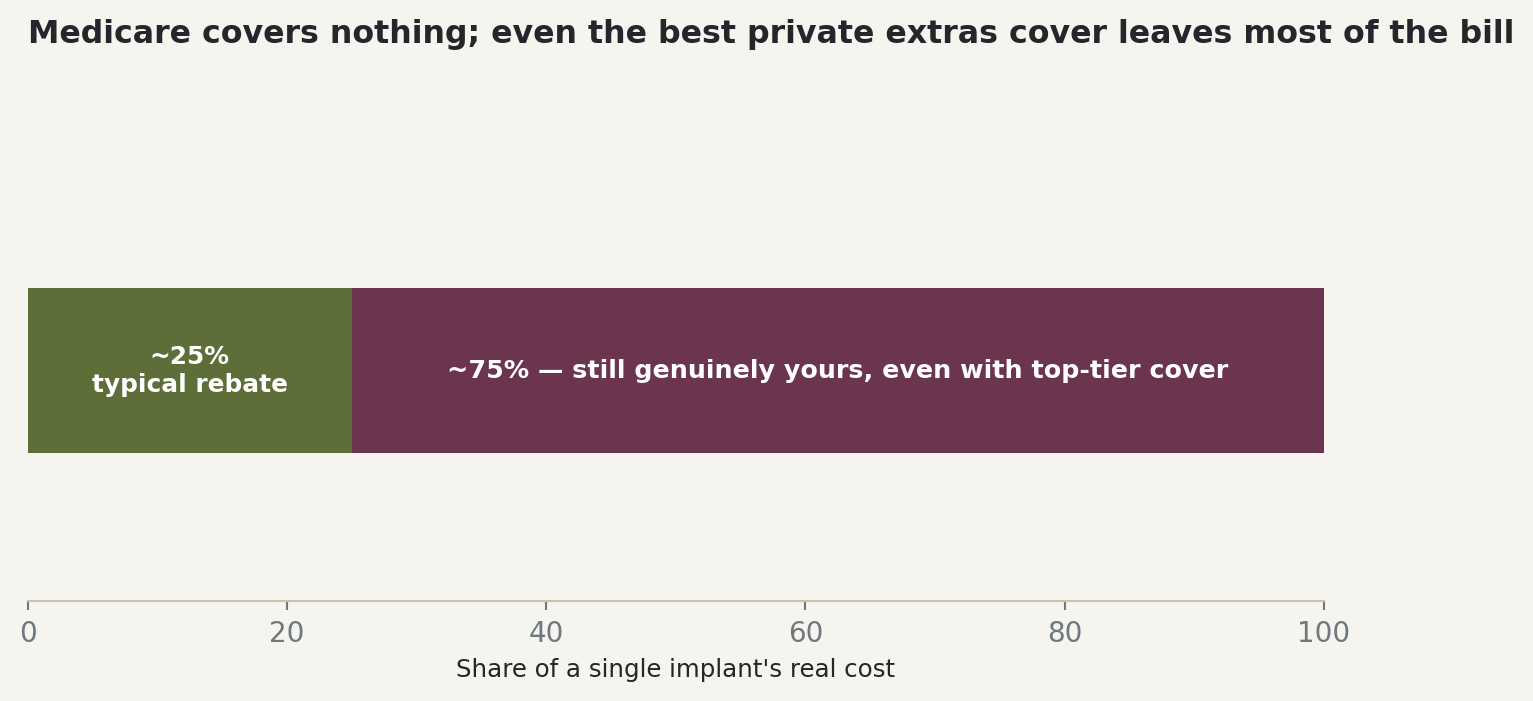
In 24 years of guiding international patients into Indian hospitals, dental implants are one of the more straightforward, unambiguous cost comparisons in this entire series, precisely because Medicare offers no coverage at all for the general adult population, and even a policyholder with top-tier private extras cover, who has correctly served the twelve-month waiting period, still typically carries the majority of the bill themselves.
This isn't a minor gap easily closed with the right insurance choice. Private health insurers classify the implant fixture itself as major dental, with rebates typically ranging from $500 to $2,500 per implant depending on policy level, while the crown may fall under a separate prosthodontic category with its own limit. Bone grafting and sinus lifts, often necessary for a genuinely successful outcome, are frequently excluded altogether or capped separately. The net result, confirmed consistently across multiple 2026 industry sources, is that most patients pay somewhere around three-quarters of the real cost themselves, even holding a policy specifically chosen for dental coverage.
Why full-mouth cases can take years to fund through insurance alone
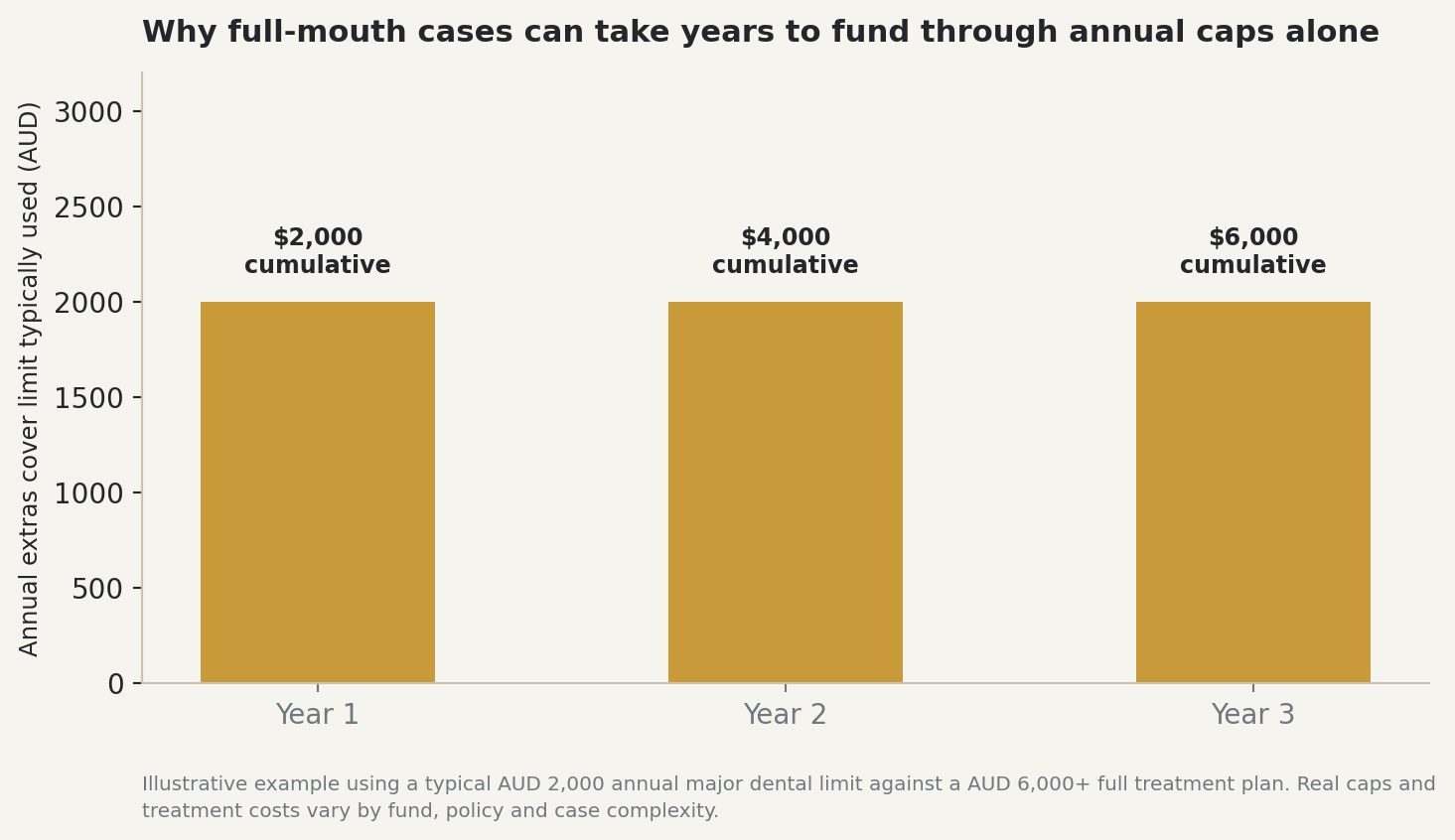
Get your full dental records, including any existing X-rays or CT imaging, together before your first overseas conversation. This matters because annual benefit caps, typically $1,000 to $2,500 depending on your fund, mean a genuinely necessary treatment plan can be artificially stretched across two, three, or more calendar years, not because the dentistry takes that long, but because the insurance funding structure forces it to.
Some clinics and funds allow splitting a claim across two benefit years, using one year's cap for the surgical phase and the next for the crown, but this still leaves the patient managing a multi-year financial and treatment timeline for what could otherwise be completed in a single, well-planned trip. For anyone needing more than one or two implants, this structural funding delay is worth understanding clearly before committing to a domestic treatment plan built around insurance timing rather than genuine clinical need.
Why a genuine implant is a two-visit process, not one
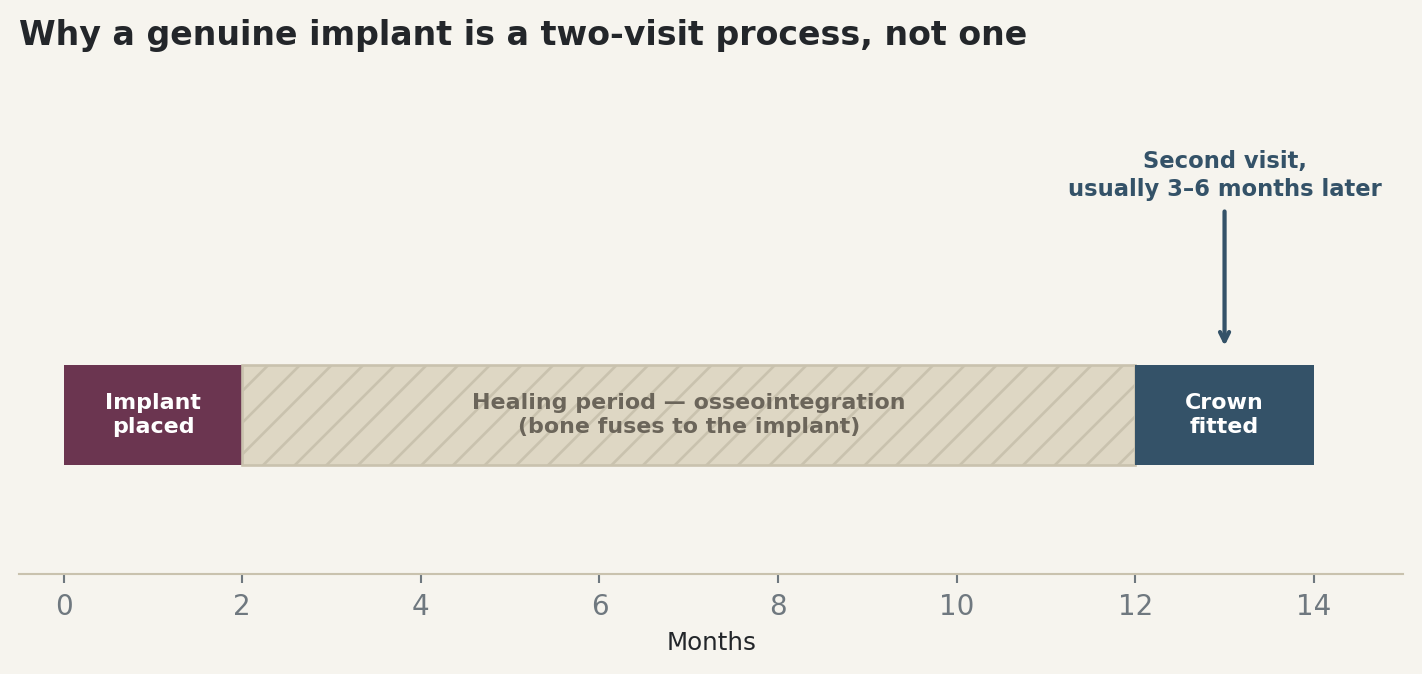
This is worth understanding clearly, because it shapes your entire travel planning regardless of where you have treatment. After the implant is placed, the jawbone needs several months to fuse to it, a genuine biological process called osseointegration that cannot be rushed by any surgeon, anywhere, before the permanent crown can be safely fitted. Ask any clinic directly how they coordinate this two-visit process for international patients specifically, since it affects your total trip planning more than almost any other factor in this decision.
Why India specifically, not just overseas
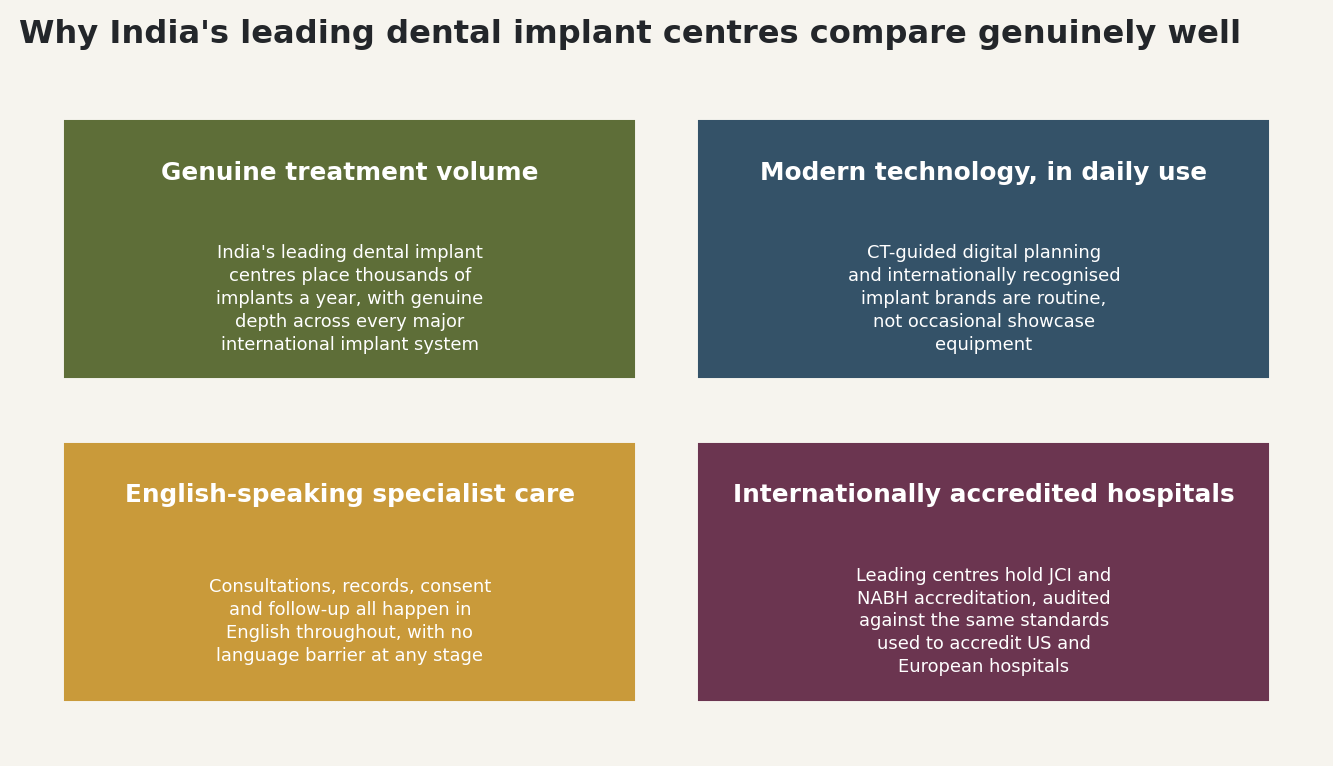
This is worth spelling out plainly. India's leading dental implant centres place a genuine volume of implants annually, with depth across every major internationally recognised implant system, not limited to a single brand chosen for cost reasons. This is not a compromise reached for cost and speed; for the right case, it is comparable or greater depth of specific implant experience, delivered by English-speaking specialists in internationally accredited hospitals, at a fraction of the equivalent Australian out-of-pocket cost.
CT-guided digital planning, essential for precise implant placement particularly near nerves or sinuses, is standard, routine practice at India's leading centres, not a premium add-on. This precision matters directly for long-term implant success and minimising complications, and it's exactly the kind of infrastructure investment that becomes genuinely affordable to offer as standard when a centre's overall patient volume supports it.
Every part of the process, from your first video consultation through detailed treatment planning, consent discussions, and every follow-up conversation, happens in English, with specialists trained to internationally recognised standards. Combined with JCI and NABH-accredited hospital infrastructure, this represents genuinely comparable dental implant care, not a lesser alternative reached through necessity.
An honest cost comparison
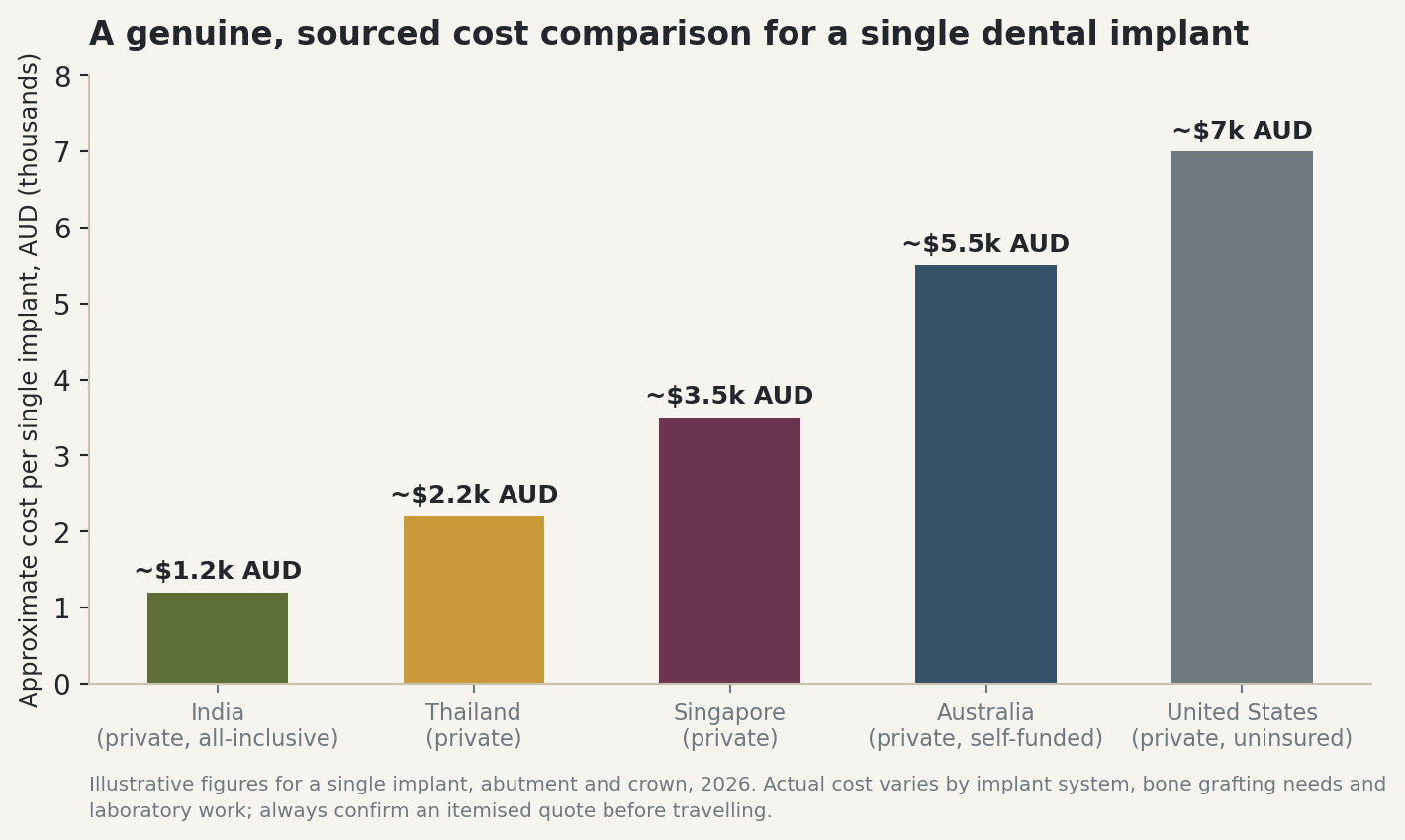
These figures are illustrative and vary by implant system, bone grafting needs and laboratory work, but the pattern holds consistently. Always insist on a written, itemised quote naming the specific implant brand, crown material, and whether the second visit for crown fitting is included in the same price or billed separately.
What Genuinely Good Dental Implant Care Looks Like, Wherever You Have Treatment
- The implant brand is specifically named. A significantly cheaper quote may use a lesser-known system; compare itemised quotes rather than headline figures alone.
- CT-guided digital planning is standard practice. Ask whether 3D imaging is used to plan your implant placement precisely.
- A coordinated two-visit timeline, explained clearly. Ask how the clinic sequences and times the healing period for international patients specifically.
- Genuine volume, not a generalist claim. Ask about the dentist's specific implant placement experience, not general dentistry volume.
- A clear, itemised quote before you travel. Confirm whether bone grafting, if needed, is included or billed separately.
Signals worth taking seriously, wherever you're considering treatment
A few patterns are worth watching for, regardless of which country or clinic you're evaluating. If the implant brand isn't named, or changes without explanation, that's the single detail most likely to explain a suspiciously low price. No CT-guided digital planning offered is a genuine concern, since this is standard practice at any genuinely capable clinic in 2026. If the two-visit healing period isn't explained clearly before you travel, a responsible clinic should walk you through this proactively, not leave you to discover it afterward. Pressure to commit before an itemised quote is provided is a signal worth taking seriously anywhere.
None of this is unique to overseas care; the same questions are worth asking of an Australian clinic too. What changes when evaluating a clinic overseas is that you have fewer easy, informal ways to verify answers, which is exactly why insisting on things in writing matters more than it might at home.
Australia-specific considerations most patients miss
Check your specific extras policy before assuming any rebate. Coverage varies enormously between funds, and waiting periods of around 12 months commonly apply to major dental, meaning a policy taken out today won't help with treatment planned for next month.
Ask your Australian dentist to coordinate the two-visit process. Many are willing to handle interim check-ups between your placement and crown-fitting trips, keeping your local dentist informed throughout.
Consider combining procedures into one well-planned trip. Since neither implants nor most cosmetic dental work is meaningfully covered by Medicare regardless of location, a coordinated treatment plan is often more efficient than separate visits spread across years.
Apply for both visas together. Australian passport holders are eligible for India's electronic medical visa, with an e-medical attendant visa for whoever travels with you.
THE QUESTIONS WORTH ASKING BEFORE YOU DECIDE
- What are your qualifications specific to implant placement?
- Which implant brand will be used, specifically?
- Is CT-guided digital planning used for my case?
- How is the two-visit timeline coordinated for international patients?
- What does the itemised quote include, and what happens if bone grafting is needed?
- What does the final documentation include for my Australian dentist?
A closing word
Dental implants sit almost entirely outside what Medicare or most private cover meaningfully pays for, and the genuine, documented gap between the headline treatment cost and the real out-of-pocket figure catches many Australians by surprise. For anyone weighing this cost against a treatment plan that could otherwise stretch across years of annual insurance caps, the case for India is a strong one: implant centres with deep, established experience across every major international system, CT-guided planning as standard practice, and treatment that can be completed within a single, well-coordinated trip, at a fraction of the equivalent Australian out-of-pocket cost. In 24 years of helping patients navigate exactly this decision, the arithmetic works clearly in favour of exploring this option properly: verify the implant system and the dentist's specific credentials, understand the genuine two-visit timeline, and the numbers speak for themselves. Those who look closely at what India's leading implant centres actually offer generally come away reassured, not because the price alone is lower, but because the standard of care genuinely holds up. If you would like a second opinion on a treatment plan or quote, send it and I will look at it properly.
Frequently Asked Questions by Australian Patients about Dental Implants and Dental Surgery in India
Why might Australian patients consider dental implants in India?
Australian patients may consider India because dental implants receive limited Medicare support and private insurance often leaves a large out-of-pocket amount. The briefing also highlights India's implant experience and digital planning capabilities.
Does Medicare cover dental implants for Australian adults?
The briefing states that Medicare provides no general adult coverage for dental implants. Patients therefore need to consider private insurance, self-funding or alternative treatment arrangements.
How much might Australian private insurance cover for an implant?
The briefing indicates that private insurers may provide approximately $500–$2,500 per implant, depending on the policy. Crowns, bone grafting and sinus lifts may have separate limits or exclusions.
Why can dental implant treatment take several months?
After the implant is placed, the jawbone needs time to fuse with it through osseointegration. The permanent crown is generally fitted during a later visit after the healing period.
How many visits are needed for dental implants?
The briefing describes a genuine implant treatment as a two-visit process: implant placement followed by crown fitting, typically around 3–6 months later, depending on the individual case.
How much does a dental implant cost in India for Australian patients?
The briefing gives an illustrative cost of approximately AUD $1,200 in India, compared with approximately AUD $5,500 in Australia, for a single implant, abutment and crown. Actual costs vary.
What should Australian patients ask about the implant brand?
They should ask for the specific implant brand and system to be named in writing. A significantly cheaper quotation may involve a lesser-known system, so headline prices should not be compared without knowing what is included.
Why is CT-guided digital planning important?
CT-guided planning allows the dentist to use 3D imaging to plan precise implant placement, particularly where nerves or sinuses are involved. The briefing describes this as standard practice at capable centres.
How should Australian patients coordinate follow-up?
Patients should ask their Australian dentist whether they can provide interim check-ups between the implant-placement and crown-fitting visits and ensure that treatment records are shared throughout the process.
What should Australian patients ask before choosing an implant centre?
They should ask about the dentist's implant-placement qualifications, exact implant brand, CT-guided planning, two-visit scheduling, bone-grafting costs, itemised pricing and the documentation that will be provided to their Australian dentist.
Sources
- Prudential Dental Clinic, How Much Do Dental Implants Cost in Australia in 2026? — prudentialdental.com.au
- Townsville Dental Directory, Does Health Insurance Cover Dental Implants? — townsvilledental.clinic
- National Medical Commission — nmc.org.in
- National Accreditation Board for Hospitals & Healthcare Providers — nabh.co
- High Commission of India, e-Visa — indianvisaonline.gov.in
Page Summary
This six-page decision briefing examines dental implants and dental surgery in India for Australian patients, focusing on Australia's limited Medicare coverage, private insurance caps, the financial delay created by annual benefit limits, the biological healing period between implant placement and crown fitting, and India's implant expertise and CT-guided planning. It includes an illustrative India-versus-Australia cost comparison, quality checks, warning signs, Australia-specific insurance and follow-up considerations, visa information and questions patients should ask before choosing an implant centre.
Citation Block
| Field | Information |
|---|---|
| Topic | Dental Implants and Dental Surgery in India for Australian Patients |
| Treatment | Dental Implants / Dental Surgery |
| Patients | Australian Patients |
| Specialist | Implant Dentist / Prosthodontist |
| Medicare Coverage | No general adult coverage for dental implants |
| Private Rebate | Approx. $500–$2,500 per implant |
| Out-of-Pocket Share | Around 75% may remain |
| India Cost | Approx. AUD $1,200 |
| Australia Cost | Approx. AUD $5,500 |
| Key Technology | CT-guided digital planning |
| Implant Process | Two visits |
| Healing Period | Usually 3–6 months |
| Implant Check | Specific brand and system |
| Quality Check | Implant-placement experience |
| Hospital Check | JCI/NABH accreditation |
| Quote Requirement | Written, itemised quotation |
| Bone Grafting | Confirm whether included or separate |
| Follow-Up | Australian dentist |
| Warning Signs | Unnamed implant brand, no CT planning or unclear two-visit process |
| Patient Journey | Records → consultation → planning → implant placement → healing → crown fitting |
| Decision Principle | Compare the complete treatment plan, not the headline price alone |


Our Mission Statement
Our mission is to place patients at the centre of every healthcare decision by providing trustworthy, evidence-based, and unbiased medical information. We believe that informed patients make better decisions. Backed by personalised guidance from our experienced advisory team, we help patients understand their treatment options, compare them objectively, and confidently choose the path that best suits their medical needs and personal circumstances.
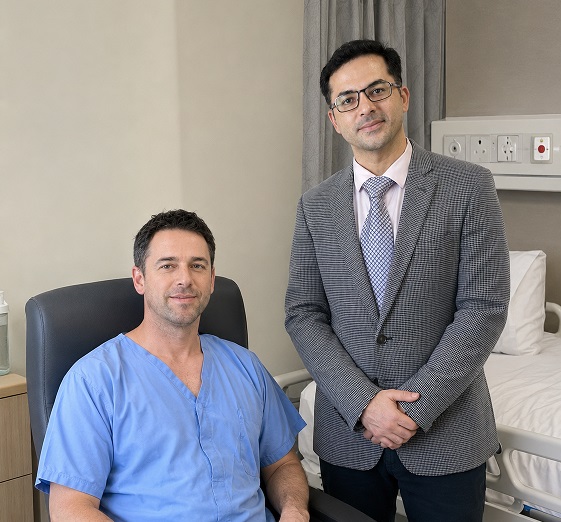
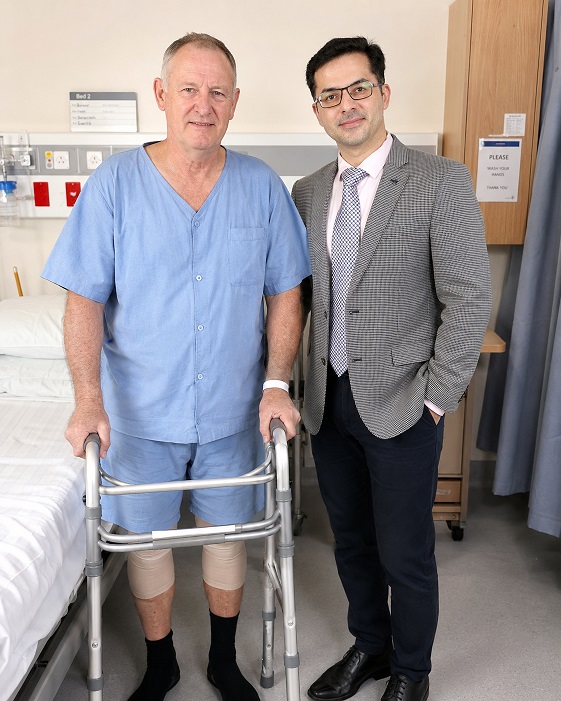
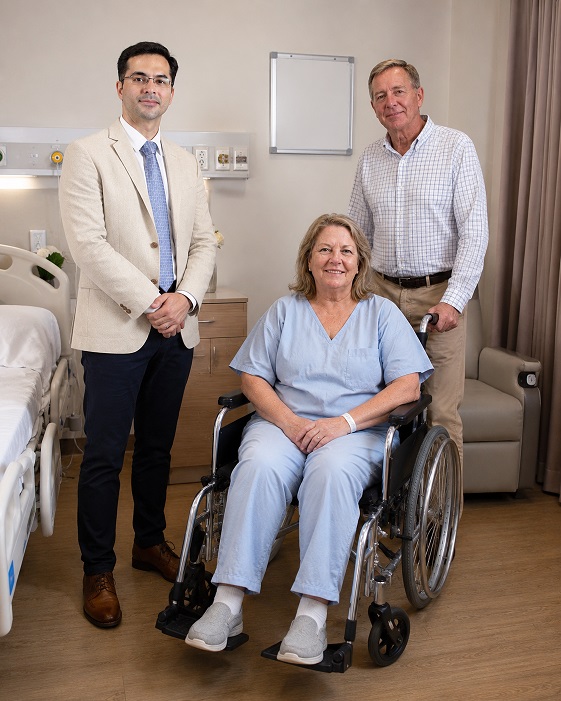
Patient Testimonials from Australia





Ready to Take the First Step?
Share your Medical Reports with our Healthcare Managers Today and Get a FREE CONSULTATION, a Personalized Treatment Plan, and Complete Support from Arrival to Recovery.
Get Your Free ConsultationAreas We Serve
This resource has been thoughtfully prepared for patients from Australia who are considering medical treatment in India. We also welcome patients from the wider region in the countries mentioned below-
We regularly assist patients from:
- Fiji
- Vanuatu
- Samoa
- Tonga
- Kiribati
- Nauru
- Tuvalu
- New Zealand
- Solomon Islands
- Papua New Guinea
Many of the insights, treatment pathways, hospital recommendations, travel guidance, and patient support services described here are equally relevant and may be used as a reference when planning treatment in India.
From Australia to India: Your Complete Patient Support Guide
- Cancer Treatment in India for Australian Patients: PBS Gap & Drug Costs
- Cardiac Surgery in India for Australian Patients: TAVI Access & Costs
- Dental Treatment & Surgery in India for Australian Patients
- Hip Surgery in India for Australian Patients: Costs, Waits & Implant Choice
- Knee Surgery in India for Australian Patients: Costs, Waits & Implants
- Neurosurgery in India for Australian Patients: Volume, Costs & When Not to Travel
- Spine Surgery in India for Australian Patients: Costs, Indications & Second Opinions (2026)
- Best Bariatric & Weight Loss Surgeons in India for Australian Patients
- Best Cancer Surgeons & Hospitals in India for Australian Patients
- Best Cardiac Surgeons & Hospitals in India for Australian Patients
- Best Cosmetic Surgeons & Hospitals in India for Australian Patients
- Best Dental Surgeons & Clinics in India for Australian Patients
- Best Hip Surgeons & Hospitals in India for Australian Patients
- Best Knee Surgeons & Hospitals in India for Australian Patients
- Best Scoliosis Surgeons & Hospitals in India for Australian Patients
- Best Spine Surgeons & Hospitals in India for Australian Patients
- Selecting the Best Urosurgery and Reconstructive Urology Centres in India for Australian Patients
- Selecting the Best Bone Marrow Transplant Centres in India for Australian Patients