

Scoliosis Correction Surgery in India: A Decision Briefing for Australian Patients
Why the angle at diagnosis matters more than the diagnosis itself, and why India's leading paediatric spine centres offer a genuinely strong path when surgery becomes necessary.
In 24 years of guiding international patients into Indian hospitals, this history matters more than most families realise. Clinical school screening for scoliosis largely disappeared from Australian government schools by the early 1990s, replaced with a voluntary program that relies on distributing a fact sheet and hoping parents and children notice the signs themselves. For many families, this means a curve isn't caught early, and by the time it's noticed, more of it has already happened than needed to.
READ THIS BEFORE ANYTHING ELSE IN THIS DOCUMENT
A child with signs of neurological involvement, rapidly progressing pain, or an unstable spine following trauma needs immediate assessment in Australia. What follows concerns stable, planned scoliosis correction, where there is genuine time to choose the right team carefully.
Healing Journeys of Australian Patients


Key Takeaways
- The briefing is intended for Australian families whose child's scoliosis has progressed to the point where surgery is genuinely being considered. It explains that most mild curves do not require surgery and that treatment depends strongly on the Cobb angle and remaining growth. Curves under 20° are generally monitored, 20–40° may be treated with bracing when growth remains, while curves around 40–50° or more commonly move toward surgical correction.
- For younger children, the briefing highlights growing rods and other growth-friendly approaches, which can allow continued spinal and lung development before definitive fusion. Adolescents closer to skeletal maturity may instead undergo spinal fusion. Growing-rod treatment requires repeated lengthening procedures, making continuity with an experienced surgical team particularly important.
- India's leading paediatric spine centres are presented as having substantial deformity-correction experience, including adolescent idiopathic scoliosis and complex early-onset curves. The briefing also highlights continuous intraoperative neuromonitoring, growth-friendly techniques, English-speaking specialists and internationally accredited hospitals as important features of appropriate care.
- The page 4 cost chart gives an illustrative private cost of approximately AUD $13,000 in India versus AUD $55,000 in Australia for a standard posterior spinal fusion package. It also shows approximately AUD $24,000 for Thailand, AUD $34,000 for Singapore and AUD $130,000 for the United States. Actual costs vary according to curve severity, number of vertebral levels fused and whether a growth-friendly technique is required.
- Australian families should have the child's actual X-rays and growth history reviewed, confirm the exact Cobb angle and remaining growth, ask about the surgeon's specific scoliosis and deformity-correction volume, and ensure continuous neuromonitoring is standard. Families should also arrange Australian growth monitoring and long-term follow-up before travelling.
Quick Facts
- Treatment
- Scoliosis Correction Surgery
- Patients
- Australian Children and Families
- Key Specialist
- Paediatric Orthopaedic / Spine Surgeon
- Main Assessment
- Cobb Angle and Remaining Growth
- Under 20°
- Observation and periodic check-ups
- 20–40°
- Bracing may be considered during growth
- 40–50°+
- Surgery usually becomes necessary
- Younger Children
- Growing Rods / Growth-Friendly Techniques
- Adolescents
- Spinal Fusion
- Key Safety Measure
- Continuous Intraoperative Neuromonitoring
- India Cost
- Approx. AUD $13,000
- Australia Cost
- Approx. AUD $55,000
- Quality Check
- Specific Scoliosis and Deformity-Correction Volume
- Quote Requirement
- Written, Itemised Quote
- Records
- X-rays and Growth History
- Follow-Up
- Australian Spine Team
- Timeline
- Treatment can typically begin within 2–3 weeks
- Author
- Dr. Dheeraj Bojwani
- Experience
- 24+ Years
In Brief
For Australian families considering scoliosis correction in India, the briefing focuses on the child's Cobb angle, skeletal growth and curve pattern before surgery is selected. It highlights India's paediatric spine expertise, continuous neuromonitoring and growth-friendly techniques, with an illustrative cost of approximately AUD $13,000 in India compared with AUD $55,000 in Australia. Families are advised to obtain a surgeon-led second opinion, a written itemised quote and a clear long-term follow-up plan.
Scoliosis is common, and most curves never need surgery at all. This briefing exists to explain a genuinely important gap in how scoliosis is detected in Australia, and to set out why India's leading paediatric and adolescent spine centres are a credible, well-evidenced option for families who do need surgical correction. It's worth being precise about who this is for. Most children with mild curves are safely observed or braced without ever needing surgery, and this document isn't written to change that. It's written for families facing a curve that has already progressed to the point where surgery is genuinely being discussed, weighing where that surgery should happen.
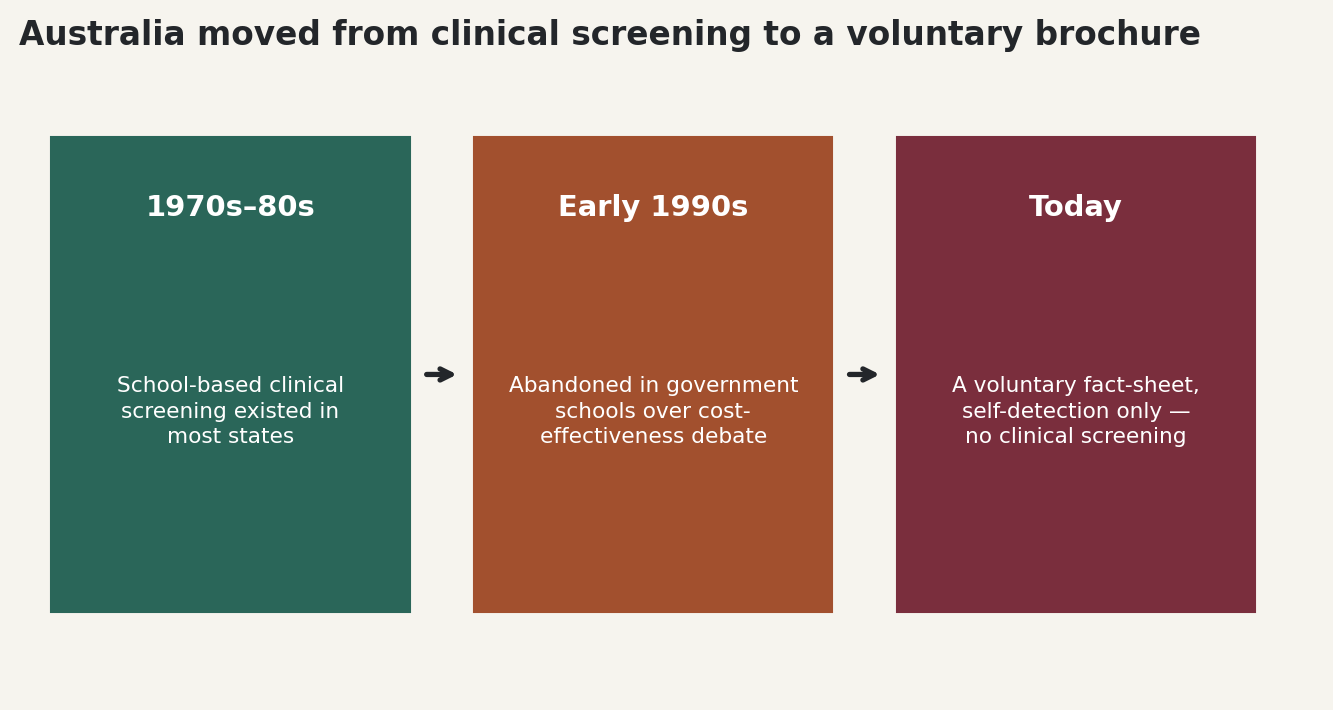
Why the angle at diagnosis decides everything that follows
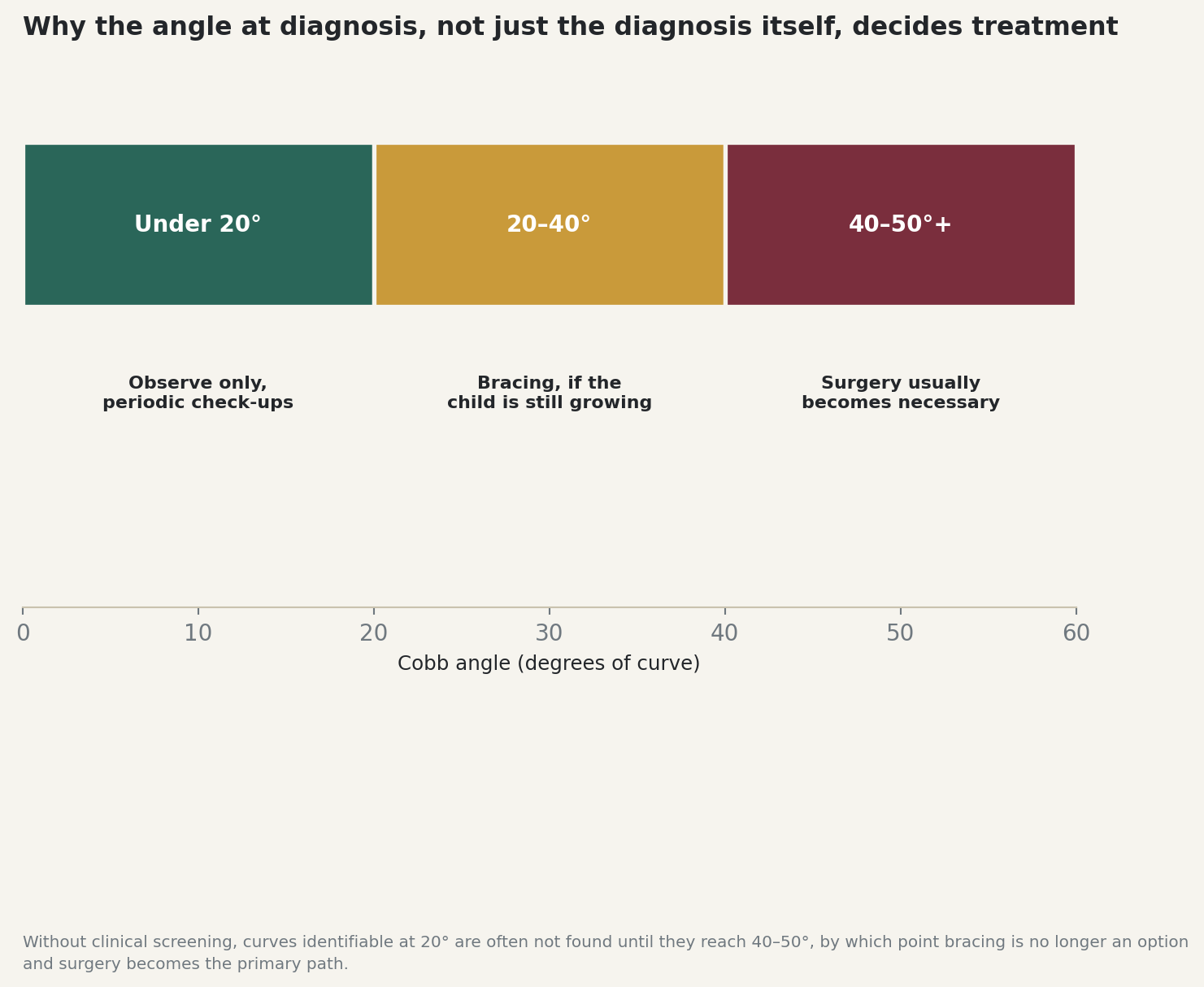
This is the single most important piece of information in this entire briefing. A curve caught early, under 20 degrees, is simply monitored. Between 20 and 40 degrees, bracing can be genuinely effective, provided the child still has meaningful growth remaining. But once a curve reaches 40 to 50 degrees, the window for non-surgical treatment has generally closed, and surgery becomes the primary path forward. Without clinical screening, many curves simply aren't found until they've already crossed that threshold.
For younger children with significant growth still ahead, surgery itself isn't always a single, definitive operation. Growing rods allow the spine to be lengthened periodically as the child grows, delaying permanent fusion until closer to skeletal maturity, when a shorter spine wouldn't limit lung development. For adolescents closer to full growth, spinal fusion, permanently joining the affected vertebrae, is the standard, well-established approach. This is a genuinely different surgical journey to plan for: growing rods mean repeated procedures every six to nine months to lengthen the construct as the child grows, followed eventually by a final, definitive fusion once growth is complete. Families choosing this path need to plan not for a single trip, but for a series of them over several years, ideally with a consistent surgical team who knows the case throughout.
None of this should be decided from an X-ray alone. A genuine assessment weighs the current Cobb angle against Risser stage, a measure of remaining skeletal growth, and the specific pattern of the curve, since a thoracic curve and a lumbar curve don't always behave the same way as a child grows. This is exactly the kind of judgement that benefits from a considered second opinion, not a single quick read of the imaging.
Why India specifically, not just overseas
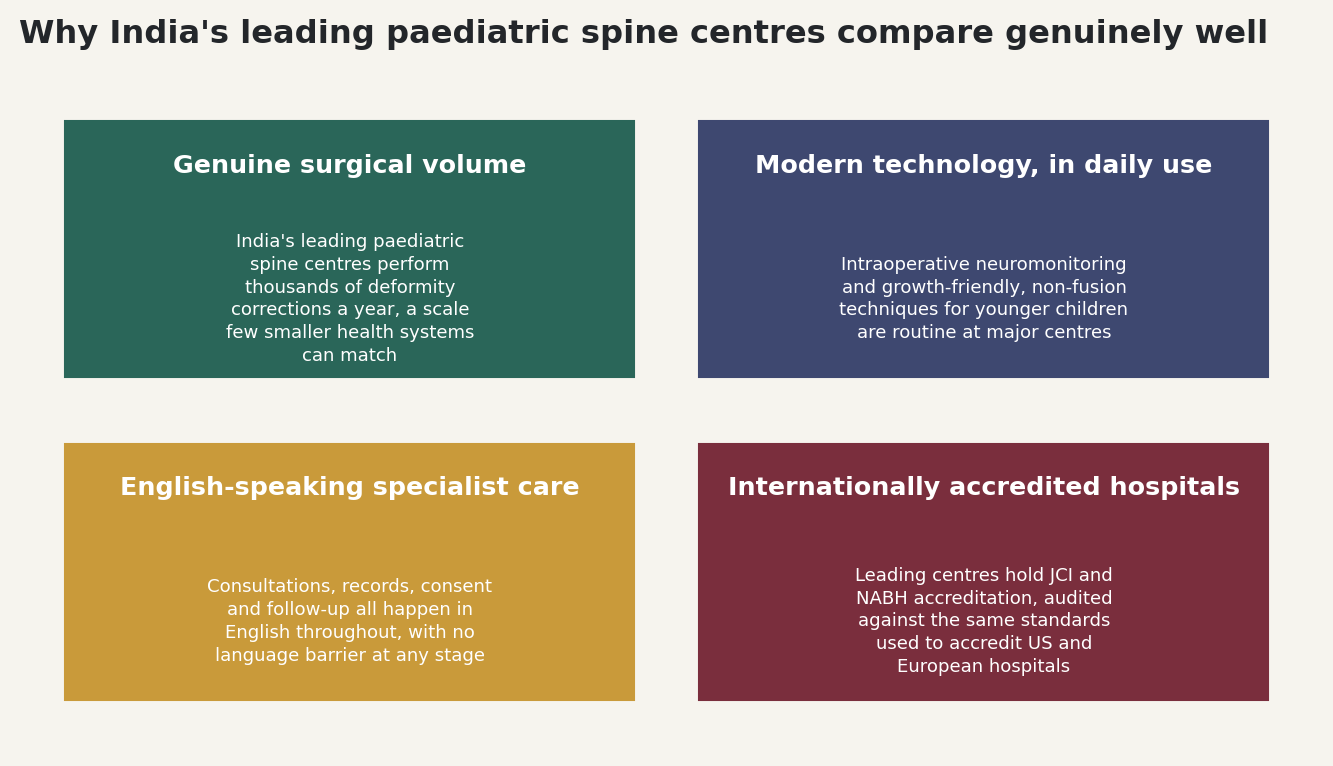
This is worth spelling out plainly. India's leading paediatric spine centres perform a volume of deformity correction surgery, across the full range from adolescent idiopathic scoliosis through to complex early-onset curves needing growing rods, that reflects the scale of the population these centres serve. Intraoperative neuromonitoring, essential for safely correcting significant curves, is standard practice at major centres, not a special arrangement. This is not a compromise reached for cost and speed; for the right case, it is comparable depth of specific paediatric spine experience, delivered by English-speaking specialists in internationally accredited hospitals, at a fraction of the equivalent Australian private cost.
An honest cost comparison
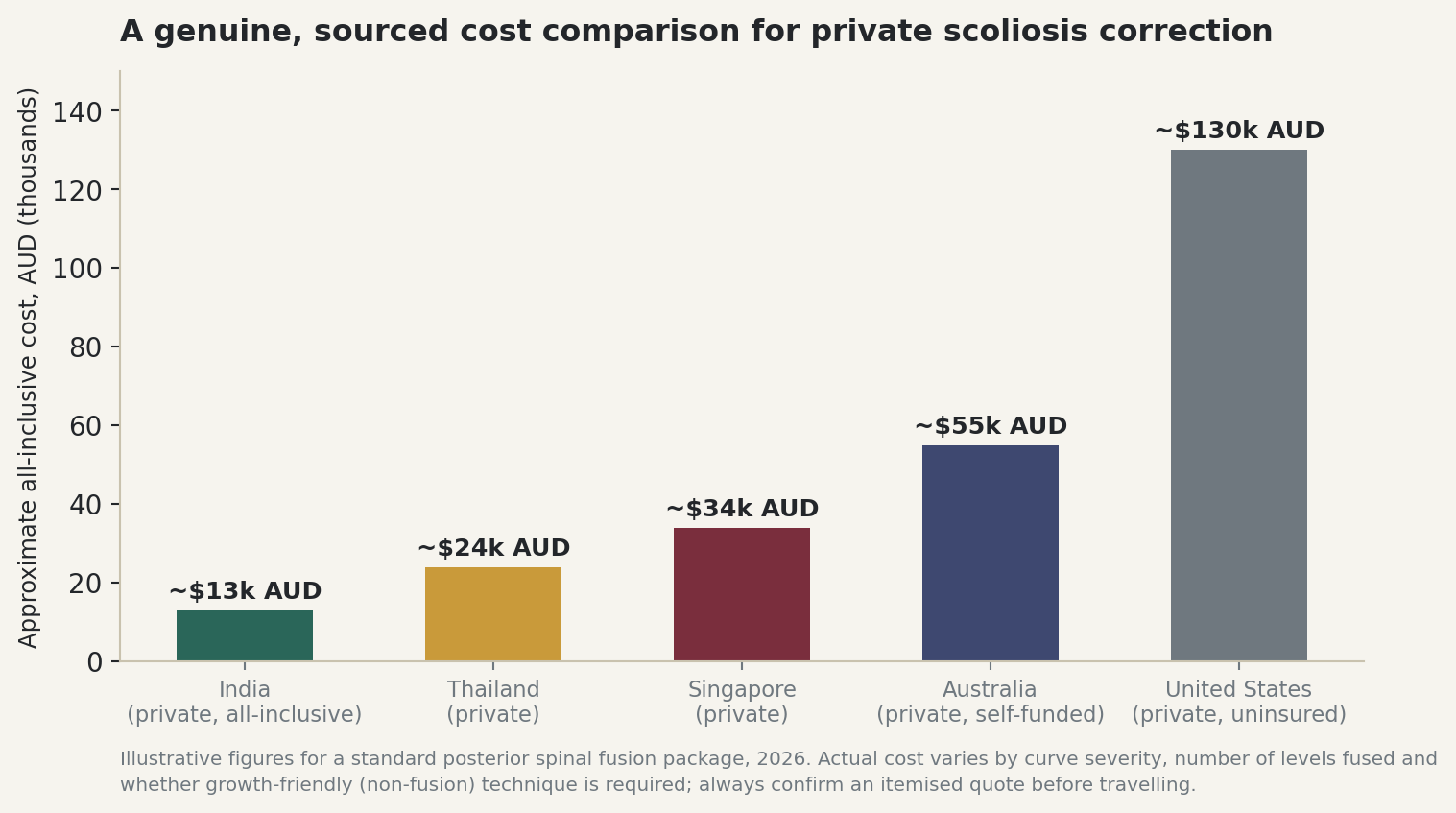
These figures are illustrative and vary considerably by curve severity, the number of vertebral levels fused, and whether growth-friendly, non-fusion technique is required for a younger child. Always insist on a written, itemised quote for your specific case before making any decision.
What Genuinely Good Scoliosis Care Looks Like, Wherever You Have Surgery
- Continuous intraoperative neuromonitoring. This should be treated as non-negotiable, not optional, for any significant curve correction.
- Genuine volume in deformity correction specifically. Ask for the surgeon's volume in scoliosis surgery, distinct from general spine surgery volume.
- Growth-friendly technique for younger children. If your child has significant growth remaining, ask directly whether growing rods, rather than early fusion, are being properly considered.
- A specific plan for the growing years ahead. For growing-rod cases, ask exactly how the lengthening schedule will be managed, and by whom, over the coming years.
- A clear, itemised quote before you travel. Confirm what happens if the surgical plan changes based on intraoperative findings.
Signals worth taking seriously, wherever you're considering treatment
A few patterns are worth watching for, regardless of which country or hospital you're evaluating. A firm recommendation for fusion without a genuine discussion of your child's remaining growth and whether growth-friendly technique was considered deserves a direct question in return. A price quoted before your child's X-rays have been properly reviewed is another signal worth pausing on, since nobody can meaningfully assess a curve, let alone price the surgery, without seeing the actual imaging and knowing the Cobb angle precisely. Vagueness about a surgical team's volume in deformity correction specifically, rather than a confident, specific number, often tells you more than the answer itself, as does any hesitation about whether continuous neuromonitoring will be used.
None of this is unique to overseas care; the same questions are worth asking of an Australian private surgeon too. What changes when evaluating a hospital overseas is that you have fewer easy, informal ways to verify answers, which is exactly why insisting on things in writing, and on a proper video consultation with the surgeon who will actually operate, matters more than it might at home.
Australia-specific considerations most families miss
Don't wait for a school program to catch it. Given the genuine gap in clinical screening, if you've noticed an uneven shoulder, waistline or rib prominence in your child, see a GP directly rather than waiting for symptoms to become obvious.
Tell your Australian spine team early, not after the fact. Most are more sympathetic to a second opinion than families expect.
Arrange your child's ongoing care before you leave. Confirm your Australian team is willing to manage growth-monitoring and long-term follow-up based on overseas surgical findings.
Apply for both visas together. Australian passport holders are eligible for India's electronic medical visa, with an e-medical attendant visa for the accompanying parent.
THE QUESTIONS WORTH ASKING BEFORE YOU DECIDE
- What is my child's exact Cobb angle, and how much growth remains?
- Is continuous intraoperative neuromonitoring standard for this procedure?
- What is the surgeon's specific volume in deformity correction?
- Should growing rods be considered instead of early fusion?
- What does the itemised quote include, and what happens if the plan changes?
- Who will manage ongoing growth monitoring once we're home?
A closing word
A child noticing nothing wrong is often exactly the problem with scoliosis: without clinical screening, curves progress quietly until they're large enough to be obvious, by which point the gentler options have often closed. For families facing surgery, the case for India is a strong one: paediatric spine teams with genuinely deep, current experience across the full range of deformity correction, neuromonitoring and growth-friendly technique used as standard practice, and treatment that can typically begin within two to three weeks rather than months, at a fraction of the equivalent Australian private cost. In 24 years of helping families navigate exactly this decision, the pattern holds: those who look closely at what India's leading paediatric spine centres actually offer generally come away reassured rather than anxious. Confirm the exact angle and growth remaining first, insist on neuromonitoring as standard, and travel with a written, itemised quote in hand. If you would like a second opinion on your child's X-rays, send them and I will look at it properly — including telling you that observation or bracing, not surgery anywhere, is the right answer for now, which is an answer I give often.
Frequently Asked Questions by Australian Patients about Scoliosis Correction Surgery in India
Why might Australian families consider scoliosis surgery in India?
Australian families may consider India when their child's scoliosis has progressed to the point where surgery is being discussed and they are evaluating specialist expertise, access, treatment planning and cost.
Does every Australian child with scoliosis need surgery?
No. The briefing explains that most mild curves are observed or treated with bracing. Surgery generally becomes the primary pathway when the curve reaches around 40–50° or more, depending on the individual assessment.
Why is the Cobb angle important for Australian children?
The Cobb angle helps determine the severity of the spinal curve and influences whether observation, bracing or surgery may be appropriate. The briefing stresses that the angle should be considered together with remaining skeletal growth.
When might growing rods be considered?
Growing rods may be considered for younger Australian children who have significant growth remaining and require surgical correction. They allow the spine to be lengthened periodically before definitive fusion closer to skeletal maturity.
How much does scoliosis surgery cost in India for Australian patients?
The page 4 chart gives an illustrative private cost of approximately AUD $13,000 in India, compared with approximately AUD $55,000 in Australia. Actual costs vary considerably depending on the child's curve and surgical requirements.
What should Australian parents check about a scoliosis surgeon?
Parents should ask about the surgeon's specific experience and volume in scoliosis and spinal deformity correction, rather than relying only on their overall spine-surgery experience.
Is neuromonitoring important during scoliosis surgery?
Yes. The briefing considers continuous intraoperative neuromonitoring an essential safety requirement for significant scoliosis correction and recommends treating it as non-negotiable.
What should Australian families send to an Indian spine centre?
Families should provide the child's actual X-rays and growth history, rather than relying only on written reports. A proper assessment should consider the Cobb angle, remaining growth and curve pattern.
How should Australian follow-up be arranged after surgery in India?
Families should confirm before travelling that their Australian spine team will continue growth monitoring and long-term follow-up using the overseas surgical findings and records.
What questions should Australian parents ask before choosing a scoliosis centre?
They should ask for the child's exact Cobb angle, remaining growth, the surgeon's deformity-correction experience, whether continuous neuromonitoring is standard, whether growing rods should be considered, what the itemised quote includes and who will manage ongoing growth monitoring after returning to Australia.
Sources
- Spine Society of Australia, National Scoliosis Detection Program — scoliosis-australia.org
- SOSORT Consensus Paper, School Screening for Scoliosis, Scoliosis and Spinal Disorders — doi.org/10.1186/1748-7161-2-17
- National Medical Commission — nmc.org.in
- National Accreditation Board for Hospitals & Healthcare Providers — nabh.co
- Australian Government Medical Treatment Overseas Program — health.gov.au
- High Commission of India, e-Visa — indianvisaonline.gov.in
Page Summary
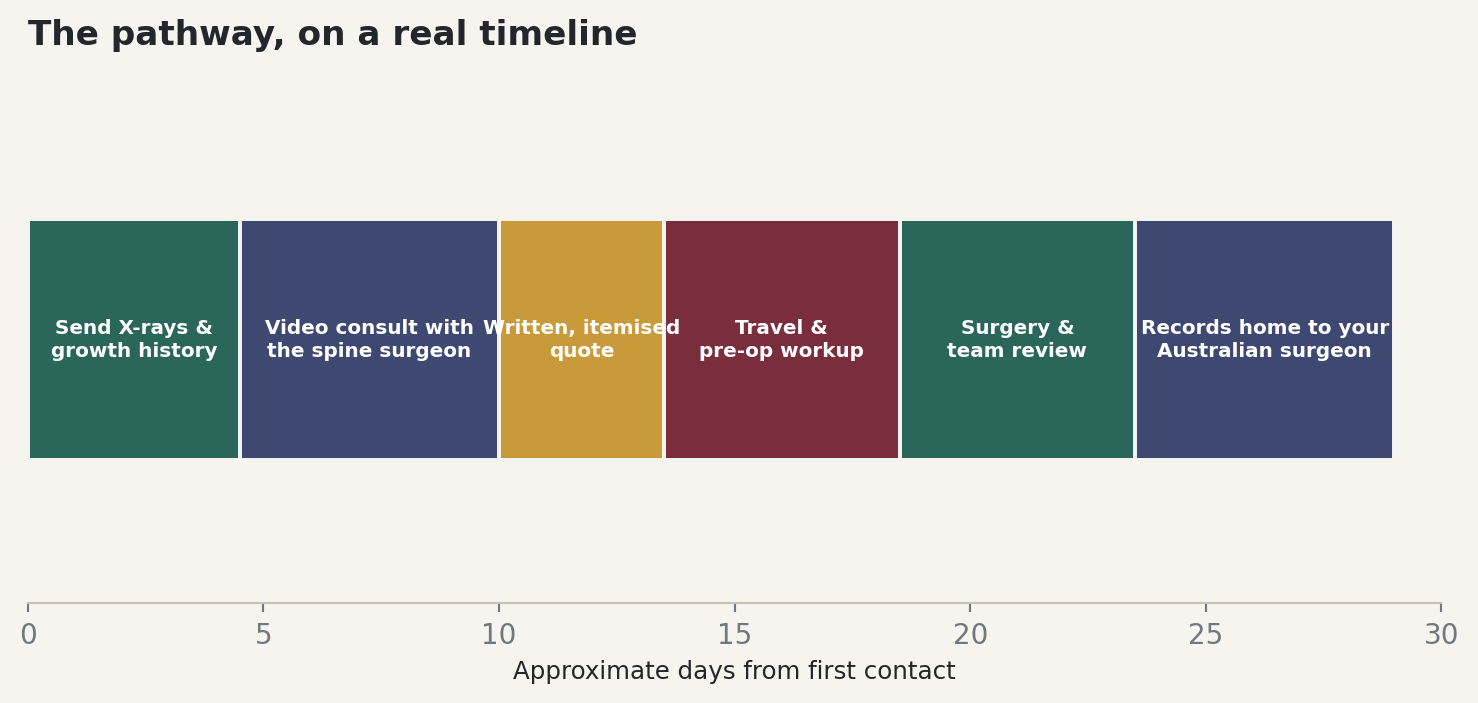
This six-page decision briefing explains scoliosis correction surgery for Australian children and families, with particular emphasis on why the Cobb angle and remaining skeletal growth should guide treatment decisions. It covers observation, bracing, spinal fusion and growing-rod treatment, while presenting India's leading paediatric spine centres as an established option for families whose children genuinely require surgery. The briefing also provides an illustrative international cost comparison, quality and safety checks, warning signs, Australia-specific considerations and a practical treatment pathway from sending X-rays and growth history through surgeon consultation, quotation, travel, surgery and continued monitoring in Australia.
Citation Block
| Field | Information |
|---|---|
| Topic | Scoliosis Correction Surgery in India for Australian Patients |
| Treatment | Scoliosis Correction Surgery |
| Patients | Australian Children and Families |
| Specialist | Paediatric Orthopaedic / Spine Surgeon |
| Main Assessment | Cobb angle, Risser stage and remaining growth |
| Under 20° | Observation |
| 20–40° | Bracing may be effective during growth |
| 40–50°+ | Surgery usually becomes the primary pathway |
| Younger Children | Growing rods / growth-friendly techniques |
| Adolescents | Spinal fusion |
| Safety Requirement | Continuous intraoperative neuromonitoring |
| India Expertise | Paediatric spine and deformity correction experience |
| India Cost | Approx. AUD $13,000 |
| Australia Cost | Approx. AUD $55,000 |
| Quality Check | Specific scoliosis and deformity-correction volume |
| Warning Signs | Fusion recommended without growth assessment, price before X-ray review or vague surgical volume |
| Quote Requirement | Written, itemised quotation |
| Pre-Travel Records | X-rays and growth history |
| Follow-Up | Australian spine team |
| Patient Journey | X-rays & growth history → surgeon consultation → quote → travel/pre-op → surgery → Australian follow-up |
| Decision Principle | Confirm the exact curve and remaining growth before deciding on surgery |

Our Mission Statement
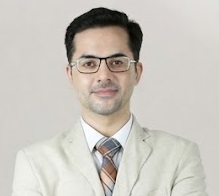
Our mission is to place patients at the centre of every healthcare decision by providing trustworthy, evidence-based, and unbiased medical information. We believe that informed patients make better decisions. Backed by personalised guidance from our experienced advisory team, we help patients understand their treatment options, compare them objectively, and confidently choose the path that best suits their medical needs and personal circumstances.
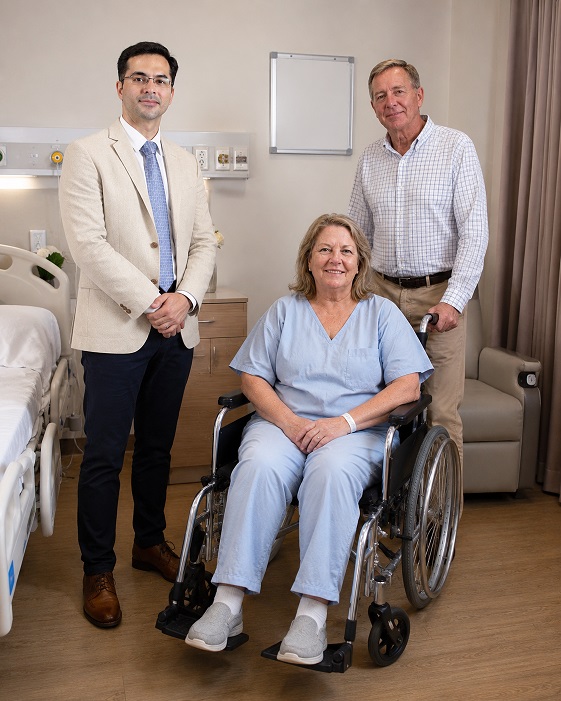
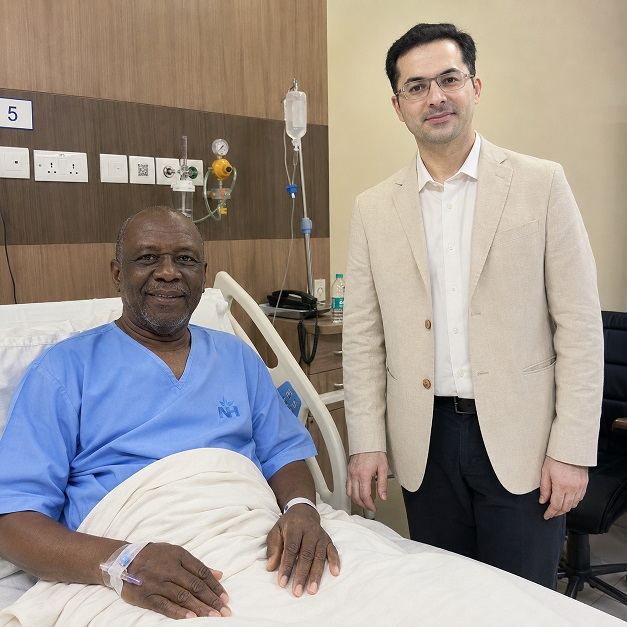
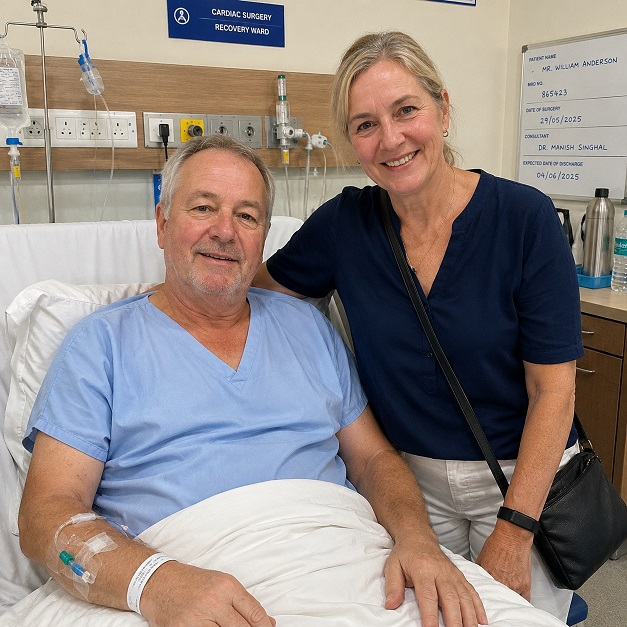
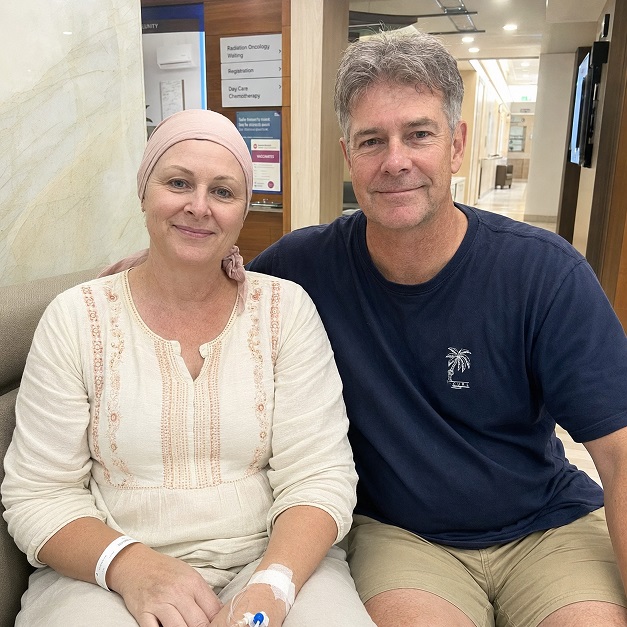
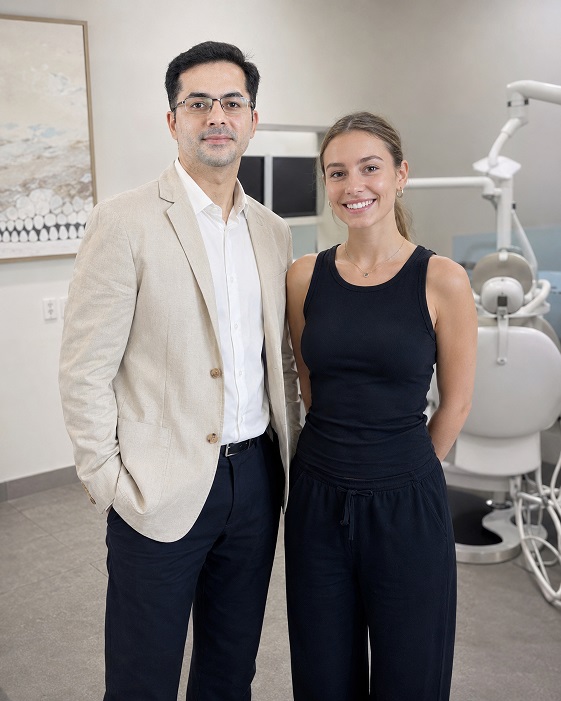
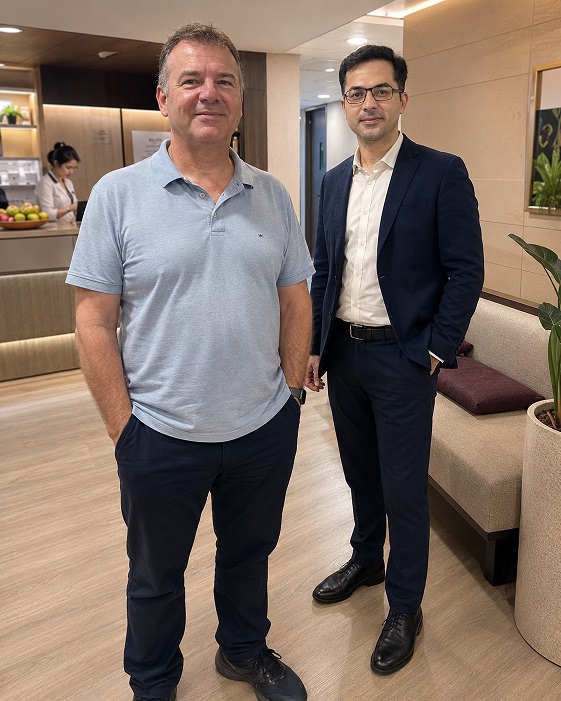
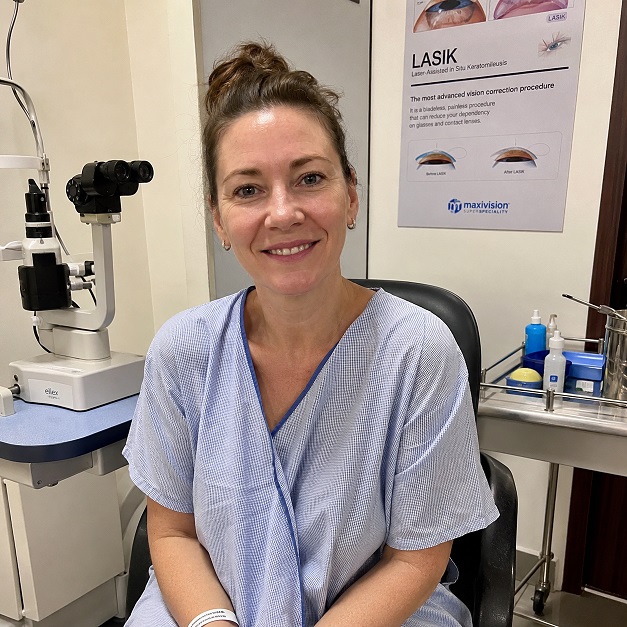
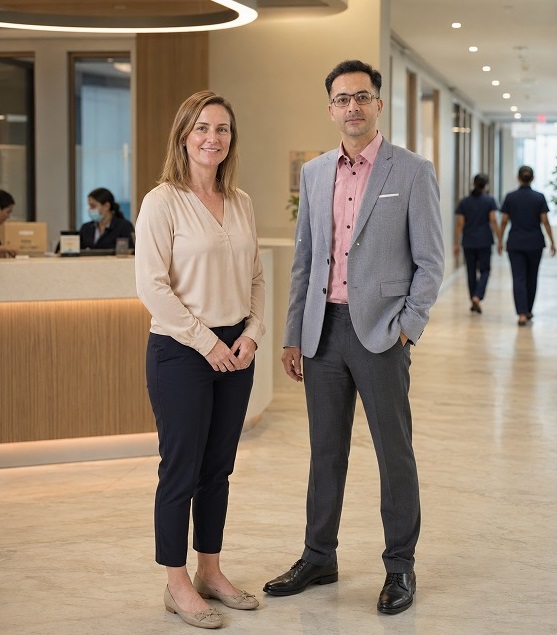
Patient Testimonials from Australia
Ready to Take the First Step?
Share your Medical Reports with our Healthcare Managers Today and Get a FREE CONSULTATION, a Personalized Treatment Plan, and Complete Support from Arrival to Recovery.
Get Your Free ConsultationAreas We Serve
This resource has been thoughtfully prepared for patients from Australia who are considering medical treatment in India. We also welcome patients from the wider region in the countries mentioned below-
We regularly assist patients from:
- Fiji
- Vanuatu
- Samoa
- Tonga
- Kiribati
- Nauru
- Tuvalu
- New Zealand
- Solomon Islands
- Papua New Guinea
Many of the insights, treatment pathways, hospital recommendations, travel guidance, and patient support services described here are equally relevant and may be used as a reference when planning treatment in India.
From Australia to India: Your Complete Patient Support Guide
- Cancer Treatment in India for Australian Patients: PBS Gap & Drug Costs
- Cardiac Surgery in India for Australian Patients: TAVI Access & Costs
- Dental Treatment & Surgery in India for Australian Patients
- Hip Surgery in India for Australian Patients: Costs, Waits & Implant Choice
- Knee Surgery in India for Australian Patients: Costs, Waits & Implants
- Neurosurgery in India for Australian Patients: Volume, Costs & When Not to Travel
- Spine Surgery in India for Australian Patients: Costs, Indications & Second Opinions (2026)
- Best Bariatric & Weight Loss Surgeons in India for Australian Patients
- Best Cancer Surgeons & Hospitals in India for Australian Patients
- Best Cardiac Surgeons & Hospitals in India for Australian Patients
- Best Cosmetic Surgeons & Hospitals in India for Australian Patients
- Best Dental Surgeons & Clinics in India for Australian Patients
- Best Hip Surgeons & Hospitals in India for Australian Patients
- Best Knee Surgeons & Hospitals in India for Australian Patients
- Best Scoliosis Surgeons & Hospitals in India for Australian Patients
- Best Spine Surgeons & Hospitals in India for Australian Patients
- Selecting the Best Urosurgery and Reconstructive Urology Centres in India for Australian Patients
- Selecting the Best Bone Marrow Transplant Centres in India for Australian Patients