

Breast Cancer Treatment and Surgery in India for Canadian Patients
Canada's national task force just reviewed the same evidence the United States did, and reached the opposite answer on when to start screening. The real gap isn't your treatment. It's whether you get looked at at all.
A 43-year-old accountant in Regina found a lump herself. She had never had a mammogram — Saskatchewan's screening programme starts at 50, and nobody had suggested otherwise. By the time it was investigated, the tumour was larger and the nodes were involved. Her story is now part of the argument Canadian doctors and advocacy groups have been making loudly since 2023: that the country's own screening guidelines, reaffirmed as recently as 2024, are missing exactly this group of women.
Healing Journeys of Canadian Patients
Key Takeaways
- The PDF focuses heavily on access to breast screening in Canada, particularly for women aged 40–49. Canada's national task force did not lower the routine screening age in its 2024 recommendation, while several provinces have independently expanded access.
- The provincial situation varies significantly. Alberta lowered its programme age to 45, Ontario expanded screening to women aged 40–49, while British Columbia and Quebec allow self-referral from 40. Several other provinces still require physician referral for women screened before 50.
- The PDF notes that roughly 40% of women over 40 have dense breast tissue, which can make abnormalities harder to see on a standard mammogram. Women who know or suspect they have dense breasts may need to discuss supplemental imaging such as ultrasound or MRI with their physician.
- For selected women aged 40–49 who face genuine access barriers, the guide presents diagnostic imaging in India as a possible option for obtaining additional clarity. It emphasizes that imaging results should be taken back to the Canadian physician and that this does not automatically mean treatment should take place abroad.
- The PDF also discusses pathology second opinions and genomic recurrence-risk testing. The page 4 chart gives an indicative multi-gene recurrence-risk test cost of approximately C$340 in India versus C$4,300 out-of-pocket in Canada where the test is not provincially funded.
- The strongest case presented for travelling to India for actual breast surgery is reconstruction, particularly DIEP flap microsurgical reconstruction. The guide states that Canadian public wait times for breast reconstruction commonly run six to eighteen months or longer, depending on province.
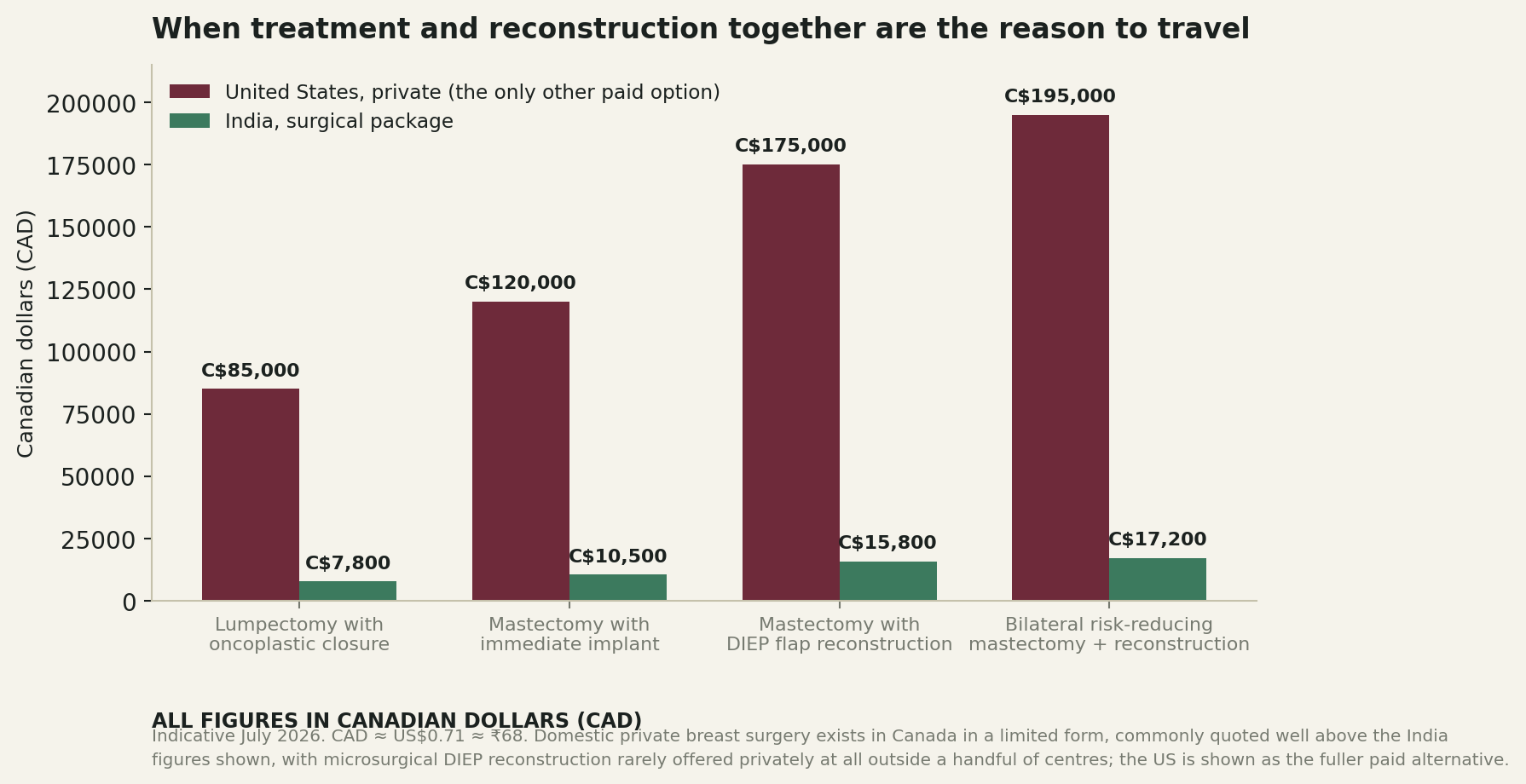
- The page 5 cost chart gives indicative India figures of approximately C$7,800 for lumpectomy with oncoplastic closure, C$10,500 for mastectomy with immediate implant, C$15,800 for DIEP flap reconstruction and C$17,200 for bilateral risk-reducing mastectomy with reconstruction.
- The guide strongly cautions against unproven clinics, delaying treatment recommended in Canada, making treatment decisions without examination of the patient's actual tissue, or using pressure-based screening and diagnostic services.
Quick Facts
- Treatment
- Breast Cancer Treatment and Surgery
- Country
- India
- Patients
- Canadian Patients
- Specialty
- Breast Oncology / Breast and Reconstructive Surgery
- Canadian Screening Issue
- National Routine Screening Recommendation Does Not Include Women Aged 40–49
- Provincial Variation
- Screening Access Differs by Province
- Dense Breast Tissue
- Approximately 40% of Women Over 40
- Second Opinions
- Pathology and Genomic Recurrence-Risk Testing
- Genomic Test – India
- Approximately C$340
- Reconstruction Wait in Canada
- Commonly Six to Eighteen Months or Longer
- Lumpectomy With Oncoplastic Closure – India
- Approximately C$7,800
- Mastectomy With Immediate Implant – India
- Approximately C$10,500
- DIEP Flap Reconstruction – India
- Approximately C$15,800
- Bilateral Risk-Reducing Mastectomy + Reconstruction – India
- Approximately C$17,200
- Follow-Up
- Canadian Treating Physician / Oncology Team
In Brief
For Canadian patients, the PDF distinguishes between diagnostic access and actual cancer treatment. Canadian breast cancer treatment is described as excellent and should remain the standard for routine, timely primary treatment. India may be considered more narrowly for diagnostic imaging when access is genuinely limited, pathology or genomic second opinions, and particularly breast reconstruction when long public waits or limited access to microsurgical techniques create a meaningful delay.
Most of what follows is an argument for staying in Canada, with one exception
Canadian breast cancer treatment — surgery, chemotherapy, radiation, reconstruction — is genuinely excellent, and in 24 years of guiding international patients into Indian hospitals I have never suggested a Canadian woman with a breast cancer diagnosis should have her primary treatment anywhere else. This briefing is not about that. It is about the narrower gap sitting in front of treatment entirely: whether, and when, you get looked at in the first place.
Canada's own task force reviewed the same evidence America did, and reached the opposite answer
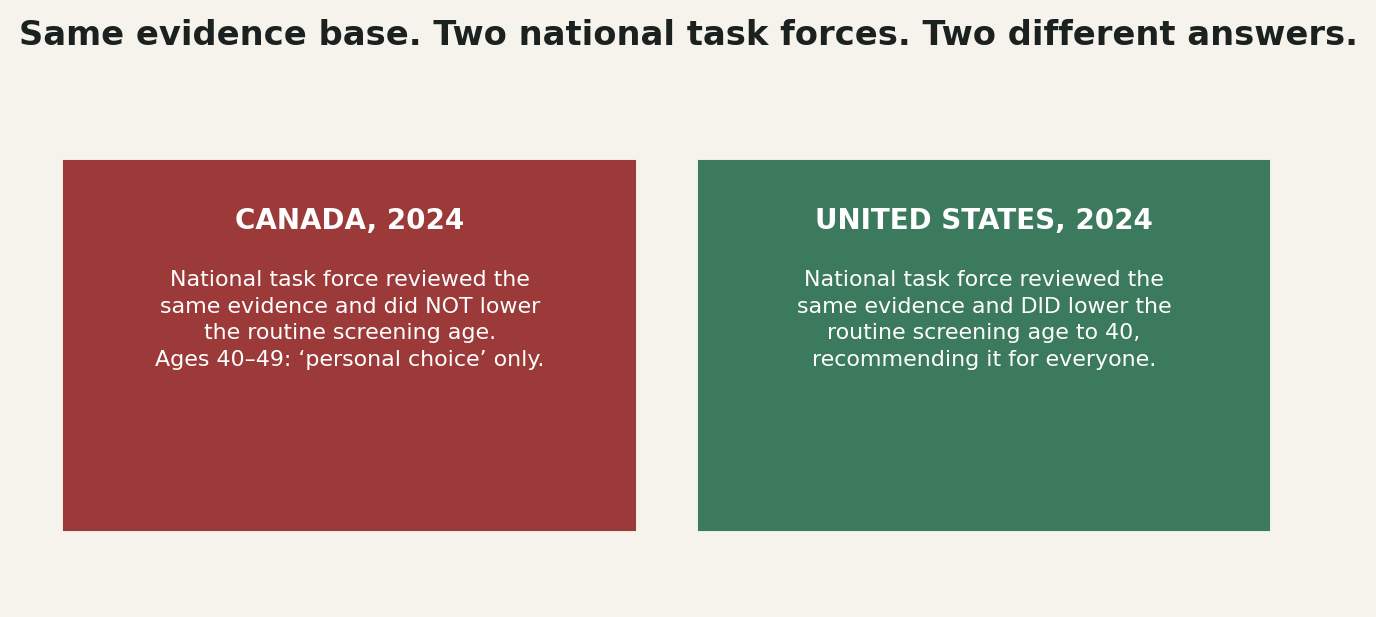
In May 2023, the United States Preventive Services Task Force proposed lowering its routine breast screening age from 50 to 40. Canada's government responded by funding an expedited review of its own guidelines. That review concluded in 2024 — and Canada's Task Force on Preventive Health Care did not lower the routine screening age. Women aged 40 to 49 remain outside routine screening nationally; the task force calls it a "personal choice" and says a mammogram should be available to anyone in that age group who requests one, while explicitly not recommending it.
The decision has been publicly contested by the Canadian Cancer Society, which now calls for screening to begin at 40, and by advocacy groups including Dense Breasts Canada, who have called the guidelines harmful and identified specific errors in how the task force characterised the underlying data in earlier versions. One in eight Canadian women will be diagnosed with breast cancer in her lifetime, and clinicians on both sides of this debate agree that earlier detection improves outcomes; the disagreement is about where the line of net benefit sits for women in their forties specifically.
It is worth understanding both sides honestly rather than picking one. The task force's core concern is genuine: routine screening in a lower-prevalence age group produces more false positives, more biopsies for what turn out to be benign findings, and a real rate of overdiagnosis, and these harms are not nothing. The counter-argument, made by working oncologists and radiologists, is that the task force's estimate of how many cancers actually occur in this age group has been criticised as too low in the past, and that a cancer missed in your forties, when it is more likely to be aggressive, is a very different harm than an unnecessary biopsy. Neither side is arguing in bad faith. The practical consequence for you is the same regardless of which argument you find more persuasive: whether you get screened in your forties currently depends more on your province and your own initiative than on a settled national answer.
While the national guideline held still, provinces did not
Independently of the national task force, several provinces have simply moved anyway. Alberta became the first to lower its own programme's start age, to 45, in 2022. Ontario expanded its provincial screening programme to include ages 40 to 49 starting in autumn 2024. British Columbia and Quebec allow self- referral to screening from 40. Others, including Saskatchewan, Manitoba and the Atlantic provinces, have not moved and still require a physician referral for anyone screened before 50.
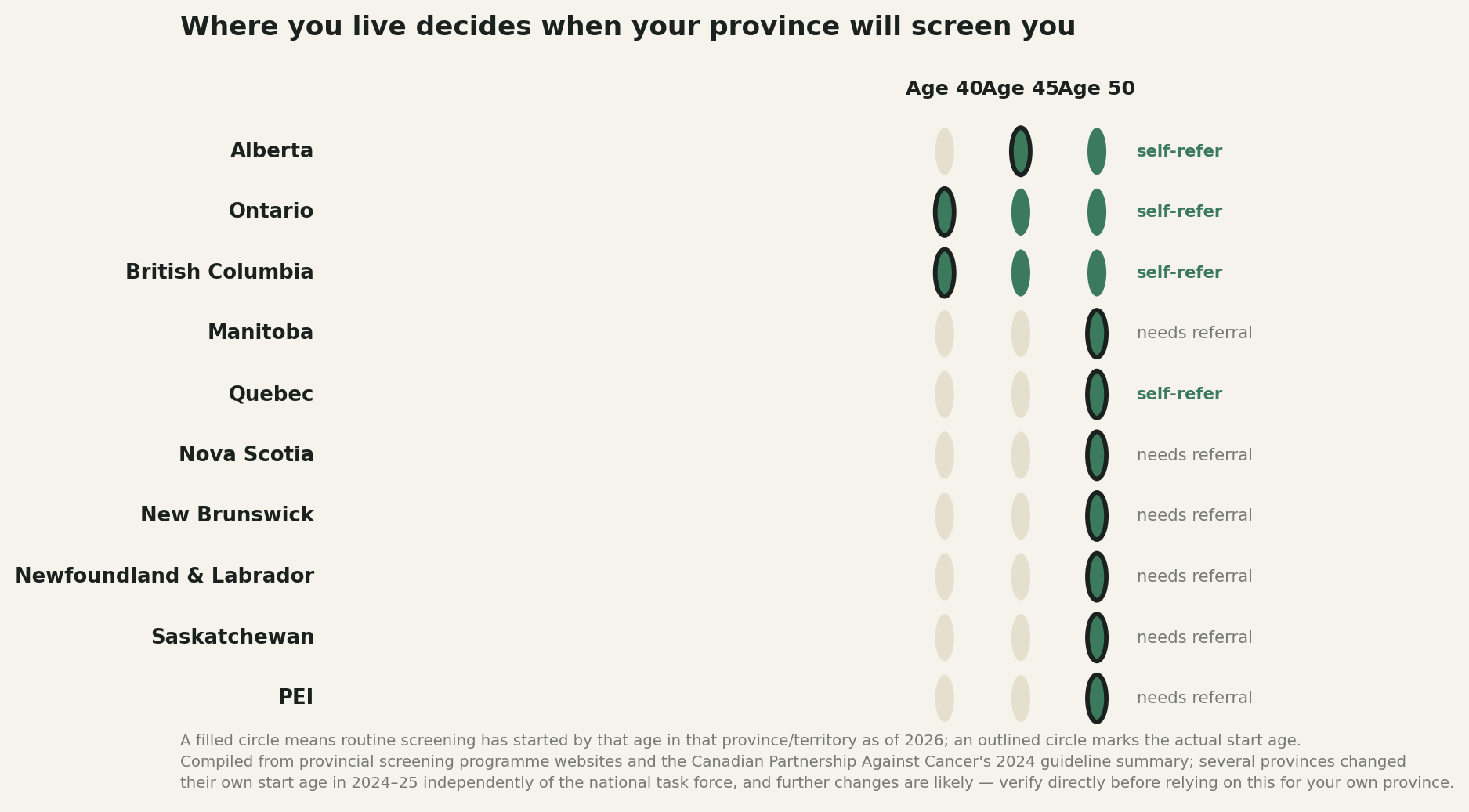
This is the practical shape of the gap: not a single national policy failure, but a genuine postcode lottery. A 43-year-old in Calgary and a 43-year-old in Regina are, as of this writing, offered different things by their own health systems for the same concern.
Density adds a further layer most women are never told about clearly. Roughly forty per cent of women over forty have dense breast tissue, which both raises breast cancer risk somewhat and makes cancers genuinely harder to see on a standard mammogram, since dense tissue and tumours both appear white on the image. Some provinces notify women of their breast density after a mammogram and some do not; where density is not disclosed, a woman may never learn that her own screening result carries more uncertainty than someone with fattier breast tissue. If you know or suspect you have dense breasts, this is worth raising directly and by name with whoever reads your imaging, because supplemental imaging such as ultrasound or MRI is a genuinely different conversation from a standard mammogram alone.
What this actually means for you, and where India fits
If you are 40 to 49, of average risk, and your province requires a referral you cannot easily get, or you want a second read on dense breast tissue, thorough diagnostic imaging — a proper 3D mammogram and, where indicated, a breast MRI — is available quickly and without the same gatekeeping. This is diagnostic clarity, not treatment, and it changes nothing about where you would be treated if something were found. Bring the images and report straight back to a Canadian physician, who can act on them the same as any other imaging.
This is worth being precise about, because it is easy to overstate. This is not a suggestion that Canadians should routinely seek imaging abroad instead of pressing their own system for access. It is an option for a specific, genuinely underserved group: women in their forties in a province without self-referral, who have already tried the referral route and found it slow or unresponsive, and who are not willing to simply wait until they turn fifty.
The same logic applies after a diagnosis, in a different form: a pathology second opinion on your specific tumour, or genomic recurrence-risk testing that helps determine whether chemotherapy adds meaningful benefit for your particular cancer.
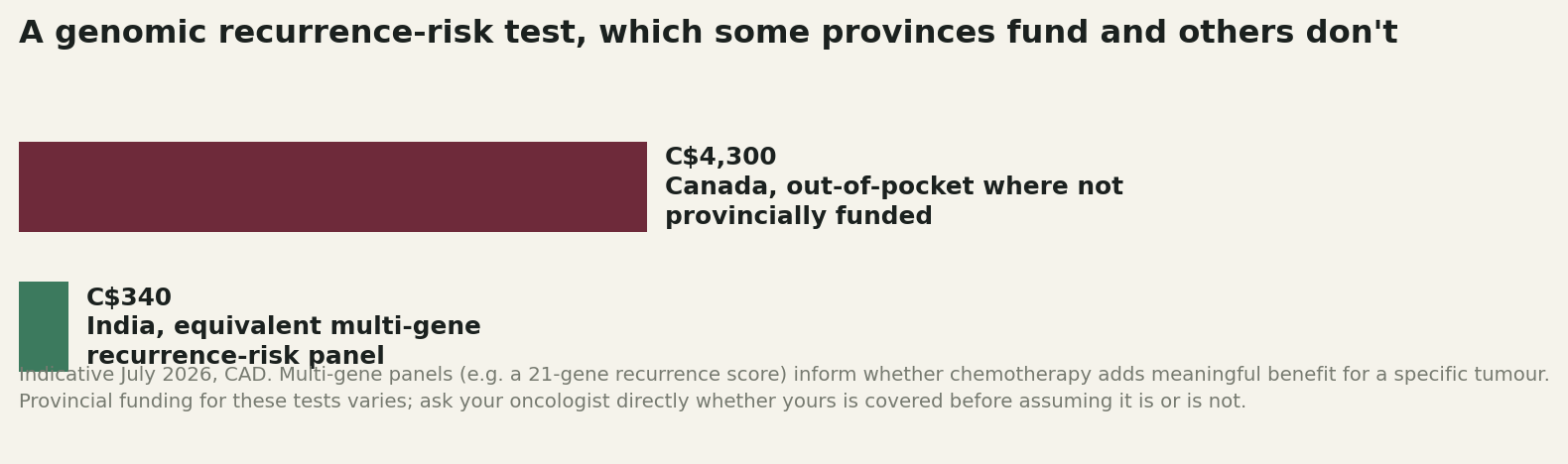
Multi-gene recurrence-score testing is provincially funded in some parts of Canada and not in others, and where it is not funded the out-of-pocket cost is substantial. None of this requires you to travel in person, and in 24 years of guiding patients through decisions like this, the ones who do best are invariably the ones who bring every result straight back to the physician already managing their care, rather than treating a second opinion as a replacement for one.
When actual travel for surgery and reconstruction becomes a concrete advantage
Everything above is about screening access and testing. There is also a genuine, narrower case for having surgery itself, particularly reconstruction, performed in India — and it rests on a wait most newly diagnosed women do not see coming.
Reconstruction is often a second, separate wait, layered on top of cancer treatment. Public wait times from consultation to breast reconstruction surgery commonly run six to eighteen months or longer depending on province, on top of whatever time surgery, chemotherapy and radiation have already taken. For a woman who has just finished a year of active cancer treatment, being told reconstruction itself is a further year away is one of the least-discussed parts of the Canadian breast cancer pathway.
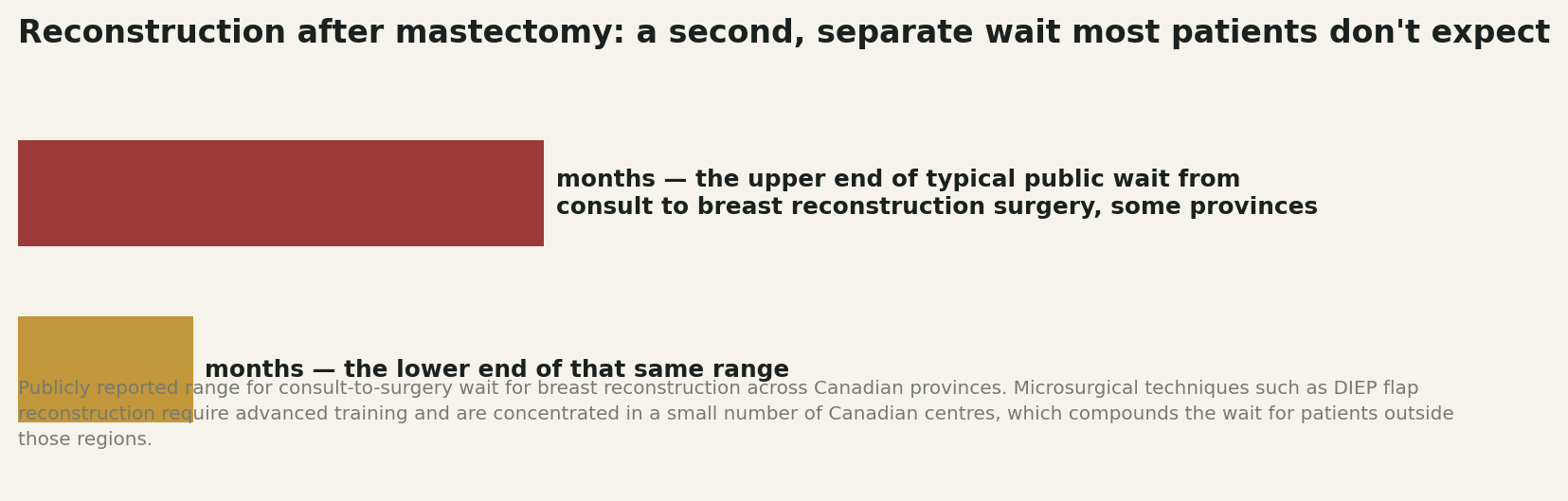
Microsurgical reconstruction is concentrated in very few Canadian centres. DIEP flap reconstruction, which uses a woman's own abdominal tissue to rebuild a natural breast mound without an implant, requires advanced microsurgical training and is genuinely demanding work — connecting blood vessels roughly a millimetre or two in diameter under a surgical microscope. This technique is offered at only a handful of centres nationally, which compounds the wait for anyone outside those specific regions and can mean the difference between DIEP being realistically available to you or not at all.
Bilateral risk-reducing surgery for BRCA and other hereditary carriers. Women who carry a BRCA1, BRCA2 or other high-risk mutation and choose preventive bilateral mastectomy with reconstruction face the same reconstruction bottleneck, often while managing significant anxiety about the cancer risk the surgery is meant to remove. A long wait here is not a delay to treatment of an existing cancer, but it is a long wait to resolve a source of real, ongoing distress.
India's major breast and reconstructive surgery centres perform DIEP and other microsurgical reconstructions in high volumes, with dedicated oncoplastic and microsurgical teams working together rather than a single surgeon managing both cancer removal and reconstruction. In 24 years of guiding patients through decisions like this, reconstruction is where I most often see Canadian women underestimate how long the full pathway actually takes — and it is precisely the part of breast cancer care where a well-chosen high-volume centre abroad can close a gap measured in months, not weeks.
Four Things that Should Make You Walk Away Immediately
Any clinic promising a cure your Canadian oncologist has not heard of. Breast cancer attracts aggressive marketing from unproven clinics. Every legitimate treatment has published trial data with a name you can look up.
Anyone who suggests pausing or delaying treatment already recommended in Canada. A responsible second opinion works alongside your Canadian team, never around them, and never as a reason to wait.
Straight answers for Canadian Patients about Breast Cancer Treatment and Surgery in India
I'm 42 and my province won't screen me without a referral. What should I actually do?
Ask your family doctor directly for a referral first — many will provide one on request even where it isn't automatic. If that route is genuinely closed to you, a private diagnostic imaging pathway is a reasonable next step, with any findings taken straight back to a Canadian physician.
Does this mean Canada's screening guidelines are wrong?
This briefing is not the place to settle that debate; genuinely qualified experts disagree, and the disagreement is real and ongoing. What is not in dispute is that access varies significantly depending on where in Canada you live, and that variation is worth understanding regardless of which side of the guideline debate you find persuasive.
Will my provincial plan or private insurance cover a genomic test if I pay for it privately first?
Rarely, if arranged outside the provincial system. Ask your oncologist whether your specific test is provincially funded before deciding whether to pay privately at all.
Should I travel to India for breast cancer surgery or chemotherapy?
For routine, timely primary treatment, no. Canadian breast cancer treatment is excellent and should remain your standard of care. Travel for surgery becomes a reasonable option in a narrower case: reconstruction, particularly DIEP flap microsurgical reconstruction, where the public wait commonly runs six to eighteen months or longer and the technique is concentrated in only a handful of Canadian centres.
Do I need to travel in person for a pathology second opinion?
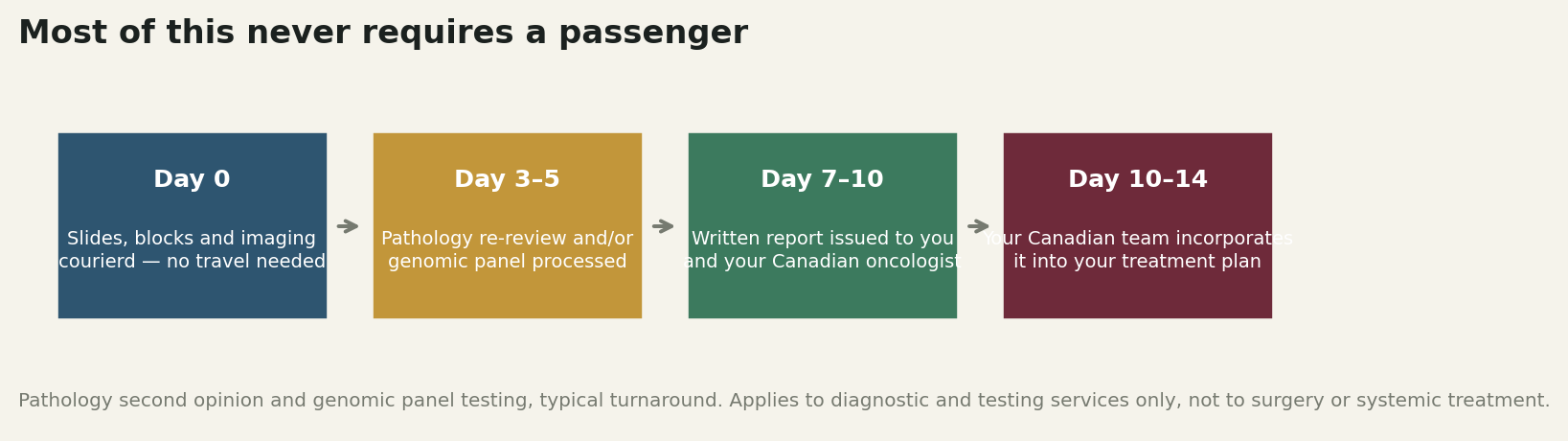
No. Slides, blocks and imaging can be couriered, and a written report returned to you and your Canadian oncologist within one to two weeks.
A closing word
Canada's breast cancer treatment system deserves your trust. The part of the system worth questioning sits earlier, in whether and when you are looked at at all — a genuine, publicly debated gap that depends heavily on your postal code. If that gap applies to you, thorough diagnostic imaging or a pathology second opinion is a reasonable, low-risk way to close it, without changing where you would ultimately be treated. Send me your situation, including your province and age, and I will tell you honestly whether this applies to you.
Sources
- 🌐 Canadian Task Force on Preventive Health Care, Breast Cancer Screening Guideline (2024) — canadiantaskforce.ca
- 🌐 Canadian Cancer Society, "Time for change: Breast screening programs must start at age 40" — cancer.ca
- 🌐 Canadian Partnership Against Cancer, provincial breast screening guideline summary — partnershipagainstcancer.ca
- 🌐 The Globe and Mail, "When are Canadians eligible for breast cancer screenings? Guidelines for each province and territory" — theglobeandmail.com
- 🌐 "Temporal Sequencing of Multimodal Treatment in Immediate Breast Reconstruction and Implications for Wait Times: A Regional Canadian Cross-Sectional Study" — ncbi.nlm.nih.gov/pmc/articles/PMC11489937
- 🌐 High Commission of India, e-Visa categories and eligibility — indianvisaonline.gov.in/evisa
Frequently Asked Questions by Canadian Patients about Breast Cancer Treatment and Surgery in India
Should Canadian women in their forties automatically travel to India for breast screening?
No. The guide does not recommend routine screening abroad. It presents diagnostic imaging in India as a possible option for a specific group facing genuine access barriers after attempting the appropriate Canadian referral pathway.
Why does breast screening access differ across Canada?
Canada's national task force did not lower the routine screening age in its 2024 recommendation, but individual provinces have made different decisions. Alberta, Ontario, British Columbia and Quebec have expanded access for some women aged 40–49, while other provinces retain referral requirements.
What if I have dense breasts?
Dense breast tissue can make cancers harder to identify on a standard mammogram. The guide recommends discussing breast density directly with the imaging team and considering whether supplemental ultrasound or MRI is appropriate.
Can I get a pathology second opinion in India without travelling?
Yes. The guide explains that slides, tissue blocks and imaging can be couriered for review, with a written report returned to the patient and Canadian oncologist.
Is genomic recurrence-risk testing available in India?
Yes. The PDF discusses multi-gene recurrence-risk testing and gives an indicative India cost of approximately C$340, compared with approximately C$4,300 out-of-pocket in Canada where the test is not provincially funded.
Should Canadian patients travel to India for routine breast cancer surgery or chemotherapy?
The guide says no for routine, timely primary treatment. It considers Canadian breast cancer treatment excellent and identifies reconstruction, particularly DIEP flap reconstruction, as the narrower situation where travelling may offer a practical advantage.
Why might breast reconstruction in India be considered?
The guide highlights Canadian reconstruction waits of approximately six to eighteen months or longer in some provinces. It also notes that DIEP flap microsurgical reconstruction is available at only a limited number of Canadian centres.
What is DIEP flap reconstruction?
DIEP flap reconstruction uses a woman's own abdominal tissue to create a breast mound without an implant. It requires advanced microsurgical expertise to connect small blood vessels under a surgical microscope.
What are the indicative costs of breast surgery in India?
The PDF gives approximately C$7,800 for lumpectomy with oncoplastic closure, C$10,500 for mastectomy with immediate implant, C$15,800 for DIEP reconstruction and C$17,200 for bilateral risk-reducing mastectomy with reconstruction.
What warning signs should make a patient avoid a clinic?
Patients should be cautious if a clinic promises an unfamiliar cure, recommends delaying Canadian treatment, gives an opinion without examining the actual tissue, or uses pressure and urgency tactics to sell screening or diagnostic services.
Page Summary
This guide explains breast cancer screening, diagnosis, second opinions, surgery and reconstruction options for Canadian patients considering services in India. It highlights significant provincial differences in screening access for women aged 40–49 and the additional challenges associated with dense breast tissue. The guide presents India as a possible option for selected diagnostic imaging, pathology and genomic testing needs. It identifies breast reconstruction, particularly DIEP flap surgery, as the clearest situation where travelling to India may offer a practical advantage because of long Canadian wait times. It also provides indicative costs and warns patients against unproven clinics, treatment delays and pressure-based medical services.
Citation Block
| Topic | Information |
|---|---|
| Topic | Breast Cancer Treatment and Surgery in India for Canadian Patients |
| Treatment | Breast Cancer Treatment, Surgery and Reconstruction |
| Country | India |
| Intended Audience | Canadian Patients |
| Specialty | Breast Oncology / Reconstructive Surgery |
| Screening Focus | Women Aged 40–49 |
| Reconstruction Wait | Six to Eighteen Months or Longer in Some Public Systems |
| DIEP Flap Reconstruction | Approximately C$15,800 in India |
| Key Reconstruction Option | DIEP Flap Microsurgical Reconstruction |
| Author | Dr. Dheeraj Bojwani |
| Experience | 24+ Years |


Our Mission Statement
Our mission is to place patients at the centre of every healthcare decision by providing trustworthy, evidence-based, and unbiased medical information. We believe that informed patients make better decisions. Backed by personalised guidance from our experienced advisory team, we help patients understand their treatment options, compare them objectively, and confidently choose the path that best suits their medical needs and personal circumstances.
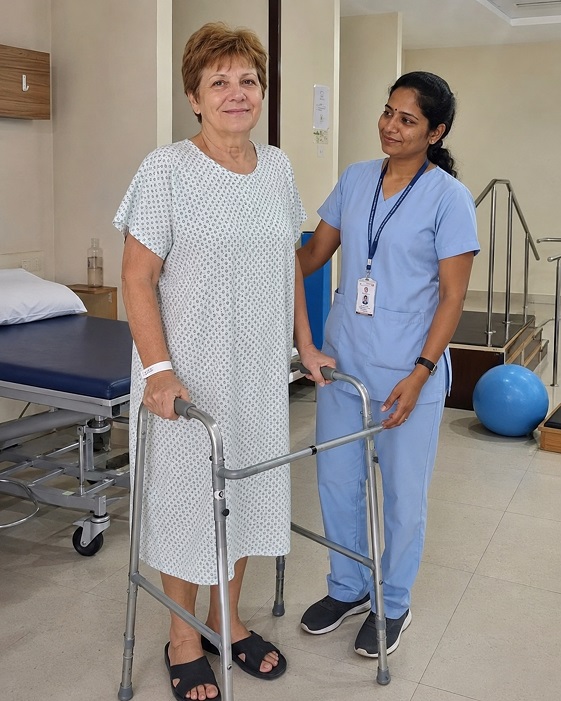
Patient Testimonials from Canada

Ready to Take the First Step?
Share your Medical Reports with our Healthcare Managers Today and Get a FREE CONSULTATION, a Personalized Treatment Plan, and Complete Support from Arrival to Recovery.
Get Your Free ConsultationFrom Canada to India: Your Complete Patient Support Guide
- Weight Loss & Bariatric Surgery in India for Canadian Patients: The Multi-Year Wait, Explained (2026)
- Bone Marrow Transplant in India for Canadian Patients: Complete Guide
- Brain Tumor Surgery in India for Canadian Patients: Complete Guide
- Breast Cancer Treatment and Surgery in India for Canadian Patients
- Cancer Treatment and Surgery in India for Canadian Patients
- Cardiac Surgery in India for Canadian Patients
- Colorectal Cancer Treatment and Surgery in India for Canadian Patients
- Cosmetic and Aesthetic Surgery in India for Canadian Patients
- CyberKnife Treatment in India for Canadian Patients: Complete Guide
- Dental Surgery in India for Canadian Patients | Complete Treatment & Cost Guide
- Gamma Knife Treatment in India for Canadian Patients
- Heart Valve Replacement Surgery in India for Canadian Patients
- Hip Surgery in India for Canadian Patients | Complete Treatment, Cost & Recovery Guide
- HIPEC Surgery in India for Canadian Patients: Complete Guide
- Kidney Transplant in India for Canadian Patients: Complete Guide
- Knee Surgery in India for Canadian Patients: Wait Times & Costs
- Neurosurgery in India for Canadian Patients: Wait Times & Costs
- Paediatric Cardiac Surgery in India for Canadian Patients