

Colorectal Cancer Treatment and Surgery in India for Canadian Patients
Colorectal cancer is falling in Canadians over 50 and rising sharply in Canadians under 50 — a group Canada's screening programmes don't reach at all. For most patients, this is about getting diagnosed properly and treated in Canada. For a specific minority, it is also about knowing when a genuinely better operation exists elsewhere.
A 38-year-old contractor in Kitchener, Ontario. Eight months of intermittent rectal bleeding, dismissed twice as haemorrhoids without examination, because he was "too young to worry about." By the time a colonoscopy was finally ordered, the tumour had grown through the bowel wall and reached two lymph nodes. He is one of 108 patients who told a national survey almost exactly the same story: symptoms explained away, months lost, and a diagnosis that arrived at a later stage than it needed to.
Healing Journeys of Canadian Patients
Key Takeaways
- Colorectal cancer is declining among Canadians over 50 but rising among younger Canadians. The PDF notes that people born since 1980 are now two to two-and-a-half times more likely to be diagnosed before age 50 than previous generations at the same age.
- Canada's organised screening programmes still begin at 50 for average-risk adults, meaning younger patients with symptoms may not fall within routine screening pathways. The guide therefore places particular emphasis on taking symptoms seriously rather than assuming that age makes colorectal cancer unlikely.
- The page 2 visual shows the contrasting trends: colorectal cancer incidence is falling among Canadians 50 and older while rising among those under 50. The guide also notes that rectal cancer accounts for much of the mortality increase seen in younger patients.
- A national survey cited in the PDF found that 67.4% of surveyed early-onset patients were initially misdiagnosed, while 51.2% said they had been dismissed because of their age. Nearly three-quarters of under-50 patients were diagnosed at stage III or IV, compared with roughly half of patients diagnosed over 50.
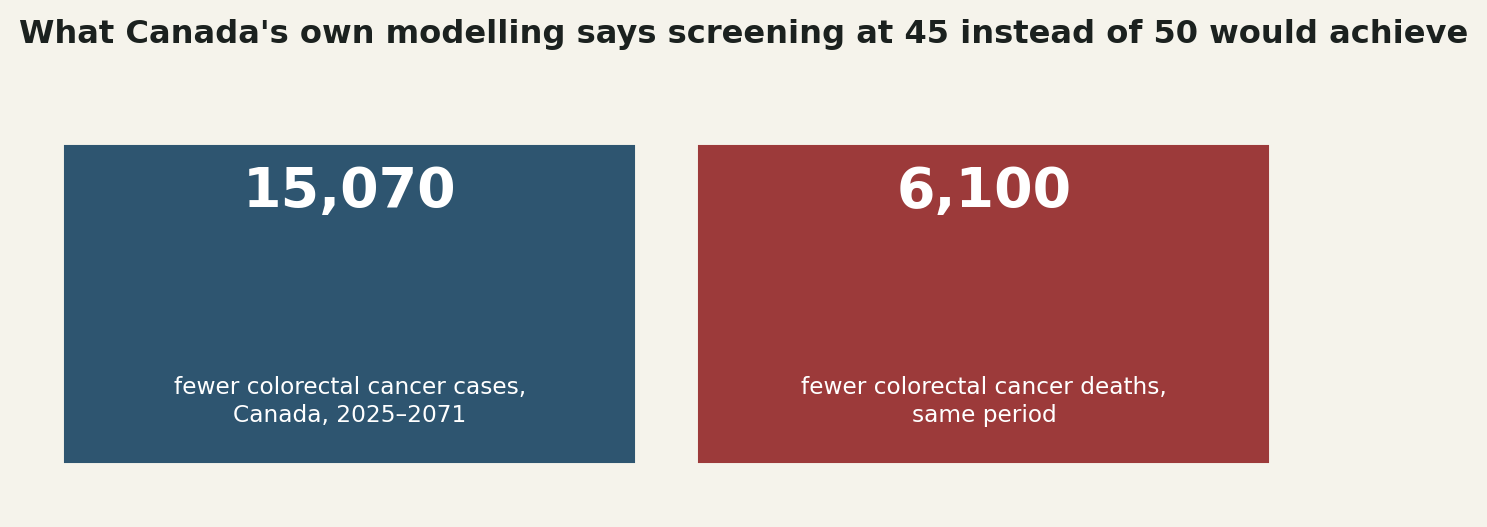
- Canadian modelling presented on page 3 estimates that starting organised screening at 45 instead of 50 could result in approximately 15,070 fewer colorectal cancer cases and 6,100 fewer deaths between 2025 and 2071.
- For diagnosed colorectal cancer, biomarker testing is important. KRAS, NRAS and BRAF status can influence whether certain targeted drugs are appropriate, while MSI and mismatch-repair status can determine eligibility for immunotherapy. The PDF gives an indicative panel cost of approximately C$290 in India versus C$3,400 in Canada where not provincially funded.
- The guide does not recommend routine travel for primary colorectal cancer treatment. It identifies narrower situations where an Indian surgical opinion may be useful, including an unreasonable surgical wait, sphincter-preserving surgery for a low rectal tumour, HIPEC for peritoneal carcinomatosis and liver metastasectomy for oligometastatic disease.
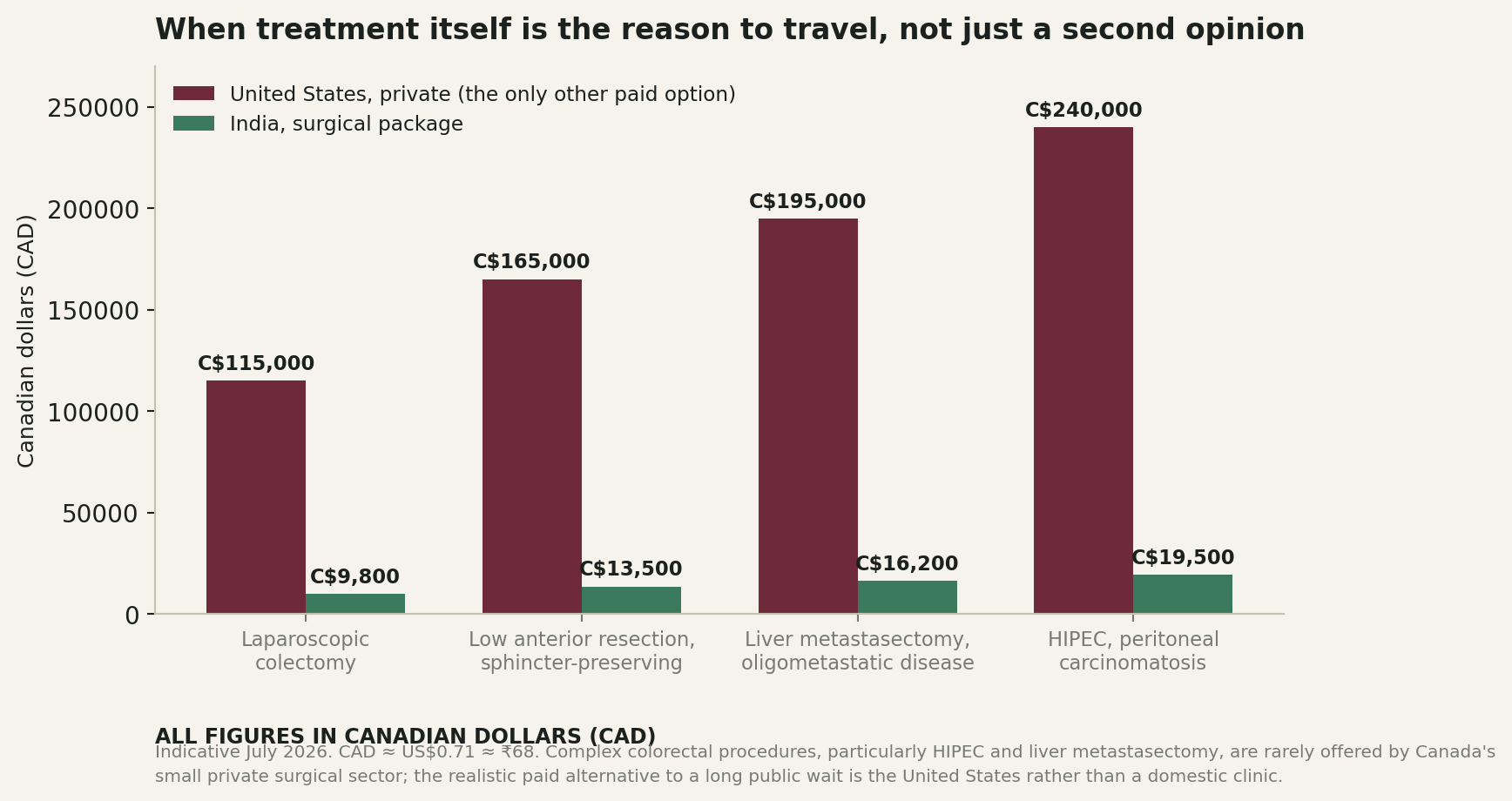
- The page 5 cost chart gives indicative India figures of approximately C$9,800 for laparoscopic colectomy, C$13,500 for low anterior resection with sphincter preservation, C$16,200 for liver metastasectomy and C$19,500 for HIPEC, compared with substantially higher US private-care figures.
Quick Facts
- Treatment
- Colorectal Cancer Treatment and Surgery
- Country
- India
- Patients
- Canadian Patients
- Specialty
- Colorectal Oncology / Surgical Oncology
- Key Age Group
- Canadians Under 50 With Symptoms
- Canadian Screening Age
- 50 for Average-Risk Adults
- Early-Onset Risk
- Two to Two-and-a-Half Times Higher for Canadians Born Since 1980
- Initial Misdiagnosis
- 67.4% in the Cited National Survey
- Reported Dismissal Due to Age
- 51.2%
- Stage III/IV Diagnosis
- Nearly Three-Quarters of Under-50 Patients
- Screening Modelled at Age 45
- 15,070 Fewer Cases and 6,100 Fewer Deaths
- Second Opinion
- High-Volume Colorectal / Hepatobiliary Team
- Follow-Up
- Canadian Oncologist / Surgical Team
- Important Principle
- Do Not Delay or Abandon Recommended Canadian Treatment
In Brief
For Canadian patients, particularly those under 50 with persistent colorectal symptoms, the first priority is timely investigation rather than travelling abroad for treatment. Once colorectal cancer is diagnosed, Canada remains the standard setting for routine primary treatment. India may be considered for specific second opinions, biomarker testing, or technically demanding procedures such as sphincter-preserving rectal surgery, HIPEC or liver metastasectomy when a high-volume specialist opinion could meaningfully change the treatment plan.
Most of what follows is an argument for staying in Canada, with a warning attached
Canadian colorectal cancer treatment — surgery, chemotherapy, radiation — is genuinely excellent, and in 24 years of guiding international patients into Indian hospitals I have never suggested a Canadian with this diagnosis should have primary treatment anywhere else. This briefing is about something narrower and, for one specific group, more urgent: getting taken seriously and diagnosed in the first place, if you are under 50.
Two trend lines moving in opposite directions
Colorectal cancer in Canadians over 50 has been getting rarer for two decades, largely because organised screening from age 50 works. Colorectal cancer in Canadians under 50 has been doing the opposite.
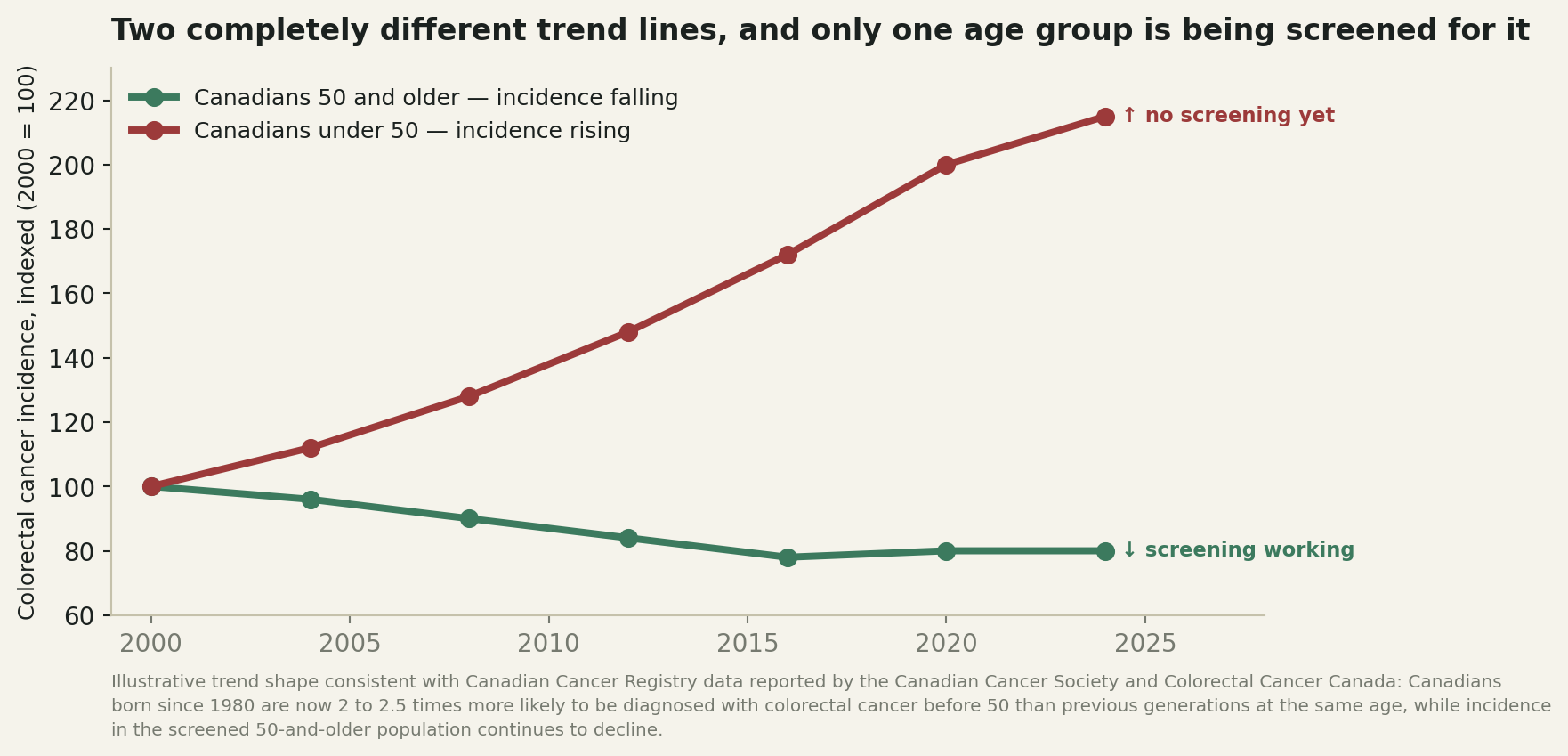
Canadians born since 1980 are now two to two-and-a-half times more likely to be diagnosed with colorectal cancer before turning 50 than previous generations were at the same age. Colorectal cancer is the second leading cause of cancer death in Canada overall, and it is one of the fastest-rising cancers specifically in people under 50 — a group Canada's organised screening programmes, which start at 50 in every province, do not reach at all.
The rise is not evenly spread across the disease. Research examining Canadian patients under 50 found rectal cancer specifically, rather than colon cancer generally, driving much of the mortality increase between 2000 and 2018, and tumours in this age group are more likely to be located in the rectum than in older patients. This matters clinically, because rectal cancer often changes the treatment sequence entirely, sometimes calling for chemotherapy and radiation before surgery rather than after, and it is exactly the kind of detail that gets missed when a diagnosis arrives late and a treatment plan has to move quickly to catch up.
What that gap actually does to a person
The Canadian Cancer Society is now formally campaigning to lower the national screening age to 45, and the case rests on more than incidence numbers.
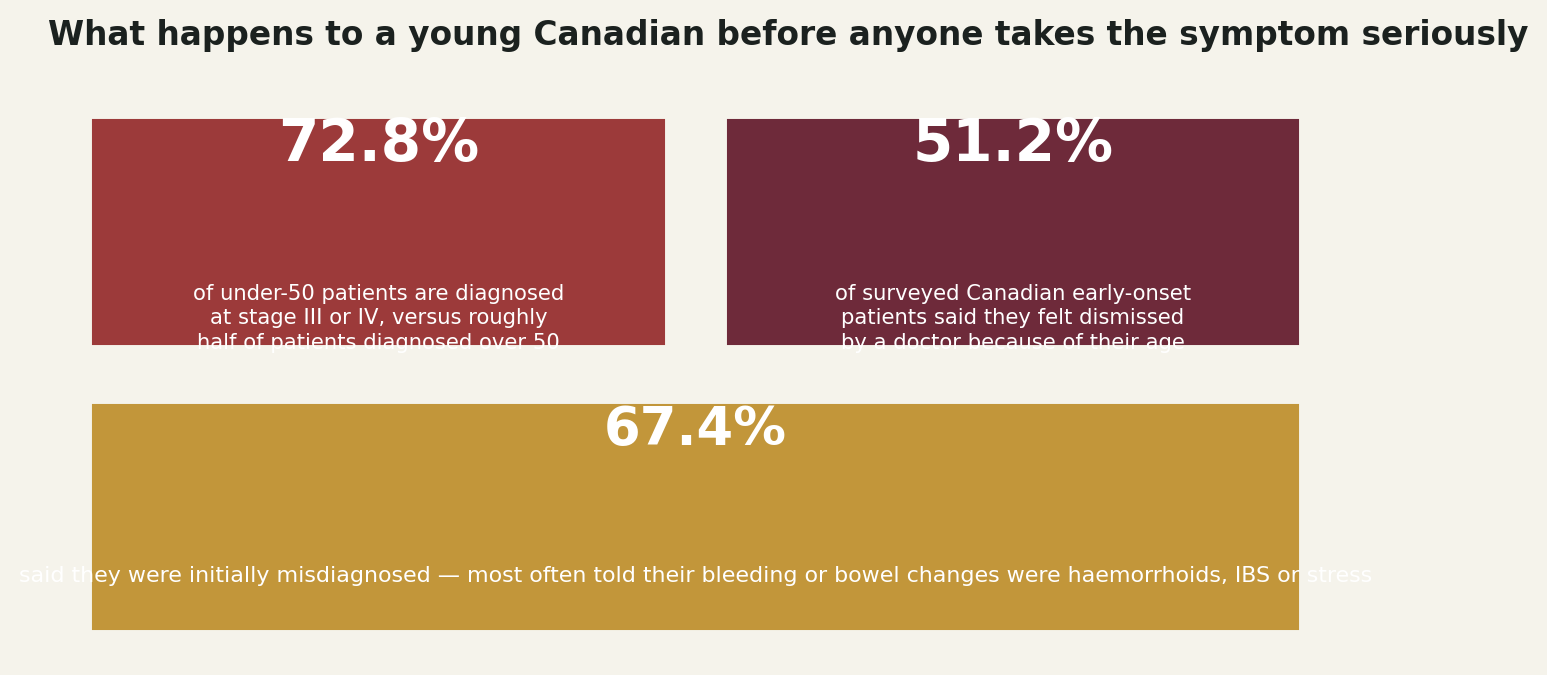
A national survey of Canadian early-onset patients, run by Colorectal Cancer Canada, found that two in three respondents were initially misdiagnosed — most often told their symptoms were haemorrhoids, irritable bowel syndrome or stress — and just over half felt actively dismissed by a doctor because of their age. The clinical consequence shows up directly in staging: nearly three-quarters of under-50 patients are diagnosed at stage III or IV, against roughly half of patients diagnosed over 50. This is not a story about worse biology in younger patients. It is a story about time lost before anyone looked.
What Canada's own modelling says the fix would achieve
Canadian researchers modelled what would happen if organised screening began at 45 instead of 50, using Canadian Cancer Registry data projected out to 2071.
Since 2025, several countries — the United States, Australia, Japan and Taiwan among them — have already lowered their own screening age to 45. As of this writing, every Canadian province still screens average-risk adults starting at 50, and the earliest changes, where they have been proposed at all, remain under review rather than implemented.
The Canadian Cancer Society has been explicit that lowering the age alone will not be enough. Their public position calls for provinces to fully fund organised screening programmes and reach at least sixty per cent participation among the eligible population in a timely way, alongside aligning guidelines for people at both average and elevated risk, such as those with a family history or inflammatory bowel disease. In 24 years of watching health systems debate exactly this kind of policy question, the gap between announcing a lower screening age and a province actually having the colonoscopy capacity to deliver on it is often measured in years, which is precisely why a patient with symptoms today cannot simply wait for the policy to catch up.
Where this leaves you if you are under 50 with a real symptom
If you are under 50 and have rectal bleeding, a persistent change in bowel habit, unexplained abdominal pain, or unintentional weight loss, the single most useful thing you can do is insist on investigation rather than accept a reassurance you were not examined to earn. If a Canadian physician has already declined to investigate and the symptom persists, a second opinion — including a colonoscopy read by an experienced endoscopist — is a reasonable, low-risk step, and one that changes nothing about where you would be treated if something were found. The same applies after a diagnosis: biomarker testing that determines which drugs will actually work against your specific tumour.
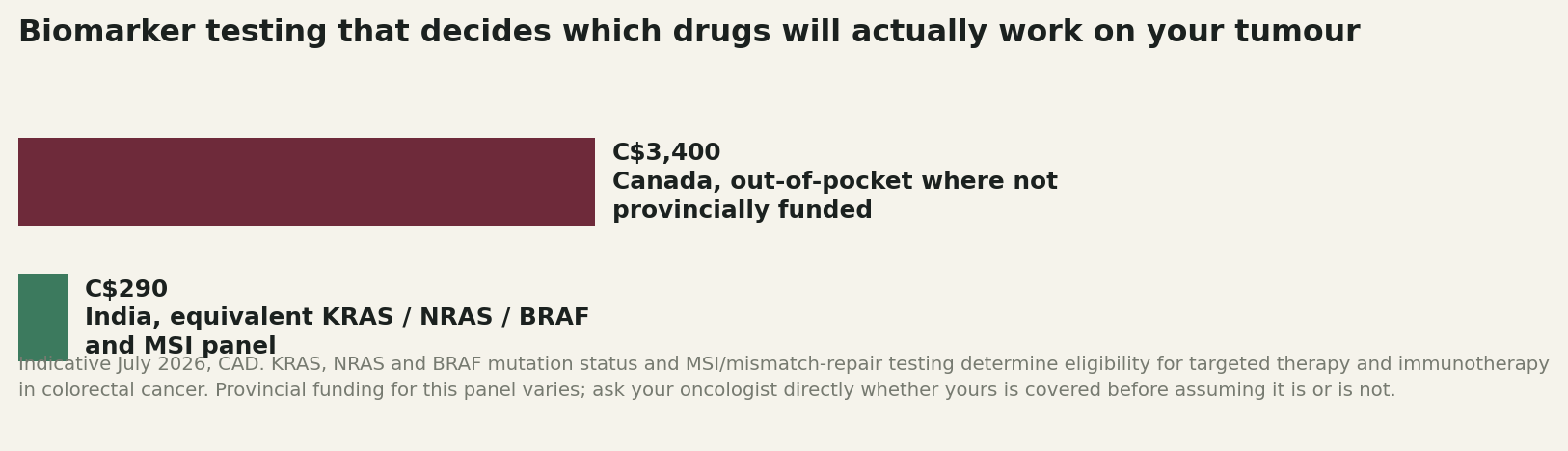
KRAS, NRAS and BRAF mutation status determine whether certain targeted drugs will work at all — giving them to a tumour with the wrong mutation profile is not just ineffective, it can be actively harmful. MSI and mismatch-repair status determines eligibility for immunotherapy, which can be transformative for the right tumour. Provincial funding for this panel varies, and where it is not funded the out-of-pocket cost is real.
None of this requires travel in person. Tissue blocks are stable and ship well internationally with proper documentation, and a written report returns to you and your Canadian oncologist within days rather than weeks.
When actual travel for treatment becomes a reasonable option
Everything above is about second opinions and testing. There is a narrower, genuine case for travelling to India for the operation itself, and it applies to a specific minority of colorectal cancer patients — not the routine case, but a real one worth naming plainly.
Your surgical wait has become genuinely unreasonable. Colorectal cancer surgery is one of the five cancer procedures Canada tracks nationally, and, as covered in this series' general cancer briefing, it carries no formal benchmark and median wait times have lengthened since 2019. If your surgical team cannot give you a defensible date and the wait is stretching into months for a cancer that is, by definition, growing while you wait, a second surgical opinion abroad is a reasonable, not a reckless, response.
Sphincter-preserving surgery for a low rectal tumour. Whether a low rectal cancer can be removed while preserving the sphincter, avoiding a permanent colostomy, depends heavily on surgeon and centre volume in this specific, technically demanding operation. High-volume Indian colorectal units performing low anterior resections in large numbers routinely achieve sphincter preservation in situations where a lower-volume unit might reasonably default to a permanent stoma. This is a genuine, quality-of-life- defining difference, and it is worth a dedicated second opinion before accepting a stoma as inevitable.
HIPEC for peritoneal carcinomatosis. Hyperthermic intraperitoneal chemotherapy, combined with cytoreductive surgery, is offered at only a small number of Canadian centres, reflecting how technically demanding and resource-intensive the combined procedure is. Major Indian cancer centres perform HIPEC in substantially higher volumes, and for the right patient with peritoneal spread, this volume difference translates directly into surgical outcomes.
Liver metastasectomy for oligometastatic disease. When colorectal cancer has spread to a limited number of liver lesions, resection can be curative in the right patient, and the decision of what is resectable varies meaningfully with a surgical team's hepatobiliary experience. A high-volume hepatobiliary and colorectal team working together, common at large Indian cancer centres, can sometimes offer resection where a lower-volume opinion concludes the disease is inoperable. This is precisely the kind of case where a second opinion from a genuinely high-volume unit can change the treatment plan, not just its location.
Complex colorectal surgery of this kind is rarely offered by Canada's small private surgical sector; HIPEC and major hepatobiliary resections require infrastructure those clinics generally do not have. For a Canadian facing a genuinely long public wait, or a second opinion that changes an "inoperable" verdict to an operable one, the realistic paid alternative is the United States rather than a domestic clinic — and India competes on the same substance described throughout this series: real volume in technically demanding procedures, dedicated colorectal and hepatobiliary teams working together, and a fraction of the American price. In 24 years of guiding patients through decisions like this, the cases that matter most are rarely about price alone; they are about a surgeon somewhere else being willing to attempt what a surgeon at home, entirely reasonably, was not.
Four Things that Should Make You Walk Away Immediately
Any clinic promising a cure your Canadian oncologist has not heard of. Colorectal cancer, like every cancer, attracts aggressive marketing from unproven clinics. Every legitimate treatment has published trial data with a name you can look up.
Anyone who suggests pausing or delaying treatment already recommended in Canada. A responsible second opinion or biomarker panel works alongside your Canadian team, never as a reason to wait.
A treatment recommendation offered without your actual tissue or scope findings being examined. Insist your own pathology and imaging are the basis of any opinion, not a description of your symptoms.
Pressure to decide quickly, or discomfort with you keeping your Canadian doctor informed. A genuine second opinion is offered calmly and welcomes being shared with your existing care team.
Straight answers for Canadian Patients about Colorectal Cancer Treatment and Surgery in India
I'm 41 with rectal bleeding and I've been told it's haemorrhoids twice. What should I do?
Ask directly for a referral for colonoscopy or, at minimum, a proper examination rather than a verbal reassurance. If that is refused and the symptom persists, seek a second opinion, whether in Canada or through a courier-based pathology and endoscopy review abroad.
Is Canada actually going to lower the screening age?
Canadian Cancer Society and Colorectal Cancer Canada are actively campaigning for it as of 2026, and several peer countries have already moved to 45. No province has implemented the change nationally as of this writing; check current status directly with your provincial screening programme.
Should I travel to India for colorectal cancer surgery or chemotherapy?
For routine, timely primary treatment, no. Canadian colorectal cancer treatment is excellent and should remain your standard of care. Travel for the operation itself becomes a reasonable option in narrower circumstances: a genuinely unreasonable surgical wait, a low rectal tumour where sphincter preservation is in question, peritoneal spread where HIPEC is being considered, or liver metastases where a second opinion might change an inoperable verdict.
Will my provincial plan cover a biomarker panel if I pay for it privately first?
Rarely, if arranged outside the provincial system. Ask your oncologist whether your specific panel is provincially funded before deciding whether to pay privately at all.
Do I need to travel in person for a second opinion or biomarker testing?
No. Tissue blocks, slides and imaging can be couriered, with a written report returned to you and your Canadian physician, typically within one to two weeks.
A closing word
Canada's colorectal cancer treatment system deserves your trust once a diagnosis is made. The part worth questioning, urgently if you are under 50, is what happens before that — whether a real symptom gets investigated or explained away. If you are in that position, or holding a treatment plan you want a second look at, send me your situation and I will tell you honestly whether this applies to you.
Sources
- 🌐 Canadian Cancer Society, "Canadian Cancer Society urges lowering colorectal cancer screening age to 45" (2026) — cancer.ca
- 🌐 Colorectal Cancer Canada, Never Too Young / Screen at 45 — colorectalcancercanada.com/screenat45
- 🌐 "A Survey Detailing Early Onset Colorectal Cancer Patient and Caregiver Experiences in Canada", PMC — ncbi.nlm.nih.gov/pmc/articles/PMC11203371
- 🌐 "Canadian considerations on updating the age of initiation for colorectal cancer screening", Canadian Journal of Surgery — canjsurg.ca/content/68/4/E313
- 🌐 High Commission of India, e-Visa categories and eligibility — indianvisaonline.gov.in/evisa
Frequently Asked Questions by Canadian Patients about Colorectal Cancer Treatment and Surgery in India
Why is colorectal cancer an important concern for Canadians under 50?
The PDF notes that Canadians born since 1980 are now two to two-and-a-half times more likely to develop colorectal cancer before 50 than previous generations. Yet average-risk organised screening in Canada still begins at 50.
What symptoms should a younger Canadian not ignore?
Rectal bleeding, persistent changes in bowel habits, unexplained abdominal pain and unintentional weight loss should be investigated rather than automatically attributed to haemorrhoids, IBS or stress.
What should I do if my rectal bleeding has already been dismissed?
The guide recommends asking directly for appropriate investigation, including colonoscopy or a proper examination. If symptoms persist and investigation is refused, seeking a second opinion is reasonable.
Why are KRAS, NRAS and BRAF tests important?
These mutation results can determine whether certain targeted drugs are likely to work against the tumour. Giving a targeted treatment without the appropriate molecular profile may be ineffective and potentially harmful.
What does MSI or mismatch-repair testing show?
MSI and mismatch-repair status can help determine whether a patient may be eligible for immunotherapy. The relevance depends on the individual tumour and treatment plan.
Do I need to travel to India for biomarker testing?
Usually not. The PDF explains that tissue blocks and slides can be transported internationally with proper documentation, allowing a written report to be returned to the patient and Canadian oncologist without the patient travelling.
When might colorectal cancer surgery in India be worth considering?
The guide identifies a few narrower situations: an unreasonable surgical wait, a low rectal tumour where sphincter preservation is uncertain, peritoneal spread where HIPEC is being considered, or limited liver metastases where a high-volume team may reassess resectability.
What is sphincter-preserving surgery?
For selected low rectal cancers, surgery may sometimes remove the tumour while preserving the anal sphincter and avoiding a permanent colostomy. The PDF emphasizes that surgeon and centre experience can be important in these technically demanding cases.
What is the indicative cost of HIPEC in India?
The PDF's page 5 chart gives an indicative India surgical-package figure of approximately C$19,500 for HIPEC for peritoneal carcinomatosis. Actual costs depend on the patient's disease and surgical requirements.
Should Canadian patients stop their treatment to travel to India?
No. The guide repeatedly emphasizes that a second opinion or treatment abroad should never be used as a reason to delay or abandon treatment already recommended by the Canadian oncology team.
Page Summary
This guide focuses on colorectal cancer in Canadian patients, particularly the rising incidence among people under 50 who may not be reached by routine screening. It highlights the risk of symptoms being dismissed or misdiagnosed and explains the importance of timely investigation, colonoscopy and appropriate biomarker testing. The guide does not recommend routine travel for colorectal cancer treatment but identifies selected situations where India may offer a useful high-volume surgical second opinion, including sphincter-preserving rectal surgery, HIPEC and liver metastasectomy. It also provides indicative biomarker and surgical cost comparisons and emphasizes continued coordination with the Canadian medical team.
Citation Block
| Topic | Information |
|---|---|
| Topic | Colorectal Cancer Treatment and Surgery in India for Canadian Patients |
| Treatment | Colorectal Cancer Treatment and Surgery |
| Country | India |
| Intended Audience | Canadian Patients |
| Specialty | Colorectal Oncology / Surgical Oncology |
| Key Concern | Rising Early-Onset Colorectal Cancer |
| Canadian Screening Age | 50 for Average-Risk Adults |
| Early-Onset Risk | Two to Two-and-a-Half Times Higher for Canadians Born Since 1980 |
| Initial Misdiagnosis | 67.4% in Cited Survey |
| Age-Based Dismissal | 51.2% in Cited Survey |
| Stage III/IV Diagnosis | Nearly Three-Quarters of Under-50 Patients |
| Follow-Up | Canadian Oncology / Surgical Team |
| Author | Dr. Dheeraj Bojwani |
| Experience | 24+ Years |


Our Mission Statement
Our mission is to place patients at the centre of every healthcare decision by providing trustworthy, evidence-based, and unbiased medical information. We believe that informed patients make better decisions. Backed by personalised guidance from our experienced advisory team, we help patients understand their treatment options, compare them objectively, and confidently choose the path that best suits their medical needs and personal circumstances.
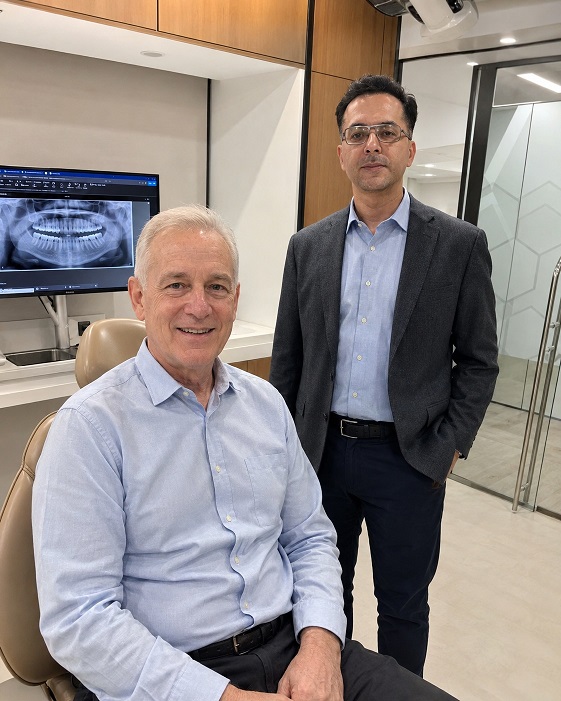
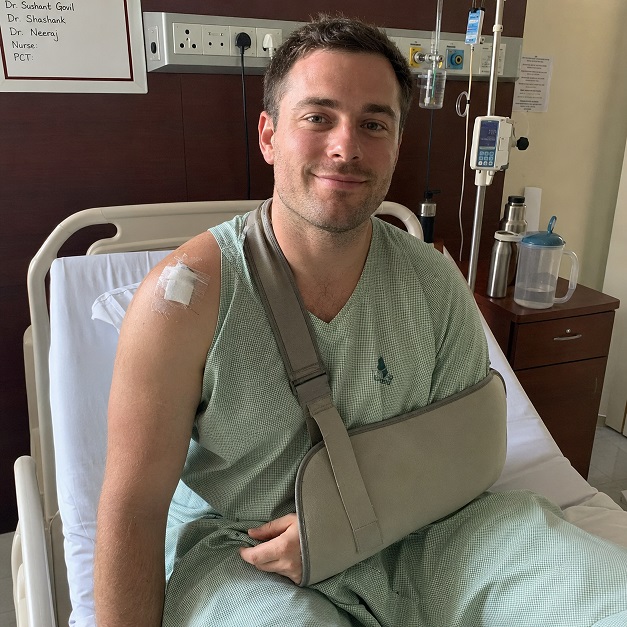
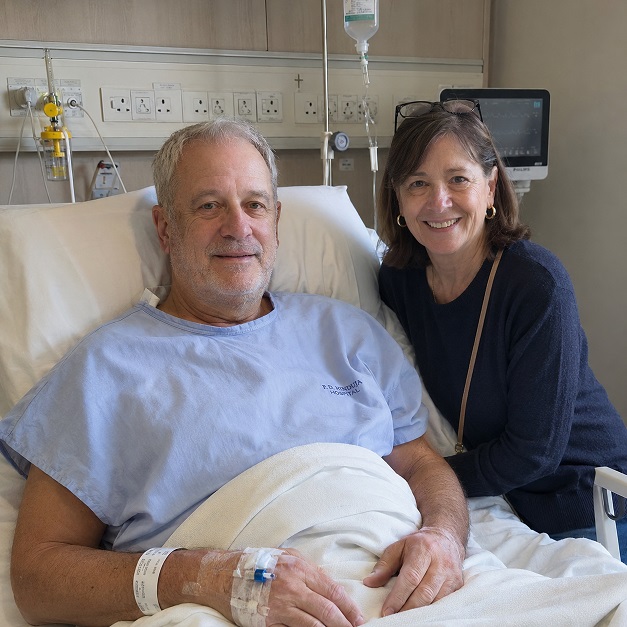
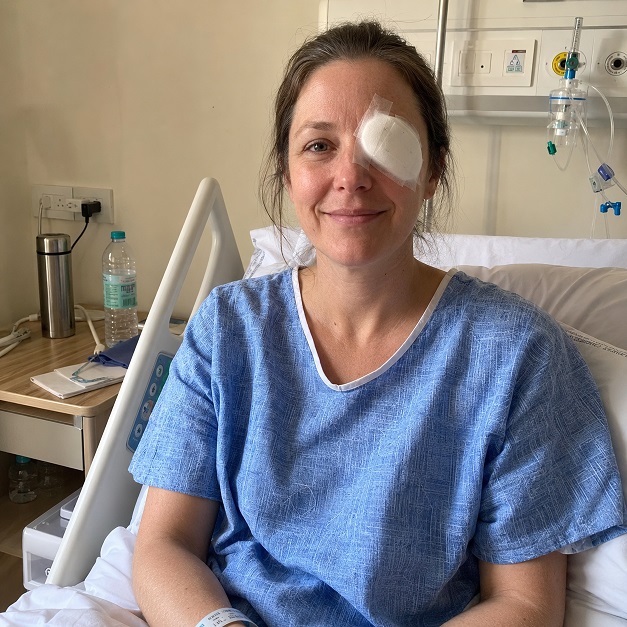
Patient Testimonials from Canada



Ready to Take the First Step?
Share your Medical Reports with our Healthcare Managers Today and Get a FREE CONSULTATION, a Personalized Treatment Plan, and Complete Support from Arrival to Recovery.
Get Your Free ConsultationFrom Canada to India: Your Complete Patient Support Guide
- Weight Loss & Bariatric Surgery in India for Canadian Patients: The Multi-Year Wait, Explained (2026)
- Bone Marrow Transplant in India for Canadian Patients: Complete Guide
- Brain Tumor Surgery in India for Canadian Patients: Complete Guide
- Breast Cancer Treatment and Surgery in India for Canadian Patients
- Cancer Treatment and Surgery in India for Canadian Patients
- Cardiac Surgery in India for Canadian Patients
- Colorectal Cancer Treatment and Surgery in India for Canadian Patients
- Cosmetic and Aesthetic Surgery in India for Canadian Patients
- CyberKnife Treatment in India for Canadian Patients: Complete Guide
- Dental Surgery in India for Canadian Patients | Complete Treatment & Cost Guide
- Gamma Knife Treatment in India for Canadian Patients
- Heart Valve Replacement Surgery in India for Canadian Patients
- Hip Surgery in India for Canadian Patients | Complete Treatment, Cost & Recovery Guide
- HIPEC Surgery in India for Canadian Patients: Complete Guide
- Kidney Transplant in India for Canadian Patients: Complete Guide
- Knee Surgery in India for Canadian Patients: Wait Times & Costs
- Neurosurgery in India for Canadian Patients: Wait Times & Costs
- Paediatric Cardiac Surgery in India for Canadian Patients