

Heart Valve Replacement Surgery in India for Canadian Patients
Mechanical or tissue is the decision every valve patient faces, and even the guidelines admit there is a wide range where they cannot settle it for you. Your geography belongs in that conversation as much as your age does.
A 47-year-old electrician outside Regina. A bicuspid aortic valve, known since childhood, now failing. His surgeon has offered him a choice: a mechanical valve, which will very likely outlast him but commits him to warfarin and regular blood tests for the rest of his life, or a tissue valve, which needs no blood thinner but will probably need replacing again in twelve to fifteen years, when he is still only in his late fifties or early sixties. Nobody has told him yet that the nearest anticoagulation clinic to his farm is ninety minutes away, in winter conditions that regularly close that road for days at a time. That fact belongs in the decision as much as any guideline does.
Healing Journeys of Canadian Patients
Key Takeaways
- The guide focuses on one of the main decisions in valve replacement: mechanical versus tissue valve, explaining that age alone should not determine the choice.
- The document uses the example of a 47-year-old Canadian patient with a failing bicuspid aortic valve. A mechanical valve offers greater durability but requires lifelong warfarin and regular INR monitoring, while a tissue valve avoids lifelong anticoagulation but may require another replacement later.
- ACC/AHA guidance cited in the document considers a mechanical valve reasonable below age 50, while European guidance extends similar reasoning to approximately age 65.
- The guide describes approximately 50–70 years as a genuine decision-making grey zone where individual circumstances become particularly important.
- For Canadian patients, geographical access to INR testing should be considered before choosing a mechanical valve, particularly for people living in rural or remote areas.
- Regular INR blood testing is generally required for life after mechanical valve replacement and is typically monthly once the patient is stable.
- The guide discusses point-of-care self-testing and newer mechanical valve designs such as On-X, although these do not eliminate the need for regular anticoagulation monitoring.
- A Ross procedure is presented as another option worth discussing in selected younger patients with aortic valve disease.
- For leaking mitral valves, the document recommends a repair-first discussion where feasible, rather than automatically proceeding to valve replacement.
- Patients should ask for the surgeon's annual volume in the exact valve position and procedure. For mitral valve surgery, the surgeon's own repair rate should also be requested.
Quick Facts
- Treatment
- Heart Valve Replacement and Repair
- Country
- India
- Intended Audience
- Canadian Patients and Families
- Primary Decision
- Mechanical Valve vs Tissue Valve
- Mechanical Valve
- Greater Durability With Lifelong Anticoagulation
- Tissue Valve
- Avoids Lifelong Anticoagulation but May Require Future Replacement
- ACC/AHA Age Context
- Mechanical Valve Reasonable Below Age 50
- European Age Context
- Similar Reasoning Extending to Approximately Age 65
- Decision Grey Zone
- Approximately 50–70 Years
- Alternative Procedure
- Ross Procedure
- Mechanical Valve Monitoring
- Regular Lifelong INR Testing
- Canadian Follow-Up
- Named Cardiologist or Anticoagulation Provider
- Author
- Dr. Dheeraj Bojwani
- Experience
- 24 Years' Experience
In Brief
Canadian patients considering heart valve surgery in India should evaluate mechanical versus tissue valve choice according to age, durability, lifestyle and access to lifelong anticoagulation monitoring. The guide also recommends discussing mitral valve repair where feasible and the Ross procedure for selected younger aortic-valve patients. Surgeon selection should be based on experience with the exact valve procedure, while Canadian cardiology and INR follow-up should be arranged before treatment.
The decision that matters most is not made in the operating room
Every guideline on heart valve replacement agrees on the broad shape of the choice and disagrees, in a genuinely unresolved way, about where the line sits. Canadian cardiac surgeons make this decision well, and in 24 years of guiding international patients into Indian hospitals I have never suggested otherwise. What I want to add to the conversation is the piece guidelines cannot account for: where you actually live, and what that means for the choice in front of you.
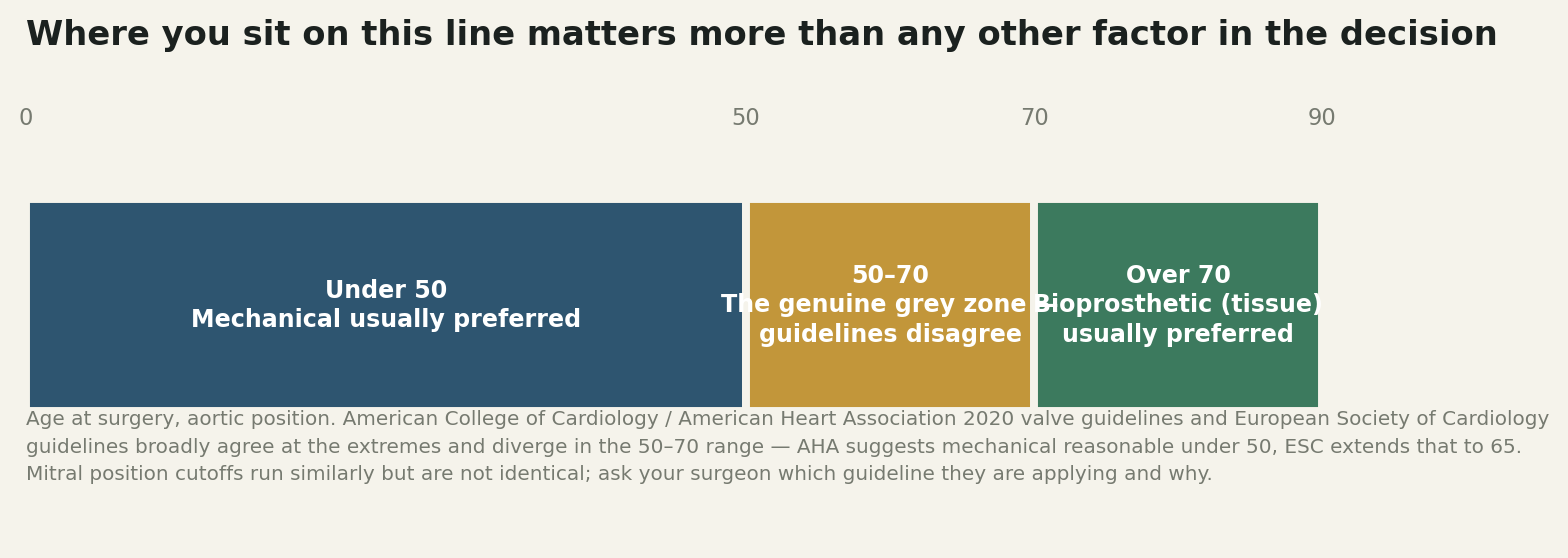
American College of Cardiology and American Heart Association guidance treats a mechanical valve as reasonable under fifty; European Society of Cardiology guidance extends that reasoning to sixty-five. Between roughly fifty and seventy, both major guideline bodies acknowledge there is no settled answer, and the decision genuinely comes down to the individual patient's circumstances rather than a formula. That grey zone is exactly where geography, not just biology, deserves a seat at the table.
Why the choice is heavier for younger patients
A tissue valve avoids lifelong anticoagulation, which matters. It also structurally deteriorates faster in younger, more metabolically active patients, which is why reoperation rates climb sharply the earlier in life the first valve goes in.
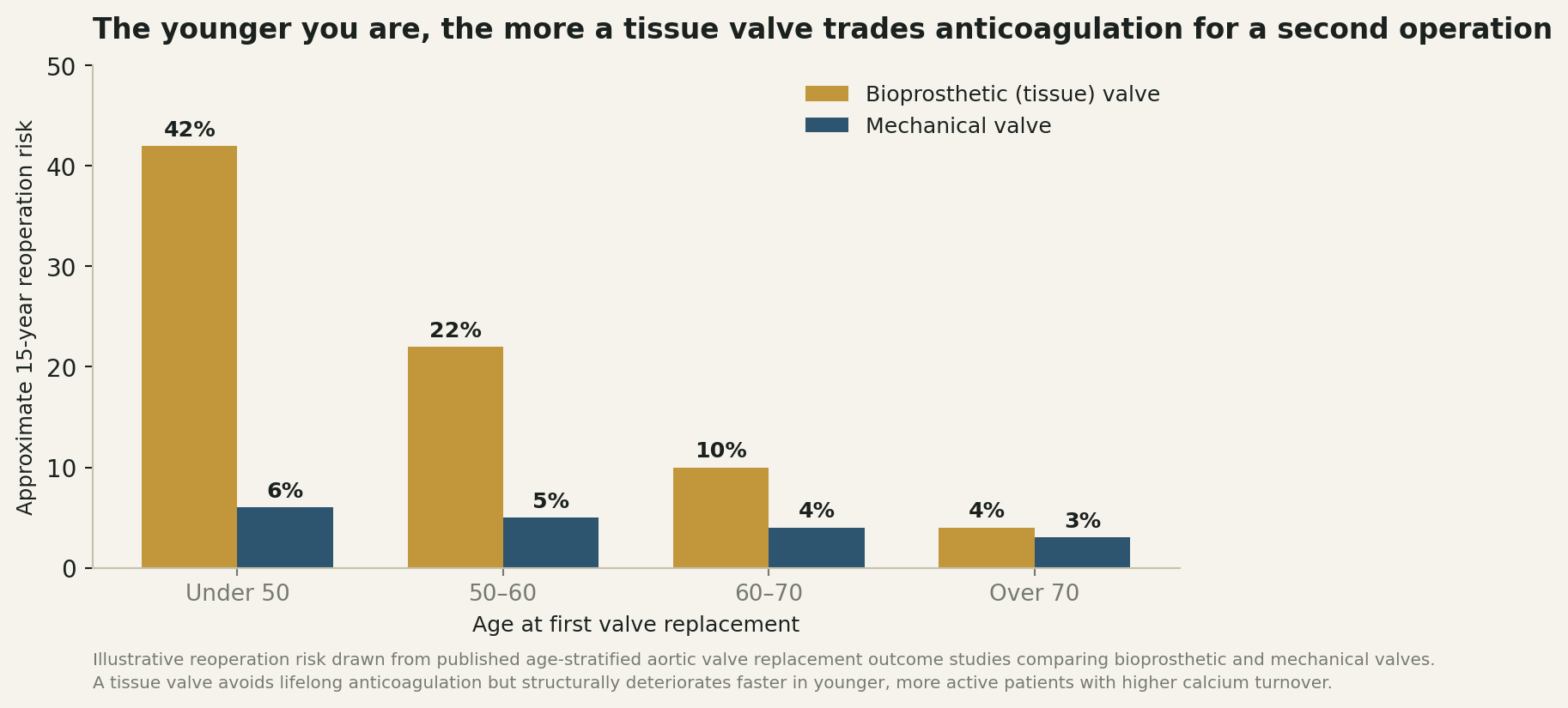
A patient having a tissue aortic valve replaced in their forties faces a materially higher chance of needing a second operation within fifteen years than someone having the same valve at seventy. That second operation is not a minor inconvenience: redo cardiac surgery carries higher risk than a first operation, takes longer, and is the single most expensive line item in valve surgery anywhere in the world — including in India. Getting the first choice right is worth more than almost any other decision in this process.
There is a third option worth raising specifically if you are young and the aortic valve is affected: the Ross procedure, in which your own pulmonary valve is moved into the aortic position and replaced with a donor valve. Done well, it avoids anticoagulation entirely and offers excellent long-term durability in the aortic position, but it is a longer, more technically demanding operation converting one valve problem into a two- valve procedure, and outcomes depend heavily on surgeon experience specifically with this technique. Ask whether it is a genuine option for your anatomy, and if so, how many the surgeon has personally performed.
The Canadian question no guideline asks: can you actually reach a lab?
A mechanical valve requires regular INR blood testing, typically monthly once stable, for the rest of your life. In a major Canadian city with a hospital anticoagulation clinic or a pharmacist-run monitoring service, this is a minor errand. In a great deal of the rest of the country, it is not.
Point-of-care self-testing devices exist and reduce the burden considerably, and some newer mechanical valve designs, such as On-X, permit a lower target INR range that modestly reduces bleeding risk without reducing protection — ask specifically whether this applies to the valve proposed for you. But none of this removes the underlying obligation: a missed or unstable INR with a mechanical valve carries a real risk of either clotting or bleeding, and that risk is not evenly distributed across a country as geographically large as Canada. If you live somewhere winter road closures, distance to the nearest clinic, or unreliable connectivity for telehealth monitoring are genuine features of your life, say so plainly to your surgeon, because it is a legitimate clinical input, not a logistical afterthought.
This is also worth raising before you travel, not after. Ask whether a self-testing device can be arranged and how it would be funded, whether a pharmacist-run anticoagulation service operates near you, and who specifically will read your results and adjust your dose. A written plan naming an actual clinic, arranged before your surgery date is even booked, is worth more than any general reassurance that monitoring is available in Canada.
What the money actually looks like
Complex valve surgery is rarely something Canada's small private surgical sector offers at all — those clinics are generally day-surgery facilities without the cardiac intensive care and perfusion infrastructure valve surgery requires. For a Canadian unable or unwilling to wait, the realistic paid alternative is the United States, not a domestic private option.
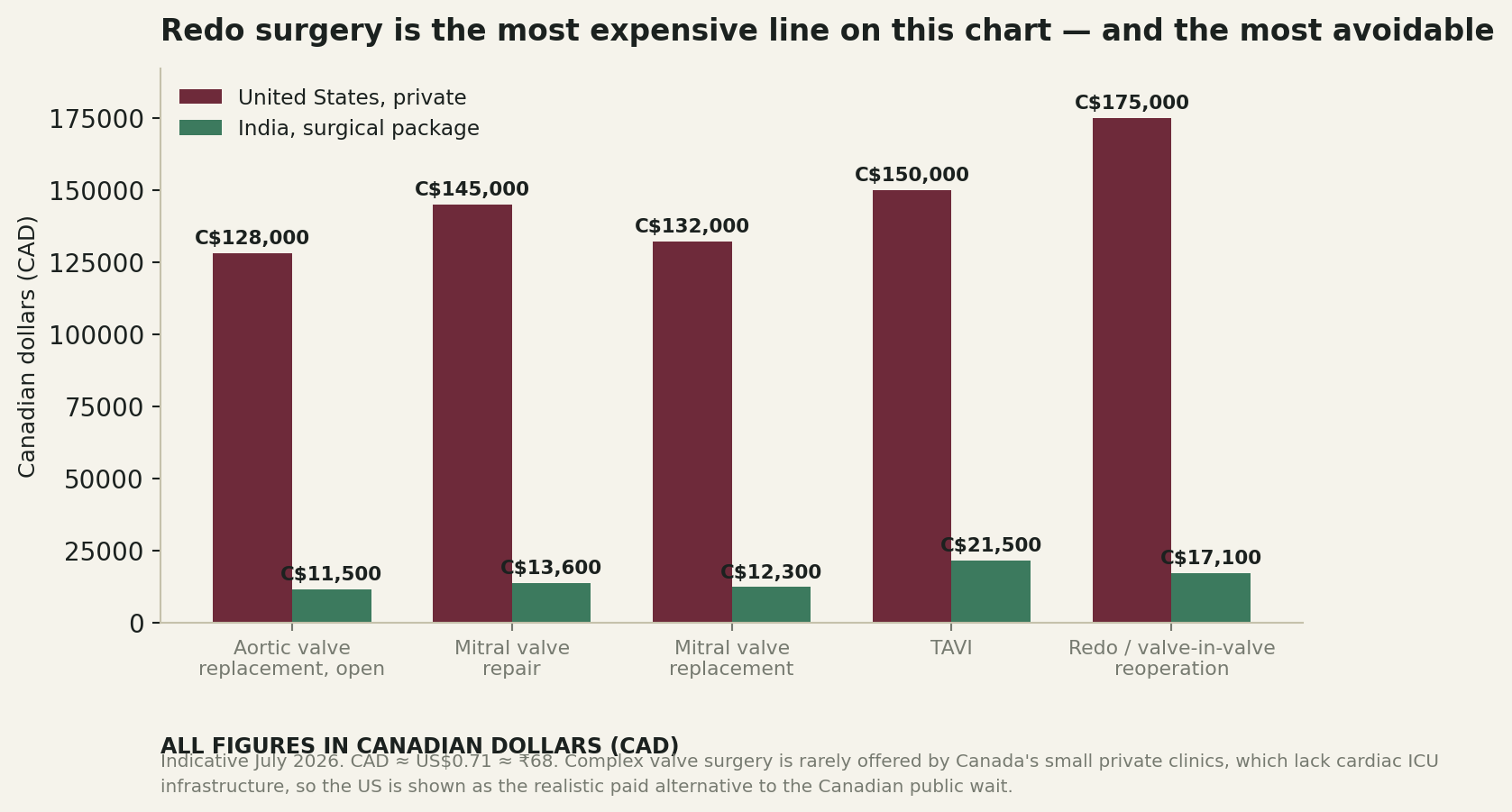
Redo valve surgery is the clearest illustration of why the first decision matters financially as well as clinically: it is priced as the most expensive procedure on the chart in every country, including India. In 24 years of guiding patients through this process, I have found disputes almost never concern the quoted price — they concern what the quote silently omitted, particularly around ICU days and the valve brand and generation. Insist on a written, itemised figure, and pay a deposit only, never the full balance in advance. Provincial health plans do not cover treatment received overseas, and out-of-country coverage exceptions are narrow and rarely granted.
What you are actually getting for it
A genuine repair-first conversation. For a leaking mitral valve, repair is usually preferable to replacement where feasible — no anticoagulation question at all, and better long-term function. Ask directly for the surgeon's own repair rate for degenerative mitral disease; it varies enormously with experience and is a number worth having in writing.
Volume in valve surgery specifically, not cardiac surgery in general. Ask how many of the exact procedure and valve position proposed for you the surgeon performed last year, and, if a Ross procedure is being discussed, his specific experience with that technique separately from general aortic valve numbers.
Structural heart programmes that run continuously, including redo and valve-in-valve capability, rather than concentrated in a handful of centres nationally the way advanced valve work is in Canada.
Accreditation you can verify independently. JCI is the international arm of the body accrediting hospitals across the United States; NABH is India's national equivalent, recognised by the same global standards authority.
Dental clearance before any valve procedure. Oral bacteria are a recognised route to prosthetic valve endocarditis; a unit that insists on this beforehand is protecting you, not obstructing you.
What to say to your family
Name the hospital and its accreditation. Name the surgeon and his annual volume in your specific valve and procedure. Explain which guideline zone you fall into, and why you and your surgeon reached the decision you did — including, if relevant, the honest conversation about how far you live from an anticoagulation clinic. Tell them your Canadian cardiologist already has the dates.
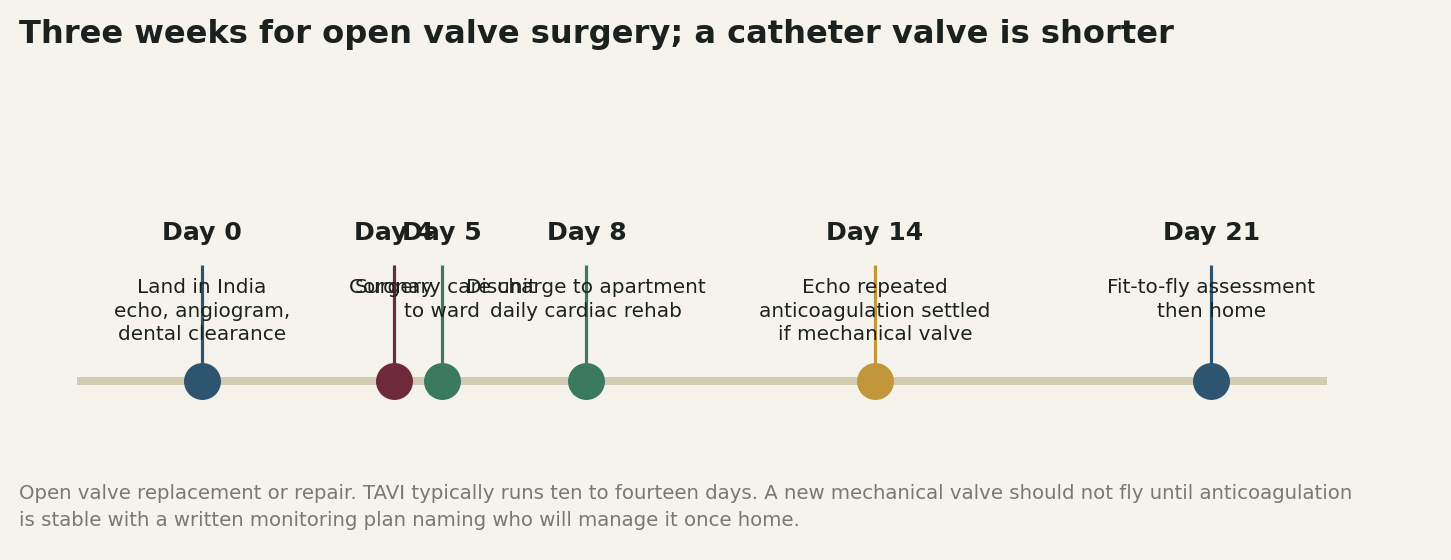
If you receive a new mechanical valve, do not fly until anticoagulation is stable and you carry a written monitoring plan naming an INR target range and who will manage it once you are home — ideally confirmed with a named Canadian clinic before you travel, not arranged afterwards.
Six Things to Have in Writing Before You FLY
1. Which guideline the recommendation is based on, and how your age, valve position and lifestyle were weighed against it.
2. The valve, fully specified — brand, model and generation — so an anticoagulation target and any lower-INR eligibility can be confirmed with your Canadian team in advance.
3. The surgeon's own repair rate, if a mitral valve is involved, and his annual volume in your exact procedure.
4. An itemised, all-inclusive price, naming ICU days assumed and the cost of exceeding them.
5. What the hospital covers if a return to theatre is needed during your stay.
6. A named Canadian anticoagulation monitoring plan, confirmed before you leave, if a mechanical valve is placed.
Straight answers for Canadian Patients about Heart Valve Replacement Surgery in India
I'm 55. Which guideline applies to me?
You sit inside the range where major guidelines genuinely disagree. Ask your surgeon which they are applying and why, and bring your own practical circumstances — including how easily you can reach anticoagulation monitoring — into that conversation directly.
Does a lower INR target make a mechanical valve meaningfully easier to live with?
For some newer designs such as On-X in the aortic position, a lower target range is guideline-supported and modestly reduces bleeding risk. It does not remove the need for regular testing. Ask specifically whether it applies to the valve proposed for you.
Will my provincial plan reimburse any of this?
Almost never. Out-of-country coverage exceptions require pre-approval showing the procedure is genuinely unavailable in Canada within a medically acceptable time, a bar rarely met regardless of your actual wait.
Should I travel for urgent valve disease?
No. Acute regurgitation, endocarditis, or decompensated heart failure belong in a Canadian emergency department immediately. Nothing here applies to unstable presentations.
How long before I can fly home?
About three weeks after open valve surgery, ten to fourteen days after TAVI, on a changeable ticket, following a documented fit-to-fly assessment.
A closing word
Valve choice is the rare medical decision where geography is a legitimate clinical variable, not an excuse, and where guidelines themselves admit there often is no single right answer. Bring your actual life into that conversation, get the reoperation math right for your age, and choose a surgeon and unit on volume in the specific procedure rather than cardiac surgery in general. If you would like a second opinion on your echocardiogram, or a review of a quote you are holding, send it to me and I will look at it properly.
Sources
- 🌐 Otto et al., 2020 ACC/AHA Guideline for the Management of Patients With Valvular Heart Disease
- 🌐 "ACC/AHA Versus ESC Guidelines on Prosthetic Heart Valve Management", JACC Guideline Comparison
- 🌐 "Age-Specific Outcomes of Bioprosthetic vs. Mechanical Aortic Valve Replacement"
- 🌐 Thrombosis Canada, Mechanical and Bioprosthetic Heart Valves: Anticoagulant Therapy clinical guide
- 🌐 Asgar et al., 2019 Canadian Cardiovascular Society Position Statement for Transcatheter Aortic Valve Implantation, Canadian Journal of Cardiology
- 🌐 High Commission of India, e-Visa categories and eligibility
Frequently Asked Questions by Canadian Patients about Heart Valve Replacement Surgery in India
How should Canadian patients choose between a mechanical and tissue valve?
Age, valve durability, lifestyle, bleeding risk and practical access to lifelong INR monitoring should all be considered.
What is the main advantage of a mechanical valve?
Mechanical valves generally provide greater long-term durability and may reduce the likelihood of future valve replacement.
What is the main disadvantage of a mechanical valve?
Patients generally require lifelong warfarin therapy and regular INR blood testing.
Why might a Canadian patient choose a tissue valve?
A tissue valve avoids lifelong anticoagulation, although it may require replacement again, particularly in younger patients.
What age range does the guide describe as a grey zone?
Approximately 50–70 years, where individual circumstances become especially important.
What is the Ross procedure?
It is an alternative operation for selected younger patients with aortic valve disease and requires specific surgical expertise.
Should a leaking mitral valve always be replaced?
No. The guide recommends discussing valve repair first where it is technically feasible.
How should Canadian patients evaluate a valve surgeon in India?
Ask for the surgeon's annual volume in the exact valve procedure and, for mitral surgery, the surgeon's own repair rate.
How long should Canadian patients stay in India after valve surgery?
The guide suggests around three weeks after open valve surgery and approximately 10–14 days after TAVI.
What should mechanical-valve patients arrange before returning to Canada?
They should have stable anticoagulation, a written INR target and a named Canadian clinic or clinician responsible for ongoing monitoring.
Page Summary
This guide helps Canadian patients evaluate heart valve replacement surgery in India, particularly the choice between mechanical valves — more durable but requiring lifelong anticoagulation — and tissue valves, which avoid warfarin but may deteriorate earlier in younger patients; guidelines identify approximately 50–70 years as a key decision grey zone. The Ross procedure is discussed for selected younger aortic patients, and mitral repair is recommended first where feasible. Patients should verify surgeon experience, hospital structural-heart capability and the exact valve brand and model, arranging Canadian follow-up beforehand. Approximately three weeks in India is suggested after open valve surgery and 10–14 days after TAVI, subject to medical clearance.
Citation Block
| Topic | Information |
|---|---|
| Topic Information | Heart Valve Replacement Surgery in India for Canadian Patients |
| Treatment | Heart Valve Replacement and Repair |
| Country | India |
| Intended Audience | Canadian Patients and Families |
| Primary Decision | Mechanical vs Tissue Valve |
| Mechanical Valve | Greater Durability + Lifelong Anticoagulation |
| Tissue Valve | No Lifelong Anticoagulation but Lower Durability in Younger Patients |
| ACC/AHA Age Context | Mechanical Reasonable Below 50 |
| European Age Context | Similar Reasoning to Approximately 65 |
| Decision Grey Zone | Approximately 50–70 Years |
| Alternative Procedure | Ross Procedure |
| Canadian Follow-Up | Cardiologist / Anticoagulation Provider |
| Author | Dr. Dheeraj Bojwani |
| Experience | 24 Years' Experience |


Our Mission Statement
Our mission is to place patients at the centre of every healthcare decision by providing trustworthy, evidence-based, and unbiased medical information. We believe that informed patients make better decisions. Backed by personalised guidance from our experienced advisory team, we help patients understand their treatment options, compare them objectively, and confidently choose the path that best suits their medical needs and personal circumstances.
Patient Testimonials from Canada

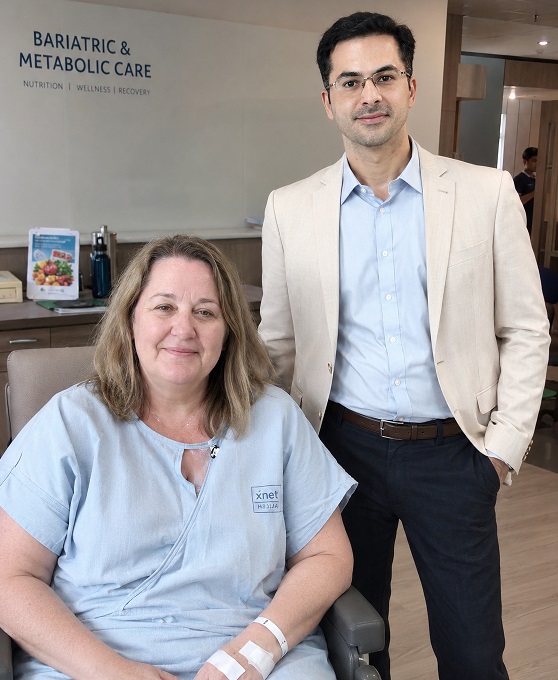
Ready to Take the First Step?
Share your Medical Reports with our Healthcare Managers Today and Get a FREE CONSULTATION, a Personalized Treatment Plan, and Complete Support from Arrival to Recovery.
Get Your Free ConsultationFrom Canada to India: Your Complete Patient Support Guide
- Weight Loss & Bariatric Surgery in India for Canadian Patients: The Multi-Year Wait, Explained (2026)
- Bone Marrow Transplant in India for Canadian Patients: Complete Guide
- Brain Tumor Surgery in India for Canadian Patients: Complete Guide
- Breast Cancer Treatment and Surgery in India for Canadian Patients
- Cancer Treatment and Surgery in India for Canadian Patients
- Cardiac Surgery in India for Canadian Patients
- Colorectal Cancer Treatment and Surgery in India for Canadian Patients
- Cosmetic and Aesthetic Surgery in India for Canadian Patients
- CyberKnife Treatment in India for Canadian Patients: Complete Guide
- Dental Surgery in India for Canadian Patients | Complete Treatment & Cost Guide
- Gamma Knife Treatment in India for Canadian Patients
- Heart Valve Replacement Surgery in India for Canadian Patients
- Hip Surgery in India for Canadian Patients | Complete Treatment, Cost & Recovery Guide
- HIPEC Surgery in India for Canadian Patients: Complete Guide
- Kidney Transplant in India for Canadian Patients: Complete Guide
- Knee Surgery in India for Canadian Patients: Wait Times & Costs
- Neurosurgery in India for Canadian Patients: Wait Times & Costs
- Paediatric Cardiac Surgery in India for Canadian Patients