

Kidney Transplant in India for Canadian Patients
Kidney transplantation offers some of the best outcomes in modern medicine. This guide covers all three genuine routes to it — and what to know if a willing donor is ready to travel with you.
A 44-year-old teacher in Winnipeg, on dialysis three times a week for two years, with a husband who has wanted to donate since day one but turned out not to be a match. Their nephrologist has already told them about the national paired exchange programme, and their names are in the system. In the meantime, they are also looking into whether her husband could simply donate directly to her in India, where the two of them, as spouses, meet the country's own definition of an eligible living donor pair.
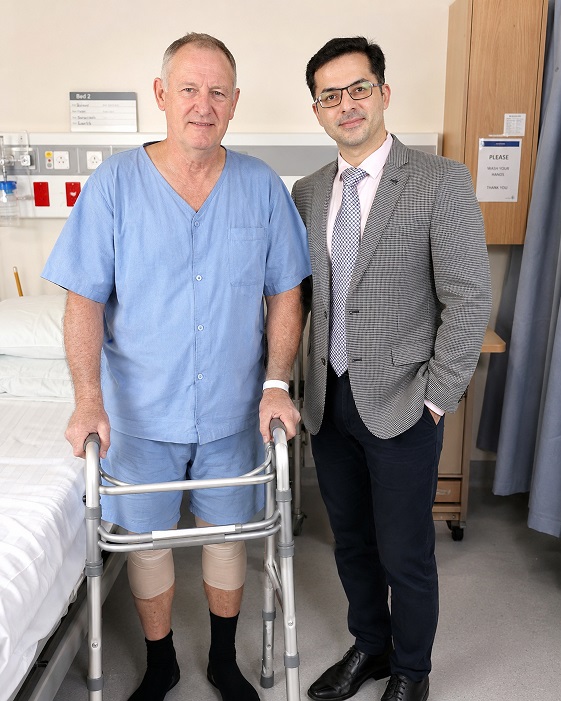
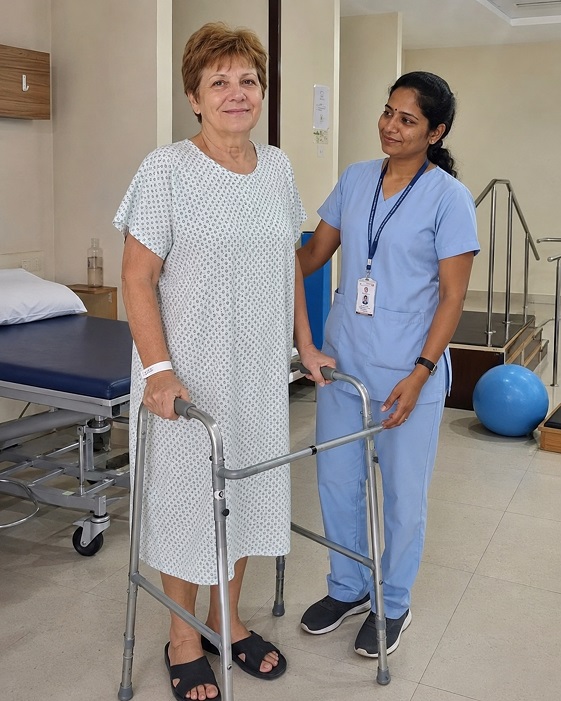
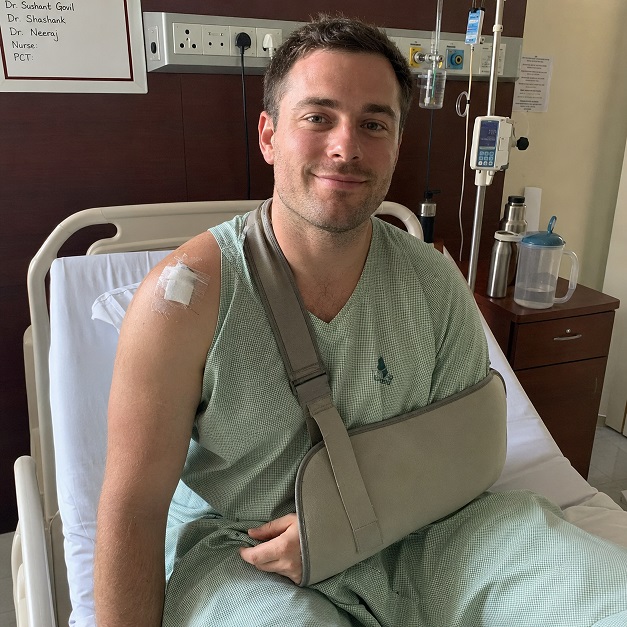
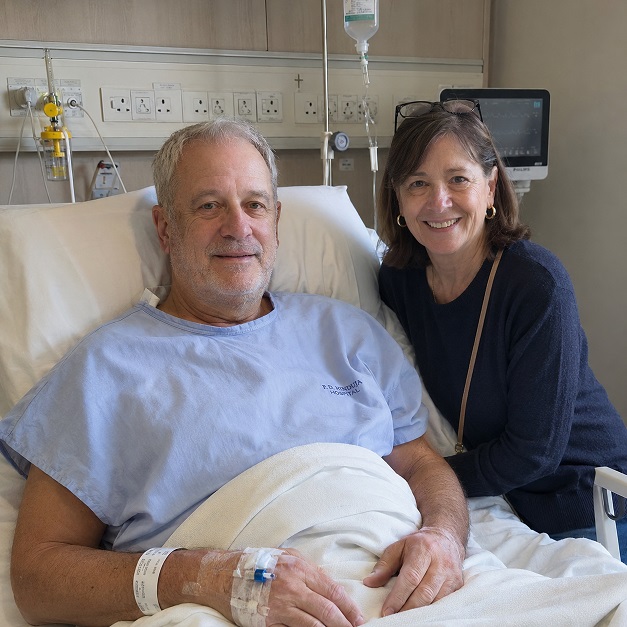
Healing Journeys of Canadian Patients
Key Takeaways
- Kidney transplantation can offer strong long-term outcomes compared with continued dialysis. The guide states that living-donor recipients have a survival and kidney-function rate of around 95% at one year, while a living-donor kidney commonly functions well for 15–18 years or longer.
- The PDF explains that Canadian patients have three genuine routes to transplantation: the deceased-donor waitlist, a directed living donor and the national Kidney Paired Donation programme. These pathways can be explored alongside each other rather than being treated as mutually exclusive.
- The page 2 timeline visual compares a national deceased-donor wait of approximately 2–5 years with a living-donor pathway that can potentially reach transplantation in as little as six months once donor and recipient assessments are complete.
- Approximately one in three potential living donors may be blood-type or crossmatch incompatible with their intended recipient. Canada's Kidney Paired Donation programme can match incompatible donor-recipient pairs with other pairs and can create donation chains involving multiple recipients.
- For patients travelling to India with a living donor, the guide notes that Indian transplant law generally permits donation by close relatives such as a parent, child, sibling, spouse or grandparent/grandchild, while additional government approval may apply to other relationships.
- Major Indian transplant centres also have established experience with ABO-incompatible transplantation, using desensitisation protocols when a willing donor's blood type does not match the recipient's.
- The page 4 cost comparison gives an indicative India transplant package of approximately C$15,500 for a directed living donor, compared with C$175,000+ for private treatment in the United States.
- Patients should verify the transplant team's experience, donor evaluation process, accreditation, complete pricing, complication coverage and long-term Canadian follow-up before travelling. The guide specifically recommends having these details in writing.
Quick Facts
- Treatment
- Kidney Transplantation
- Country
- India
- Patients
- Canadian Patients
- Specialty
- Nephrology / Transplant Surgery
- Transplant Pathways
- Deceased Donor, Directed Living Donor and Kidney Paired Donation
- Living-Donor One-Year Outcome
- Around 95% Survival and Kidney Function
- Expected Living-Donor Kidney Function
- Commonly 15–18 Years or Longer
- Deceased-Donor Wait
- Approximately 2–5 Years
- Living-Donor Timeline
- As Little as 6 Months After Assessments
- Potential Donor Incompatibility
- Approximately 1 in 3 Potential Donors
- Donor Eligibility in India
- Generally Close Relatives, Subject to Applicable Approval
- Hospital Selection
- Verifiable JCI or NABH Accreditation
- Follow-Up
- Canadian Nephrology Team
- Important Principle
- Confirm Donor Eligibility and Complete Transplant Planning Before Travel
In Brief
For Canadian patients considering kidney transplantation in India, the decision should begin with understanding all available transplant pathways, particularly living donation and Canada's Kidney Paired Donation programme. For families with a willing donor who prefer not to wait, India may be an option after confirming donor eligibility, transplant-centre experience, ABO compatibility considerations, complete costs and a long-term follow-up plan with the Canadian nephrology team.
Kidney transplantation is one of the genuine success stories in modern medicine
Canadian nephrology and transplant teams are excellent, and in 24 years of guiding international patients into Indian hospitals I have never suggested otherwise. It is worth starting with what the outcomes actually look like, because they are genuinely good: recipients of a living donor kidney have a survival and function rate around 95 per cent at one year, and a transplanted kidney from a living donor commonly functions well for fifteen to eighteen years or longer. Compared with long-term dialysis, transplantation offers significantly longer life expectancy, better quality of life, and a real return to normal daily activity for most recipients.
Three genuine routes to transplant, not just one
The path to a transplant is not a single queue. Canada runs three parallel, genuinely complementary pathways, and understanding all three changes the whole picture.
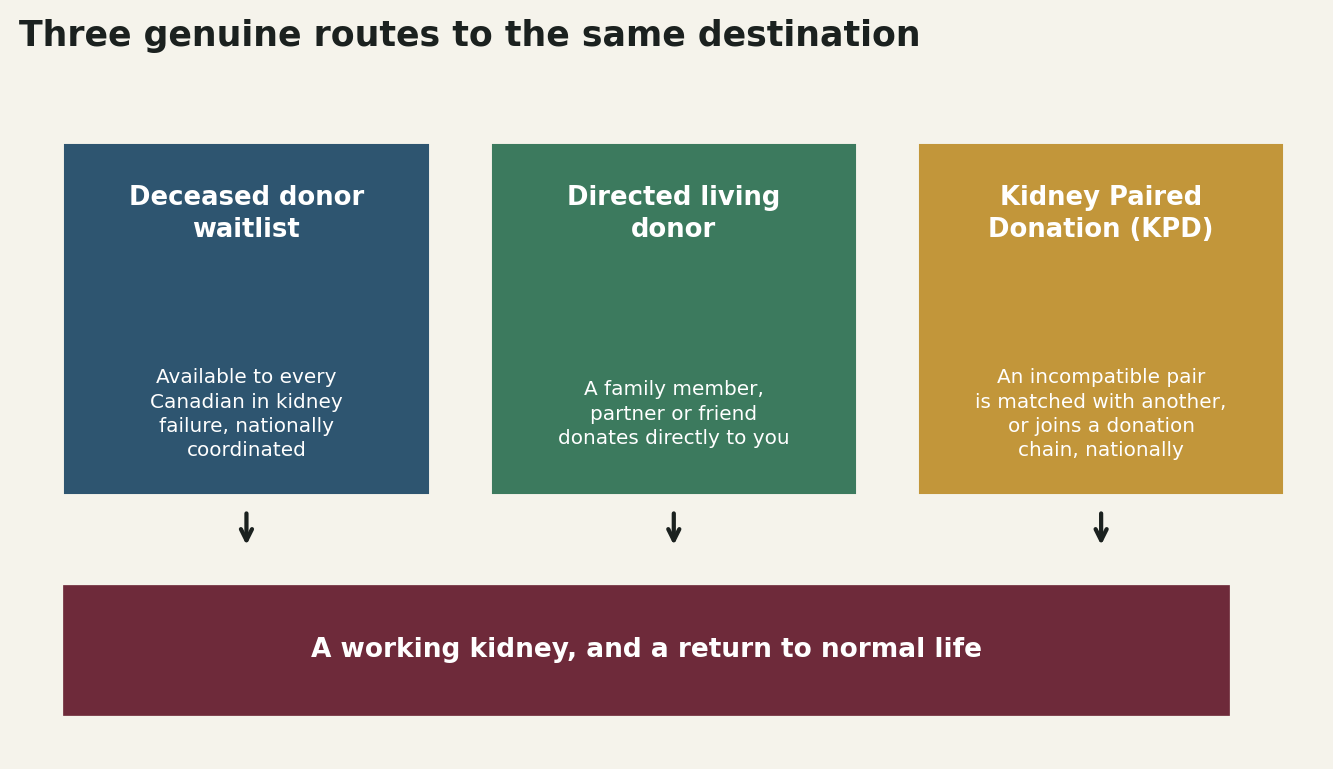
The deceased donor waitlist is coordinated nationally and available to every Canadian in kidney failure. A directed living donor — a spouse, family member or friend — can donate straight to a specific recipient. And where a willing donor turns out not to be a compatible match, Canada's national Kidney Paired Donation programme offers a genuinely elegant solution.
Why living donation changes the timeline so dramatically
This is the single most useful thing to understand early in this process, because it reframes the whole decision.
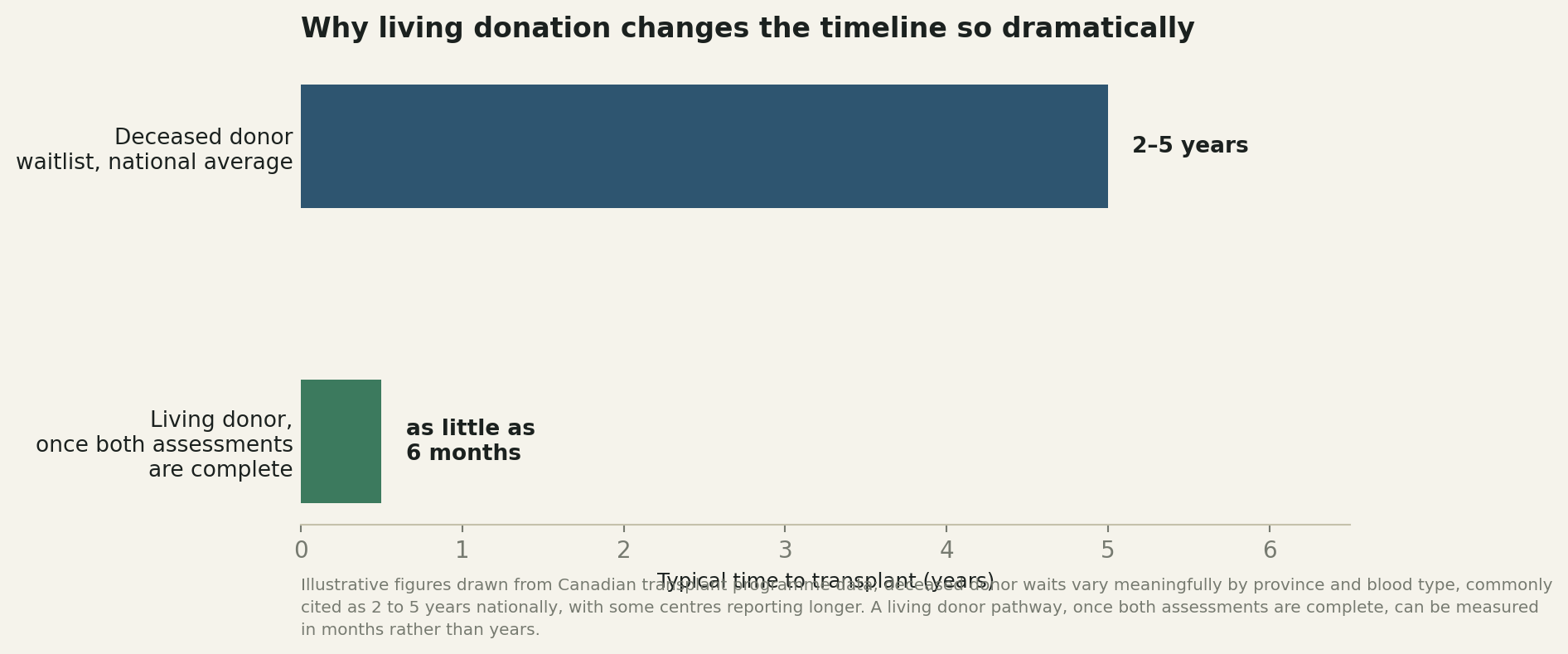
National deceased donor waitlist times commonly run two to five years, varying by province and blood type. A living donor pathway, once both the donor's and recipient's medical assessments are complete, can be measured in months rather than years — commonly as little as six months from start to surgery. This is precisely why exploring living donation early, rather than waiting to see how the deceased donor list moves, is worth doing from the outset.
When your donor isn't a match: the paired exchange solution
It is common, not rare, for a loved one to step forward as a willing donor and discover they are not medically compatible — roughly one in three potential living donors turns out to be blood-type or crossmatch incompatible with their intended recipient. Canada's response to this is genuinely one of the more elegant pieces of transplant medicine anywhere in the world.
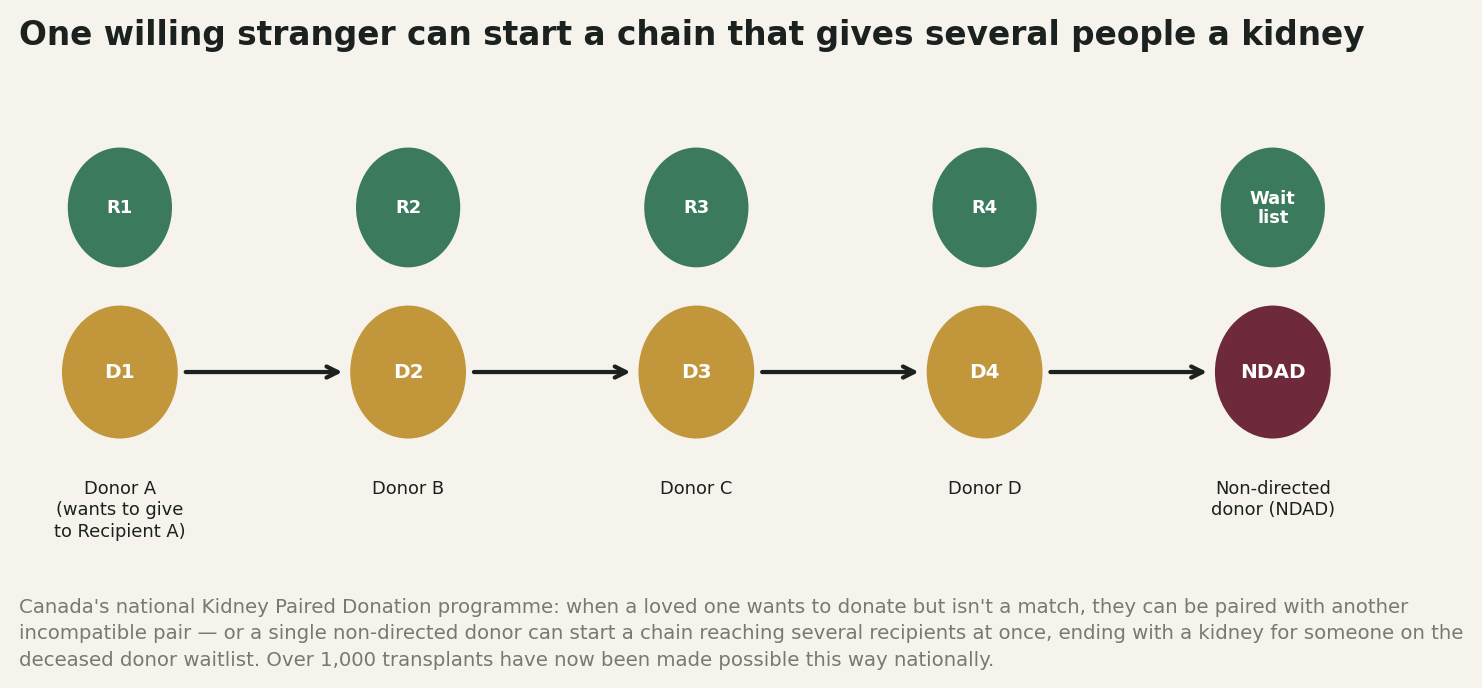
Through the national Kidney Paired Donation programme, an incompatible pair can be matched with another incompatible pair whose donor happens to be compatible with them, and vice versa. A single willing stranger with no specific recipient in mind, called a non-directed donor, can start a chain of exchanges reaching several recipients at once, with the final donor in the chain giving to someone on the deceased donor waitlist. Since the programme's national launch, well over a thousand transplants have been made possible this way, and every one of them also shortens the deceased donor waitlist for everyone else on it.
If you already have a willing donor and are considering travel
For a family with a specific, willing, compatible living donor — a spouse, parent, adult child or sibling — who would rather not wait even the shorter living-donor timeline at home, travelling for the transplant itself is a genuine option worth understanding properly. India's transplant law generally requires a living donor to be a close relative — typically a parent, child, sibling, spouse, or grandparent/grandchild — with additional government approval required for donors outside this circle. This is worth knowing early, since it shapes who can realistically accompany you as a donor.
India's major transplant centres also have genuine, established expertise in ABO-incompatible transplantation, using desensitisation protocols to allow transplant across blood-type barriers that would otherwise rule a donor out — a real, additional option worth asking about directly if your willing donor's blood type does not match yours.
What the money actually looks like
Kidney transplantation is not something Canada's private surgical sector offers; it requires a full transplant programme, immunology and tissue-typing infrastructure, and long-term follow-up capability that exists only within Canada's public system. For a family with a ready, willing directed donor exploring options beyond the domestic timeline, the realistic paid alternative is the United States rather than a domestic private clinic.
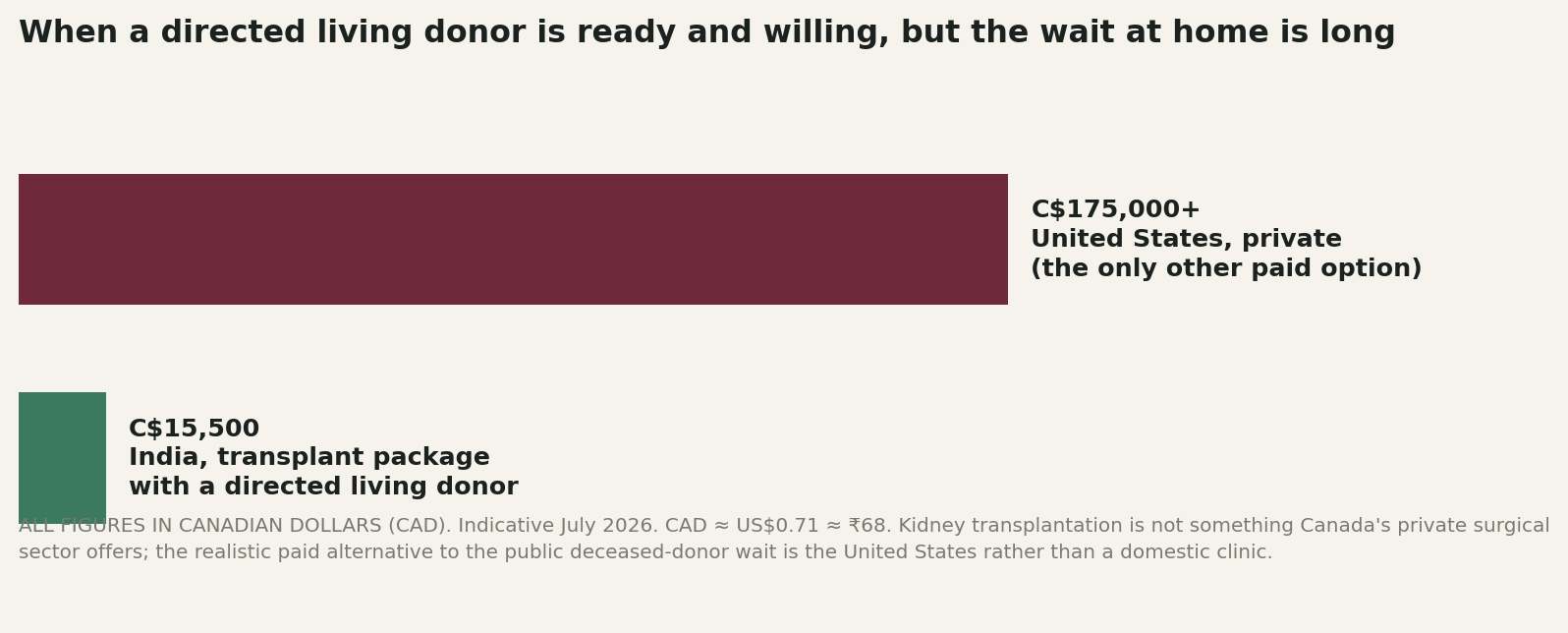
American transplant care, priced for an insurance-backed domestic market, commonly runs well into six figures. India's major transplant centres perform living donor transplants at high volume, with the same immunological workup and long-term protocols, at a fraction of the American price. In 24 years of guiding patients through this decision, the families who do best are the ones who explore every domestic pathway, including paired exchange, in parallel with any international option, rather than treating them as mutually exclusive.
What you are actually getting for it
A genuine transplant team, including nephrology, transplant surgery, immunology and dedicated long- term follow-up.
Established ABO-incompatible transplant capability, where relevant, expanding who can donate to you.
Accreditation you can verify independently. JCI is the international arm of the body accrediting hospitals across the United States; NABH is India's national equivalent, recognised by the same global standards authority.
A full donor and recipient workup completed transparently, with results shared with you directly.
A discharge record built for your Canadian nephrology team to use, including the full operative and immunosuppression details for ongoing care.
Six Things to Have in Writing Before You FLY
1. Confirmation your specific donor relationship meets the eligibility requirements before travelling.
2. The centre's annual living donor transplant volume, and its experience with ABO- incompatible cases if relevant.
3. A complete donor evaluation plan, and confirmation the donor's own long-term health is a genuine focus.
4. An itemised, all-inclusive price for both donor and recipient care, including the immunosuppression regimen.
5. What the centre covers if a complication requires extended care during your stay.
6. Your Canadian follow-up, already agreed: a named nephrologist and a specific long-term monitoring plan.
Straight answers for Canadian Patients about Kidney Transplant in India
Should I explore Canada's Kidney Paired Donation programme before looking abroad?
Yes, and the two are not mutually exclusive. Ask your transplant team to enrol you in the national programme early; many families pursue this in parallel with researching other options.
Who is eligible to be my living donor if I travel to India?
Generally a close relative — a parent, child, sibling, spouse, or grandparent or grandchild — under India's transplant law, with additional approval required for others. Confirm your specific relationship's eligibility with the treating centre before travelling.
Will my provincial plan reimburse a transplant performed in India?
Almost never. Out-of-country coverage exceptions require pre-approval showing the procedure is genuinely unavailable in Canada within a medically acceptable time.
What if my donor's blood type doesn't match mine?
Ask specifically about ABO-incompatible transplant protocols, a well-established option at major transplant centres that allows transplantation across blood-type barriers using desensitisation treatment beforehand.
Who manages my long-term follow-up once I'm home?
Your Canadian nephrology team, provided they have the complete transplant record and immunosuppression details in writing before you leave, and ideally confirmed in advance of travel.
A closing word
Kidney transplantation offers some of the best outcomes in modern transplant medicine, and Canada's own system, including its national paired exchange programme, is genuinely well designed to get patients there. For a family with a ready, willing donor who would rather not wait, travelling for the transplant is a real and reasonable option, provided the donor relationship and the centre's experience are both properly confirmed in advance. If you would like to talk through your specific situation, send me the details and I will look at it properly.
Sources
- 🌐 Canadian Institute for Health Information, "Summary statistics on organ transplants, wait-lists and donors" — cihi.ca
- 🌐 Canadian Blood Services, "Kidney Paired Donation Program" — blood.ca
- 🌐 Malik & Cole, "Foundations and principles of the Canadian living donor paired exchange program" — ncbi.nlm.nih.gov/PMC4346240
- 🌐 High Commission of India, e-Visa categories and eligibility — indianvisaonline.gov.in/evisa
Frequently Asked Questions by Canadian Patients about Kidney Transplant in India
What are the main routes to kidney transplantation in Canada?
The guide identifies three pathways: the deceased-donor waitlist, a directed living donor and the national Kidney Paired Donation programme.
How long can a Canadian patient wait for a deceased-donor kidney?
The guide states that national deceased-donor wait times commonly range from approximately two to five years, depending on province and blood type.
How quickly can a living-donor transplant happen?
Once donor and recipient medical assessments are complete, the living-donor pathway can potentially lead to transplantation in as little as six months.
What if my willing donor is not compatible with me?
Canada's Kidney Paired Donation programme can match incompatible donor-recipient pairs with other pairs. Non-directed donors can also initiate donation chains involving several recipients.
Who can be a living kidney donor in India?
The guide states that Indian transplant law generally permits close relatives such as parents, children, siblings, spouses and grandparents or grandchildren. Other relationships may require additional government approval.
Can a kidney transplant be performed if the donor and recipient have different blood types?
Major Indian transplant centres have established ABO-incompatible transplant programmes using desensitisation protocols to overcome certain blood-type barriers.
How much does a kidney transplant cost in India?
The PDF gives an indicative package cost of approximately C$15,500 for a directed living-donor transplant, while noting that actual costs should be confirmed with the treating centre.
Will a Canadian provincial plan reimburse a kidney transplant performed in India?
Almost never. Out-of-country coverage generally requires pre-approval demonstrating that the procedure is genuinely unavailable in Canada within a medically acceptable time.
What should I have confirmed before travelling to India?
The guide recommends written confirmation of donor eligibility, transplant-centre volume, donor evaluation, complete pricing, complication coverage and an agreed Canadian long-term follow-up plan.
Who manages follow-up after returning to Canada?
The Canadian nephrology team should manage long-term follow-up, with the complete transplant record and immunosuppression details provided before the patient leaves India.
Page Summary
This guide explains kidney transplantation in India for Canadian patients and outlines three routes to transplantation: deceased donation, directed living donation and Canada's national Kidney Paired Donation programme. It highlights the major difference in potential timelines between deceased and living donation, explains what can happen when a willing donor is incompatible and discusses India's living-donor eligibility requirements and ABO-incompatible transplant expertise. The guide gives an indicative India transplant cost of approximately C$15,500 and emphasizes complete donor and recipient evaluation, transparent pricing, accreditation and confirmed Canadian follow-up.
Citation Block
| Topic | Information |
|---|---|
| Topic | Kidney Transplant in India for Canadian Patients |
| Treatment | Kidney Transplantation |
| Country | India |
| Intended Audience | Canadian Patients |
| Specialty | Nephrology / Transplant Surgery |
| Transplant Routes | Deceased Donor, Directed Living Donor, Kidney Paired Donation |
| Living-Donor One-Year Outcome | Around 95% |
| Living-Donor Kidney Function | Commonly 15–18 Years or Longer |
| Deceased-Donor Wait | Approximately 2–5 Years |
| Living-Donor Timeline | As Little as 6 Months |
| Potential Donor Incompatibility | Approximately 1 in 3 |
| Key Selection Factor | Complete Donor and Recipient Evaluation |
| Author | Dr. Dheeraj Bojwani |
| Experience | 24+ Years |


Our Mission Statement
Our mission is to place patients at the centre of every healthcare decision by providing trustworthy, evidence-based, and unbiased medical information. We believe that informed patients make better decisions. Backed by personalised guidance from our experienced advisory team, we help patients understand their treatment options, compare them objectively, and confidently choose the path that best suits their medical needs and personal circumstances.
Patient Testimonials from Canada





Ready to Take the First Step?
Share your Medical Reports with our Healthcare Managers Today and Get a FREE CONSULTATION, a Personalized Treatment Plan, and Complete Support from Arrival to Recovery.
Get Your Free ConsultationFrom Canada to India: Your Complete Patient Support Guide
- Weight Loss & Bariatric Surgery in India for Canadian Patients: The Multi-Year Wait, Explained (2026)
- Bone Marrow Transplant in India for Canadian Patients: Complete Guide
- Brain Tumor Surgery in India for Canadian Patients: Complete Guide
- Breast Cancer Treatment and Surgery in India for Canadian Patients
- Cancer Treatment and Surgery in India for Canadian Patients
- Cardiac Surgery in India for Canadian Patients
- Colorectal Cancer Treatment and Surgery in India for Canadian Patients
- Cosmetic and Aesthetic Surgery in India for Canadian Patients
- CyberKnife Treatment in India for Canadian Patients: Complete Guide
- Dental Surgery in India for Canadian Patients | Complete Treatment & Cost Guide
- Gamma Knife Treatment in India for Canadian Patients
- Heart Valve Replacement Surgery in India for Canadian Patients
- Hip Surgery in India for Canadian Patients | Complete Treatment, Cost & Recovery Guide
- HIPEC Surgery in India for Canadian Patients: Complete Guide
- Kidney Transplant in India for Canadian Patients: Complete Guide
- Knee Surgery in India for Canadian Patients: Wait Times & Costs
- Neurosurgery in India for Canadian Patients: Wait Times & Costs
- Paediatric Cardiac Surgery in India for Canadian Patients