

Paediatric Cardiac Surgery in India for Canadian Patients
This is written for one specific situation: a stable child, a confirmed diagnosis, and a family with time to choose carefully. It is not written for a critically unwell newborn, and it says so before anything else.
A family in rural Saskatchewan. Their nine-year-old daughter has a moderate atrial septal defect, picked up incidentally on a school health check and confirmed by echocardiogram. She is well, active, and asymptomatic day to day, but the defect is large enough that closure is recommended before adolescence. Their nearest paediatric cardiac surgical programme is a five-hour drive and a wait they have already been told will run past a year for a non-urgent repair. They are not in crisis. They are simply trying to work out where, and when, to have a well-defined, low-risk operation performed for a child who is otherwise thriving.
Read This Before Anything Else in This Document
This briefing is not written for a critically unwell newborn, and nothing in it should be read as suggesting otherwise. Single-ventricle physiology, duct-dependent circulation, and any infant whose cardiac condition requires ongoing NICU-linked care belong in a Canadian children's hospital, immediately, without exception. Canada's paediatric cardiac centres manage these presentations very well, and that is precisely where they should be managed. What follows concerns a narrower and calmer situation: a child with a confirmed, stable congenital heart condition, and a family weighing where a planned, non- emergency repair should happen.
Healing Journeys of Canadian Patients
Key Takeaways
- This guide is written for a stable child with a confirmed congenital heart condition and a family with time to carefully plan a non-emergency repair.
- It does not apply to critically unwell newborns, children with single-ventricle physiology, duct-dependent circulation or infants requiring ongoing NICU-linked cardiac care.
- The document uses the example of a nine-year-old child with a moderate atrial septal defect where closure has been recommended before adolescence.
- Paediatric congenital cardiac surgery is highly concentrated in Canada, with the document describing roughly a dozen dedicated programmes nationally.
- Paediatric cardiac surgery does not have a national CIHI wait-time benchmark or coast-to-coast compliance target.
- Ontario's overall paediatric surgical waiting list reached nearly 12,000 children in early 2023, with around half waiting beyond clinically recommended timeframes. The figure had fallen to around 6,000 by 2024, but this data covers all paediatric surgery rather than cardiac cases specifically.
- Families should ask for the hospital's annual paediatric congenital surgery caseload and the surgeon's own volume in the child's exact congenital defect.
- A genuine paediatric cardiac programme should have a dedicated paediatric cardiac ICU staffed by paediatric cardiac intensivists, rather than an adult cardiac ICU adapted for children.
- The case should be reviewed jointly by paediatric cardiology and cardiac surgery rather than relying on one clinician's opinion.
- Families should confirm a named paediatric cardiac anaesthetist before travelling.
Quick Facts
- Treatment
- Paediatric Congenital Cardiac Surgery
- Country
- India
- Intended Audience
- Canadian Children and Families
- Patient Profile
- Stable Child With a Confirmed Congenital Heart Condition
- Not Intended For
- Critically Unwell Newborns
- Critical Conditions Excluded
- Single-Ventricle Physiology, Duct-Dependent Circulation and NICU-Dependent Cardiac Conditions
- Primary Example
- Atrial Septal Defect
- National CIHI Benchmark
- None
- Primary Planning Method
- Joint Paediatric Cardiology and Cardiac Surgery Review
- Surgeon Evaluation
- Personal Volume in the Child's Specific Defect
- Hospital Evaluation
- Annual Paediatric Congenital Surgery Caseload
- Canadian Follow-Up
- Named Paediatric Cardiologist and Surveillance Schedule
- Author
- Dr. Dheeraj Bojwani
- Experience
- 24 Years' Experience
In Brief
Canadian families considering paediatric cardiac surgery in India should first establish that the child's condition is stable and appropriate for planned travel. The guide recommends comparing programmes using paediatric-specific congenital surgery volume, the surgeon's experience with the exact defect, dedicated paediatric cardiac ICU capability, paediatric cardiac anaesthesia and multidisciplinary review. Canadian paediatric cardiology follow-up should be organised before the family travels.
The first fact worth knowing: this is one of the most concentrated fields in Canadian medicine
Canadian paediatric cardiac surgeons and their teams are excellent, and in 24 years of guiding international patients into Indian hospitals I have never suggested otherwise. What is genuinely different about this specialty is how few places in the country actually practise it.
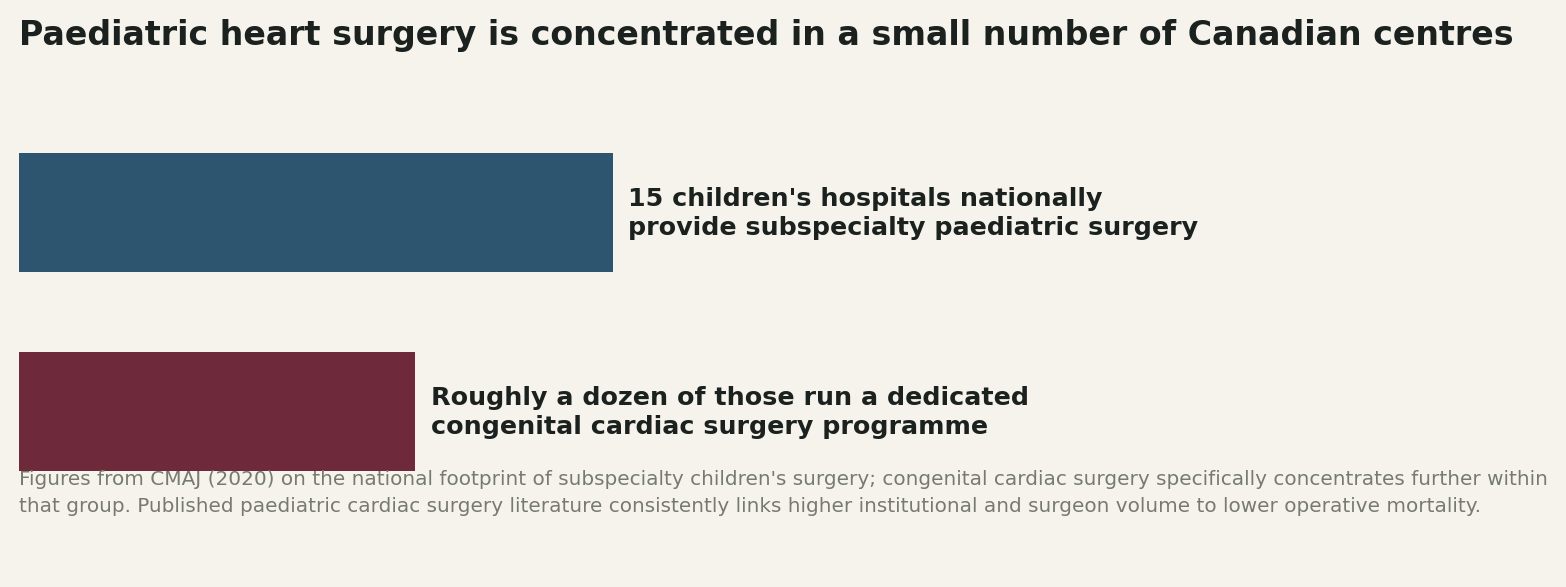
Published research in the Canadian Medical Association Journal identified fifteen children's hospitals nationally providing subspecialty children's surgery of any kind. Congenital cardiac surgery specifically concentrates in fewer than that — roughly a dozen dedicated programmes serving a country of over forty million people. This is not a criticism of those programmes; it is the reason volume and outcomes research in this field exists at all. Published paediatric cardiac surgery literature consistently links higher institutional and surgeon volume to lower operative mortality, which is exactly why the concentration itself matters to the decision in front of you.
This is not a uniquely Canadian problem. Paediatric congenital heart surgery concentrates into high-volume centres in every country with a comparable population, because the range of defects is wide, individual defects are rare, and expertise genuinely deepens with repetition. What differs is what sits on the other side of that concentration. A Canadian family reaches a national programme with a caseload built from forty million people. A major Indian paediatric cardiac centre reaches one built from over a billion, and several such centres perform more congenital heart operations in a single year than most Canadian programmes see in several.
Which child this actually applies to
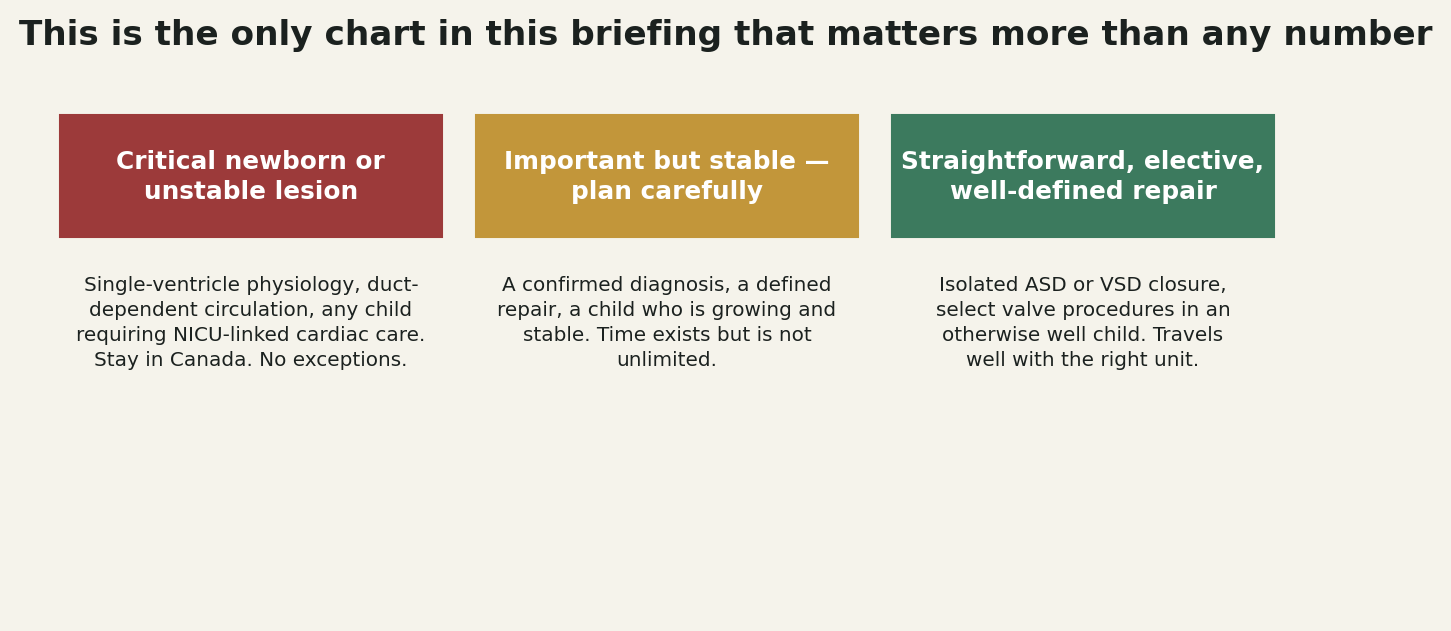
The middle and right-hand categories are what this briefing is written for: a confirmed diagnosis, a stable child, and a defined repair with time to plan it properly. If your child's condition falls into the left-hand category, close this document and speak to your Canadian cardiac team today.
What the wait actually looks like
Paediatric cardiac surgery has never been one of the procedures nationally benchmarked by CIHI, so there is no coast-to-coast target and no published national compliance percentage the way there is for hip or knee replacement. A small number of provinces publish their own figures — Nova Scotia, for example, tracks congenital heart surgery wait times provincially — but there is no equivalent picture for the country as a whole.
What is documented is system-wide strain. Ontario's paediatric hospitals reported a combined surgical wait list of nearly twelve thousand children in early 2023, with roughly half waiting beyond clinically recommended timeframes; that figure had fallen to around six thousand by 2024, still described by SickKids' own surgeon-in-chief as “unacceptable.” That data covers all paediatric surgery, not cardiac cases specifically — cardiac surgery was explicitly protected as an urgent priority throughout the pandemic-era cuts, which is reassuring for critical cases and part of why non-urgent, stable repairs like the one in the vignette above can end up waiting longer behind them.
What the money actually looks like
Complex paediatric cardiac surgery is not something Canada's small private surgical sector offers at all; it requires paediatric cardiac ICU, paediatric cardiac anaesthesia and perfusion capability that exists only within the dedicated programmes described above. For a family exploring a paid alternative, the realistic comparison is not a domestic clinic. It is the United States.
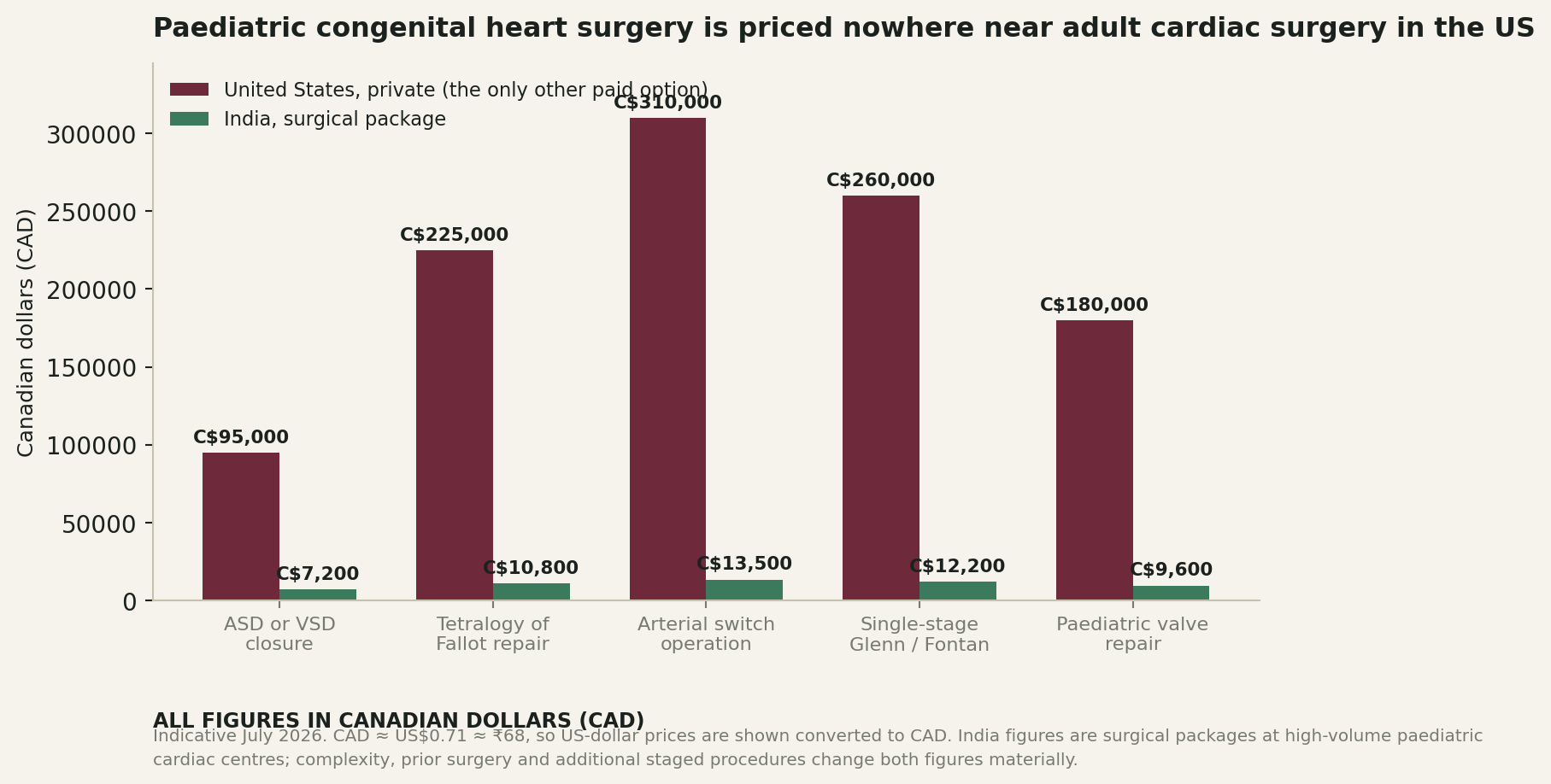
American paediatric congenital heart surgery, priced for an insurance-backed domestic market, runs into the hundreds of thousands of dollars for more complex repairs once insurance is not in the picture. India's major paediatric cardiac programmes — several of which are among the highest-volume congenital heart surgery centres in the world, performing thousands of paediatric cases annually — compete on the same substance as elsewhere in this series: genuine volume, dedicated paediatric cardiac teams, and a fraction of the American price. In 24 years I have found that disputes almost never concern the quoted price; they concern what the quote silently omitted, particularly around paediatric ICU days. Insist on a written, itemised figure, and pay a deposit only, never the full balance in advance.
What you are actually getting for it
Genuine paediatric-specific volume, not adult cardiac volume with children treated occasionally. Ask for the unit's annual paediatric congenital surgery caseload, and separately for the surgeon's own volume in your child's specific defect.
A dedicated paediatric cardiac intensive care unit, staffed by paediatric cardiac intensivists, not a general paediatric ICU or an adult cardiac ICU adapted for a smaller patient.
Multidisciplinary review as standard, not one surgeon's opinion. Ask whether your child's case will be reviewed by a paediatric cardiology and cardiac surgery team together, and ask for that confirmation in writing.
Accreditation you can verify independently. JCI is the international arm of the body accrediting hospitals across the United States; NABH is India's national equivalent, recognised by the same global standards authority.
A named paediatric anaesthetist, specifically trained in congenital cardiac anaesthesia, confirmed before you travel rather than assumed.
A discharge record built for a Canadian paediatric cardiologist to use. Before you leave, ask for the full operative note, imaging, and a written surveillance schedule specific to your child's repair — the document that lets your Canadian team pick up long-term follow-up confidently rather than starting from a summary.
What to say to your family
Name the hospital, its accreditation, and its annual paediatric congenital caseload. Name the surgeon and his personal volume in your child's specific defect. Explain that the diagnosis and the plan were reviewed by a full team, not one clinician. Tell them your Canadian paediatric cardiologist already has the dates for follow-up. Bring both parents if you can — the attendant visa exists for exactly this, and a second set of ears in every consultation involving your child is not a luxury.
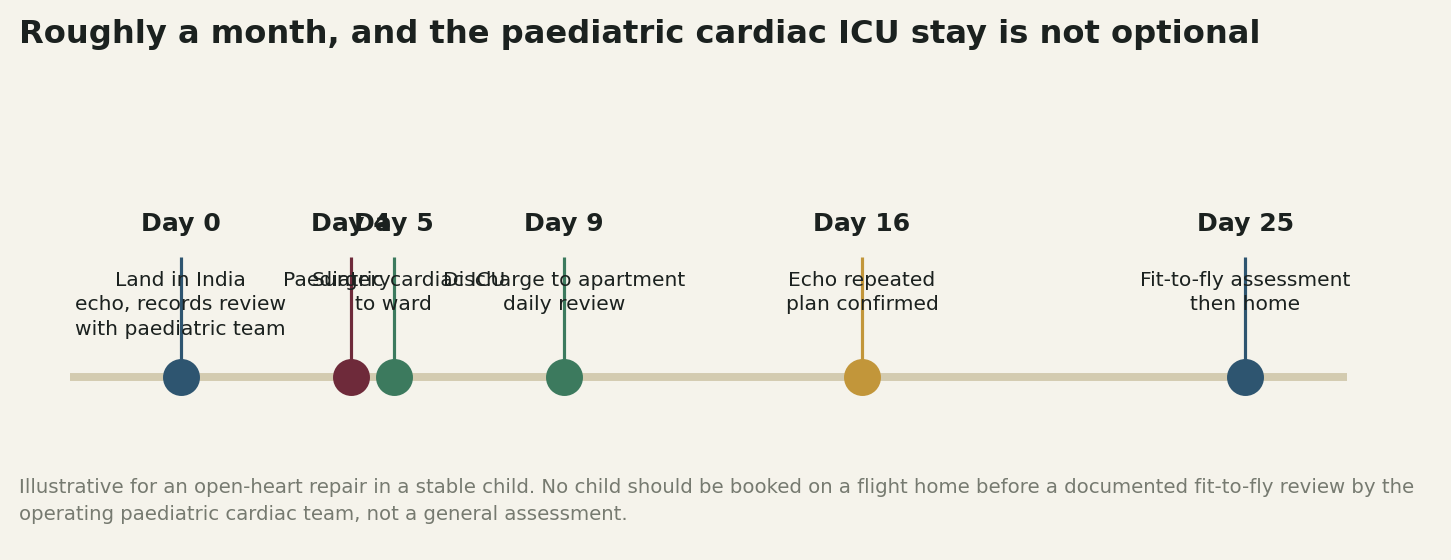
Plan for a longer stay than an equivalent adult procedure. A child's fit-to-fly assessment should come from the operating paediatric cardiac team specifically, and no return flight should be booked until that assessment is complete.
Six Things to Have in Writing Before You FLY
1. Independent confirmation of the diagnosis and plan, reviewed by a paediatric cardiology and surgery team together, not one clinician's opinion.
2. The unit's annual paediatric congenital surgery volume, and the surgeon's own volume in your child's specific defect.
3. Confirmation of a dedicated paediatric cardiac ICU and a named paediatric cardiac anaesthetist.
4. An itemised, all-inclusive price, naming ICU days assumed and the cost of exceeding them.
5. What the hospital covers if a return to theatre is needed during your child's stay.
6. Your Canadian follow-up, already agreed: a named paediatric cardiologist and a surveillance schedule.
Straight answers for Canadian Patients about Paediatric Cardiac Surgery in India
My baby has a critical heart defect diagnosed prenatally. Does this apply to us?
No. Critical and duct-dependent congenital heart disease should be managed in a Canadian children's hospital from birth. This briefing concerns stable, non-urgent repairs in children who are otherwise well.
Will our provincial plan reimburse surgery performed in India?
Almost never. Out-of-country coverage exceptions require pre-approval showing the procedure is genuinely unavailable in Canada within a medically acceptable time, a bar rarely met regardless of the actual wait.
How do we judge whether a unit genuinely specialises in children, not just cardiac surgery?
Ask for the paediatric-specific caseload, a named paediatric cardiac anaesthetist, and confirmation of a dedicated paediatric cardiac ICU. A unit that primarily treats adults and occasionally sees children is a different proposition from one built around paediatric cardiac care.
How long should we plan to stay?
Around three to four weeks for an open repair in a stable child, on a changeable ticket, following a fit-to-fly assessment from the operating team specifically.
Who manages follow-up once we are home?
Your Canadian paediatric cardiologist, provided they have the full operative record and a specific surveillance schedule in writing before you leave India. Arrange this before you travel, not after.
A closing word
Paediatric cardiac surgery is among the fields where the case for careful travel is genuinely strong for the right child — a stable, well-defined repair, reviewed by a real team, at a unit whose paediatric-specific volume dwarfs what any single Canadian programme can offer. It is also a field with no room for improvisation. If your child's situation is anything other than stable and non-urgent, that decision belongs with your Canadian team today. If it is stable, and you would like a second opinion on the diagnosis or a review of a quote you are holding, send me the echocardiogram and I will look at it properly.
Sources
- 🌐 Flageole et al., "Prioritizing specialized children's surgery in Canada during the COVID-19 pandemic", CMAJ , 2020
- 🌐 CBC News, "Ontario pediatric hospitals ask for help to deal with backlog of 12,000 surgeries", 2023
- 🌐 The Globe and Mail, "SickKids lowers surgery backlog through successful new partnership with nearby hospitals", 2024
- 🌐 Nova Scotia Wait Time Information, Congenital Heart Surgery
- 🌐 SickKids, Labatt Family Heart Centre
- 🌐 High Commission of India, e-Visa categories and eligibility
Frequently Asked Questions by Canadian Patients about Paediatric Cardiac Surgery in India
Which Canadian children does this guide apply to?
It applies to stable children with confirmed congenital heart conditions where there is time to plan treatment carefully.
Does this guide apply to critically ill newborns?
No. Critical, duct-dependent or NICU-linked congenital heart conditions should be managed immediately in Canada.
Does Canada have a national paediatric cardiac surgery wait-time benchmark?
No. The document states that paediatric cardiac surgery is not nationally benchmarked by CIHI.
How should Canadian families evaluate a paediatric cardiac surgeon in India?
Ask how many operations the surgeon personally performs for the child's exact congenital heart defect.
What hospital volume should families check?
They should ask for the unit's annual paediatric congenital cardiac surgery caseload.
What ICU facility should the hospital have?
The guide recommends a dedicated paediatric cardiac ICU staffed by paediatric cardiac intensivists.
Who should review the child's treatment plan?
A paediatric cardiology and cardiac surgery team should review the case together.
What should the hospital quotation include?
It should state the ICU days included, additional ICU costs and what happens financially if a return to theatre is required.
How long should a Canadian family plan to stay in India?
The guide suggests around three to four weeks for an open repair in a stable child.
Who manages follow-up after returning to Canada?
A named Canadian paediatric cardiologist should continue care using the operative record and written surveillance schedule.
Page Summary
This guide is intended for Canadian families considering planned paediatric cardiac surgery in India for a stable child with a confirmed congenital heart condition. It clearly excludes critically ill newborns and children requiring urgent NICU-linked cardiac care. The document explains that paediatric congenital cardiac surgery is highly concentrated and does not have a national CIHI wait-time benchmark in Canada. Families are advised to evaluate the surgeon according to experience with the child's exact defect and the hospital according to its paediatric-specific congenital surgery caseload. Dedicated paediatric cardiac ICU care, specialist anaesthesia and multidisciplinary review are presented as important indicators of a genuine paediatric programme. Before travelling, families should obtain written confirmation of the diagnosis and plan, surgeon and hospital volume, ICU capability, itemised pricing and Canadian follow-up arrangements.
Citation Block
| Topic | Information |
|---|---|
| Topic Information | Paediatric Cardiac Surgery in India for Canadian Patients |
| Treatment | Paediatric Congenital Cardiac Surgery |
| Country | India |
| Intended Audience | Canadian Children and Families |
| Patient Scope | Stable Congenital Heart Conditions |
| Primary Example | Atrial Septal Defect |
| National CIHI Benchmark | None |
| Planning Method | Paediatric Cardiology + Cardiac Surgery Review |
| Surgeon Evaluation | Volume in the Child's Specific Defect |
| Hospital Evaluation | Annual Paediatric Congenital Surgery Volume |
| Critical Facility | Dedicated Paediatric Cardiac ICU |
| Follow-Up | Canadian Paediatric Cardiologist |
| Author | Dr. Dheeraj Bojwani |
| Experience | 24 Years' Experience |


Our Mission Statement
Our mission is to place patients at the centre of every healthcare decision by providing trustworthy, evidence-based, and unbiased medical information. We believe that informed patients make better decisions. Backed by personalised guidance from our experienced advisory team, we help patients understand their treatment options, compare them objectively, and confidently choose the path that best suits their medical needs and personal circumstances.
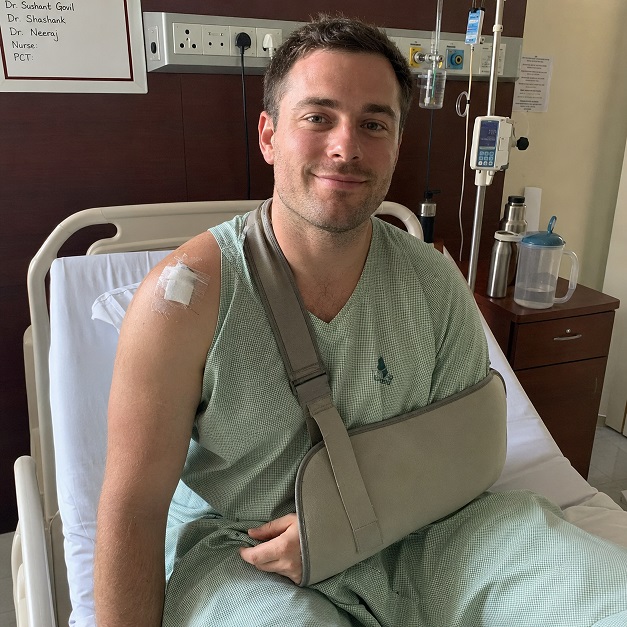
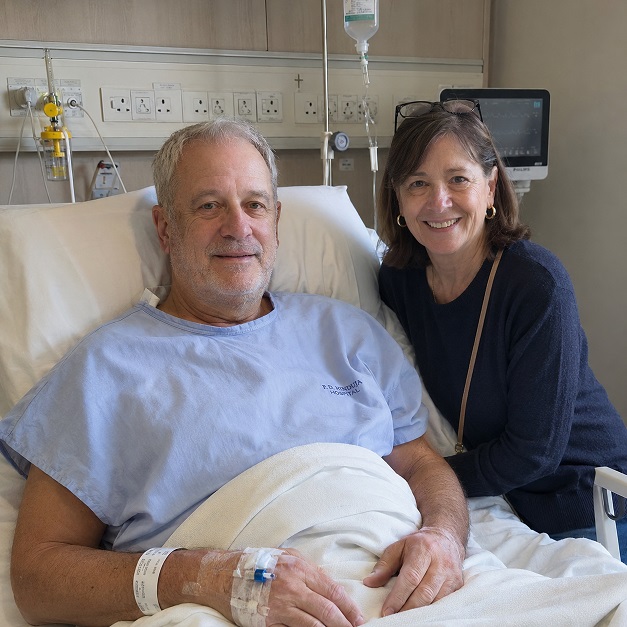
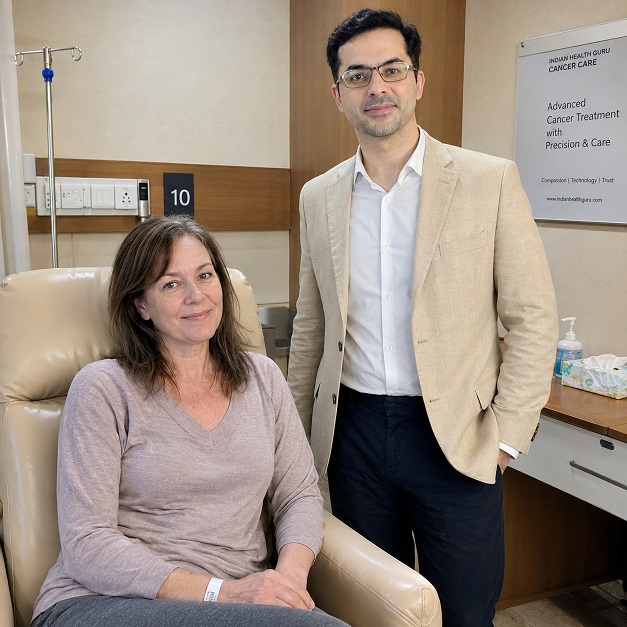
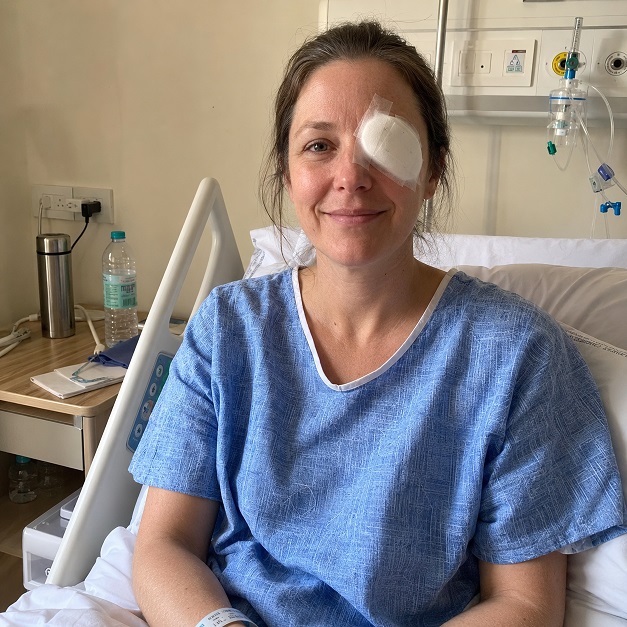
Patient Testimonials from Canada

Ready to Take the First Step?
Share your Medical Reports with our Healthcare Managers Today and Get a FREE CONSULTATION, a Personalized Treatment Plan, and Complete Support from Arrival to Recovery.
Get Your Free ConsultationFrom Canada to India: Your Complete Patient Support Guide
- Weight Loss & Bariatric Surgery in India for Canadian Patients: The Multi-Year Wait, Explained (2026)
- Bone Marrow Transplant in India for Canadian Patients: Complete Guide
- Brain Tumor Surgery in India for Canadian Patients: Complete Guide
- Breast Cancer Treatment and Surgery in India for Canadian Patients
- Cancer Treatment and Surgery in India for Canadian Patients
- Cardiac Surgery in India for Canadian Patients
- Colorectal Cancer Treatment and Surgery in India for Canadian Patients
- Cosmetic and Aesthetic Surgery in India for Canadian Patients
- CyberKnife Treatment in India for Canadian Patients: Complete Guide
- Dental Surgery in India for Canadian Patients | Complete Treatment & Cost Guide
- Gamma Knife Treatment in India for Canadian Patients
- Heart Valve Replacement Surgery in India for Canadian Patients
- Hip Surgery in India for Canadian Patients | Complete Treatment, Cost & Recovery Guide
- HIPEC Surgery in India for Canadian Patients: Complete Guide
- Kidney Transplant in India for Canadian Patients: Complete Guide
- Knee Surgery in India for Canadian Patients: Wait Times & Costs
- Neurosurgery in India for Canadian Patients: Wait Times & Costs
- Paediatric Cardiac Surgery in India for Canadian Patients