

Cancer Treatment and Surgery in India for Canadian Patients
Your cancer care in Canada is excellent and fully covered. The gap this briefing addresses sits somewhere narrower and more specific: the medicine your own oncologist recommends, approved by Health Canada, and still not on your provincial formulary.
A 58-year-old teacher in Halifax with metastatic breast cancer. Her oncologist recommends a CDK4/6 inhibitor, approved by Health Canada eleven months ago. It has not yet been listed on her provincial formulary, and her oncologist cannot say when it will be. Her private insurance, capped and means-tested, covers a fraction of the $5,600 monthly private price. She is not choosing between good care and bad care. Her cancer care — her surgery, her chemotherapy, her radiation — is excellent and fully covered. She is choosing between a medicine her own doctor recommended and a bill she cannot sustain indefinitely.
Healing Journeys of Canadian Patients
Key Takeaways
- Canadian cancer care remains the standard of care for most patients, and the PDF specifically advises newly diagnosed patients with an established treatment plan to stay with their Canadian oncology team and complete recommended treatment.
- The guide identifies a narrower problem involving oncology medicines that have received Health Canada approval but have not yet been added to a patient's provincial formulary. The reimbursement pathway can involve Health Canada, Canada's Drug Agency, the pan-Canadian Pharmaceutical Alliance and individual provincial decisions.
- A 2025 study cited in the PDF found a median 509-day interval, approximately 17 months, between Health Canada approval and first provincial listing for oncology drugs under the assessed pathway.
- The page 3 chart shows substantial differences between Canadian private prices and indicative Indian hospital-pharmacy prices for several oncology medicines. Examples include approximately C$5,600 vs C$780 for a CDK4/6 inhibitor and C$8,800 vs C$2,100 for a checkpoint inhibitor infusion.
- The PDF identifies four situations in which travelling or arranging services in India may genuinely be worth considering: an oncologist-recommended drug not yet provincially listed, long-term maintenance that is financially unsustainable, pathology/genomic second opinions, and an unusually unreasonable cancer-surgery wait.
- The strongest case for treatment itself abroad is presented as proton beam therapy, because the PDF states that Canada has no medical proton therapy facility. It also identifies high-volume complex surgical oncology as another area where Indian centres may offer substantial experience.
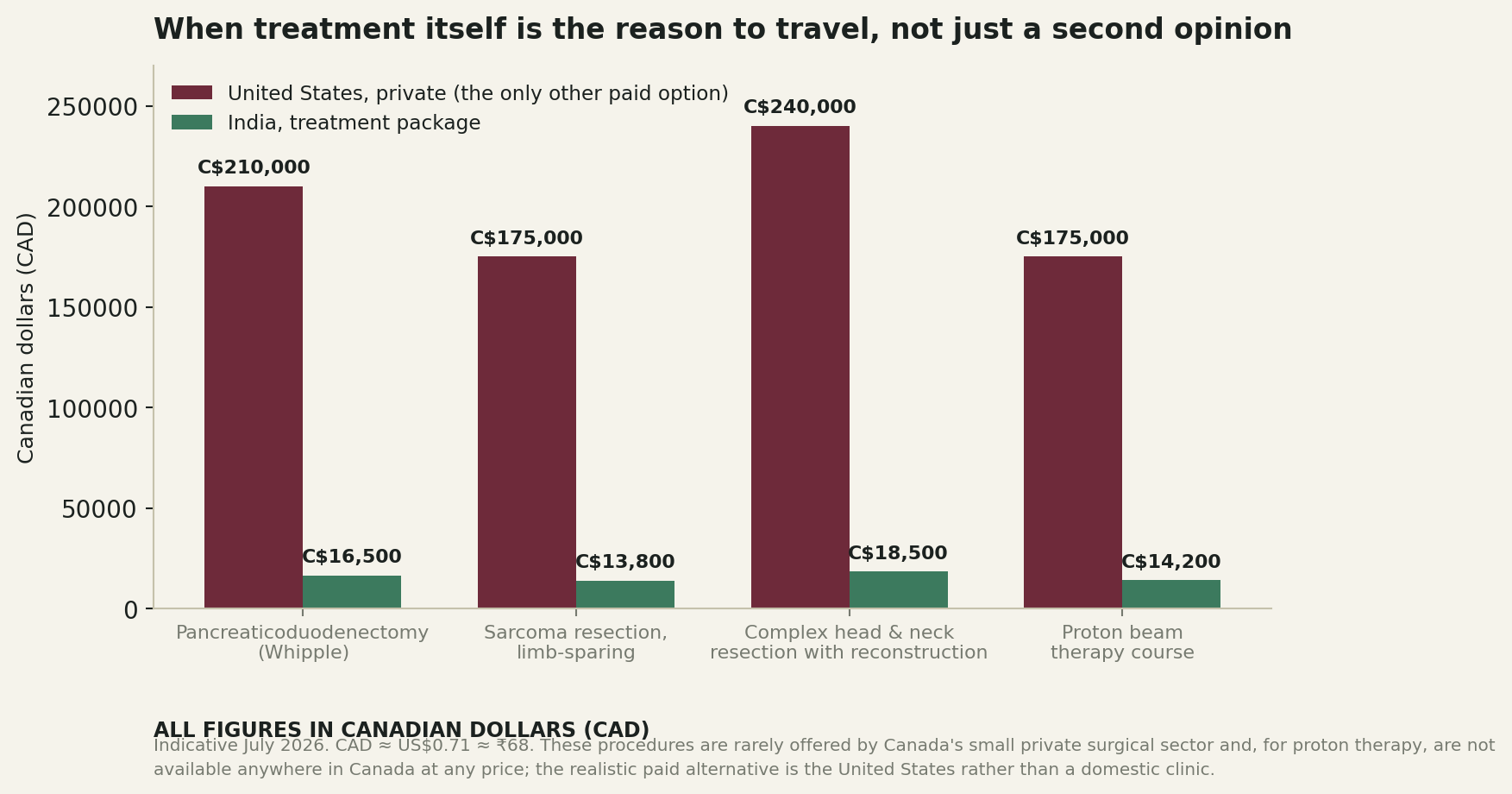
- The page 5 chart gives indicative India treatment-package figures of approximately C$16,500 for pancreaticoduodenectomy, C$13,800 for limb-sparing sarcoma resection, C$18,500 for complex head-and-neck resection with reconstruction, and C$14,200 for proton beam therapy, compared with substantially higher US private-care figures.
- The guide strongly warns patients against unproven cures, stopping Canadian treatment, buying cancer medicines from online or unlicensed sources, or accepting a treatment quote before the pathology has been reviewed.
Quick Facts
- Treatment
- Cancer Treatment and Surgery
- Country
- India
- Patients
- Canadian Patients
- Specialty
- Medical Oncology / Surgical Oncology / Radiation Oncology
- Canadian Cancer Care
- Excellent and Generally Covered
- Radiation Benchmark
- 28 Days From Ready-to-Treat to First Treatment
- Radiation Benchmark Achievement
- 94% of Patients in 2024
- Tracked Cancer Surgeries
- Bladder, Breast, Colorectal, Lung and Prostate
- Cancer Surgery Benchmark
- No Equivalent National Target
- Oncology Drug Listing Gap
- Median 509 Days / Approximately 17 Months
- Key Drug Issue
- Health Canada Approval Does Not Automatically Mean Provincial Formulary Listing
- Medicine Source
- Established Manufacturer and Licensed Hospital Pharmacy
- Follow-Up
- Canadian Oncologist / Treating Team
- Important Principle
- Do Not Pause or Abandon Effective Canadian Treatment
In Brief
For Canadian patients, the PDF presents India not as a replacement for Canada's cancer-care system but as a targeted option for specific gaps. These include access to an oncologist-recommended medicine that is not yet provincially listed, financially sustainable long-term maintenance therapy, pathology or genomic second opinions, unreasonable surgical waits, proton beam therapy and selected complex cancer surgeries. The Canadian oncology team should remain involved throughout the process.
Most of what follows is an argument against travelling
Canadian oncology is excellent, and I want to say that plainly before anything else, because it is not the usual way to open a document trying to persuade you of something. Your surgery is covered. Your chemotherapy is covered. Your radiation therapy is covered, and measured against a real national standard your provincial system mostly meets. In 24 years of guiding international patients into Indian hospitals, I have turned away more Canadians with cancer than from almost any other specialty, and I would do it again tomorrow. If you have been newly diagnosed and your oncologist has a plan, stay. Finish it.
This briefing is about the narrower, real gap that sits underneath that otherwise strong system — and about the specific, limited circumstances in which India solves it.
Cancer treatment is one of Canada's five tracked priorities. Only half of it is actually measured.
In 2004, Canada's governments agreed to reduce wait times in five priority areas, cancer treatment among them. What that commitment produced, two decades later, is a genuine national benchmark for radiation therapy — 28 days from ready-to-treat to first treatment, met by 94 per cent of patients in 2024. It did not produce an equivalent benchmark for cancer surgery.
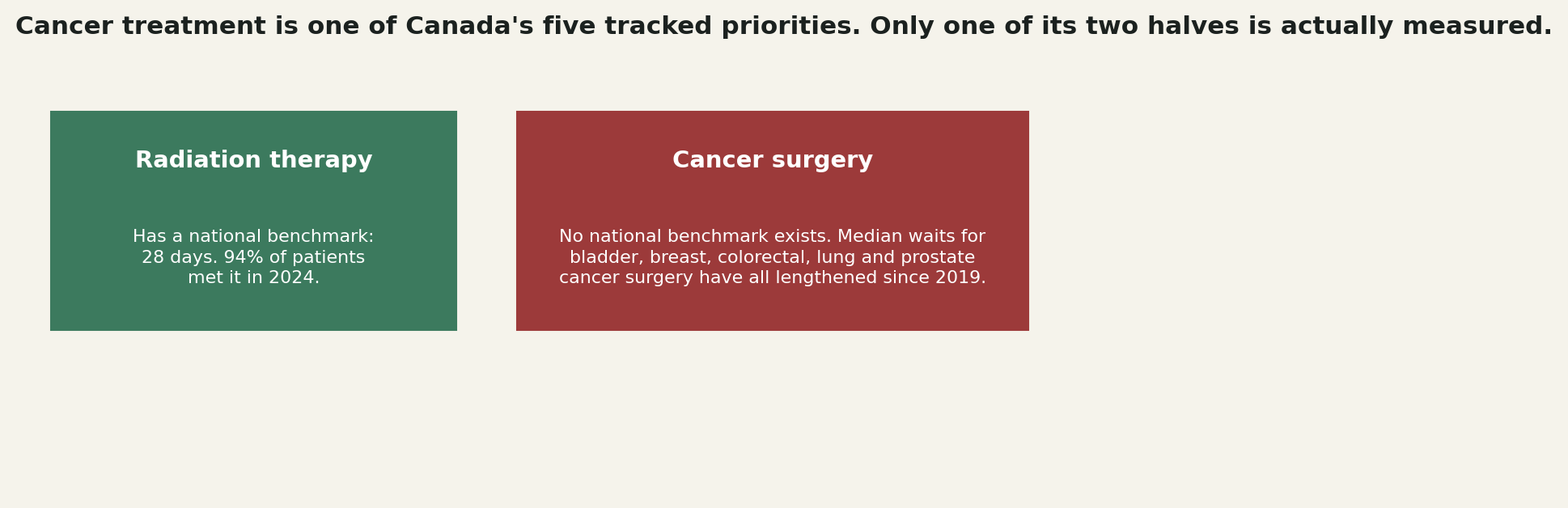
CIHI tracks wait times for five specific cancer surgeries — bladder, breast, colorectal, lung and prostate — and reports them publicly. It does not hold them against a national target the way it does for radiation, hip replacement or cataract surgery. What the tracked data does show is not encouraging: median wait times for all five cancer surgery types have lengthened since 2019, prostate cancer surgery by over a week, despite seven per cent more cancer surgeries being performed in 2024 than before the pandemic. Demand is outpacing capacity in exactly the part of cancer care Canada does not formally benchmark.
This is not a reason to distrust Canadian surgical oncology, which remains excellent. It is a reason to ask your own surgical team a direct question: what is a reasonable wait for my specific cancer, at my stage, and who do I speak to if that timeframe is exceeded? Without a national benchmark behind you, that question is the closest substitute you have.
The gap that actually brings people to me: the drug that exists but isn't listed yet
This is the part of Canadian cancer care I most want to explain plainly, because almost nobody does. A drug can complete Health Canada's regulatory approval and still be a very long way from your pharmacy.
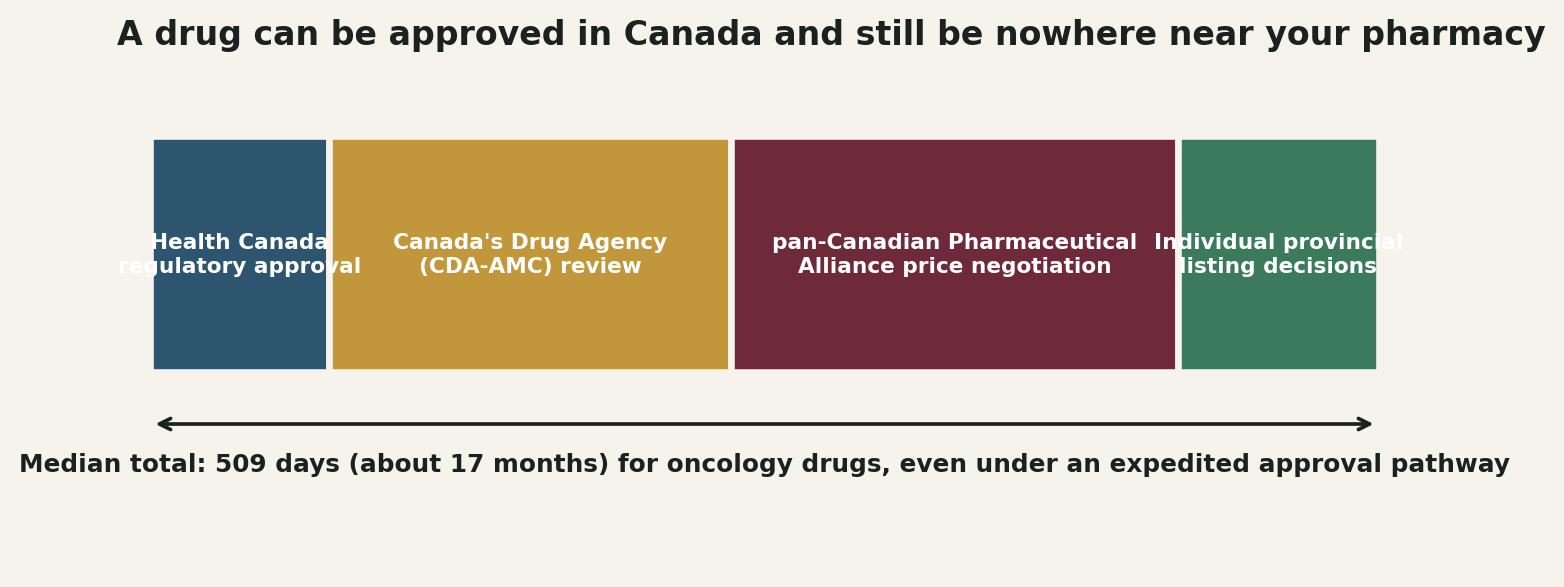
After Health Canada approval, a new oncology drug is reviewed by Canada's Drug Agency, which assesses cost-effectiveness and issues a reimbursement recommendation. Only then does the pan-Canadian Pharmaceutical Alliance begin negotiating a price with the manufacturer on behalf of every provincial and territorial drug plan. Only after that negotiation concludes does each province separately decide whether, and when, to list the drug on its own formulary. A 2025 peer-reviewed study of oncology drugs approved between 2023 and 2024 found the median time from Health Canada approval to first provincial listing was 509 days — about seventeen months — even under an expedited conditional-approval pathway designed specifically for cancer drugs with early, promising data. A newer accelerated process introduced in 2023 can shorten this considerably, but as of the most recent published assessment, only a single drug had been carried through it.
Two details worth understanding, because they change how a patient should read a listing delay. First, the sequence is genuinely sequential rather than parallel in most cases: Canada's Drug Agency does not usually begin its cost-effectiveness review until Health Canada approval is finalised, and the pan-Canadian Pharmaceutical Alliance does not usually begin price negotiation until that review concludes. Second, even once national negotiation ends, each province decides separately whether and when to add the drug to its own formulary, which is why the same medicine can become available in one province months before another.
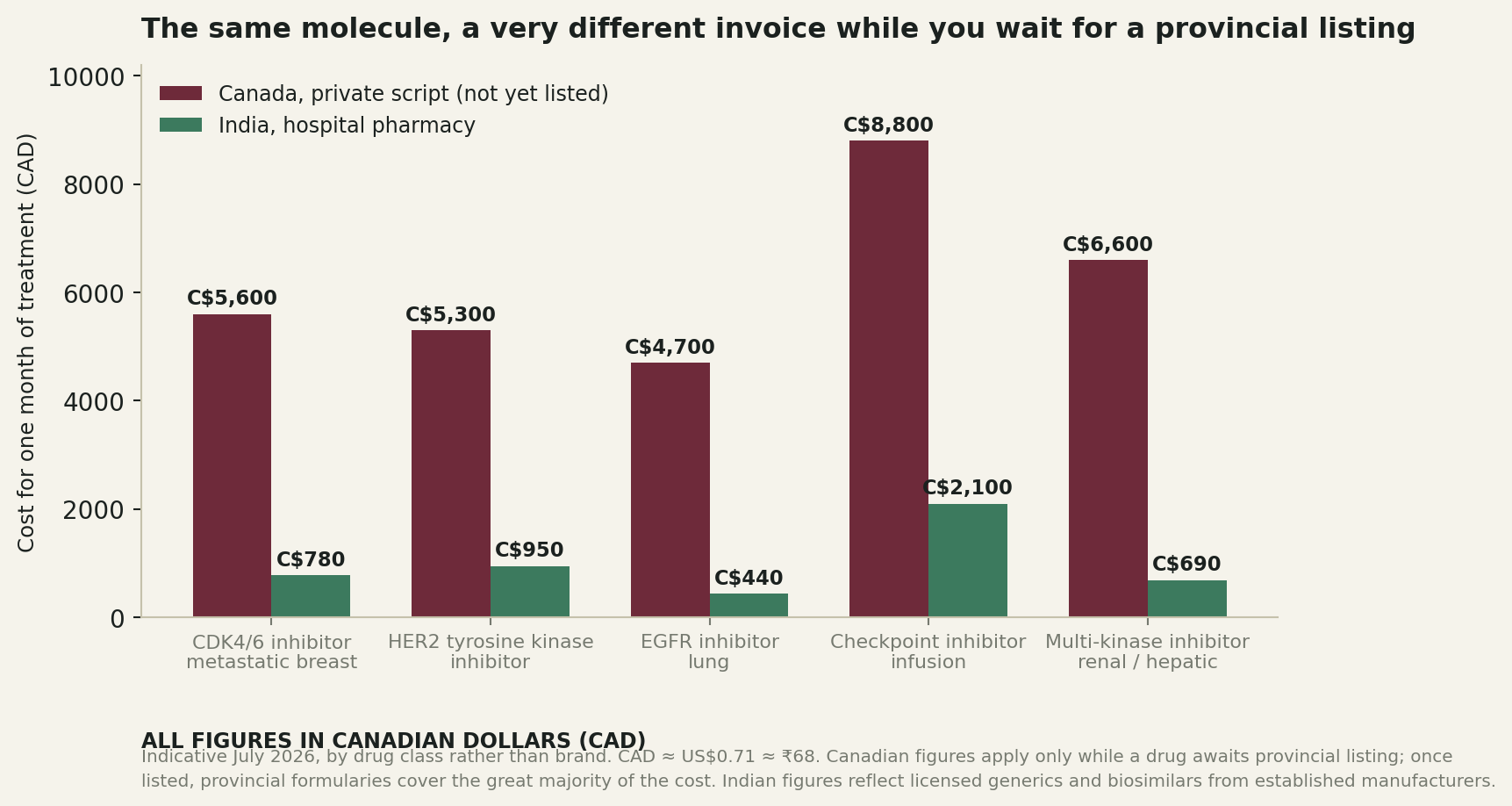
How big is the gap, in dollars?
India manufactures a very large share of the world's generic and biosimilar medicines, including for the major multinational originators, and the same molecules are dispensed there at a fraction of the Canadian private price. That is not a quality compromise when the product comes from an established manufacturer through a hospital pharmacy; it is a pricing difference produced by patent status, market size and regulation. The number that matters most, though, is not the monthly figure. It is what happens when the months accumulate across a 509-day wait.
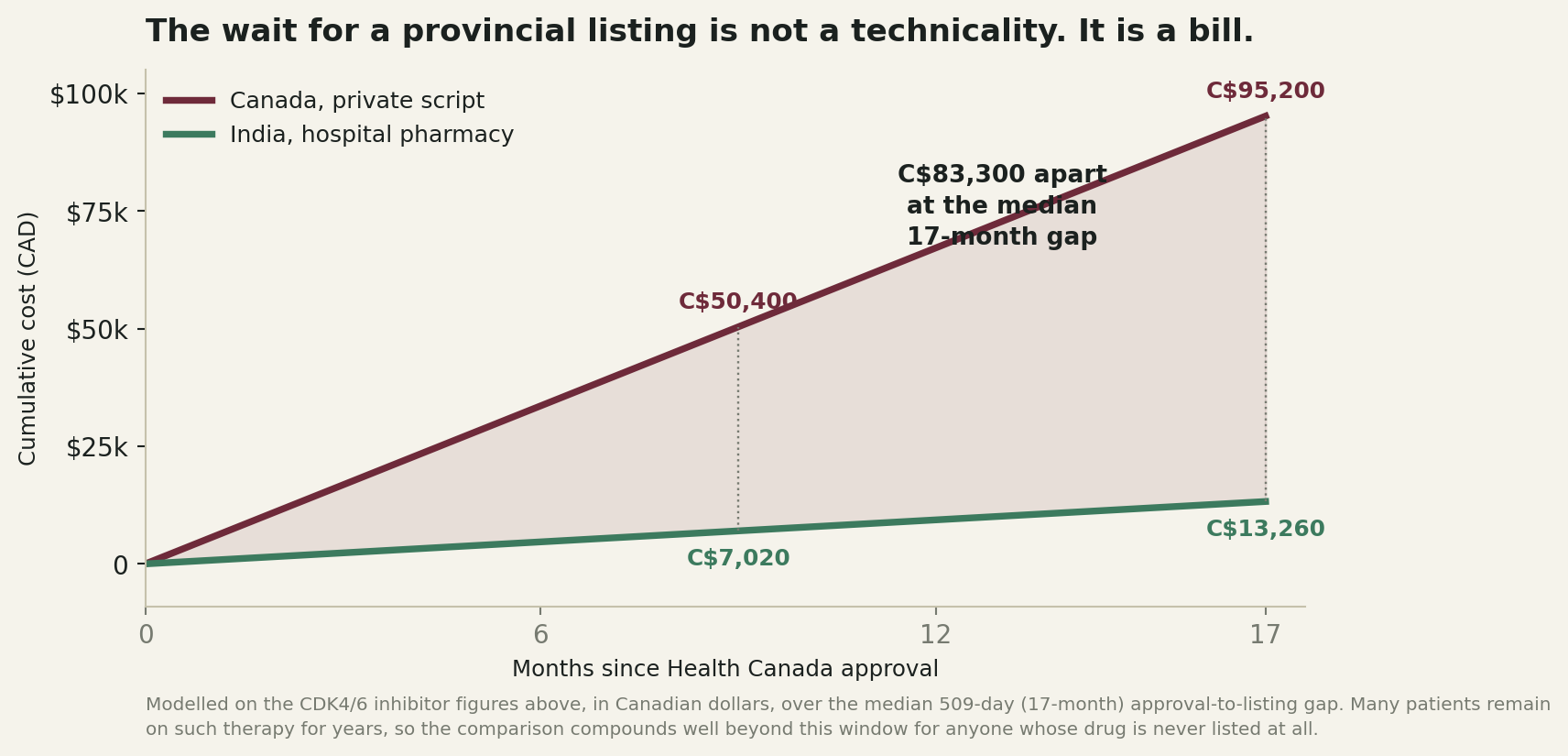
Maintenance therapy is not a purchase. It is a subscription, and people often stay on these drugs for years when they work. Oncologists have a term for this: financial toxicity, meaning a treatment's cost becomes a side effect in its own right, one that causes people to quietly stop taking a drug that is working. In 24 years of guiding patients through this exact decision, that is the outcome I most want to help Canadians avoid.
Which situations genuinely justify the trip
01 A drug your oncologist wants that isn't provincially listed yet
The commonest case by far. Your Canadian oncologist prescribes and supervises; the medicine is sourced at a sustainable price while you wait out the listing process. Nothing about your clinical care changes.
02 Long-term maintenance you cannot sustain at Canadian private prices
You started privately, it is working, and the arithmetic has caught up with you. This is the situation where travelling converts an impossible bill into a manageable one.
03 A pathology second opinion or comprehensive genomic profiling
Tumour type and grade are matters of interpretation more often than patients realise, and broad genomic testing can open targeted options. Neither requires a passenger — samples and scans travel instead.
04 A cancer surgery wait that has become genuinely unreasonable
Since no national benchmark exists to hold a province accountable, an unusually long wait for one of the five tracked cancer surgeries is worth raising directly with your surgical team — and, if it does not resolve, worth getting a second opinion on elsewhere.
When actual treatment abroad is the concrete advantage, not just a workaround
Everything above is about medicine and second opinions. There is also a direct, genuine case for having treatment itself performed in India, and it rests on two things Canada does not currently offer at any price.
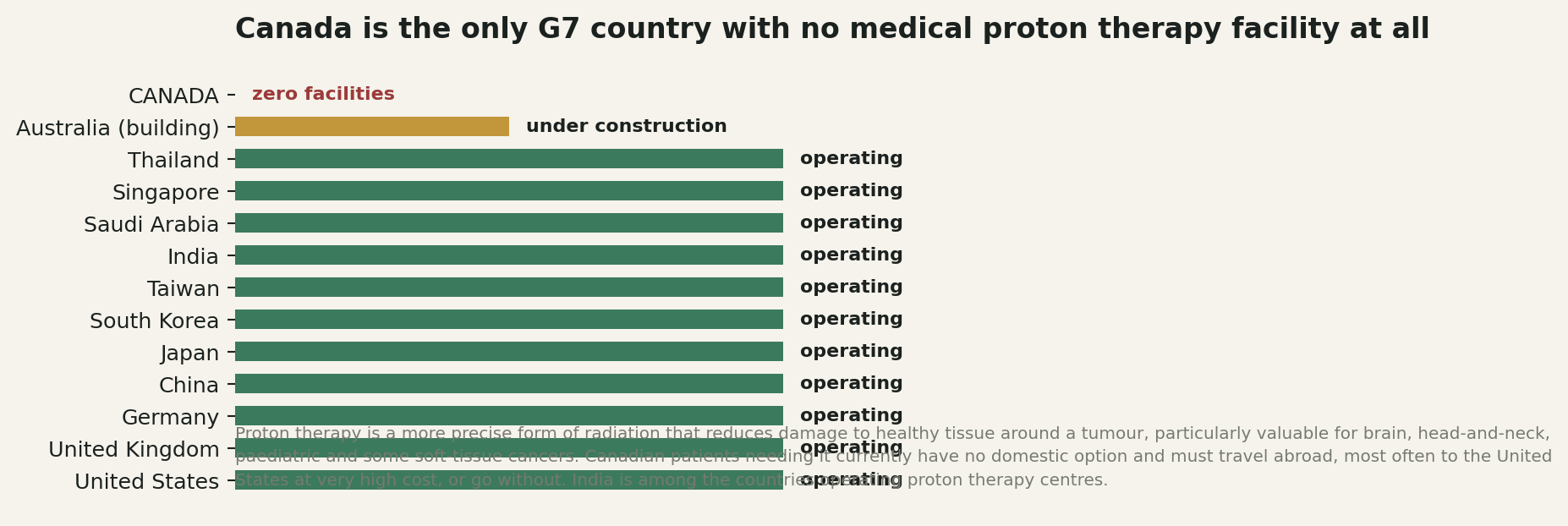
Proton beam therapy does not exist anywhere in Canada. Canada is the only G7 country with no medical proton therapy facility at all. Proton therapy delivers radiation with far greater precision than conventional photon radiotherapy, sparing healthy tissue around the tumour, and Canadian clinical guidelines themselves recognise its value for brain, head-and-neck and soft-tissue cancers, with paediatric cases benefiting particularly from reduced damage to a still-developing body. A Canadian patient who needs it today has no domestic option whatsoever and must travel — typically to the United States, where the price is extraordinary.
Complex surgical oncology rewards volume in a way Canada's smaller caseloads structurally cannot match. Procedures like pancreaticoduodenectomy, limb-sparing sarcoma resection, and complex head-and-neck resection with reconstruction are technically demanding, relatively uncommon, and outcomes are strongly linked to how often a surgical team performs them. High-volume Indian cancer centres, drawing on a far larger population, perform these operations at a frequency few Canadian units can match, and combine this with the same accreditation standards described throughout this series — JCI internationally, NABH as India's national equivalent.
In 24 years of guiding patients through decisions like this, proton therapy is the clearest case in this entire briefing: it is not a question of Canada being slower or more expensive. For most Canadian patients, it is currently unavailable at home at any price, and travelling is not an alternative to Canadian care but the only way to access a treatment Canadian oncology guidelines themselves recommend.
Four Things that Should Make You Walk Away Immediately
Any clinic promising a cure your Canadian oncologist has not heard of. Cancer attracts the worst actors in medical tourism. Every legitimate treatment has published trial data with a name you can look up.
Anyone who suggests pausing or abandoning your Canadian treatment. A responsible unit works alongside your oncologist, never around them.
Medicines bought online, or from anywhere other than a hospital or licensed pharmacy. Counterfeit oncology drugs exist, and this is the one place a small saving can cost you everything.
A quote that arrives before a pathology report has been read. Nobody can price your treatment before they know precisely what you have.
What does this look like in practice, and what do I tell my oncologist?
In most cases you are not moving your cancer care to India. You are solving one component of it there — usually a medicine — and keeping everything else exactly where it is: your diagnosis, your surgery, your oncologist, your surveillance imaging. Tell your oncologist early and plainly: I can't sustain the private
Canadian oncologists have had this conversation before, because they see the financial toxicity of their own prescriptions regularly. Ask what they need to see — manufacturer, formulation, batch documentation — and bring back exactly that. Two practical notes: check whether a compassionate access or patient support programme exists for your specific drug, since manufacturers run them and they are often unadvertised; and note that Health Canada permits limited personal importation of medicine under specific conditions, which your oncologist and pharmacist can advise on directly.
Straight answers for Canadian Patients about Cancer Treatment and Surgery in India
Are Indian generic cancer drugs the same as the Canadian originals?
Where they come from an established manufacturer and a licensed pharmacy, they contain the same active molecule to the same standard. Ask for the manufacturer, batch documentation and a proper invoice, and give all three to your oncologist. Avoid online sellers entirely.
Should I stop my Canadian treatment while I sort this out?
No. Nothing here is a reason to pause effective treatment, and any provider suggesting otherwise should lose your confidence immediately.
My drug might be listed provincially soon. Should I wait?
Ask your oncologist to check the CDA-AMC recommendation status and pCPA negotiation stage directly, since the answer changes month to month. Do not go without treatment while waiting, and do not wait in the dark.
Will my provincial plan or private insurance reimburse any of this?
Almost never for treatment sourced overseas. If your drug is not yet listed, ask your private insurer specifically what they cover for non-formulary medications, since policies vary considerably.
Do I have to travel in person?
Often not. Pathology review, genomic profiling and medicine sourcing can all be arranged with samples, scans and courier logistics rather than a passenger.
A closing word
If you take one thing from this, let it be that Canadian cancer care is worth staying inside. But if you are holding a private script you cannot sustain, or a surgical wait with no benchmark behind it, that is a solvable problem, and you should not solve it by stopping treatment that is working. Send me the pathology report, the current prescription and what you are being charged, and I will tell you honestly whether there is a better route — including telling you there is not.
Sources
- 🌐 Canadian Institute for Health Information, "Wait times for priority procedures in Canada, 2025" — cihi.ca/en/wait-times-for-priority-procedures-in-canada-2025
- 🌐 CIHI, "Longer wait times for surgeries and diagnostic imaging persist across Canada compared with the pre-pandemic period" — cihi.ca
- 🌐 "Accelerating Oncology Drug Reimbursement in Canada: Impact of the CDA-AMC Time-Limited Recommendation and pCPA Temporary Access Process", Current Oncology, 2025 — pmc.ncbi.nlm.nih.gov/articles/PMC12025630
- 🌐 "Time-limited reimbursement and Temporary Access Process for early access to oncology treatments in Canada" — pmc.ncbi.nlm.nih.gov/articles/PMC12142399
- 🌐 "Proton beam therapy: A modern treatment for cancer, but not in Canada (yet)", The Conversation, 2024 — theconversation.com
- 🌐 High Commission of India, e-Visa categories and eligibility — indianvisaonline.gov.in/evisa
Frequently Asked Questions by Canadian Patients about Cancer Treatment and Surgery in India
Should Canadian patients move their cancer treatment to India?
Not routinely. The PDF specifically states that Canadian cancer care is excellent and recommends staying with the Canadian oncology team when an appropriate treatment plan is already in place.
Why might a Canadian patient consider getting a cancer medicine in India?
A medicine may be approved by Health Canada but still not be listed on the patient's provincial formulary. India may provide an established hospital-pharmacy source at a lower indicative private cost while the Canadian oncologist continues prescribing and monitoring the treatment.
How long can oncology-drug listing take in Canada?
The PDF cites a 2025 study reporting a median of 509 days, or approximately 17 months, from Health Canada approval to first provincial listing under the assessed pathway.
Can I obtain a pathology or genomic second opinion without travelling?
Yes. The PDF explains that pathology samples, scans and other materials can be sent through courier arrangements, meaning the patient often does not need to travel in person for these services.
What cancer treatments does the PDF identify as reasons to travel for actual treatment?
It identifies proton beam therapy as the clearest example because the PDF states that Canada has no medical proton therapy facility. It also discusses selected complex surgical oncology procedures performed at high-volume Indian centres.
What complex cancer surgeries are discussed?
The guide specifically mentions pancreaticoduodenectomy, limb-sparing sarcoma resection and complex head-and-neck resection with reconstruction as technically demanding procedures where surgical volume can be important.
What is the indicative cost of proton beam therapy in India?
The page 5 chart gives an indicative India treatment-package figure of approximately C$14,200 for proton beam therapy. Actual costs depend on the patient's diagnosis and treatment plan.
How should Canadian patients source cancer medicines from India?
The guide recommends using an established manufacturer and licensed hospital pharmacy. Patients should obtain manufacturer details, formulation information, batch documentation and a proper invoice and provide these to their Canadian oncologist.
Should I stop my Canadian treatment while arranging treatment or medicines in India?
No. The PDF repeatedly emphasizes that nothing in the guide is a reason to pause, abandon or delay effective treatment recommended in Canada. Any provider suggesting otherwise should be treated as a major warning sign.
What should make a Canadian patient immediately avoid a cancer-treatment provider?
The guide identifies four warning signs: promises of an unfamiliar cure, advice to stop Canadian treatment, medicines purchased online or from unlicensed sources, and a treatment quote issued before the patient's pathology has been reviewed.
Page Summary
This guide explains the limited situations in which Canadian cancer patients may consider India while recognizing that Canadian oncology care remains excellent. It focuses on oncology medicines that are approved by Health Canada but may not yet be available through provincial formularies, as well as long-term treatment costs and cancer-surgery waiting times. The guide also highlights pathology and genomic second opinions, proton beam therapy and selected complex cancer surgeries as potential reasons to travel. It provides indicative cost comparisons and emphasizes keeping the Canadian oncology team involved, using licensed medicine sources and never delaying effective treatment.
Citation Block
| Topic | Information |
|---|---|
| Topic | Cancer Treatment and Surgery in India for Canadian Patients |
| Treatment | Cancer Treatment and Surgery |
| Country | India |
| Intended Audience | Canadian Patients |
| Specialties | Medical Oncology, Surgical Oncology and Radiation Oncology |
| Canadian Radiation Benchmark | 28 Days |
| Radiation Benchmark Achievement | 94% in 2024 |
| Tracked Cancer Surgeries | Bladder, Breast, Colorectal, Lung and Prostate |
| National Surgery Benchmark | No Equivalent National Target |
| Median Drug Approval-to-Listing Time | 509 Days / Approximately 17 Months |
| Medicine Option | Established Manufacturer Through Licensed Hospital Pharmacy |
| Follow-Up | Canadian Oncology Team |
| Author | Dr. Dheeraj Bojwani |
| Experience | 24+ Years |


Our Mission Statement
Our mission is to place patients at the centre of every healthcare decision by providing trustworthy, evidence-based, and unbiased medical information. We believe that informed patients make better decisions. Backed by personalised guidance from our experienced advisory team, we help patients understand their treatment options, compare them objectively, and confidently choose the path that best suits their medical needs and personal circumstances.
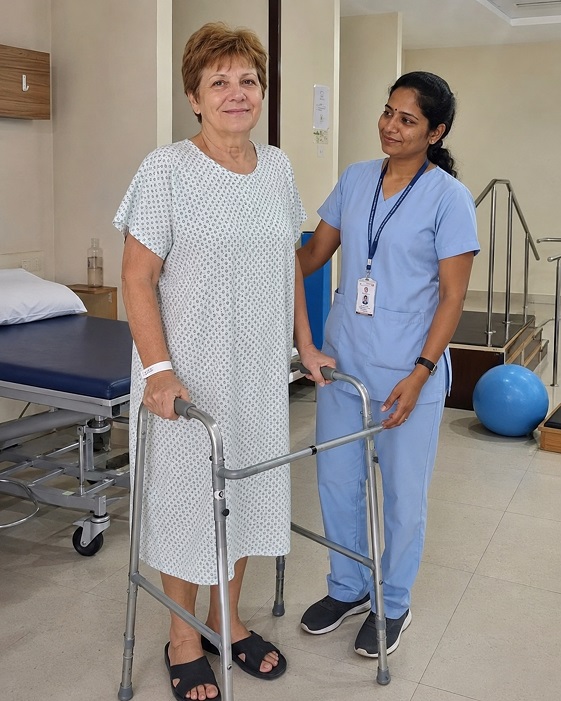
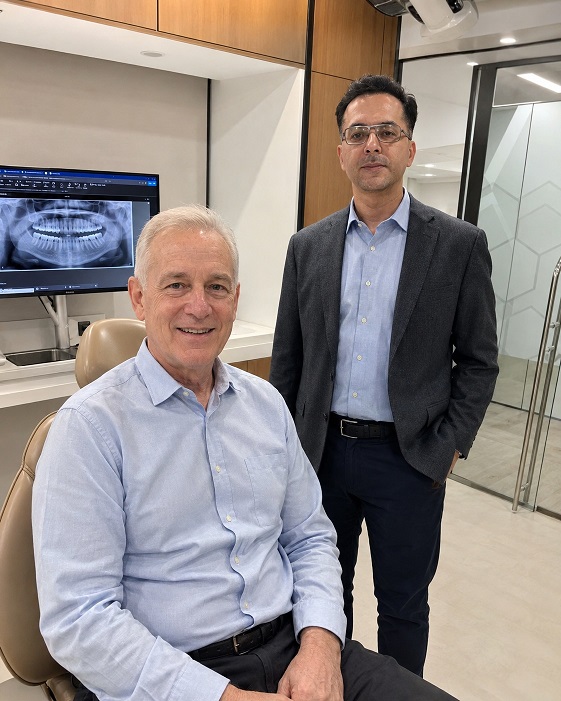
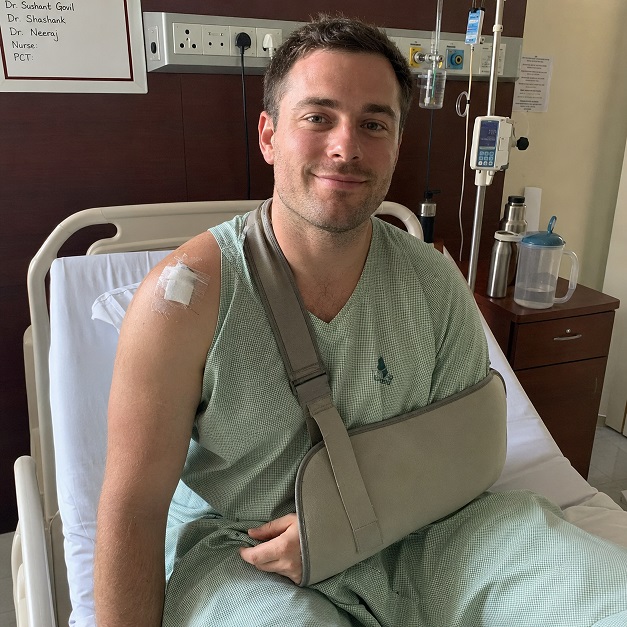
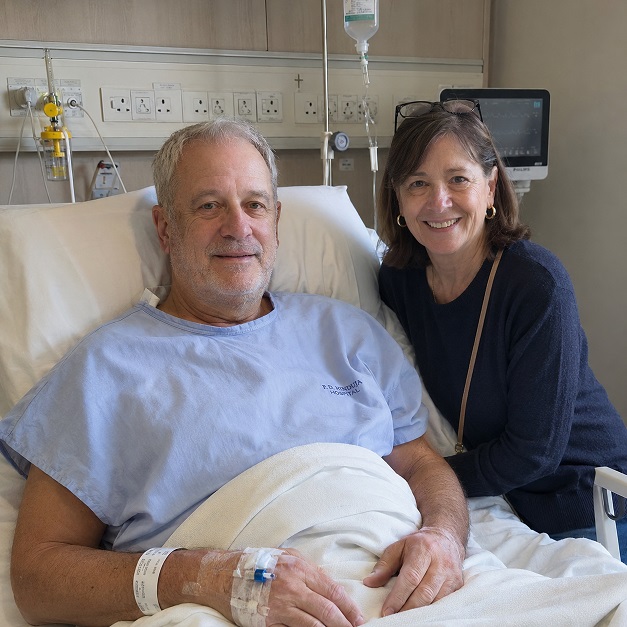
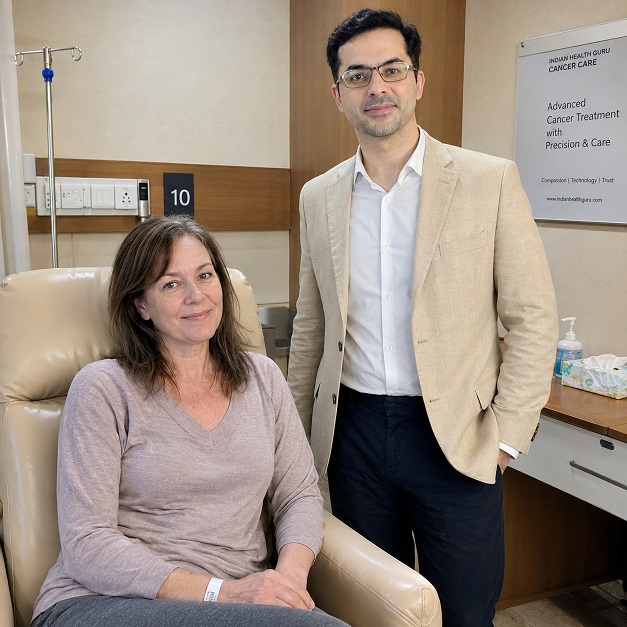
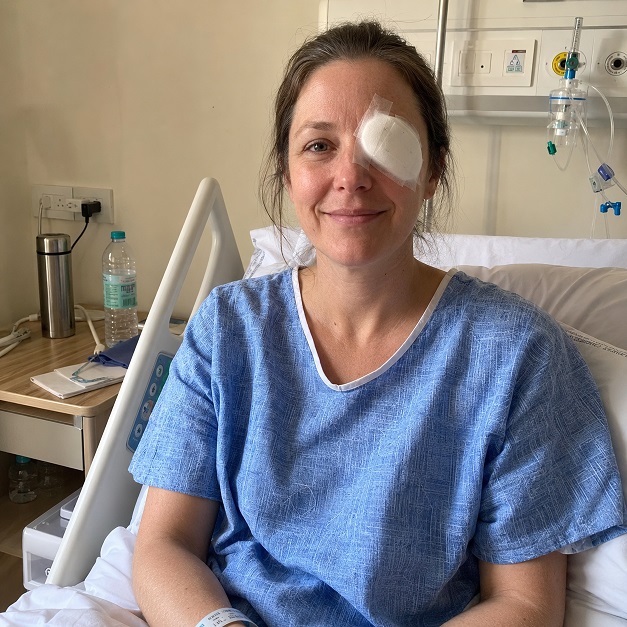
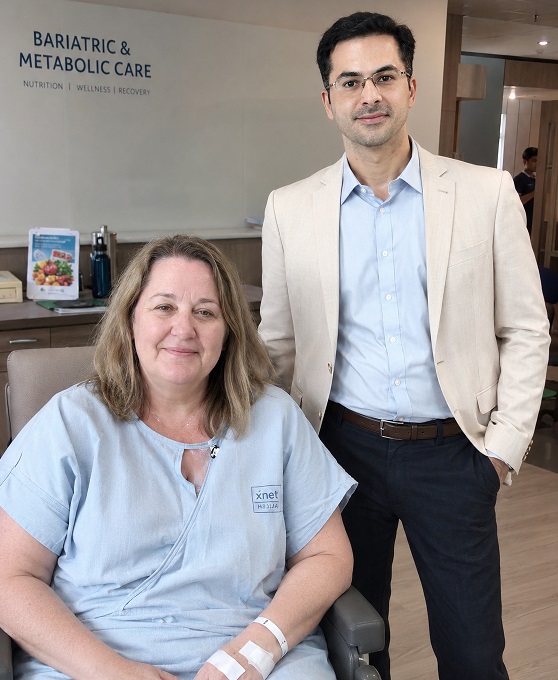
Patient Testimonials from Canada

Ready to Take the First Step?
Share your Medical Reports with our Healthcare Managers Today and Get a FREE CONSULTATION, a Personalized Treatment Plan, and Complete Support from Arrival to Recovery.
Get Your Free ConsultationFrom Canada to India: Your Complete Patient Support Guide
- Weight Loss & Bariatric Surgery in India for Canadian Patients: The Multi-Year Wait, Explained (2026)
- Bone Marrow Transplant in India for Canadian Patients: Complete Guide
- Brain Tumor Surgery in India for Canadian Patients: Complete Guide
- Breast Cancer Treatment and Surgery in India for Canadian Patients
- Cancer Treatment and Surgery in India for Canadian Patients
- Cardiac Surgery in India for Canadian Patients
- Colorectal Cancer Treatment and Surgery in India for Canadian Patients
- Cosmetic and Aesthetic Surgery in India for Canadian Patients
- CyberKnife Treatment in India for Canadian Patients: Complete Guide
- Dental Surgery in India for Canadian Patients | Complete Treatment & Cost Guide
- Gamma Knife Treatment in India for Canadian Patients
- Heart Valve Replacement Surgery in India for Canadian Patients
- Hip Surgery in India for Canadian Patients | Complete Treatment, Cost & Recovery Guide
- HIPEC Surgery in India for Canadian Patients: Complete Guide
- Kidney Transplant in India for Canadian Patients: Complete Guide
- Knee Surgery in India for Canadian Patients: Wait Times & Costs
- Neurosurgery in India for Canadian Patients: Wait Times & Costs
- Paediatric Cardiac Surgery in India for Canadian Patients