

Cervical and Lumbar Artificial Disc Replacement in India for Canadian Patients
Approved in Canada since 2007, with outcome data that genuinely outperforms fusion — yet only a handful of Canadian surgeons are trained to offer it. Most patients never hear it's an option.
A 57-year-old in Toronto with a ruptured cervical disc. His Canadian surgeon offered exactly one option: fusion. When adjacent discs later ruptured too, he faced the prospect of fusing three, possibly four levels of his neck, each one further limiting his mobility. Researching alternatives himself, he discovered artificial disc replacement had been performed successfully abroad for years, preserving motion rather than eliminating it. He is far from the only Canadian to have found this out the hard way, rather than being told about it upfront.
Healing Journeys of Canadian Patients
Key Takeaways
- Canadian patients considering artificial disc replacement should first ask whether disc replacement was considered for their specific cervical or lumbar disc condition before committing to fusion.
- Artificial disc replacement has been approved in Canada since 2007, with four manufacturers having held Health Canada approval for cervical and lumbar devices.
- Artificial disc replacement preserves movement at the treated spinal level, whereas fusion permanently joins the vertebrae and eliminates movement at that level.
- Comparative evidence cited in the PDF reports approximately 86% overall satisfaction for cervical disc replacement compared with roughly 74% for fusion.
- Five-year data cited in the briefing shows cervical arthroplasty patients requiring three to five times fewer reoperations than matched fusion patients.
- Lumbar artificial disc replacement patients have experienced roughly one-third of the adjacent-level degeneration seen after fusion in the comparative evidence described.
- Disc replacement is not appropriate for every Canadian patient and may not be suitable in cases involving significant spinal instability, advanced arthritis, certain deformities or urgent neurological conditions.
- Canadian patients considering treatment in India should seek an assessment from a spine surgeon who regularly performs both fusion and artificial disc replacement.
- Patients should verify the specific artificial disc device, surgeon experience, hospital accreditation and the discharge documentation that will be provided to their Canadian surgeon.
- The PDF indicates an indicative cost of approximately C$7,800 for a single-level artificial disc replacement package in India, compared with approximately C$68,000 in the United States as the paid alternative shown in the briefing.
Quick Facts
- Treatment
- Cervical and Lumbar Artificial Disc Replacement
- Country
- India
- Patients
- Canadian Patients
- Primary Condition
- Cervical or Lumbar Disc Disease
- Main Procedures
- Cervical and Lumbar Artificial Disc Replacement
- Alternative Procedure
- Spinal Fusion
- Key Treatment Goal
- Preserve Motion at the Treated Spinal Level
- Health Canada Approval
- Artificial disc replacement devices approved since 2007
- Reported Cervical Satisfaction
- Approximately 86% with artificial disc replacement versus roughly 74% with fusion
- Reoperation Data
- Three to five times fewer reoperations at five years for cervical arthroplasty in the cited comparison
- Key Candidate Assessment
- Actual spine imaging reviewed by a qualified spine surgeon
- Important Exclusions
- Significant instability, advanced arthritis, certain deformities and urgent neurological presentations
- Indicative India Cost
- Approximately C$7,800 for a single-level disc replacement package
- Typical India Stay
- Around 1–2 weeks, depending on the number of levels treated and fit-to-fly assessment
- Follow-Up
- Canadian surgeon with complete operative and device records
In Brief
Canadian patients considering cervical or lumbar artificial disc replacement in India should first establish whether they are suitable candidates for disc arthroplasty rather than automatically proceeding with fusion. Artificial disc replacement removes the damaged disc and replaces it with a moving implant designed to preserve natural spinal movement, while fusion permanently eliminates movement at the treated level. The PDF notes that artificial disc replacement has been Health Canada-approved since 2007, although adoption and surgeon training remain limited in Canada. Comparative evidence presented in the briefing reports higher patient satisfaction, fewer reoperations and lower adjacent-level degeneration with disc replacement in several measures. Patients travelling to India should obtain a second opinion from a surgeon experienced in both procedures, confirm the specific device being used, verify hospital accreditation and arrange a detailed discharge record for continued follow-up with their Canadian surgeon.
An approved, proven alternative that most Canadian patients are never offered
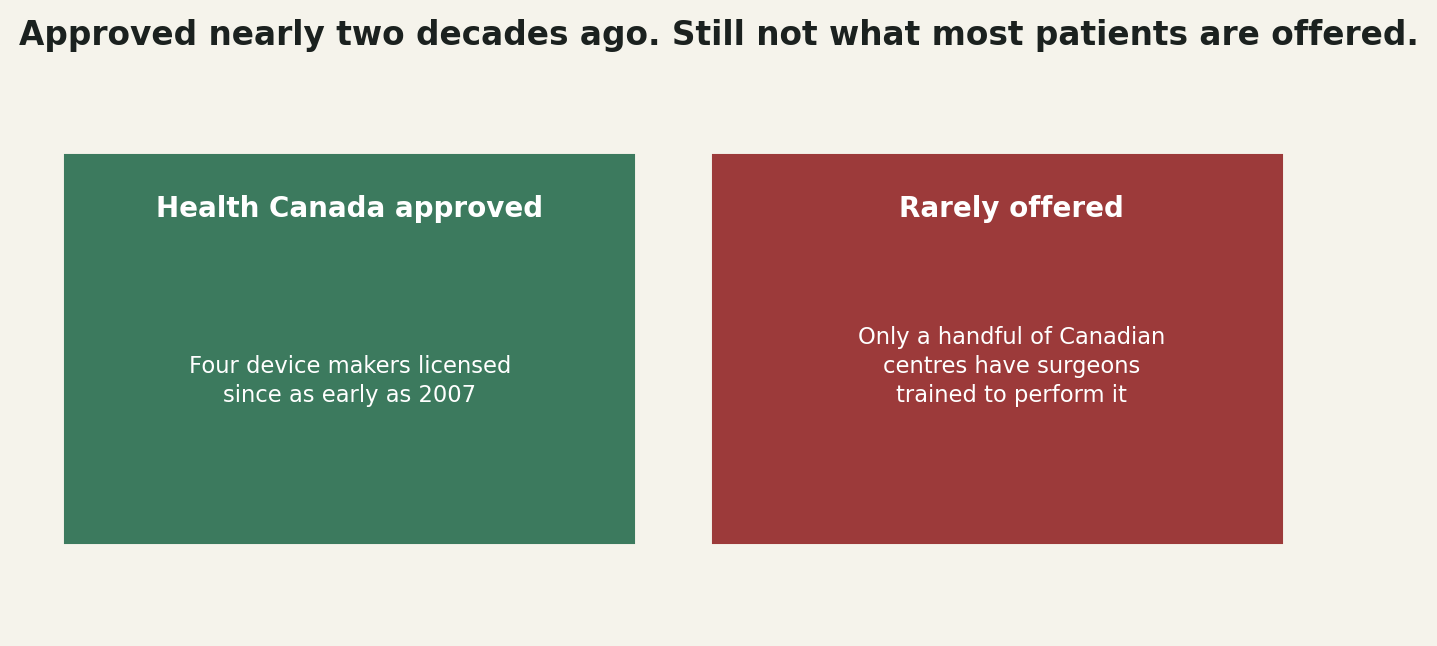
Canadian spine surgeons performing fusion do skilled, careful work, and in 24 years of guiding international patients into Indian hospitals I have never suggested otherwise. What's worth understanding clearly is that fusion is not the only proven option for cervical or lumbar disc disease — and the alternative has been sitting, approved and ready, for nearly two decades.
Four manufacturers have held Health Canada approval for cervical and lumbar disc replacement devices since as early as 2007. The gap isn't regulatory; it's training and adoption. Ontario's own health technology assessment found that only a small number of centres in the entire province have surgeons trained to perform disc arthroplasty in either the neck or lower back, and estimated roughly a thousand patients a year in Ontario alone would qualify for cervical disc replacement specifically, most of whom are simply never offered it as an option.
What the two procedures actually do differently
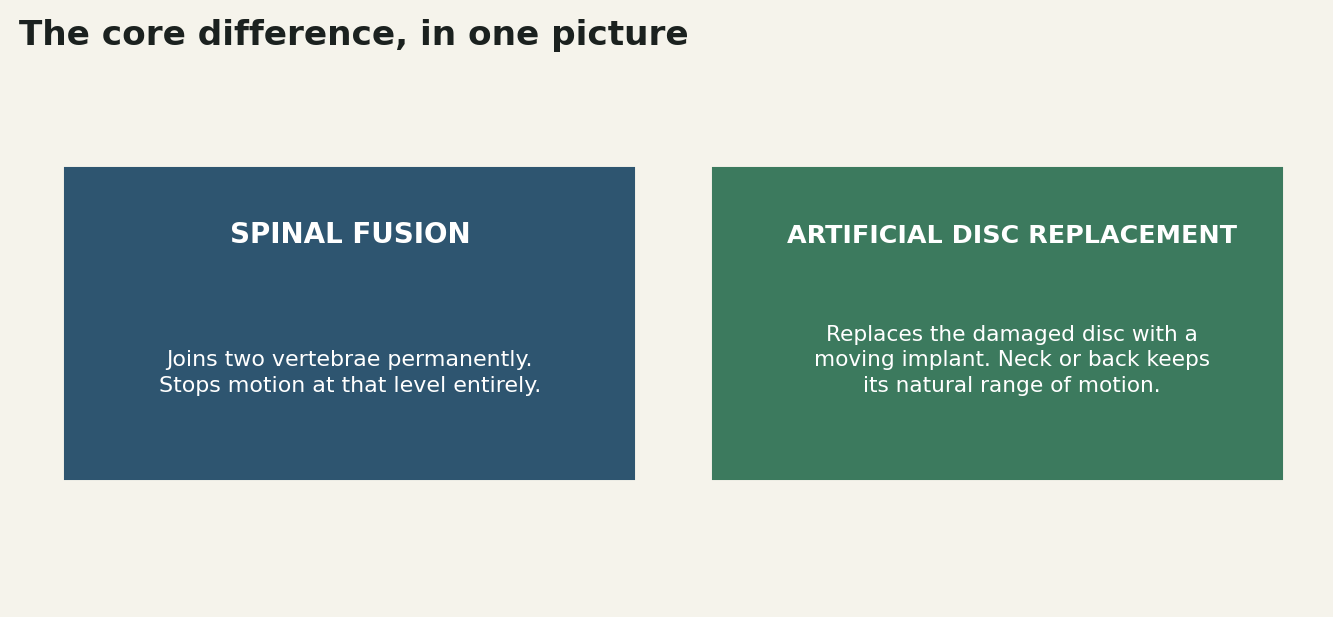
Fusion joins two vertebrae permanently, eliminating movement at that level entirely to stabilise the spine. Disc replacement removes the damaged disc and replaces it with a moving implant, preserving the neck or back's natural range of motion. Both are legitimate, evidence-based treatments, and fusion remains the right choice for certain patients and conditions. The issue is that disc replacement, where appropriate, isn't reliably offered as the alternative it genuinely is.
The outcome data is genuinely persuasive, not marginal
This isn't a case of a slightly-better alternative being underused. The comparative evidence, built over more than fifteen years of follow-up in some studies, shows a real, substantial advantage for disc replacement in several important measures.
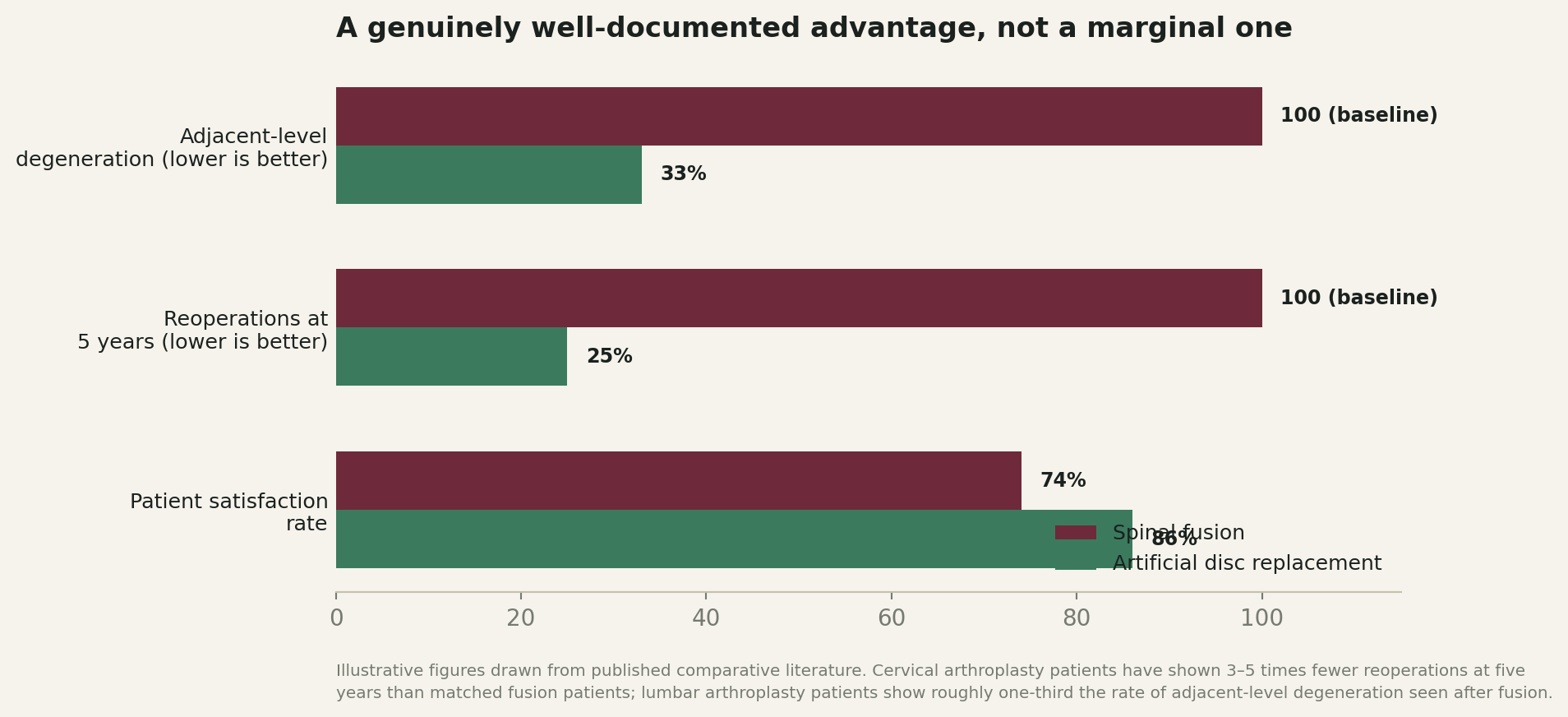
Cervical disc replacement patients report an overall satisfaction rate around 86 per cent, against roughly 74 per cent for fusion. Five-year data shows cervical arthroplasty patients need three to five times fewer reoperations than matched fusion patients, and lumbar arthroplasty patients experience roughly a third of the adjacent-level degeneration, damage to the discs next to the treated level, seen after fusion. Long-term studies following patients for fifteen to twenty-five years have found the large majority never need any significant further intervention for device wear or failure.
Who is, and isn't, a good candidate
Disc replacement isn't right for every patient. It generally isn't appropriate for significant spinal instability, advanced arthritis at the affected level, or certain deformities, and cauda equina syndrome or other urgent neurological presentations require immediate surgical attention regardless of technique. A genuinely qualified spine surgeon, whether in Canada or abroad, will assess your imaging directly and tell you plainly whether you are a candidate rather than defaulting to whichever procedure they happen to perform.
What the money actually looks like
Because so few Canadian centres offer disc replacement at all, most Canadians exploring it as an alternative to fusion end up looking outside the country regardless of price. For those weighing a paid option, the comparison is meaningful.
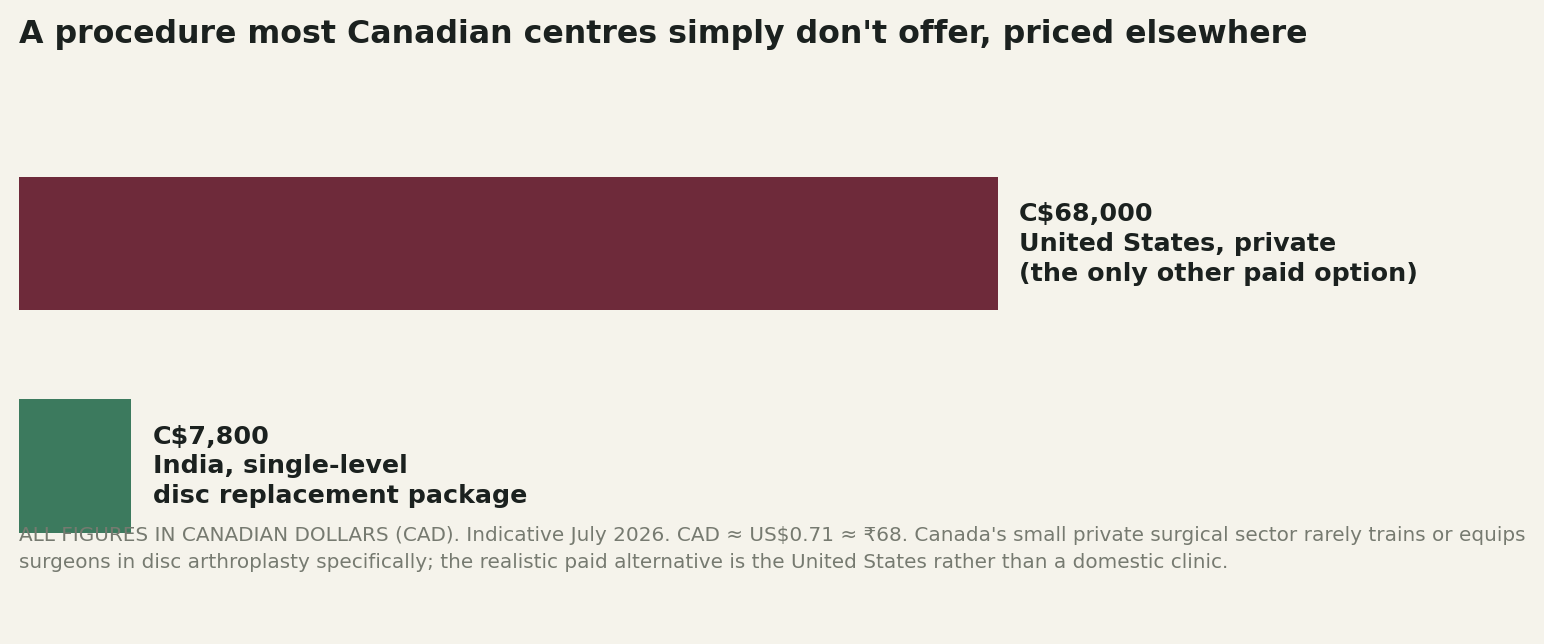
American disc replacement, priced for an insurance-backed domestic market, commonly runs well into five figures. India's major spine centres perform disc arthroplasty routinely, using the same devices and techniques, at a fraction of the American price. In 24 years of guiding patients through this decision, the single most useful thing anyone can do is ask their Canadian surgeon directly whether disc replacement was considered for their specific case, and if not, why not — and to get a second opinion from a surgeon who actually performs both procedures before committing to either.
What you are actually getting for it
A surgeon who genuinely performs both fusion and disc replacement regularly, not one who defaults to whichever procedure they are trained in.
An honest assessment of candidacy, based on your actual imaging, not an assumption.
The specific device being used, since several manufacturers hold approval and long-term data varies somewhat by design.
Accreditation you can verify independently. JCI is the international arm of the body accrediting hospitals across the United States; NABH is India's national equivalent, recognised by the same global standards authority.
A discharge record built for your Canadian surgeon to use, including the exact device, level treated, and a specific follow-up plan.
Straight answers for Canadian Patients about Cervical and Lumbar Artificial Disc Replacement in India
My surgeon only offered fusion. Should I get a second opinion?
It's a reasonable, sensible step, particularly given how few Canadian surgeons are trained in disc replacement. Ask specifically whether you are a candidate for arthroplasty, and if your own surgeon doesn't perform it, ask for a referral to one who does.
Will my provincial plan reimburse disc replacement performed in India?
Almost never. Out-of-country coverage exceptions require pre-approval showing the procedure is genuinely unavailable in Canada within a medically acceptable time.
Is disc replacement safe long-term?
Long-term studies following patients for 15 to 25 years have found the large majority never need significant further intervention for device wear or failure, with outcomes at least comparable to, and in several measures better than, fusion.
How long should I plan to stay in India?
Typically one to two weeks, depending on whether one or multiple levels are treated, following a documented fit-to-fly assessment.
Who manages my follow-up once I'm home?
Your Canadian surgeon, provided they have the full operative record and device details in writing before you leave.
A closing word
Artificial disc replacement is not an experimental alternative to fusion; it is an approved, well-studied procedure with genuinely strong long-term outcomes that most Canadian patients simply never hear about, because so few Canadian surgeons are trained to offer it. Ask the question directly before committing to fusion. If you would like a second opinion on your imaging, send it to me and I will look at it properly.
Sources
- 🌐 "Cervical Artificial Disc Replacement Versus Fusion for Cervical Degenerative Disc Disease: A Health Technology Assessment", Health Quality Ontario — pmc.ncbi.nlm.nih.gov/PMC6394883
- 🌐 "Overcoming Insurance Challenges for Disc Replacement", National Spine Health Foundation — spinehealth.org
- 🌐 High Commission of India, e-Visa categories and eligibility — indianvisaonline.gov.in/evisa
Frequently Asked Questions by Canadian Patients about Cervical and Lumbar Artificial Disc Replacement in India
Why should Canadian patients consider artificial disc replacement in India?
Canadian patients may consider India when artificial disc replacement has not been offered locally or when they want a second opinion from a surgeon who regularly performs both disc replacement and fusion. The PDF describes Indian spine centres as routinely performing disc arthroplasty.
What should Canadian patients ask their surgeon before choosing fusion?
Canadian patients should specifically ask whether they are candidates for artificial disc replacement and why fusion is being recommended instead. If their Canadian surgeon does not perform disc replacement, the briefing recommends considering a second opinion from a surgeon who performs both procedures.
Can Canadian patients receive cervical or lumbar artificial disc replacement in India?
Yes. Canadian patients can seek cervical or lumbar artificial disc replacement in India, subject to individual medical assessment and suitability for the procedure. The PDF states that major Indian spine centres routinely perform disc arthroplasty.
How much does artificial disc replacement in India cost for Canadian patients?
The PDF shows an indicative price of approximately C$7,800 for a single-level artificial disc replacement package in India. Canadian patients should obtain a written quotation because costs can vary according to the number of levels and individual treatment requirements.
Will Canadian provincial health insurance reimburse artificial disc replacement performed in India?
Canadian patients should not assume that their provincial plan will reimburse treatment in India. The briefing states that out-of-country coverage exceptions generally require pre-approval showing that the procedure is genuinely unavailable in Canada within a medically acceptable time.
How should Canadian patients choose an artificial disc replacement surgeon in India?
Canadian patients should look for a spine surgeon who genuinely performs both fusion and artificial disc replacement rather than routinely offering only one procedure. They should also ask about the specific device, experience with the procedure and hospital accreditation.
How long should Canadian patients stay in India after artificial disc replacement?
Canadian patients should generally plan for approximately one to two weeks in India, according to the PDF, depending on whether one or multiple spinal levels are treated and following a documented fit-to-fly assessment.
What records should Canadian patients take back to Canada after surgery in India?
Canadian patients should leave India with a complete operative and discharge record that identifies the exact artificial disc device, spinal level treated and specific follow-up plan. This allows their Canadian surgeon to continue appropriate care after they return home.
How should Canadian patients arrange follow-up after artificial disc replacement in India?
Canadian patients can coordinate follow-up with their Canadian surgeon after returning home, provided that the Indian hospital supplies the complete operative record and device details in writing. The PDF specifically recommends preparing the discharge documentation for continued Canadian care.
Is artificial disc replacement a proven option for Canadian patients?
Yes. The briefing states that artificial disc replacement is not an experimental alternative for Canadian patients and notes Health Canada approval since 2007, along with long-term outcome data extending 15–25 years in some studies.
Page Summary
This guide explains cervical and lumbar artificial disc replacement in India for Canadian patients considering an alternative to spinal fusion. It highlights the Health Canada approval history of artificial disc replacement, limited Canadian availability, differences between fusion and disc replacement, comparative outcome data and patient selection. The guide also discusses indicative treatment costs, surgeon experience, device selection, hospital accreditation, discharge documentation, provincial reimbursement considerations, travel duration and follow-up with a Canadian surgeon. The chart on page 3 illustrates the comparative outcomes presented in the briefing, including patient satisfaction, five-year reoperations and adjacent-level degeneration.
Citation Block
| Topic | Information |
|---|---|
| Topic Information | Cervical and Lumbar Artificial Disc Replacement in India for Canadian Patients |
| Treatment | Artificial Disc Replacement |
| Country | India |
| Intended Audience | Canadian Patients |
| Primary Condition | Cervical and Lumbar Disc Disease |
| Main Procedures | Cervical and Lumbar Artificial Disc Replacement |
| Alternative Treatment | Spinal Fusion |
| Treatment Goal | Preservation of Spinal Motion |
| Health Canada Approval | Devices approved since 2007 |
| Reported Patient Satisfaction | Approximately 86% for cervical arthroplasty versus roughly 74% for fusion |
| Reoperation Advantage | Three to five times fewer cervical reoperations at five years in the cited comparison |
| Key Candidate Assessment | Direct review of spinal imaging |
| Important Contraindications | Significant instability, advanced arthritis, certain deformities and urgent neurological presentations |
| India Cost | Approximately C$7,800 for single-level disc replacement package |
| Typical Stay | Around 1–2 weeks |
| Key Specialists | Spine Surgeon |
| Hospital Accreditation | JCI or NABH accreditation can be independently verified |
| Follow-Up | Continued care with Canadian surgeon |
| Author | Dr. Dheeraj Bojwani |
| Experience | 24+ Years |


Our Mission Statement
Our mission is to place patients at the centre of every healthcare decision by providing trustworthy, evidence-based, and unbiased medical information. We believe that informed patients make better decisions. Backed by personalised guidance from our experienced advisory team, we help patients understand their treatment options, compare them objectively, and confidently choose the path that best suits their medical needs and personal circumstances.
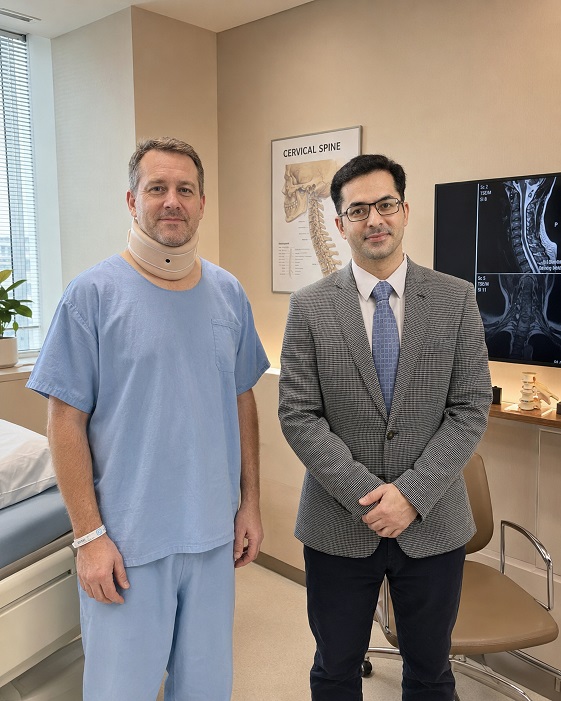
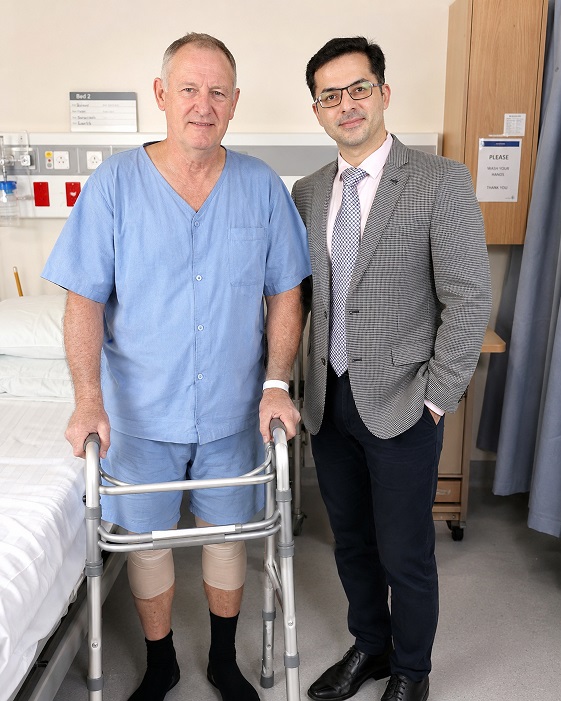
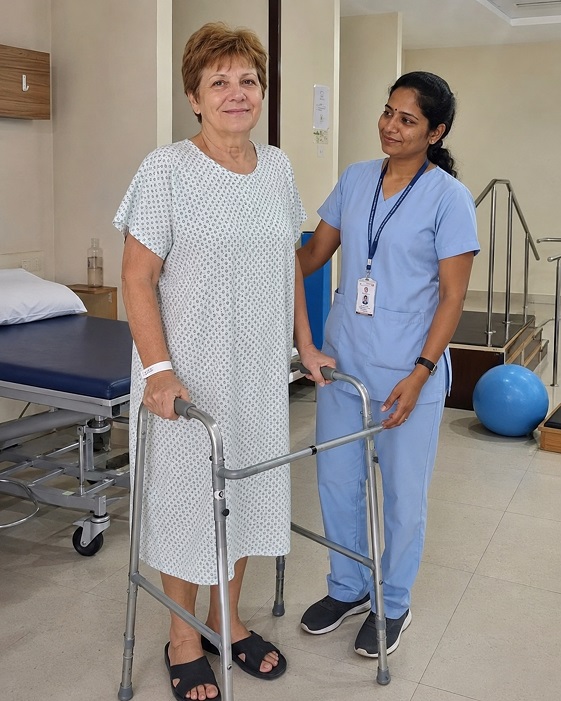
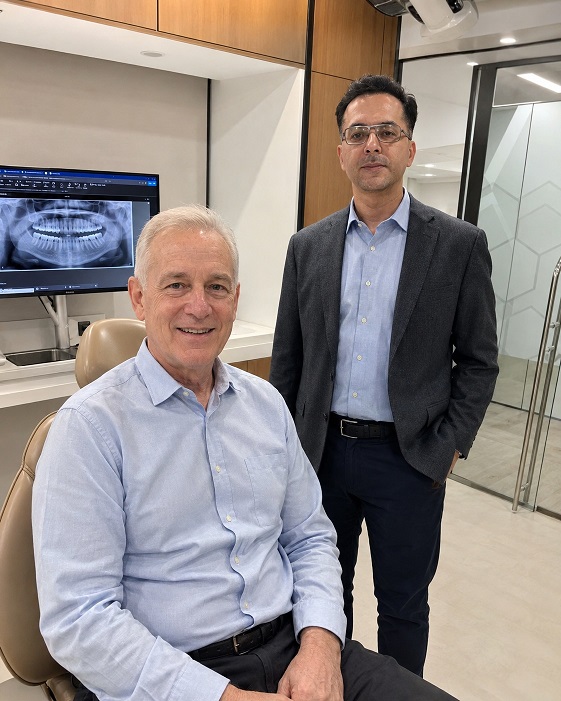
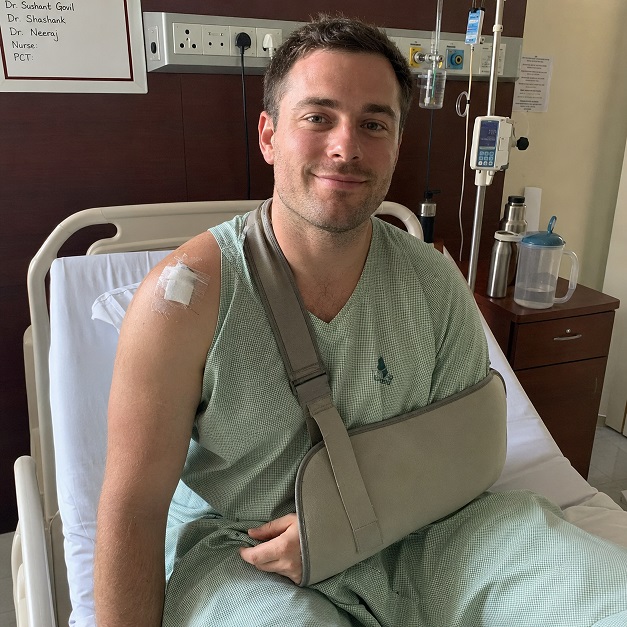
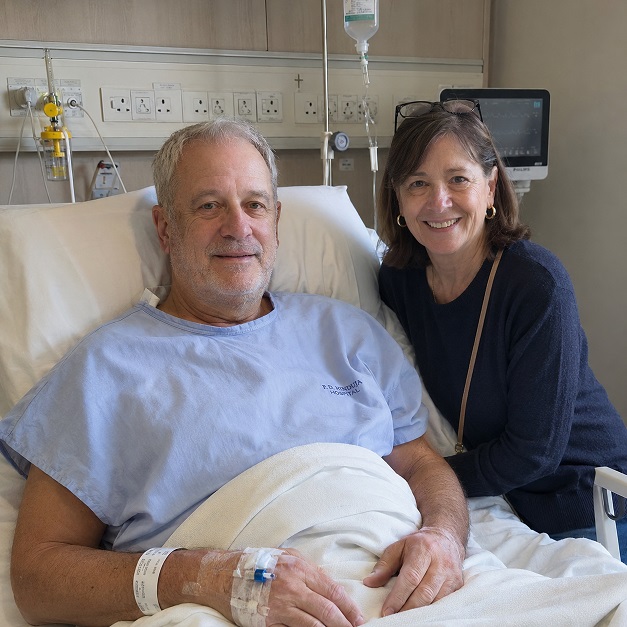
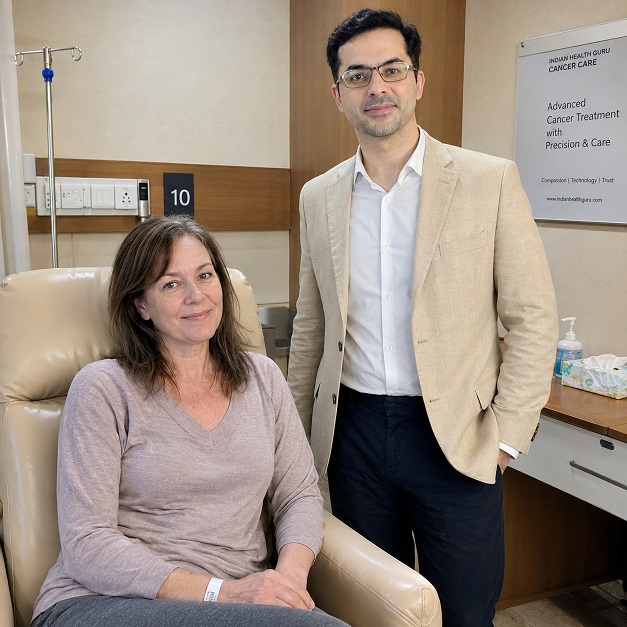
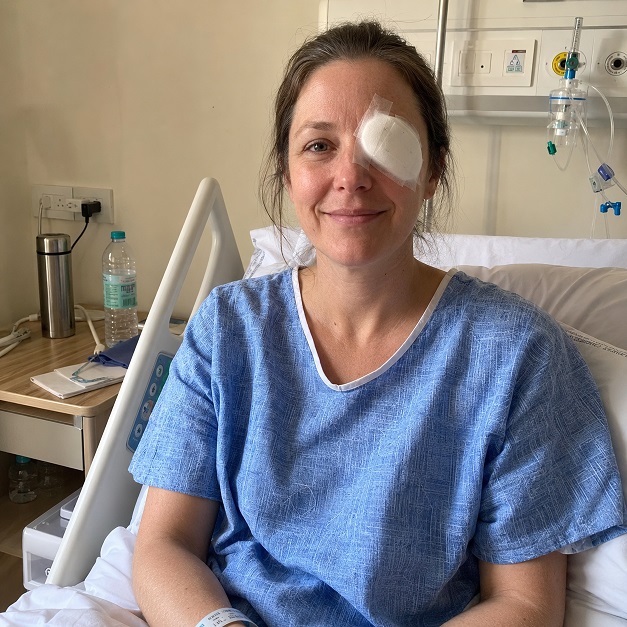
Patient Testimonials from Canada


Ready to Take the First Step?
Share your Medical Reports with our Healthcare Managers Today and Get a FREE CONSULTATION, a Personalized Treatment Plan, and Complete Support from Arrival to Recovery.
Get Your Free ConsultationFrom Canada to India: Your Complete Patient Support Guide
- Weight Loss & Bariatric Surgery in India for Canadian Patients: The Multi-Year Wait, Explained (2026)
- Bone Marrow Transplant in India for Canadian Patients: Complete Guide
- Brain Tumor Surgery in India for Canadian Patients: Complete Guide
- Breast Cancer Treatment and Surgery in India for Canadian Patients
- Cancer Treatment and Surgery in India for Canadian Patients
- Cardiac Surgery in India for Canadian Patients
- Colorectal Cancer Treatment and Surgery in India for Canadian Patients
- Cosmetic and Aesthetic Surgery in India for Canadian Patients
- CyberKnife Treatment in India for Canadian Patients: Complete Guide
- Dental Surgery in India for Canadian Patients | Complete Treatment & Cost Guide
- Gamma Knife Treatment in India for Canadian Patients
- Heart Valve Replacement Surgery in India for Canadian Patients
- Hip Surgery in India for Canadian Patients | Complete Treatment, Cost & Recovery Guide
- HIPEC Surgery in India for Canadian Patients: Complete Guide
- Kidney Transplant in India for Canadian Patients: Complete Guide
- Knee Surgery in India for Canadian Patients: Wait Times & Costs
- Neurosurgery in India for Canadian Patients: Wait Times & Costs
- Paediatric Cardiac Surgery in India for Canadian Patients