

Cardiac Pacemaker Treatment in India for Canadian Patients
Pacemaker implantation is one of the safest, most established procedures in cardiology. The newest leadless devices, no incision, no scar, safe for MRI, represent a genuinely exciting modern option worth understanding.
A 71-year-old in Sherbrooke, Quebec, diagnosed with a slow heart rhythm causing dizziness and fatigue. Her cardiologist explains a pacemaker will resolve it reliably, and mentions, almost as an aside, that a newer leadless option exists, implanted without any chest incision at all. Her own cardiologist has said openly she'd like to offer it to more of her patients. This isn't a story about crisis. It's about a very common, very treatable condition, and a genuinely remarkable piece of modern technology worth understanding before choosing.
Healing Journeys of Canadian Patients
Key Takeaways
- Canadian patients considering pacemaker treatment should first determine which specific device type matches their heart rhythm problem rather than simply deciding whether a pacemaker is required.
- Traditional pacemakers have been implanted safely for more than half a century and remain an established treatment for slow or irregular heart rhythms.
- Single-chamber pacemakers address rhythm problems affecting one heart chamber, while dual-chamber pacemakers coordinate the upper and lower chambers and are the most commonly implanted type.
- Cardiac resynchronisation therapy is a specialised pacemaker treatment for certain heart failure patients and coordinates both ventricles to improve pumping efficiency.
- Leadless pacemakers are self-contained devices delivered through a vein in the leg directly into the heart, avoiding a chest incision, visible pocket and pacing leads.
- The PDF states that leadless pacemakers can be up to 90% smaller than traditional pacemakers, are suitable for full-body MRI scanning and newer generations offer approximately 16–17 years of battery life.
- Recent multicentre data cited in the briefing reports an overall acute complication rate of approximately 0.6% for leadless pacemaker implantation.
- Canadian patients should choose a cardiac centre with an experienced electrophysiology team that can assess the full range of pacemaker technologies rather than defaulting to one device type.
- Patients should confirm MRI compatibility, the exact device model, hospital accreditation and a detailed follow-up and monitoring plan before travelling to India.
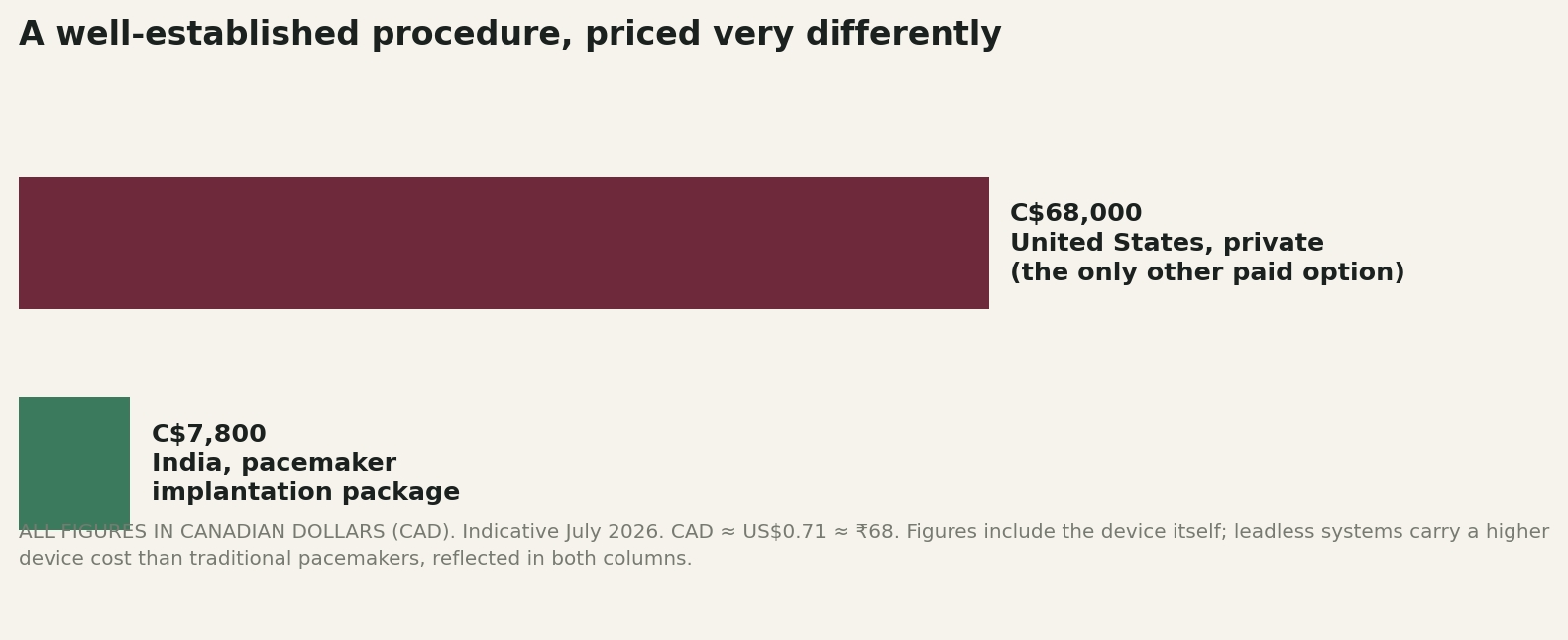
- The PDF shows an indicative cost of approximately C$7,800 for a pacemaker implantation package in India, compared with approximately C$68,000 in the United States as the other paid option shown in the briefing.
Quick Facts
- Treatment
- Cardiac Pacemaker Implantation
- Country
- India
- Patients
- Canadian Patients
- Primary Condition
- Slow or Irregular Heart Rhythm
- Main Device Types
- Single-Chamber, Dual-Chamber, CRT and Leadless Pacemakers
- Most Common Type
- Dual-Chamber Pacemaker
- Modern Option
- Leadless Pacemaker
- Leadless Pacemaker Size
- Up to 90% smaller than a traditional pacemaker
- Leadless Implantation
- Delivered through a vein in the leg directly into the heart
- MRI Compatibility
- Newer leadless systems support full-body MRI scanning
- Leadless Battery Life
- Approximately 16–17 years
- Reported Acute Complication Rate
- Approximately 0.6% for leadless implantation
- Indicative India Cost
- Approximately C$7,800 for a pacemaker implantation package
- Typical India Stay
- Under 1 week for implantation and initial device check
- Key Specialists
- Cardiologist and Electrophysiologist
- Follow-Up
- Canadian Cardiology Team with complete device records and remote monitoring
In Brief
Canadian patients considering pacemaker treatment in India should first identify the device type appropriate for their specific rhythm problem. Traditional pacemakers use a chest pocket and leads threaded through a vein to the heart, while leadless pacemakers are self-contained devices delivered through a vein in the leg without a chest incision, visible pocket or leads. The PDF describes single-chamber, dual-chamber, cardiac resynchronisation and leadless pacemaker options, with leadless systems representing the newest development. Newer leadless devices offer approximately 16–17 years of battery life and are designed for full-body MRI scanning. Patients travelling from Canada should seek assessment from an experienced electrophysiology team, confirm the exact device model and MRI compatibility, verify hospital accreditation and obtain complete device records for their Canadian cardiology team before returning home.
Pacemaker implantation is one of the most established procedures in modern cardiology
Canadian cardiologists and electrophysiologists do excellent work, and in 24 years of guiding international patients into Indian hospitals I have never suggested otherwise. It's worth opening with how routine and well-established this procedure actually is: pacemakers have been implanted safely for over half a century, treating slow or irregular heart rhythms reliably and restoring normal energy and function for the overwhelming majority of patients.
A well-established field with genuinely modern options
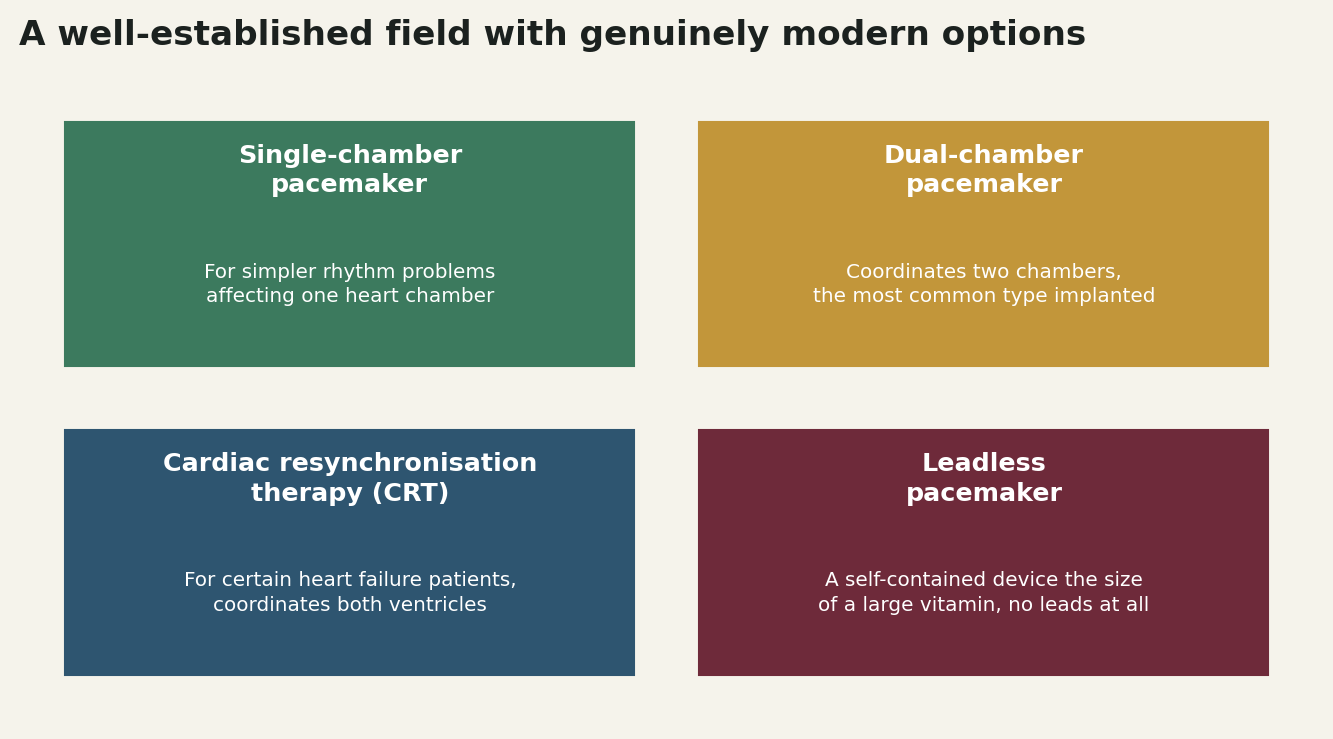
Single-chamber pacemakers address simpler rhythm problems affecting one heart chamber. Dual-chamber devices, the most commonly implanted type, coordinate both the upper and lower chambers for a more natural rhythm. Cardiac resynchronisation therapy, a specialised form for certain heart failure patients, coordinates both ventricles to improve the heart's pumping efficiency. And leadless pacemakers represent the newest development in the field entirely.
A genuinely different way to do the same job
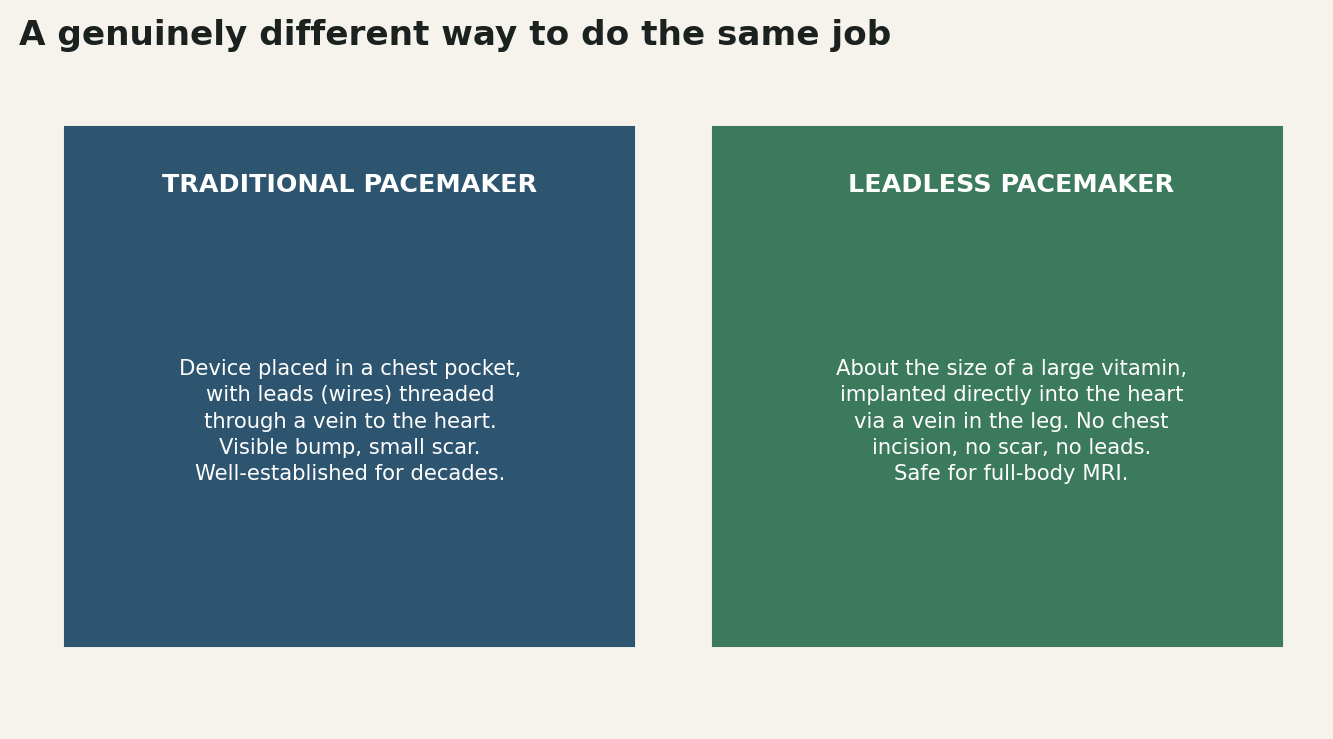
A traditional pacemaker sits in a small pocket under the skin of the chest, with thin wires, called leads, threaded through a vein to the heart itself. It works extremely well and has done so for decades. A leadless pacemaker does the same job in a completely different way: a self-contained device, about the size of a large vitamin and up to ninety per cent smaller than a traditional pacemaker, is delivered directly into the heart through a vein in the leg. There is no chest incision, no visible bump, and no leads at all. It's also safe for full-body MRI scanning, and the newest generation now offers battery life of sixteen to seventeen years, meaning more than eighty per cent of patients who receive one may need only a single device for life.
Why removing the leads matters
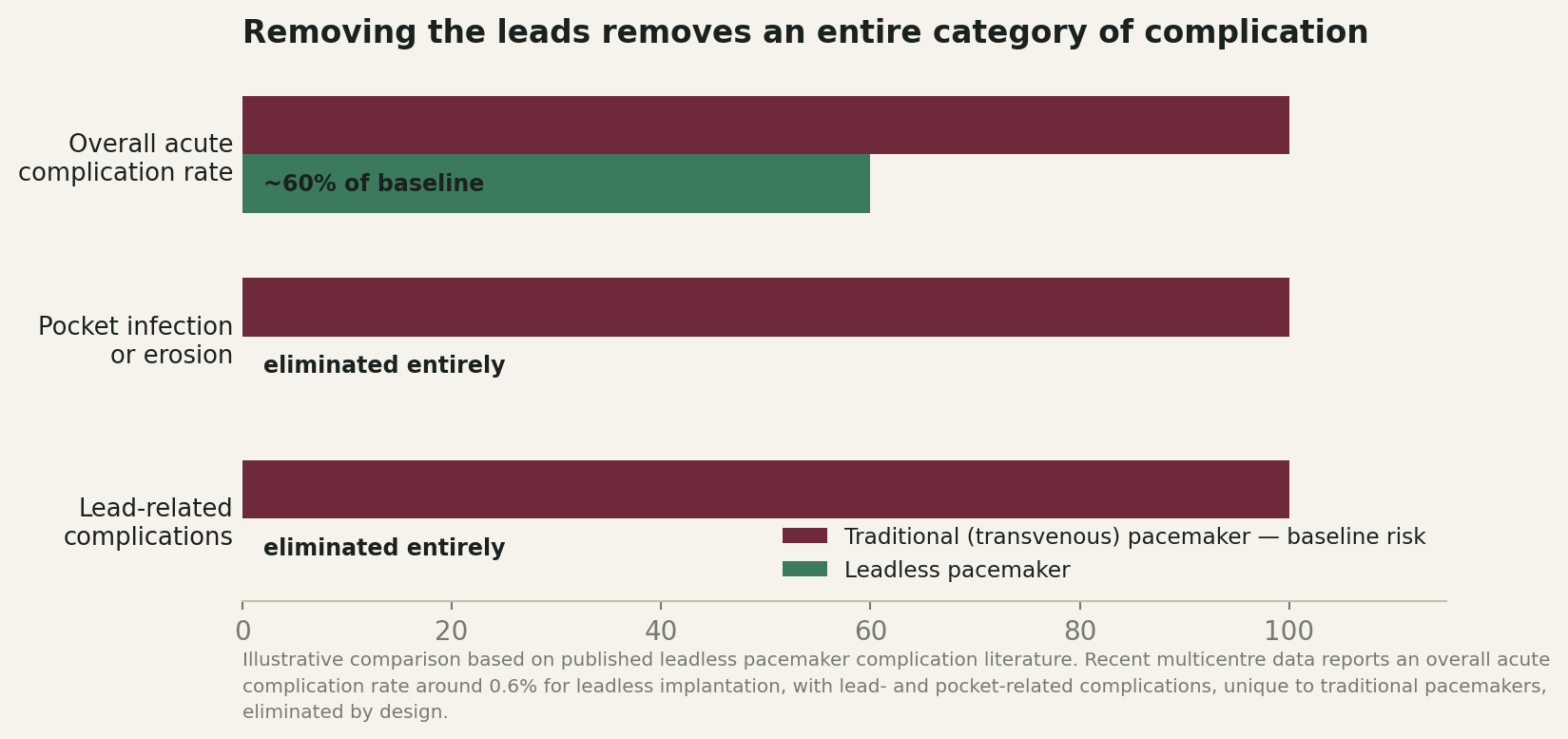
Leads and the chest pocket are, historically, where most pacemaker complications originate, whether infection, lead fracture, or dislodgement. By removing both entirely, leadless pacemakers eliminate those specific categories of risk by design, and recent multicentre data reports an overall acute complication rate around 0.6 per cent, genuinely low for any implanted cardiac device. This isn't a marginal refinement; it's a structurally different, safer approach for many patients.
What the money actually looks like
Pacemaker implantation, particularly with newer leadless technology, is not something Canada's small private surgical sector generally offers; it requires a dedicated electrophysiology team and catheterisation
lab infrastructure found at larger cardiac centres.
American pacemaker implantation, priced for an insurance-backed domestic market, commonly runs well into five figures. India's major cardiac centres offer the full range of pacemaker technology, including leadless systems, at a fraction of the American price. In 24 years of guiding patients through this decision, the question worth asking first is which specific device type is right for your rhythm problem, not simply whether a pacemaker is needed at all.
What you are actually getting for it
A genuine electrophysiology team, experienced in the full range of device types, not defaulting to whichever one they're most familiar with.
An honest recommendation on device type, since leadless isn't right for every patient or every rhythm problem.
Confirmed MRI compatibility details, important for any future imaging you may need.
Accreditation you can verify independently. JCI is the international arm of the body accrediting hospitals across the United States; NABH is India's national equivalent, recognised by the same global standards authority.
A discharge record built for your Canadian cardiology team to use, including the exact device model and a specific follow-up and monitoring plan.
Straight answers for Canadian Patients about Cardiac Pacemaker Treatment in India
Am I a candidate for a leadless pacemaker?
This depends on your specific rhythm problem; leadless devices are currently best suited to certain single- and dual-chamber indications rather than every case requiring cardiac resynchronisation therapy. Your cardiologist should assess your specific situation directly.
Will my provincial plan reimburse the procedure performed in India?
Almost never. Out-of-country coverage exceptions require pre-approval showing the procedure is genuinely unavailable in Canada within a medically acceptable time.
How long does a pacemaker battery actually last?
Traditional devices commonly last eight to twelve years; the newest leadless generation now offers sixteen to seventeen years, meaning many patients may need only one device for life.
How long should I plan to stay in India?
Typically under a week for the implant and initial device check, following a documented fit-to-fly assessment.
Who manages my device monitoring once I'm home?
Your Canadian cardiology team, provided they have the complete device record and remote monitoring set up before you leave, since most modern pacemakers support remote check-ins.
A closing word
Pacemaker implantation is one of the safest, most established procedures in modern medicine, and the leadless option represents a genuine, exciting advance for many patients. Match your specific rhythm problem to the right device with an honest conversation, and the cost comparison works clearly in your favour too. If you'd like a second opinion on your diagnosis or device options, send it to me and I will look at it properly.
Sources
- 🌐 Manzo et al., "Outcomes of Micra Leadless Pacemaker Implants in Centers With and Without Cardiac Surgery", Journal of Cardiovascular Electrophysiology , 2025 — pubmed.ncbi.nlm.nih.gov/40296280
- 🌐 Medtronic Canada, "Medtronic receives Health Canada licence for its next generation Micra leadless pacing systems" — canadanews.medtronic.com
- 🌐 High Commission of India, e-Visa categories and eligibility — indianvisaonline.gov.in/evisa
Frequently Asked Questions by Canadian Patients about Cardiac Pacemaker Treatment in India
Why should Canadian patients consider pacemaker treatment in India?
Canadian patients may consider India when seeking access to different pacemaker technologies, including leadless systems, from experienced electrophysiology teams. The PDF states that major Indian cardiac centres offer the full range of pacemaker technology.
What should Canadian patients ask before choosing a pacemaker in India?
Canadian patients should ask which specific device type is appropriate for their rhythm problem, whether a leadless device is suitable, and whether the treating team regularly performs the recommended procedure.
Can Canadian patients receive a leadless pacemaker in India?
Yes. Canadian patients can be assessed for leadless pacemaker implantation in India if their specific rhythm problem is suitable for the technology. The PDF notes that leadless devices are currently best suited to certain single- and dual-chamber indications.
How much does pacemaker implantation in India cost for Canadian patients?
The PDF gives an indicative cost of approximately C$7,800 for a pacemaker implantation package in India. Canadian patients should obtain a patient-specific written quotation because costs can vary according to the device and treatment requirements.
Will Canadian provincial health insurance reimburse pacemaker treatment performed in India?
Canadian patients should not assume that provincial coverage will reimburse treatment in India. The briefing states that out-of-country coverage exceptions require pre-approval showing that the procedure is genuinely unavailable in Canada within a medically acceptable time.
How should Canadian patients choose a pacemaker hospital in India?
Canadian patients should look for a cardiac centre with a genuine electrophysiology team experienced in different pacemaker technologies. They should also independently verify hospital accreditation and confirm the device and follow-up arrangements.
How long should Canadian patients stay in India after pacemaker implantation?
Canadian patients should typically plan for under one week in India for implantation and the initial device check, according to the PDF. A documented fit-to-fly assessment should be completed before travelling home.
What pacemaker records should Canadian patients take back to Canada?
Canadian patients should obtain a complete device record identifying the exact pacemaker model, together with the follow-up and monitoring plan. These records allow their Canadian cardiology team to continue appropriate device care after they return home.
How can Canadian patients continue pacemaker monitoring after returning from India?
Canadian patients can have their device monitored by their Canadian cardiology team after returning home, provided the complete device information and remote monitoring arrangements are established before departure. The PDF notes that most modern pacemakers support remote check-ins.
Can Canadian patients have MRI scans after receiving a leadless pacemaker in India?
The PDF states that leadless pacemakers are safe for full-body MRI scanning and highlights MRI compatibility as an important detail for Canadian patients to confirm before treatment. Patients should still obtain the exact device's MRI compatibility information for their Canadian healthcare team.
Page Summary
This guide explains cardiac pacemaker treatment in India for Canadian patients, focusing on the established role of pacemaker implantation and the newer leadless pacemaker option. It describes single-chamber, dual-chamber, cardiac resynchronisation and leadless systems, along with the differences between traditional and leadless devices. The guide also discusses lead-related complications, MRI compatibility, battery life, indicative treatment costs, electrophysiology expertise, hospital accreditation, provincial reimbursement, travel duration and follow-up with a Canadian cardiology team. The comparison graphic on page 2 illustrates traditional versus leadless pacemakers, while the chart on page 3 highlights the reduction in lead-related and pocket-related complications associated with the leadless approach.
Citation Block
| Topic | Information |
|---|---|
| Topic Information | Cardiac Pacemaker Treatment in India for Canadian Patients |
| Treatment | Pacemaker Implantation |
| Country | India |
| Intended Audience | Canadian Patients |
| Primary Condition | Slow or Irregular Heart Rhythm |
| Device Types | Single-Chamber, Dual-Chamber, CRT and Leadless Pacemakers |
| Most Common Type | Dual-Chamber Pacemaker |
| Modern Device Option | Leadless Pacemaker |
| Leadless Implantation | Through a vein in the leg directly into the heart |
| MRI Compatibility | Newer leadless systems support full-body MRI |
| Leadless Battery Life | Approximately 16–17 years |
| Acute Complication Rate | Approximately 0.6% in cited multicentre data |
| Key Specialists | Cardiologist and Electrophysiologist |
| Hospital Accreditation | JCI or NABH accreditation can be independently verified |
| India Cost | Approximately C$7,800 for pacemaker implantation package |
| Typical Stay | Under 1 week |
| Follow-Up | Canadian Cardiology Team |
| Monitoring | Remote monitoring where supported |
| Author | Dr. Dheeraj Bojwani |
| Experience | 24+ Years |


Our Mission Statement
Our mission is to place patients at the centre of every healthcare decision by providing trustworthy, evidence-based, and unbiased medical information. We believe that informed patients make better decisions. Backed by personalised guidance from our experienced advisory team, we help patients understand their treatment options, compare them objectively, and confidently choose the path that best suits their medical needs and personal circumstances.
Patient Testimonials from Canada


Ready to Take the First Step?
Share your Medical Reports with our Healthcare Managers Today and Get a FREE CONSULTATION, a Personalized Treatment Plan, and Complete Support from Arrival to Recovery.
Get Your Free ConsultationFrom Canada to India: Your Complete Patient Support Guide
- Weight Loss & Bariatric Surgery in India for Canadian Patients: The Multi-Year Wait, Explained (2026)
- Bone Marrow Transplant in India for Canadian Patients: Complete Guide
- Brain Tumor Surgery in India for Canadian Patients: Complete Guide
- Breast Cancer Treatment and Surgery in India for Canadian Patients
- Cancer Treatment and Surgery in India for Canadian Patients
- Cardiac Surgery in India for Canadian Patients
- Colorectal Cancer Treatment and Surgery in India for Canadian Patients
- Cosmetic and Aesthetic Surgery in India for Canadian Patients
- CyberKnife Treatment in India for Canadian Patients: Complete Guide
- Dental Surgery in India for Canadian Patients | Complete Treatment & Cost Guide
- Gamma Knife Treatment in India for Canadian Patients
- Heart Valve Replacement Surgery in India for Canadian Patients
- Hip Surgery in India for Canadian Patients | Complete Treatment, Cost & Recovery Guide
- HIPEC Surgery in India for Canadian Patients: Complete Guide
- Kidney Transplant in India for Canadian Patients: Complete Guide
- Knee Surgery in India for Canadian Patients: Wait Times & Costs
- Neurosurgery in India for Canadian Patients: Wait Times & Costs
- Paediatric Cardiac Surgery in India for Canadian Patients