

Cornea Transplant and Advanced Eye Surgery in India for Canadian Patients
Same country, same diagnosis, a wait of weeks in one province and years in another. Quebec proved the problem is organisational, not medical — and genuinely solvable.
Two Canadians, both diagnosed with Fuchs' dystrophy within months of each other, both needing a corneal transplant. One lives in Montreal and is treated within weeks. The other lives in Calgary and is told the wait could run two to three years. Same country, same diagnosis, same excellent surgical outcome waiting on the other end — just a very different amount of time to get there, decided almost entirely by which province they happen to call home.
Healing Journeys of Canadian Patients
Key Takeaways
- Canadian patients considering cornea transplantation should understand that the procedure is highly established, with penetrating keratoplasty reporting a success rate above 97% in the briefing.
- Corneal transplant waiting times can vary dramatically across Canadian provinces, with British Columbia typically reporting four to six months and Alberta and Ontario reporting waits of two to three years.
- Quebec significantly shortened its corneal transplant waiting period after centralising eye-bank coordination through Héma-Québec in 2008, with waits now commonly ranging from a couple of weeks to a couple of months.
- Modern corneal surgery is no longer limited to full-thickness transplantation. Techniques include penetrating keratoplasty (PKP), DALK, DSEK and DMEK.
- DSEK and DMEK can be appropriate for conditions affecting the innermost corneal layer, including Fuchs' dystrophy, while advanced keratoconus or corneal opacity may require PKP or DALK.
- DMEK is a more precise endothelial transplant technique that can lower rejection risk and speed visual recovery compared with a full-thickness graft, according to the briefing.
- Canadian patients travelling to India should confirm that donor tissue comes from an established eye bank with transparent sourcing and appropriate screening standards.
- The PDF indicates approximate India surgical package costs of C$3,200 for PKP, C$3,400 for DALK, C$3,600 for DSEK and C$4,200 for DMEK, including donor tissue procurement and screening.
- Canadian patients should choose a corneal surgeon with checkable experience in the specific technique required for their condition rather than relying only on general corneal surgery experience.
- Patients should obtain a complete surgical record and specific follow-up schedule for their Canadian ophthalmologist before returning home.
Quick Facts
- Treatment
- Cornea Transplant and Advanced Eye Surgery
- Country
- India
- Patients
- Canadian Patients
- Primary Condition
- Corneal Disease
- Main Techniques
- PKP, DALK, DSEK and DMEK
- PKP Success Rate
- Reported above 97%
- Fuchs' Dystrophy
- DSEK or DMEK may be suitable depending on the corneal layer affected
- Advanced Keratoconus
- May require PKP or DALK
- British Columbia Wait
- Typically 4–6 months
- Alberta and Ontario Wait
- Approximately 2–3 years
- Quebec Wait
- Commonly a couple of weeks to a couple of months
- Indicative PKP Cost in India
- Approximately C$3,200
- Indicative DALK Cost in India
- Approximately C$3,400
- Indicative DSEK Cost in India
- Approximately C$3,600
- Indicative DMEK Cost in India
- Approximately C$4,200
- Typical India Stay
- Approximately 1–2 weeks for initial surgery and early follow-up
- Long-Term Follow-Up
- Canadian Ophthalmologist
- Donor Tissue
- Screened tissue from an established eye bank
- Hospital Accreditation
- JCI or NABH can be independently verified
In Brief
Canadian patients considering cornea transplant in India should first determine which layer of the cornea is affected and which surgical technique is appropriate. Penetrating keratoplasty replaces the full thickness of the cornea, while DALK replaces the outer layers and preserves the patient's healthy inner layer. For endothelial conditions such as Fuchs' dystrophy, DSEK and the more precise DMEK replace only the innermost layer. The PDF highlights major differences in Canadian waiting times, with some provinces reporting waits of several months and others two to three years. Patients considering India should verify donor-tissue screening and sourcing, check the surgeon's specific volume in the required technique, confirm hospital accreditation and obtain a detailed surgical record and follow-up schedule for their Canadian ophthalmologist.
One of the most reliable transplant procedures in all of medicine
Canadian corneal surgeons do excellent work, and in 24 years of guiding international patients into Indian hospitals I have never suggested otherwise. It's worth opening with how genuinely successful this field is.
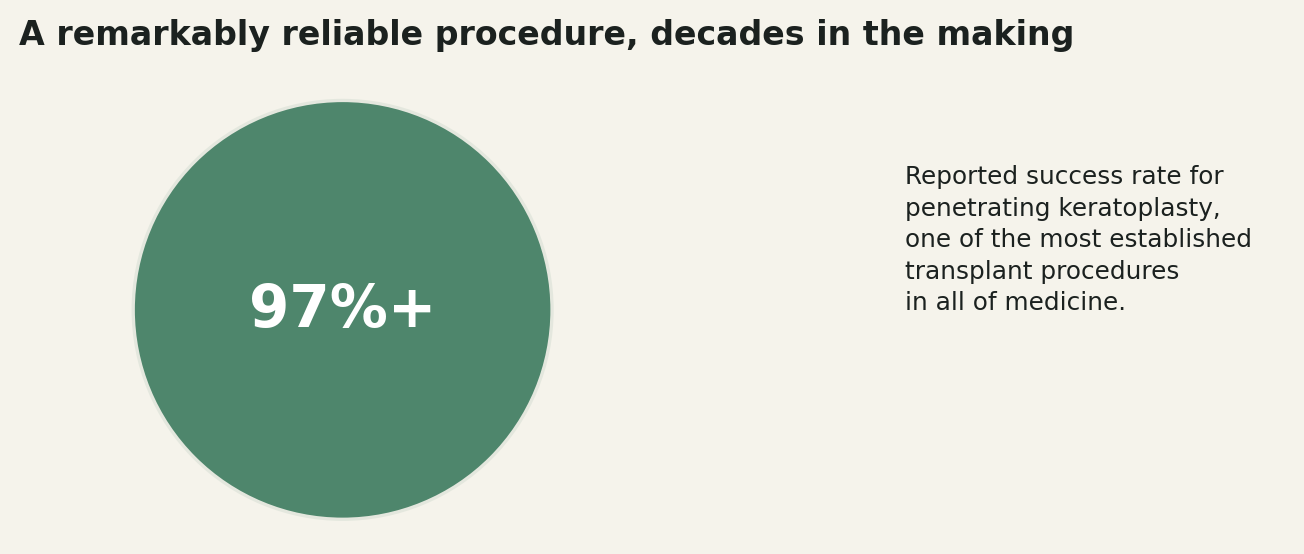
Penetrating keratoplasty, the traditional full-thickness corneal transplant, has a reported success rate above ninety-seven per cent, and newer, more precise techniques have pushed outcomes further still. This is decades of accumulated surgical refinement at work, not an experimental field.
The same country, a wait measured in weeks or in years
What genuinely varies, and varies dramatically, is how long Canadians wait to actually receive that excellent outcome, and the reason is organisational rather than medical.
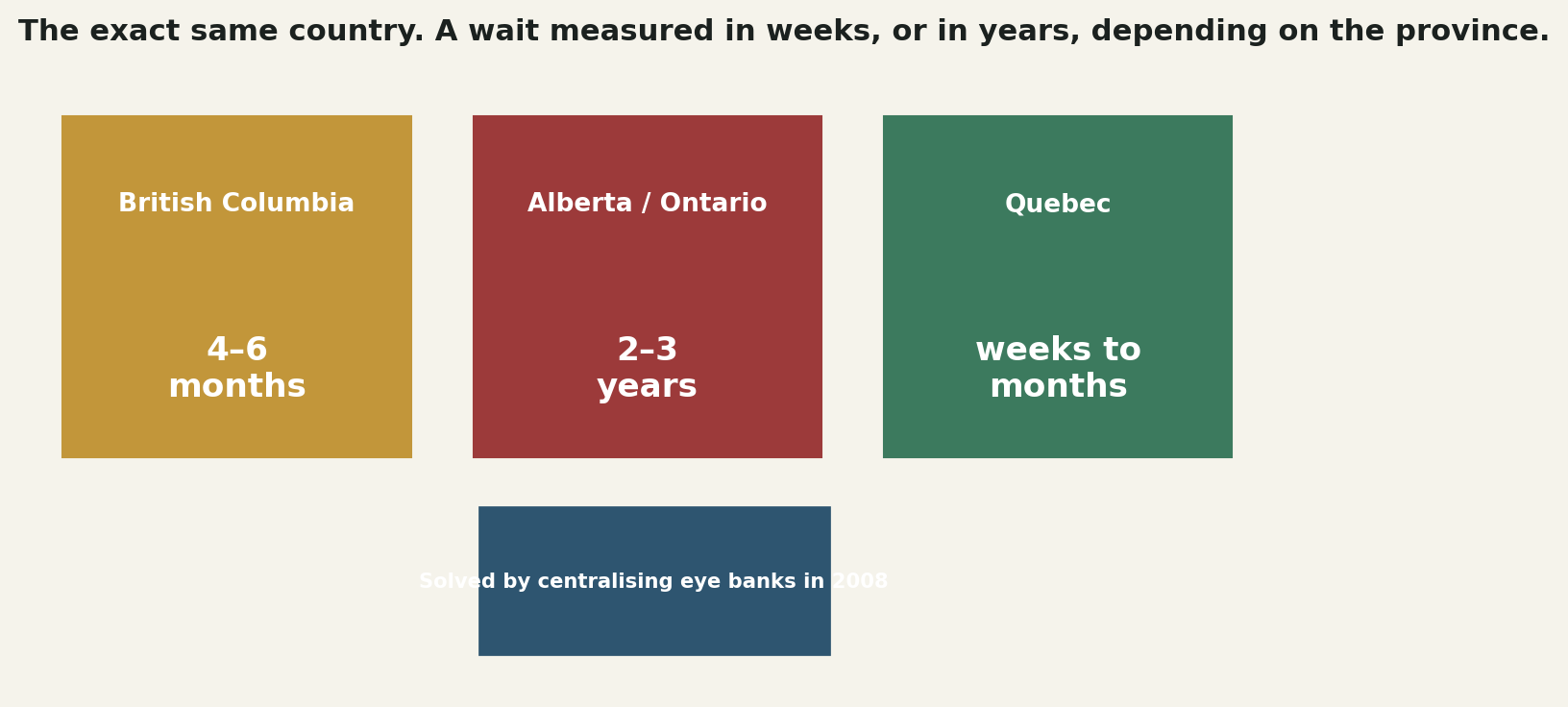
British Columbia's wait typically runs four to six months. Alberta and Ontario have both reported waits of two to three years. Quebec, once in the same position, solved the problem directly: in 2008, Héma-Québec took over coordination of the province's eye banks, working to increase donations, importing additional tissue from the United States where needed, and engaging front-line hospital staff to identify potential donors. The wait in Quebec now commonly runs from a couple of weeks to a couple of months. As one Vancouver corneal specialist and World Health Organization corneal expert has put it plainly, the core problem elsewhere in Canada isn't a shortage of willing donors; it's that eye banks are governed province by province rather than nationally, and Quebec is the clearest proof the problem is genuinely solvable.
From replacing the whole cornea to a single, precise layer
Modern corneal surgery has moved well beyond one-size-fits-all transplantation, and matching the right
technique to the right condition matters for how quickly vision recovers and how well the graft is tolerated.
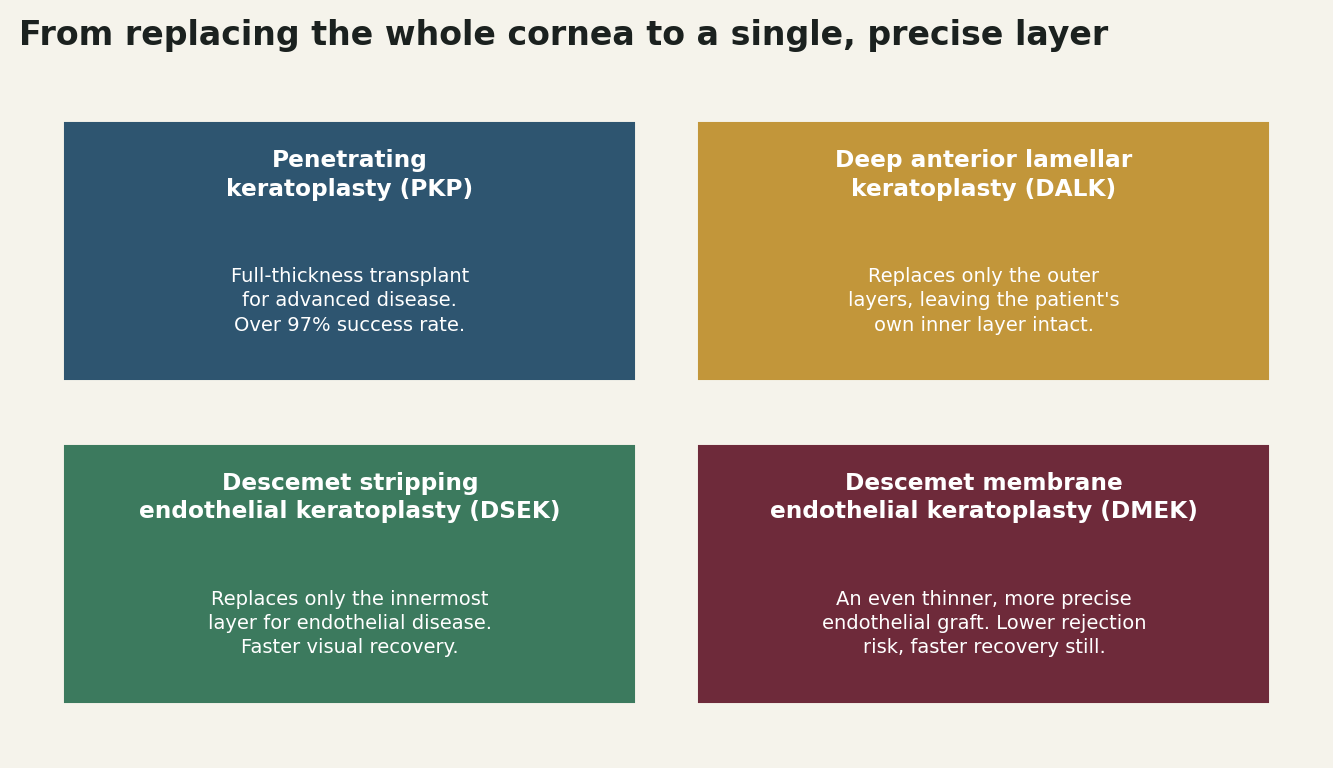
Penetrating keratoplasty replaces the full thickness of the cornea and remains the right choice for advanced disease. Deep anterior lamellar keratoplasty replaces only the outer layers, preserving the patient's own healthy inner layer. For conditions affecting only the innermost layer, such as Fuchs' dystrophy, DSEK and the even more precise DMEK technique replace just that layer, meaningfully lowering rejection risk and speeding visual recovery compared with a full-thickness graft. Canada's own leading centres have recently performed the country's first pre-loaded DMEK transplant, a genuine sign of where the field is heading, even as access to it remains uneven.
What the money actually looks like
Corneal transplant surgery, particularly the newer endothelial techniques, is rarely offered outside major academic eye centres, in Canada or elsewhere. For patients facing a multi-year wait in their own province, exploring options abroad is a reasonable, practical step.
American corneal transplant surgery, priced for an insurance-backed domestic market, commonly runs into
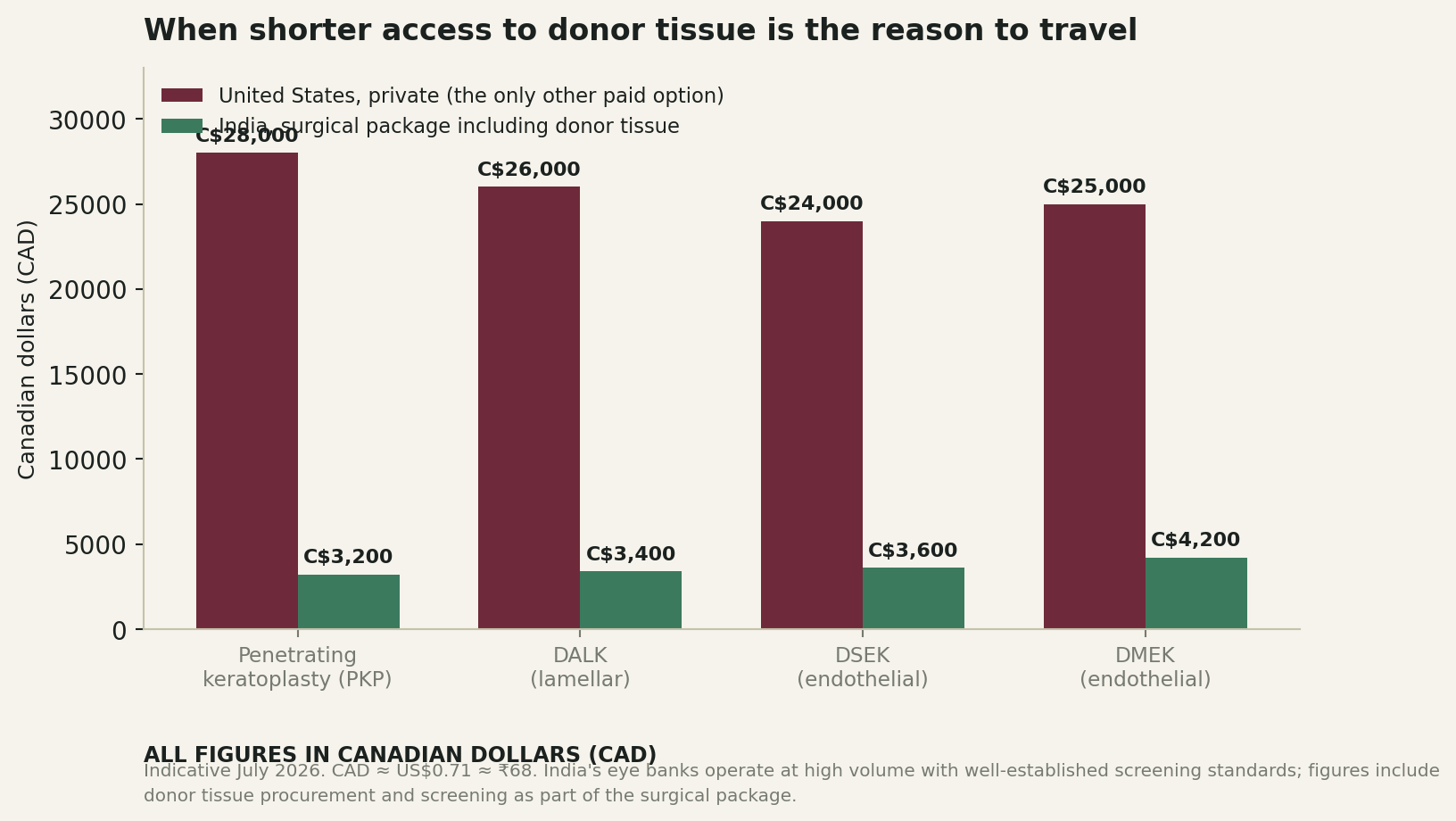
five figures. India operates high-volume eye banks with well-established screening standards and performs the full range of modern techniques, including DMEK, at a fraction of the American price. In 24 years of guiding patients through this decision, the question worth asking first is which specific technique is appropriate for your condition, since matching that correctly matters more than any other single factor in the outcome.
What you are actually getting for it
Access to the full range of modern techniques, matched to your specific corneal condition rather than defaulting to full-thickness transplant.
Rigorously screened donor tissue, from an established eye bank with transparent sourcing.
Genuine, checkable surgical volume in the specific technique your condition requires.
Accreditation you can verify independently. JCI is the international arm of the body accrediting hospitals across the United States; NABH is India's national equivalent, recognised by the same global standards authority.
A discharge record built for your Canadian ophthalmologist to use, including the exact technique and a specific follow-up schedule.
Straight answers for Canadian Patients about Cornea Transplant and Advanced Eye Surgery in India
Why does my wait time depend so much on which province I live in?
Canadian eye banks are governed provincially rather than nationally, and coordination varies significantly. Quebec centralised its eye bank system in 2008 and dramatically shortened its wait as a direct result, while other provinces have not made the same change.
Will my provincial plan reimburse a transplant performed in India?
Almost never. Out-of-country coverage exceptions require pre-approval showing the procedure is genuinely unavailable in Canada within a medically acceptable time, though a documented multi-year provincial wait may be relevant to raise directly.
Which technique is right for my condition?
This depends on which layer of the cornea is affected. Fuchs' dystrophy and similar endothelial conditions are usually well suited to DSEK or DMEK; advanced keratoconus or corneal opacity often requires penetrating keratoplasty or DALK. Ask your ophthalmologist directly which applies to you.
How long should I plan to stay in India?
Typically one to two weeks for the initial surgery and early follow-up, though sutures from penetrating keratoplasty remain in place for several months to a year, managed by your Canadian ophthalmologist afterward.
Who manages my long-term follow-up once I'm home?
Your Canadian ophthalmologist, provided they have the complete surgical record and a specific follow- up schedule in writing before you leave.
A closing word
Corneal transplantation is a remarkably successful field of surgery, and Quebec has already proven the wait-time problem elsewhere in Canada is organisational, not medical, and genuinely solvable. If you're facing a long wait in your own province, that's worth acting on rather than simply enduring. If you'd like a second opinion on your diagnosis, send it to me and I will look at it properly.
Sources
- 🌐 "Corneal transplant wait list varies across Canada", CMAJ — cmaj.ca
- 🌐 "Canadian demand and access to corneal transplantation: a provincial comparison", Cell and Tissue Banking — link.springer.com
- 🌐 Kensington Health, "Kensington Health Enables First-In-Canada Eye Tissue Transplant" — kensingtonhealth.org
- 🌐 High Commission of India, e-Visa categories and eligibility — indianvisaonline.gov.in/evisa
Frequently Asked Questions by Canadian Patients about Cornea Transplant and Advanced Eye Surgery in India
Why might Canadian patients consider cornea transplant surgery in India?
Canadian patients facing a prolonged provincial waiting period may consider India as an alternative for accessing corneal transplantation. The PDF specifically highlights that waits can reach two to three years in Alberta and Ontario.
How can Canadian patients determine which cornea transplant technique they need in India?
Canadian patients should have their corneal condition assessed to determine which layer is affected and whether PKP, DALK, DSEK or DMEK is appropriate. The briefing recommends matching the technique to the specific condition rather than automatically choosing a full-thickness transplant.
Can Canadian patients with Fuchs' dystrophy receive DMEK or DSEK in India?
Yes. Canadian patients with Fuchs' dystrophy or similar endothelial conditions may be assessed for DSEK or DMEK. The PDF explains that these procedures replace the affected innermost corneal layer rather than the entire cornea.
How much does cornea transplant surgery in India cost for Canadian patients?
The PDF gives indicative India package costs of approximately C$3,200 for PKP, C$3,400 for DALK, C$3,600 for DSEK and C$4,200 for DMEK. Canadian patients should obtain a patient-specific quotation before travelling.
Will Canadian provincial health insurance reimburse a cornea transplant performed in India?
Canadian patients should not assume that their provincial plan will reimburse treatment in India. The briefing states that out-of-country coverage generally requires pre-approval showing that the procedure is unavailable in Canada within a medically acceptable time, although a documented multi-year wait may be relevant to discuss directly with the provincial authority.
How should Canadian patients choose a corneal surgeon in India?
Canadian patients should specifically ask about the surgeon's experience and checkable surgical volume in the exact technique required for their condition. The PDF emphasises that technique-specific experience is more useful than relying only on general corneal surgery volume.
How long should Canadian patients stay in India for cornea transplant surgery?
Canadian patients should typically plan for approximately one to two weeks in India for the initial surgery and early follow-up. Patients undergoing penetrating keratoplasty may require longer-term suture management after returning to Canada.
What donor-tissue information should Canadian patients check before cornea transplant in India?
Canadian patients should ask for confirmation that the donor tissue has been rigorously screened and sourced through an established eye bank with transparent sourcing. The PDF specifically identifies screened donor tissue as an important part of choosing treatment abroad.
What records should Canadian patients take back to their ophthalmologist after surgery in India?
Canadian patients should obtain a complete surgical record identifying the exact corneal technique performed and a specific follow-up schedule. This allows their Canadian ophthalmologist to continue appropriate postoperative management after they return home.
How should Canadian patients arrange long-term follow-up after cornea transplant in India?
Canadian patients should arrange continuing care with their Canadian ophthalmologist after returning home, provided the Indian surgical team supplies the complete operative record and follow-up schedule before departure. For penetrating keratoplasty, sutures may remain for several months to a year and can be managed by the Canadian ophthalmologist.
Page Summary
This guide explains cornea transplantation and advanced eye surgery in India for Canadian patients, with particular focus on the major differences in provincial waiting times and the development of modern layer-specific transplant techniques. It covers PKP, DALK, DSEK and DMEK, donor-tissue screening, surgeon-specific experience, indicative treatment costs, hospital accreditation, travel duration and follow-up in Canada. The comparison graphic on page 2 shows the different corneal layers treated by each technique, while the cost chart on page 3 compares indicative India and United States costs for PKP, DALK, DSEK and DMEK.
Citation Block
| Topic | Information |
|---|---|
| Topic Information | Cornea Transplant and Advanced Eye Surgery in India for Canadian Patients |
| Treatment | Cornea Transplantation and Advanced Eye Surgery |
| Country | India |
| Intended Audience | Canadian Patients |
| Primary Condition | Corneal Disease |
| Main Techniques | PKP, DALK, DSEK and DMEK |
| PKP Success Rate | Reported above 97% |
| Fuchs' Dystrophy | DSEK or DMEK may be appropriate |
| Advanced Keratoconus / Opacity | May require PKP or DALK |
| British Columbia Wait | 4–6 months |
| Alberta / Ontario Wait | 2–3 years |
| Quebec Wait | Weeks to months |
| Indicative PKP Cost in India | Approximately C$3,200 |
| Indicative DALK Cost in India | Approximately C$3,400 |
| Indicative DSEK Cost in India | Approximately C$3,600 |
| Indicative DMEK Cost in India | Approximately C$4,200 |
| Donor Tissue | Screened tissue from established eye bank |
| Key Specialist | Corneal Surgeon / Ophthalmologist |
| Surgical Volume | Should be checked for the specific technique required |
| Hospital Accreditation | JCI or NABH can be independently verified |
| Typical Stay | Approximately 1–2 weeks |
| Follow-Up | Canadian Ophthalmologist |
| Required Records | Complete surgical record and specific follow-up schedule |
| Author | Dr. Dheeraj Bojwani |
| Experience | 24+ Years |


Our Mission Statement
Our mission is to place patients at the centre of every healthcare decision by providing trustworthy, evidence-based, and unbiased medical information. We believe that informed patients make better decisions. Backed by personalised guidance from our experienced advisory team, we help patients understand their treatment options, compare them objectively, and confidently choose the path that best suits their medical needs and personal circumstances.
Patient Testimonials from Canada

Ready to Take the First Step?
Share your Medical Reports with our Healthcare Managers Today and Get a FREE CONSULTATION, a Personalized Treatment Plan, and Complete Support from Arrival to Recovery.
Get Your Free ConsultationFrom Canada to India: Your Complete Patient Support Guide
- Weight Loss & Bariatric Surgery in India for Canadian Patients: The Multi-Year Wait, Explained (2026)
- Bone Marrow Transplant in India for Canadian Patients: Complete Guide
- Brain Tumor Surgery in India for Canadian Patients: Complete Guide
- Breast Cancer Treatment and Surgery in India for Canadian Patients
- Cancer Treatment and Surgery in India for Canadian Patients
- Cardiac Surgery in India for Canadian Patients
- Colorectal Cancer Treatment and Surgery in India for Canadian Patients
- Cosmetic and Aesthetic Surgery in India for Canadian Patients
- CyberKnife Treatment in India for Canadian Patients: Complete Guide
- Dental Surgery in India for Canadian Patients | Complete Treatment & Cost Guide
- Gamma Knife Treatment in India for Canadian Patients
- Heart Valve Replacement Surgery in India for Canadian Patients
- Hip Surgery in India for Canadian Patients | Complete Treatment, Cost & Recovery Guide
- HIPEC Surgery in India for Canadian Patients: Complete Guide
- Kidney Transplant in India for Canadian Patients: Complete Guide
- Knee Surgery in India for Canadian Patients: Wait Times & Costs
- Neurosurgery in India for Canadian Patients: Wait Times & Costs
- Paediatric Cardiac Surgery in India for Canadian Patients