

Laparoscopic and Robotic Myomectomy Surgery in India for Canadian Patients
Fibroids affect up to 80% of women. Myomectomy removes them while preserving the uterus and fertility — and the outcomes for patients pursuing it for exactly that reason are genuinely encouraging.
A 34-year-old in Calgary, three fibroids found on ultrasound, heavy periods that have started affecting her work, and a clear goal: she and her partner want children in the next few years. Her doctor is straightforward that fibroids this size warrant treatment, and equally straightforward that removing them while preserving her fertility is entirely realistic. This isn't a story about crisis. It's about a very common condition with a well-established, fertility- preserving surgical answer.
Healing Journeys of Canadian Patients
Key Takeaways
- Uterine fibroids are extremely common, with the PDF stating that up to 80% of women develop fibroids by menopause, although most do not require treatment.
- For women whose fibroids cause heavy bleeding, pelvic pressure or fertility concerns, myomectomy provides a fertility-preserving option because it removes the fibroids while keeping the uterus intact.
- Myomectomy can be performed through open surgery, laparoscopy or robotic assistance, with minimally invasive approaches associated with less blood loss and shorter hospital stays than open surgery.
- The page 2 comparative chart illustrates a hospital stay of approximately 1.2 days for laparoscopic/robotic myomectomy versus 3.5 days for open surgery.
- The same chart illustrates a substantially smaller haemoglobin drop with minimally invasive surgery compared with open surgery, supporting the recovery advantages described in the PDF.
- Laparoscopic and robotic myomectomy require procedure-specific expertise because the surgeon must remove the fibroid along the correct surgical plane and close the uterine wall in multiple precise layers.
- A 10-year study cited in the PDF followed 86 patients undergoing robotic-assisted myomectomy for fertility enhancement; 49 conceived spontaneously, while the remaining patients conceived with IVF support, with most pregnancies reaching term.
- The PDF stresses that fibroid size, number and location affect individual fertility outcomes, so published statistics should not be treated as a personal prediction.
- The indicative India package cost for laparoscopic or robotic myomectomy is approximately C$5,600, compared with C$42,000 in the United States shown in the page 3 comparison.
- Canadian patients should specifically verify the surgeon's myomectomy volume, experience with fibroids similar in size, number and location, multilayered uterine closure technique and fertility-focused experience.
Quick Facts
- Treatment
- Laparoscopic and Robotic Myomectomy
- Country
- India
- Patients
- Canadian Patients
- Condition
- Uterine Fibroids
- Fibroid Prevalence
- Up to 80% of women may develop fibroids by menopause
- Treatment Goal
- Remove fibroids while preserving the uterus
- Main Approaches
- Laparoscopic, Robotic and Open Myomectomy
- Minimally Invasive Hospital Stay
- Approximately 1.2 days in the cited comparison
- Open Surgery Hospital Stay
- Approximately 3.5 days in the cited comparison
- Fertility Study
- 86 patients followed for fertility outcomes
- Spontaneous Conceptions
- 49 patients in the cited study
- Additional Conceptions
- Remaining tracked patients conceived with IVF support
- Indicative India Cost
- Approximately C$5,600
- U.S. Cost Shown
- Approximately C$42,000
- Typical India Stay
- Approximately 1–2 weeks depending on surgical approach and recovery
- Key Specialist
- Gynaecologist / Surgeon experienced specifically in myomectomy
- Important Surgical Skill
- Multilayered uterine wall closure
- Important Assessment
- Fibroid size, number and location
- Fertility Planning
- Specific timing for future pregnancy should be provided by the surgeon
- Follow-Up
- Canadian Gynaecologist
- Required Records
- Surgical technique, uterine closure details and pregnancy-timing guidance
In Brief
Canadian patients considering myomectomy in India should understand that the goal of the procedure is to remove uterine fibroids while preserving the uterus, making it particularly relevant for patients who wish to maintain fertility. The PDF explains that laparoscopic and robotic approaches are associated with less blood loss and shorter hospital stays than open surgery, with the page 2 chart illustrating approximately 1.2 days versus 3.5 days of hospital stay. A 10-year fertility-focused study cited in the briefing followed 86 patients after robotic-assisted myomectomy, with 49 conceiving spontaneously and others conceiving with IVF support; most pregnancies reached term. Canadian patients should not use these figures as a personal fertility prediction, because fibroid size, number and location influence individual outcomes. Before travelling, they should verify procedure-specific myomectomy volume, experience with similar fibroids, uterine closure technique and the plan for future pregnancy.
One of the most common conditions in women's health
Canadian gynaecologic surgeons do excellent work, and in 24 years of guiding international patients into Indian hospitals I have never suggested otherwise. It's worth starting with how common this actually is,
because fibroids carry an outsized reputation for alarm relative to how routine they are.
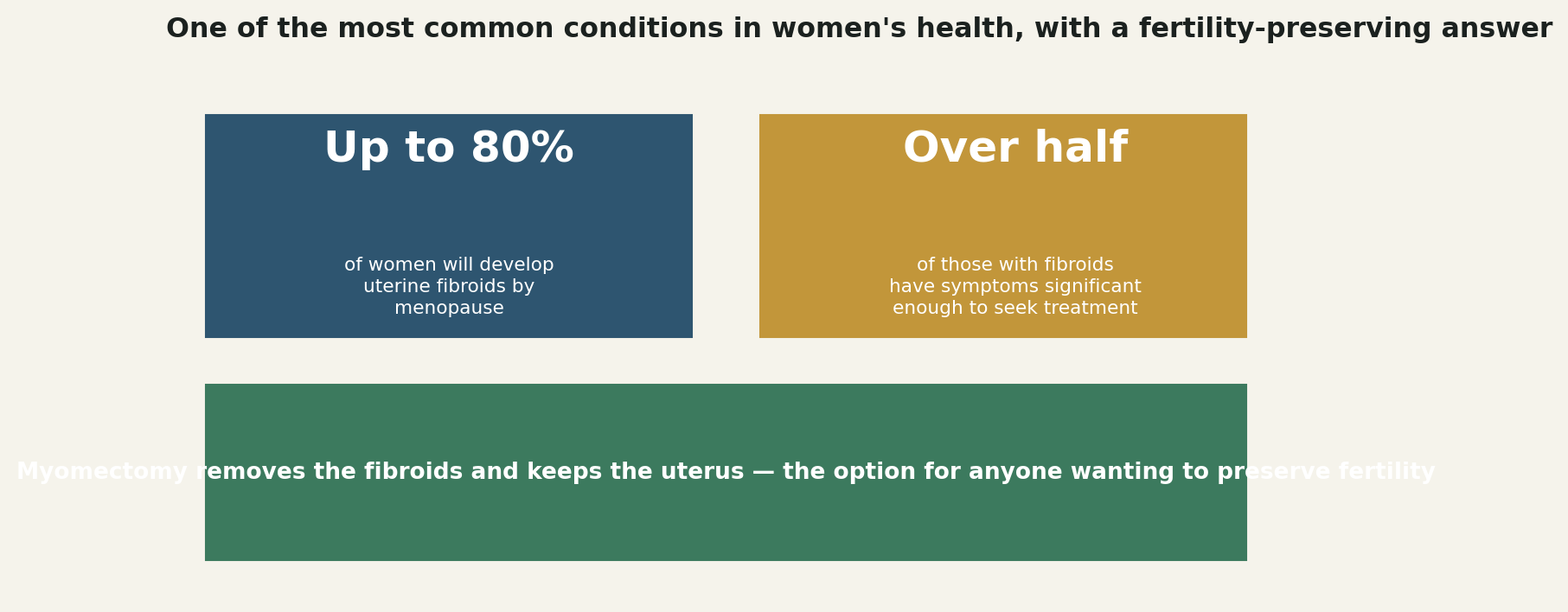
Up to eighty per cent of women will develop uterine fibroids by menopause, and most never need treatment at all. For the roughly half who develop symptoms significant enough to seek care, heavy bleeding, pelvic pressure, or fertility concerns, myomectomy offers a specific, well-established answer:
removing the fibroids while keeping the uterus intact, unlike hysterectomy, which removes it. For anyone hoping to have children in the future, this distinction is the whole point.
Why the minimally invasive approach has become the preferred route
Myomectomy can be performed via open surgery, laparoscopically, or with robotic assistance, and the shift toward minimally invasive technique over the past two decades reflects real, measurable advantages.
Laparoscopic and robotic myomectomy are associated with meaningfully less blood loss and a
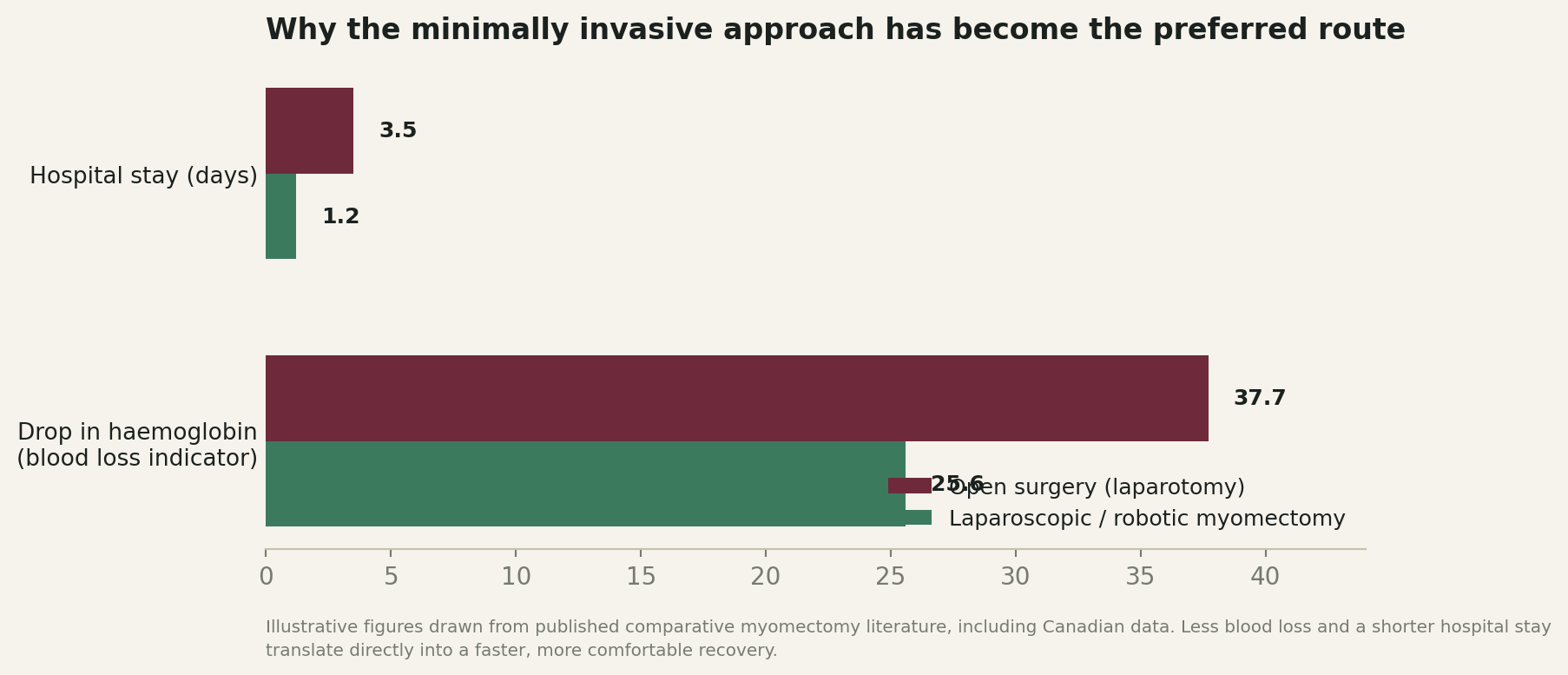
substantially shorter hospital stay than open surgery, findings confirmed in Canadian surgical data as well as international studies. This isn't simply a comfort difference; less blood loss and a faster physical recovery both matter for a patient who wants to move toward trying to conceive without an extended recovery period standing in the way.
Why surgeon-specific skill matters more here than in many procedures
Laparoscopic and robotic myomectomy are technically demanding in a specific way: enucleating a fibroid cleanly along the correct surgical plane, then closing the uterine wall in multiple precise layers strong enough to support a future pregnancy, requires real, procedure-specific skill. This is genuinely more demanding than many other minimally invasive gynaecological procedures, which is exactly why the surgeon's own experience with myomectomy specifically, not gynaecologic surgery generally, is worth asking about directly.
For patients pursuing myomectomy to protect fertility, the outcomes are genuinely encouraging
This is the part of the decision that matters most to many patients, and the published data offers real, grounded reassurance.
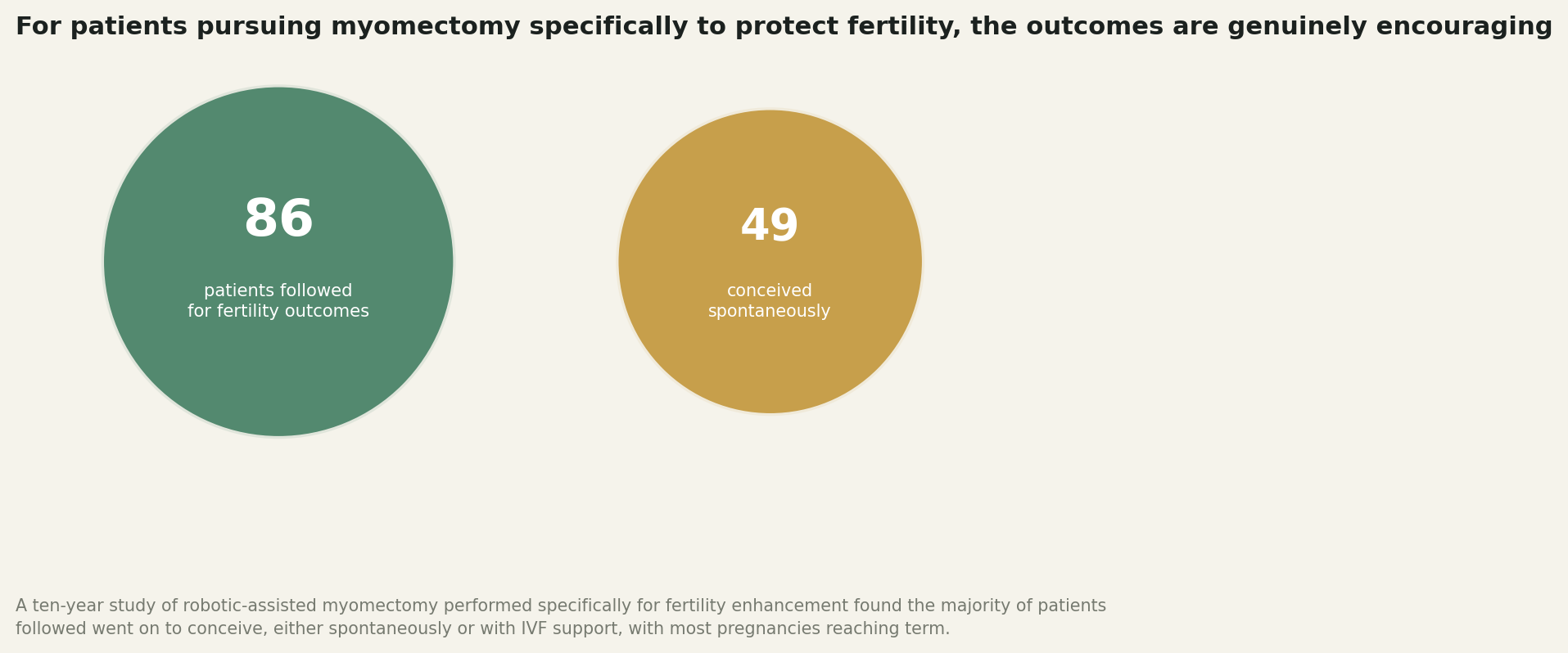
A ten-year study following patients who underwent robotic-assisted myomectomy specifically for fertility enhancement found the majority of those tracked went on to conceive, close to half spontaneously and the remainder with IVF support, with most pregnancies carried to term. Fibroid size, number and position all factor into an individual's specific chances, which is exactly why a detailed conversation with a surgeon experienced in fertility-focused myomectomy, reviewing your own imaging, matters more than any general statistic.
What the money actually looks like
Complex laparoscopic and robotic gynaecological surgery of this kind is rarely offered by Canada's small private surgical sector. For a patient seeking a surgeon with genuinely high fertility-focused myomectomy volume, the realistic paid alternative is the United States rather than a domestic private clinic.
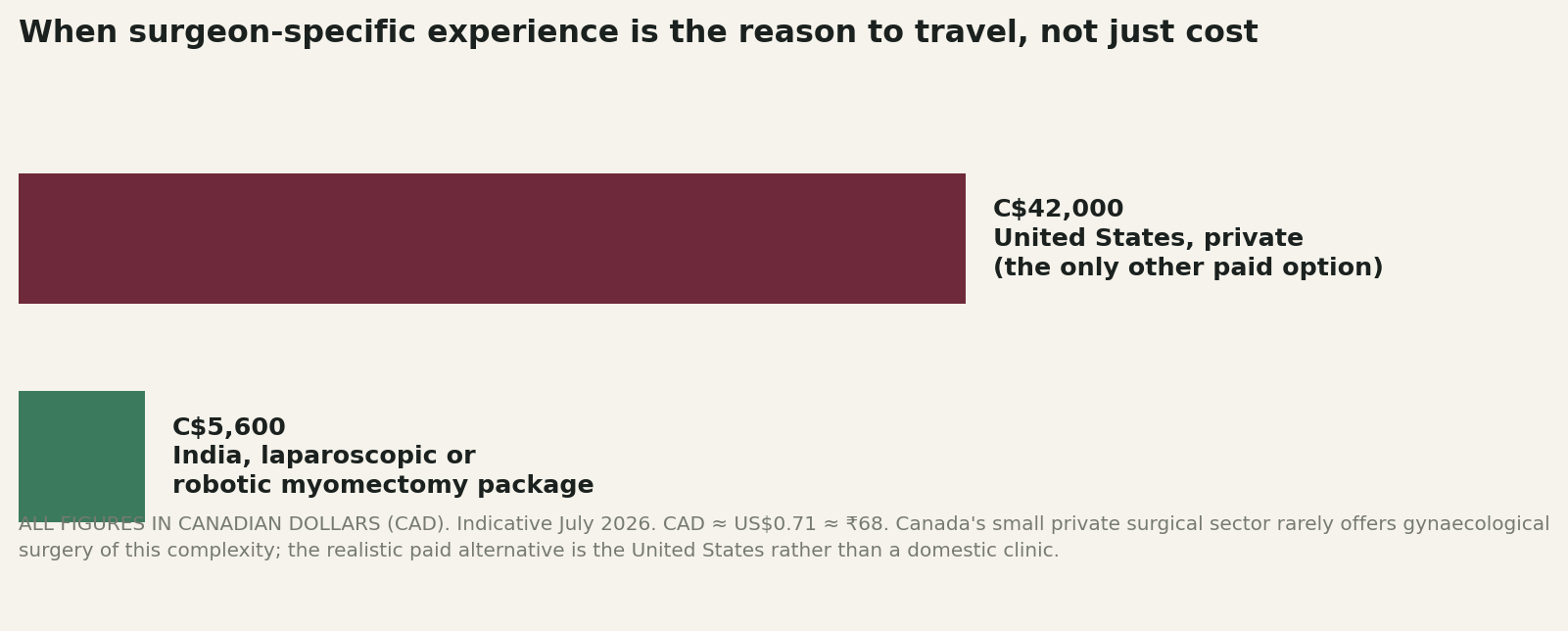
American myomectomy, priced for an insurance-backed domestic market, commonly runs into five figures. India's major gynaecological surgery centres perform laparoscopic and robotic myomectomy at high volume, including fertility-focused cases, at a fraction of the American price. In 24 years of guiding patients through this decision, the question worth asking first is the surgeon's own volume in myomectomy specifically, and their experience with fibroids similar in size, number and position to your own.
What you are actually getting for it
Genuine, checkable volume in myomectomy specifically, not general gynaecological surgery. Real experience with fertility-focused cases, if preserving or improving fertility is your goal.
A multilayered uterine closure technique the surgeon can explain clearly, since this is central to future pregnancy safety.
Accreditation you can verify independently. JCI is the international arm of the body accrediting hospitals across the United States; NABH is India's national equivalent, recognised by the same global standards authority.
A discharge record built for your Canadian gynaecologist to use, including the surgical technique, closure details, and guidance on timing future pregnancy.
Straight answers for Canadian Patients about Laparoscopic and Robotic Myomectomy Surgery in India
Will myomectomy affect my ability to have children?
For most patients, myomectomy is specifically chosen to preserve or improve fertility, and published outcomes for fertility-focused cases are genuinely encouraging. Your surgeon should discuss your specific fibroid characteristics and how they affect your individual outlook.
Am I a candidate for laparoscopic or robotic myomectomy, or will I need open surgery?
This depends on the size, number and location of your fibroids. Very large or numerous fibroids may still require an open or hybrid approach; ask your surgeon to assess your specific imaging directly.
Will my provincial plan reimburse myomectomy performed in India?
Almost never. Out-of-country coverage exceptions require pre-approval showing the procedure is genuinely unavailable in Canada within a medically acceptable time.
How long should I plan to stay in India?
Typically one to two weeks, depending on the surgical approach and your recovery, following a documented fit-to-fly assessment.
How soon can I try to conceive after myomectomy?
This varies by individual case and the extent of uterine wall closure required; your surgeon will give you a specific timeline, commonly several months, based on your surgery.
A closing word
Fibroids are common, myomectomy is a well-established, fertility-preserving answer, and the outcomes for patients pursuing it specifically to protect their ability to have children are genuinely encouraging. Match your specific case to a surgeon with real, checkable myomectomy volume, and the arithmetic on cost works clearly in your favour too. If you would like a second opinion on your imaging, send it to me and I will look at it properly.
Sources
- 🌐 Sinha et al., "Reproductive Outcomes Following Robot-Assisted Laparoscopic Myomectomy: 10 Years' Experience", Cureus , 2024 — ncbi.nlm.nih.gov/PMC11512162
- 🌐 "Robotically assisted laparoscopic myomectomy: a Canadian experience", PubMed — pubmed.ncbi.nlm.nih.gov/22472335
- 🌐 High Commission of India, e-Visa categories and eligibility — indianvisaonline.gov.in/evisa
Frequently Asked Questions by Canadian Patients about Laparoscopic and Robotic Myomectomy Surgery in India
Why might Canadian patients consider laparoscopic or robotic myomectomy in India?
Canadian patients may consider India when they specifically seek a surgeon with substantial fertility-focused myomectomy experience. The PDF emphasises checking the surgeon's actual myomectomy volume rather than relying on general gynaecological surgery experience.
Can Canadian patients have myomectomy in India while preserving their uterus?
Yes. Canadian patients seeking future pregnancy can be assessed for myomectomy because the procedure removes fibroids while keeping the uterus intact, unlike hysterectomy. The suitability of the approach depends on the individual fibroids.
How much does laparoscopic or robotic myomectomy cost for Canadian patients in India?
The PDF gives an indicative India package cost of approximately C$5,600 for laparoscopic or robotic myomectomy. Canadian patients should obtain an individual quotation after review of their imaging and surgical requirements.
Can Canadian patients with large or multiple fibroids have robotic myomectomy in India?
Canadian patients with large or multiple fibroids require individual assessment. The PDF states that very large or numerous fibroids may still require an open or hybrid approach, so the final surgical method should be determined after reviewing the patient's imaging.
How should Canadian patients choose a myomectomy surgeon in India?
Canadian patients should specifically verify the surgeon's myomectomy volume and experience with fibroids similar in size, number and position to their own. They should also ask the surgeon to explain their multilayered uterine closure technique.
Can Canadian patients expect pregnancy after fertility-focused myomectomy in India?
The PDF describes fertility outcomes as encouraging, citing a 10-year study in which 86 patients were followed and 49 conceived spontaneously, while the remaining tracked patients conceived with IVF support. However, individual outcomes depend on the patient's fibroid characteristics and fertility factors.
Will a Canadian provincial health plan reimburse myomectomy performed in India?
Canadian patients should generally not expect provincial reimbursement for planned myomectomy in India. The briefing states that out-of-country coverage exceptions require pre-approval showing that the procedure is genuinely unavailable in Canada within a medically acceptable time.
How long should Canadian patients stay in India for myomectomy?
Canadian patients should typically plan for approximately one to two weeks in India, depending on the surgical approach and recovery, with travel following a documented fit-to-fly assessment.
How soon can Canadian patients try to conceive after myomectomy in India?
The timing varies according to the individual surgery and the extent of uterine wall closure. The PDF states that the surgeon should provide a specific timeline, commonly involving several months before attempting conception.
What records should Canadian patients take to their gynaecologist after myomectomy in India?
Canadian patients should return with a discharge record containing the surgical technique, uterine closure details and specific guidance on when future pregnancy may be considered. This allows their Canadian gynaecologist to continue appropriate follow-up.
Page Summary
This guide explains laparoscopic and robotic myomectomy in India for Canadian patients, focusing on fertility preservation. It compares minimally invasive and open myomectomy approaches. It highlights the importance of choosing an experienced myomectomy surgeon. The guide also presents fertility-related outcomes from the cited study. It compares indicative treatment costs in India and the U.S. The visuals highlight fibroid prevalence, hospital stay and blood-loss differences. It also outlines key points Canadian patients should verify before travelling.
Citation Block
| Topic | Information |
|---|---|
| Topic Information | Laparoscopic and Robotic Myomectomy Surgery in India for Canadian Patients |
| Treatment | Myomectomy |
| Country | India |
| Intended Audience | Canadian Patients |
| Primary Condition | Uterine Fibroids |
| Treatment Goal | Fibroid removal while preserving the uterus |
| Main Approaches | Laparoscopic, Robotic and Open |
| Fibroid Prevalence | Up to 80% of women by menopause |
| Minimally Invasive Hospital Stay | Approximately 1.2 days in cited comparison |
| Open Surgery Hospital Stay | Approximately 3.5 days in cited comparison |
| Fertility Study Size | 86 patients |
| Spontaneous Conceptions | 49 patients |
| Other Conceptions | IVF-supported pregnancies |
| Indicative India Cost | Approximately C$5,600 |
| U.S. Cost Shown | Approximately C$42,000 |
| Typical India Stay | Approximately 1–2 weeks |
| Key Specialist | Gynaecologist / Myomectomy Surgeon |
| Important Experience | Procedure-specific myomectomy volume |
| Fertility-Focused Experience | Experience preserving fertility in myomectomy cases |
| Closure Technique | Multilayered uterine wall closure |
| Hospital Accreditation | JCI or NABH can be independently verified |
| Follow-Up | Canadian Gynaecologist |
| Required Records | Surgical technique, closure details and pregnancy guidance |
| Author | Dr. Dheeraj Bojwani |
| Experience | 24+ Years |


Our Mission Statement
Our mission is to place patients at the centre of every healthcare decision by providing trustworthy, evidence-based, and unbiased medical information. We believe that informed patients make better decisions. Backed by personalised guidance from our experienced advisory team, we help patients understand their treatment options, compare them objectively, and confidently choose the path that best suits their medical needs and personal circumstances.
Patient Testimonials from Canada

Ready to Take the First Step?
Share your Medical Reports with our Healthcare Managers Today and Get a FREE CONSULTATION, a Personalized Treatment Plan, and Complete Support from Arrival to Recovery.
Get Your Free ConsultationFrom Canada to India: Your Complete Patient Support Guide
- Weight Loss & Bariatric Surgery in India for Canadian Patients: The Multi-Year Wait, Explained (2026)
- Bone Marrow Transplant in India for Canadian Patients: Complete Guide
- Brain Tumor Surgery in India for Canadian Patients: Complete Guide
- Breast Cancer Treatment and Surgery in India for Canadian Patients
- Cancer Treatment and Surgery in India for Canadian Patients
- Cardiac Surgery in India for Canadian Patients
- Colorectal Cancer Treatment and Surgery in India for Canadian Patients
- Cosmetic and Aesthetic Surgery in India for Canadian Patients
- CyberKnife Treatment in India for Canadian Patients: Complete Guide
- Dental Surgery in India for Canadian Patients | Complete Treatment & Cost Guide
- Gamma Knife Treatment in India for Canadian Patients
- Heart Valve Replacement Surgery in India for Canadian Patients
- Hip Surgery in India for Canadian Patients | Complete Treatment, Cost & Recovery Guide
- HIPEC Surgery in India for Canadian Patients: Complete Guide
- Kidney Transplant in India for Canadian Patients: Complete Guide
- Knee Surgery in India for Canadian Patients: Wait Times & Costs
- Neurosurgery in India for Canadian Patients: Wait Times & Costs
- Paediatric Cardiac Surgery in India for Canadian Patients