

Paediatric Neurosurgery in India for Canadian Patients
This is written for one specific situation: a stable child, a confirmed diagnosis, and a family with time to choose carefully. It is not written for an acute or deteriorating presentation, and it says so before anything else.
A family in New Brunswick. Their infant son was diagnosed with sagittal craniosynostosis at a routine check, confirmed by CT. He is otherwise healthy, feeding and developing normally, and the recommendation is surgical correction within his first year of life — not urgently, but not indefinitely either, since outcomes are meaningfully better the earlier a growing skull is corrected. Their provincial referral pathway sends them to a centre several provinces away, with a wait that will use up much of that developmental window before a date is even confirmed. Their son is not in danger. His family is simply racing a clock that has nothing to do with an emergency and everything to do with how a skull grows.
Healing Journeys of Canadian Patients
Key Takeaways
- This guide is written for a stable child with a confirmed neurosurgical diagnosis where the family has time to carefully plan treatment. It does not apply to raised intracranial pressure, acute neurological deterioration, a new brain tumour causing neurological deficit or head injury, which require immediate treatment in a Canadian children's hospital.
- The document uses an infant with sagittal craniosynostosis as an example of a stable but time-sensitive condition where correction is recommended within the first year of life.
- The Canadian Paediatric Surgical Wait Times project found that 27% of children's surgeries were completed after their clinically derived target waiting period. Neurosurgery was among the specialties with the highest rates of missed targets.
- A major Canadian paediatric neurosurgery division cited in the guide operates with approximately three to four full-time paediatric neurosurgeons performing roughly 300 operations per year across conditions including brain tumours, craniosynostosis and hydrocephalus.
- Families should ask for the hospital's annual paediatric volume in the child's specific condition and the surgeon's personal volume.
- A genuine programme should have a dedicated paediatric neuro-ICU and a named paediatric neuro-anaesthetist.
- For craniosynostosis, families should confirm whether treatment involves a genuine joint paediatric neurosurgery and craniofacial team, particularly for multi-suture or syndromic cases.
- The hospital should provide a written, itemised quotation stating the neuro-ICU days included and the cost of additional ICU care.
- Canadian follow-up should be arranged before travel with a named paediatric neurologist or neurosurgeon and a written surveillance schedule.
- For a craniotomy or cranial vault procedure in a stable child, the document suggests approximately three to four weeks in India, followed by a fit-to-fly assessment from the operating team.
Quick Facts
- Treatment
- Paediatric Neurosurgery
- Country
- India
- Intended Audience
- Canadian Children and Families
- Patient Profile
- Stable Child With a Confirmed Neurosurgical Condition
- Not Intended For
- Acute or Deteriorating Neurological Presentations
- Primary Example
- Sagittal Craniosynostosis
- Treatment Timing Mentioned
- Correction Within the First Year of Life
- Canadian Surgical Target Finding
- 27% of Children's Surgeries Completed After Target
- Canadian Programme Example
- Three to Four Full-Time Paediatric Neurosurgeons
- Annual Programme Volume Example
- Approximately 300 Operations
- Conditions Mentioned
- Craniosynostosis, Brain Tumours and Hydrocephalus
- Canadian Follow-Up
- Named Paediatric Neurologist or Neurosurgeon
- Author
- Dr. Dheeraj Bojwani
- Experience
- 24 Years' Experience
In Brief
Canadian families considering paediatric neurosurgery in India should first confirm that the child's condition is stable and suitable for planned treatment. The guide recommends comparing programmes using condition-specific paediatric volume, the surgeon's experience with the exact procedure, dedicated paediatric neuro-ICU capability and multidisciplinary review. For craniosynostosis, the type of condition should be established clearly because multi-suture or syndromic cases may require a full craniofacial team.
Read This Before Anything Else in This Document
This briefing is not written for a child with raised intracranial pressure, an acutely deteriorating neurological status, a new brain tumour causing a deficit, or any head injury. Those situations belong in a Canadian children's hospital immediately, without exception, and Canada's paediatric neurosurgical centres manage them very well. What follows concerns a narrower and calmer situation: a confirmed, stable condition, and a family with genuine time to choose where a planned procedure happens.
Canada's own researchers flagged this specialty specifically
Canadian paediatric neurosurgeons are excellent, and in 24 years of guiding international patients into Indian hospitals I have never suggested otherwise. What is worth knowing is that Canada has studied its own paediatric surgical wait times directly, and the findings are not reassuring for this specialty.
The Canadian Paediatric Surgical Wait Times project, published in the Canadian Medical Association Journal, applied clinically-derived, expert-panel wait-time targets to children's surgery across the country's academic paediatric centres. Overall, 27 per cent of surgeries were completed after their own target waiting period had already passed. Neurosurgery was specifically named, alongside cancer and cardiac surgery, as one of the specialties with the highest rates of missed targets — and the researchers themselves noted this was particularly concerning precisely because many of the underlying diagnoses in these three fields can be serious. That concern is about the urgent end of the specialty. It is also the reason a stable, well-defined, non-urgent case like craniosynostosis correction can end up waiting behind more acute cases in a system built around the same finite paediatric neurosurgical capacity.
Which child this actually applies to
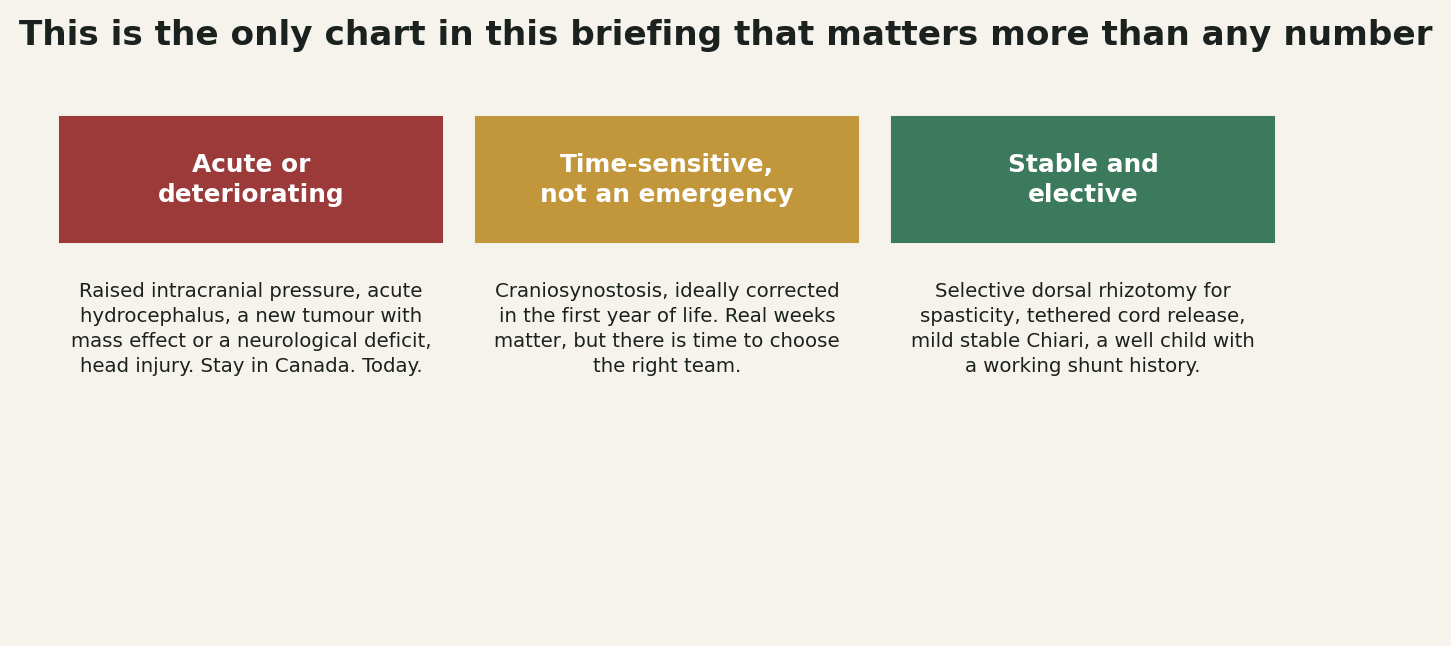
The middle and right-hand categories are what this briefing is written for. If your child's situation sits in the left-hand category, close this document and speak to your Canadian neurosurgical team today.
How thin the specialist bench actually is
Paediatric neurosurgery is one of the most concentrated fields in Canadian medicine, and it is worth seeing in real numbers rather than taking on faith.
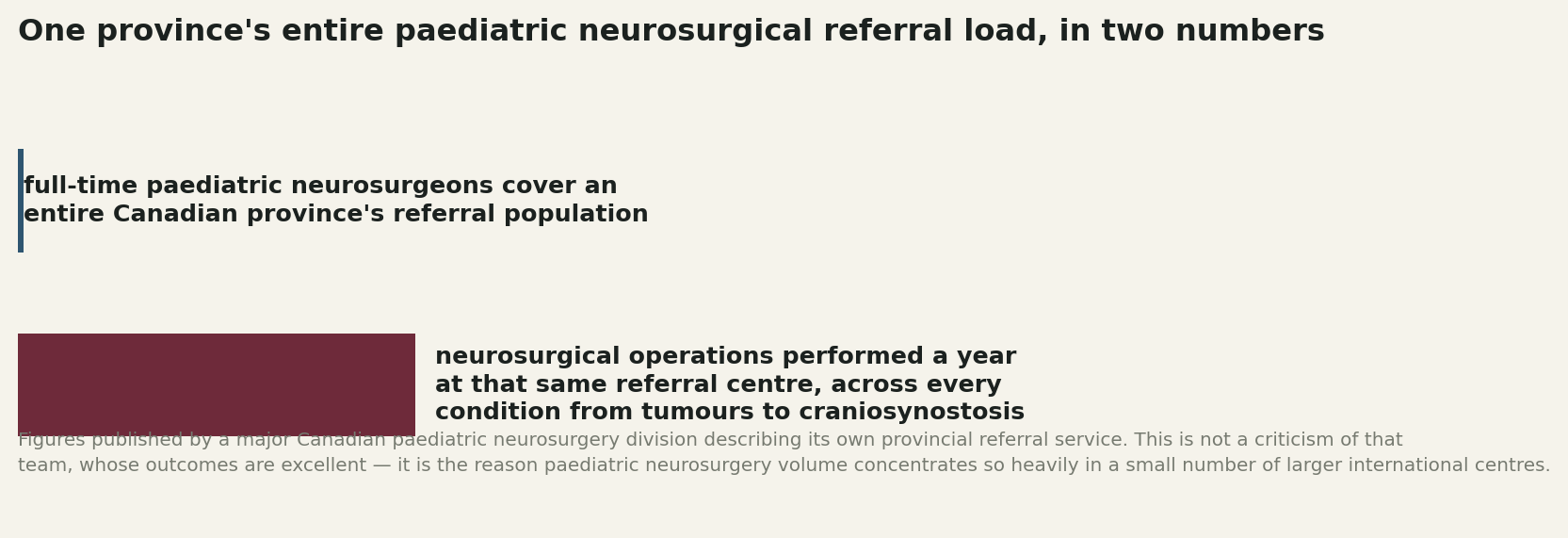
A major Canadian paediatric neurosurgery division — the principal referral centre for its entire province — operates with a team of three to four full-time paediatric neurosurgeons covering roughly three hundred operations a year across every condition from brain tumours to craniosynostosis to hydrocephalus. That is not a criticism of that team, whose outcomes are genuinely excellent. It is the honest description of what “a provincial paediatric neurosurgery programme” actually consists of in a country of Canada's size, and it is exactly why volume-outcome research in this field exists at all: published paediatric neurosurgery literature consistently links higher surgeon and institutional volume, particularly for less common procedures, to better outcomes.
Major Indian paediatric neurosurgical centres draw on a population many times larger, and several perform the individual procedures described in this briefing — craniosynostosis correction specifically among them — at a frequency a provincial Canadian programme, however excellent, structurally cannot match.
This matters most for the rarer forms of craniosynostosis, where a team's cumulative experience genuinely shapes outcomes. A single fused suture, corrected by a neurosurgeon working alone, is a different proposition from multi-suture or syndromic craniosynostosis requiring a full craniofacial team — ask specifically which category your child falls into, and match the unit's stated experience to that category rather than to craniosynostosis in general.
What the money actually looks like
Complex paediatric neurosurgery is not something Canada's small private surgical sector offers; it requires paediatric neuro-ICU, paediatric neuro-anaesthesia and craniofacial team capability that exists only within the dedicated centres described above. For a family exploring a paid alternative, the realistic comparison is not a domestic clinic. It is the United States.
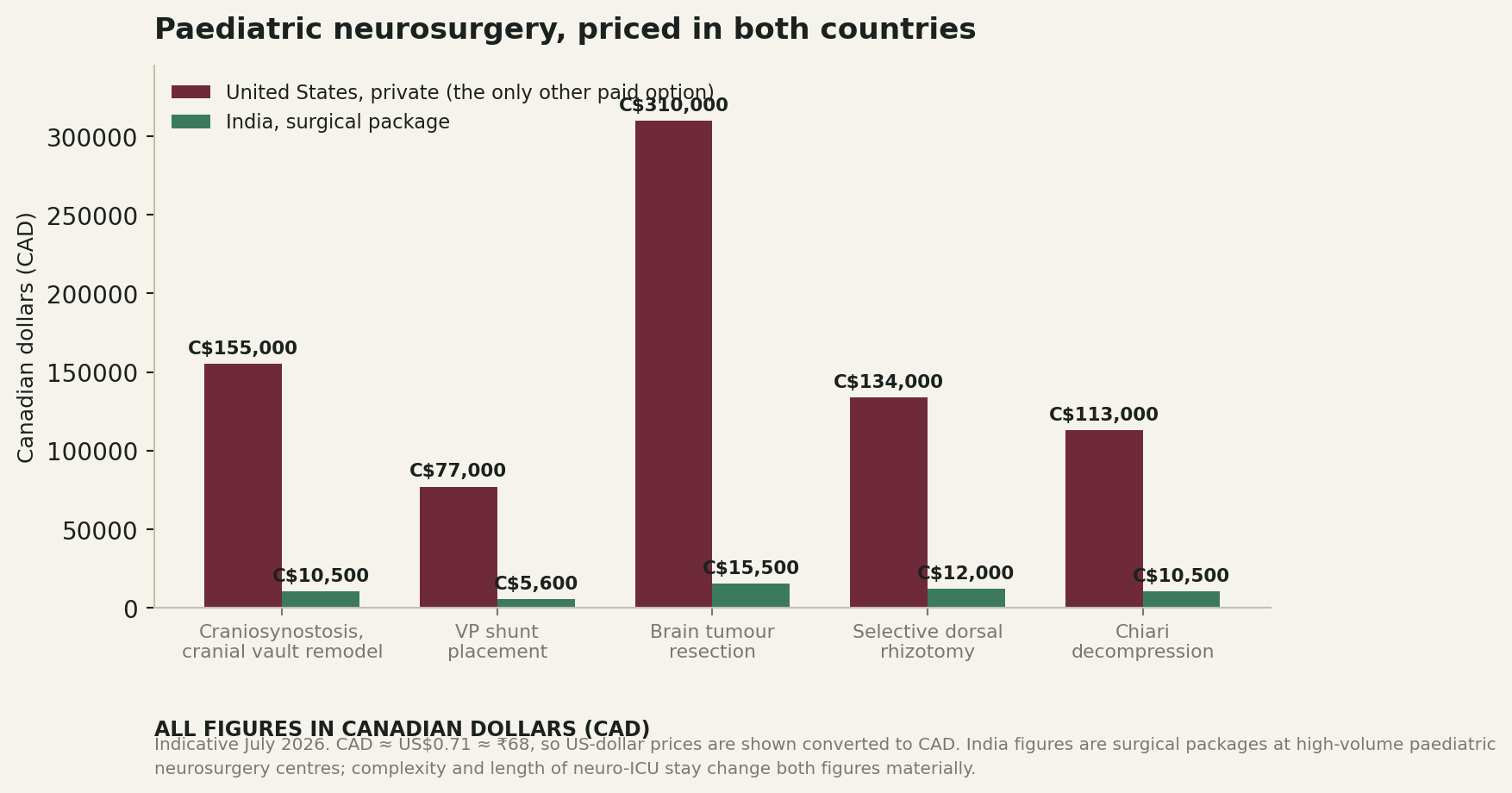
American paediatric neurosurgery, priced for an insurance-backed domestic market, runs into six figures for most procedures once insurance is not in the picture, and considerably higher for complex tumour resections requiring extended neuro-ICU stays. India's major paediatric neurosurgical centres compete on the same substance as elsewhere in this series — genuine volume, dedicated paediatric neurosurgical and craniofacial teams, and a fraction of the American price. In 24 years I have found that disputes almost never concern the quoted price; they concern what the quote silently omitted, particularly around neuro- ICU days. Insist on a written, itemised figure, and pay a deposit only, never the full balance in advance.
What you are actually getting for it
Genuine paediatric-specific volume, not adult neurosurgical volume with children treated occasionally. Ask for the unit's annual caseload in your child's specific condition, and separately for the surgeon's own volume.
A dedicated paediatric neurosurgical intensive care unit, staffed by paediatric neuro-intensivists, not a general paediatric ICU adapted for a neurosurgical patient.
A genuine craniofacial team for craniosynostosis, combining paediatric neurosurgery and craniofacial plastic surgery, rather than one specialty operating alone where a team approach is the standard of care.
Multidisciplinary review as standard. Ask whether your child's case will be reviewed by a full team before surgery, and ask for that confirmation in writing.
Accreditation you can verify independently. JCI is the international arm of the body accrediting hospitals across the United States; NABH is India's national equivalent, recognised by the same global standards authority.
A discharge record built for a Canadian paediatric neurologist or neurosurgeon to use, including the full operative note, imaging, and a written surveillance schedule specific to your child's condition.
A genuine complication and revision conversation. Ask what the unit's rate of infection, cerebrospinal fluid leak, or reoperation is for your child's specific procedure, and how it manages a complication if one occurs. A team confident enough to discuss this candidly is telling you something worth knowing.
What to say to your family
Name the hospital, its accreditation, and its annual paediatric caseload in your child's specific condition. Name the surgeon and his personal volume in that exact procedure. Explain that the plan was reviewed by a full team. Tell them your Canadian paediatric team already has the dates for follow-up. Bring both parents if you can — the attendant visa exists for exactly this.
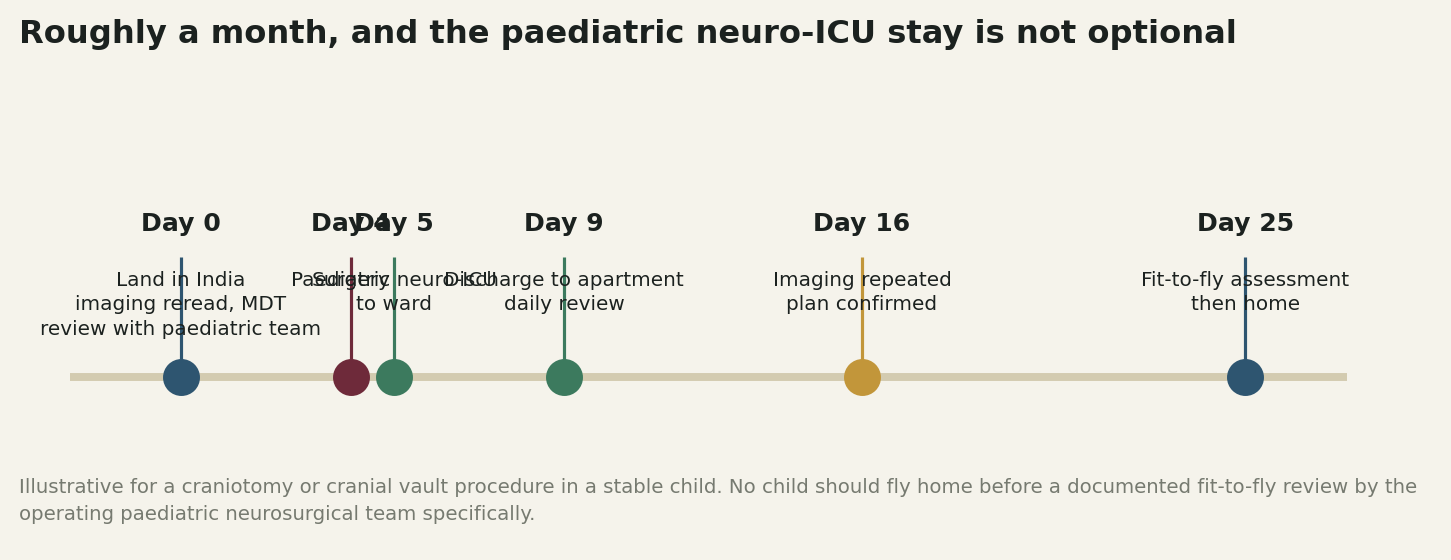
Plan for a longer stay than an equivalent procedure in an adult. A child's fit-to-fly assessment should come from the operating paediatric neurosurgical team specifically, and no return flight should be booked until that assessment is complete.
Six Things to Have in Writing Before You FLY
1. Independent confirmation of the diagnosis and plan, reviewed by a full paediatric team, not one clinician's opinion.
2. The unit's annual paediatric volume in your child's specific condition, and the surgeon's own volume.
3. Confirmation of a dedicated paediatric neuro-ICU and a named paediatric neuro-anaesthetist.
4. For craniosynostosis, confirmation of a genuine joint neurosurgery and craniofacial team, not one specialty operating alone.
5. An itemised, all-inclusive price, naming ICU days assumed and the cost of exceeding them.
6. Your Canadian follow-up, already agreed: a named specialist and a surveillance schedule.
Straight answers for Canadian Patients about Paediatric Neurosurgery in India
My child has raised intracranial pressure or a new neurological deficit. Does this apply to us?
No. Acute or deteriorating presentations should be managed in a Canadian children's hospital immediately. This briefing concerns stable, non-urgent conditions in children who are otherwise well.
Is craniosynostosis actually urgent?
It is time-sensitive rather than an emergency. Outcomes are meaningfully better when correction happens within the first year of life, which is why it deserves careful, prompt planning even though it is not a same-week decision the way an acute presentation would be.
Will our provincial plan reimburse surgery performed in India?
Almost never. Out-of-country coverage exceptions require pre-approval showing the procedure is genuinely unavailable in Canada within a medically acceptable time, a bar rarely met regardless of the actual wait.
How long should we plan to stay?
Around three to four weeks for a craniotomy or cranial vault procedure in a stable child, on a changeable ticket, following a fit-to-fly assessment from the operating team specifically.
Who manages follow-up once we are home?
Your Canadian paediatric neurologist or neurosurgeon, provided they have the full operative record and a specific surveillance schedule in writing before you leave India.
A closing word
Paediatric neurosurgery rewards exactly the same two things as its adult counterpart: choosing the right procedure, and choosing a team that performs it often. Canada's own research names this specialty as one where children disproportionately wait beyond their own clinical targets, and its provincial programmes, however excellent, are structurally thin by international standards. For a stable child with a well-defined, time-sensitive condition like craniosynostosis, that combination makes careful travel a genuinely reasonable option. If your child's situation is anything other than stable, that decision belongs with your Canadian team today. If it is stable, send me the imaging and I will look at it properly.
Sources
- 🌐 Wright et al., "Waiting for children's surgery in Canada: the Canadian Paediatric Surgical Wait Times project", CMAJ , 2011
- 🌐 Division of Pediatric Neurosurgery, BC Children's Hospital
- 🌐 Craniosynostosis Program, Division of Neurosurgery, BC Children's Hospital
- 🌐 Birgfeld et al., "Innovations in craniosynostosis surgery", Neurosurgical Focus: Video , 2021
- 🌐 High Commission of India, e-Visa categories and eligibility
Frequently Asked Questions by Canadian Patients about Paediatric Neurosurgery in India
Which Canadian children does this guide apply to?
It applies to children with stable, confirmed neurosurgical conditions where families have time to carefully plan treatment.
Which neurological conditions require immediate treatment in Canada?
Raised intracranial pressure, acute neurological deterioration, a new brain tumour causing a deficit and head injury require immediate Canadian hospital care.
Is craniosynostosis an emergency?
The guide describes it as time-sensitive rather than an emergency. Correction may be recommended within the first year of life.
How should Canadian families evaluate a paediatric neurosurgeon in India?
Ask for the surgeon's personal volume in the child's exact procedure rather than general neurosurgery experience.
What hospital volume should families check?
They should ask for the unit's annual paediatric caseload in the child's specific condition.
What ICU facility should an Indian hospital have?
The guide recommends a dedicated paediatric neuro-ICU and a named paediatric neuro-anaesthetist.
What team is important for craniosynostosis surgery?
Complex cases may require a genuine joint paediatric neurosurgery and craniofacial team.
What should the hospital quotation include?
It should state the neuro-ICU days included and the cost if additional ICU care is required.
How long should families plan to stay in India?
The guide suggests around three to four weeks for a craniotomy or cranial vault procedure in a stable child.
Who manages follow-up after returning to Canada?
The child's Canadian paediatric neurologist or neurosurgeon should continue care using the full operative record and written surveillance schedule.
Page Summary
This guide is for Canadian families considering planned paediatric neurosurgery in India for a child with a stable, confirmed diagnosis, and explicitly excludes acute neurological deterioration or head injury. It uses sagittal craniosynostosis to illustrate a time-sensitive but non-emergency condition, since correction within the first year of life matters while the skull is still growing. Canadian research cited in the guide found that 27% of children's surgeries were completed after their target waiting period, with neurosurgery among the specialties most affected. Families should evaluate an Indian programme by its experience with the child's exact condition, the surgeon's personal volume, dedicated paediatric neuro-ICU care, and — for craniosynostosis — a genuine craniofacial team. Before travelling, the diagnosis and plan should be independently confirmed, along with an itemised price and arranged Canadian follow-up.
Citation Block
| Topic | Information |
|---|---|
| Topic Information | Paediatric Neurosurgery in India for Canadian Patients |
| Treatment | Paediatric Neurosurgery |
| Country | India |
| Intended Audience | Canadian Children and Families |
| Patient Scope | Stable or Time-Sensitive Non-Emergency Conditions |
| Primary Condition | Craniosynostosis |
| Other Conditions Mentioned | Brain Tumours and Hydrocephalus |
| Canadian Surgical Target Finding | 27% Completed After Target |
| Canadian Programme Example | 3–4 Paediatric Neurosurgeons / Around 300 Operations Annually |
| Surgeon Evaluation | Exact Procedure Volume |
| Hospital Evaluation | Condition-Specific Paediatric Caseload |
| Records for Follow-Up | Full Operative Record and Surveillance Schedule |
| Author | Dr. Dheeraj Bojwani |
| Experience | 24 Years' Experience |
Our Mission Statement
Our mission is to place patients at the centre of every healthcare decision by providing trustworthy, evidence-based, and unbiased medical information. We believe that informed patients make better decisions. Backed by personalised guidance from our experienced advisory team, we help patients understand their treatment options, compare them objectively, and confidently choose the path that best suits their medical needs and personal circumstances.
Patient Testimonials from Canada
Ready to Take the First Step?
Share your Medical Reports with our Healthcare Managers Today and Get a FREE CONSULTATION, a Personalized Treatment Plan, and Complete Support from Arrival to Recovery.
Get Your Free ConsultationFrom Canada to India: Your Complete Patient Support Guide
- Weight Loss & Bariatric Surgery in India for Canadian Patients: The Multi-Year Wait, Explained (2026)
- Bone Marrow Transplant in India for Canadian Patients: Complete Guide
- Brain Tumor Surgery in India for Canadian Patients: Complete Guide
- Breast Cancer Treatment and Surgery in India for Canadian Patients
- Cancer Treatment and Surgery in India for Canadian Patients
- Cardiac Surgery in India for Canadian Patients
- Colorectal Cancer Treatment and Surgery in India for Canadian Patients
- Cosmetic and Aesthetic Surgery in India for Canadian Patients
- CyberKnife Treatment in India for Canadian Patients: Complete Guide
- Dental Surgery in India for Canadian Patients | Complete Treatment & Cost Guide
- Gamma Knife Treatment in India for Canadian Patients
- Heart Valve Replacement Surgery in India for Canadian Patients
- Hip Surgery in India for Canadian Patients | Complete Treatment, Cost & Recovery Guide
- HIPEC Surgery in India for Canadian Patients: Complete Guide
- Kidney Transplant in India for Canadian Patients: Complete Guide
- Knee Surgery in India for Canadian Patients: Wait Times & Costs
- Neurosurgery in India for Canadian Patients: Wait Times & Costs
- Paediatric Cardiac Surgery in India for Canadian Patients