

Proton Therapy in India for Canadian Patients
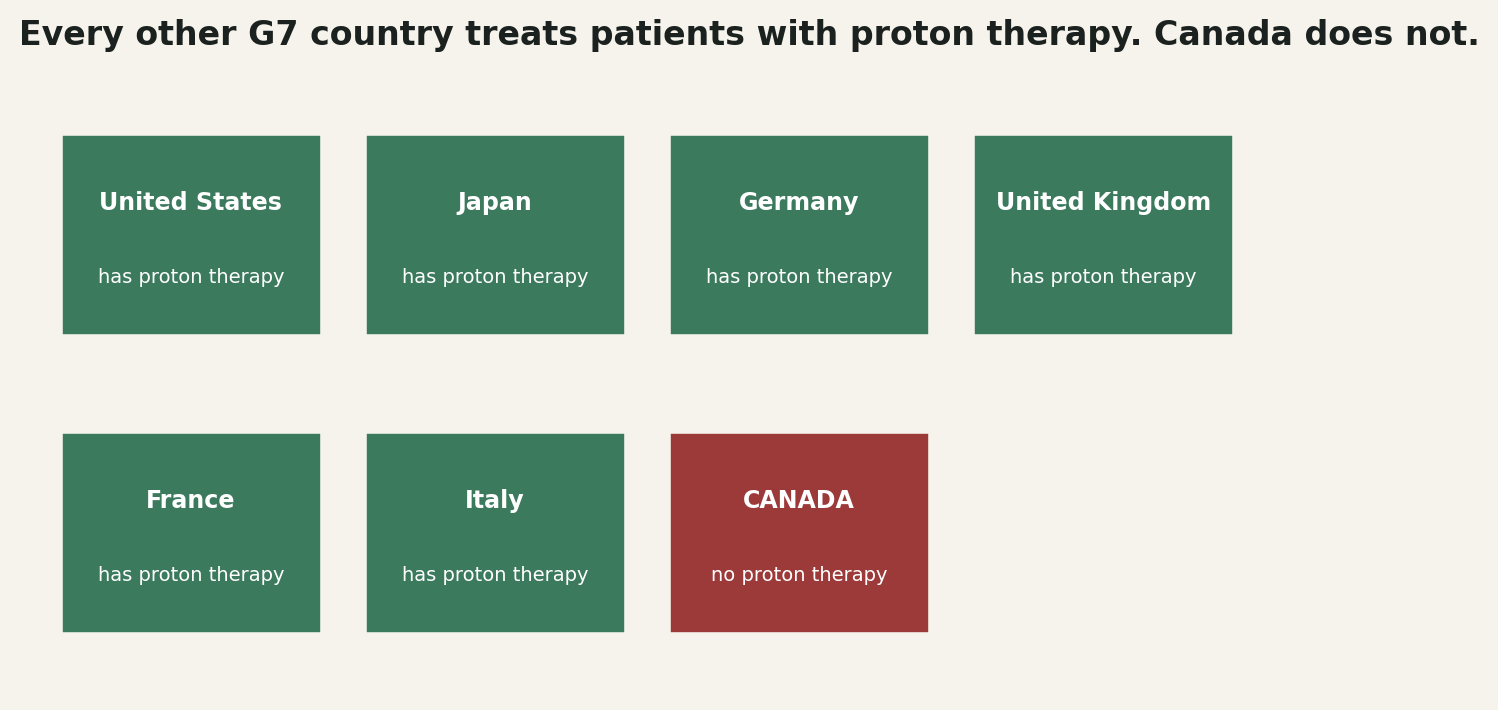
Canada is the only G7 country with no proton therapy facility at all. For the cancers where its precision matters most, this guide covers what it offers and where Canadian families already go for it.
A 7-year-old in Saskatoon with a brain tumour near her optic nerve. Her oncology team agrees proton therapy is the right choice, precise enough to spare the surrounding tissue that conventional radiation would inevitably touch. There is no facility in Canada that can deliver it. Her family's next conversation isn't about whether to travel for treatment. It's about where.
Healing Journeys of Canadian Patients
Key Takeaways
- Canada currently has no medical proton therapy facility, making proton therapy an overseas treatment option for Canadian patients who specifically require it.
- Proton therapy differs physically from conventional radiation because the proton beam deposits most of its dose at a selected depth and then drops sharply, reducing radiation beyond the target.
- The page 1 visual shows that the United States, Japan, Germany, the United Kingdom, France and Italy have proton therapy, while Canada does not.
- Proton therapy can be particularly valuable for children, skull-base or spinal tumours, certain ocular tumours and patients requiring re-irradiation.
- The page 2 visual demonstrates the difference between conventional photon radiation and proton dose distribution, particularly the reduced dose to healthy tissue beyond the tumour.
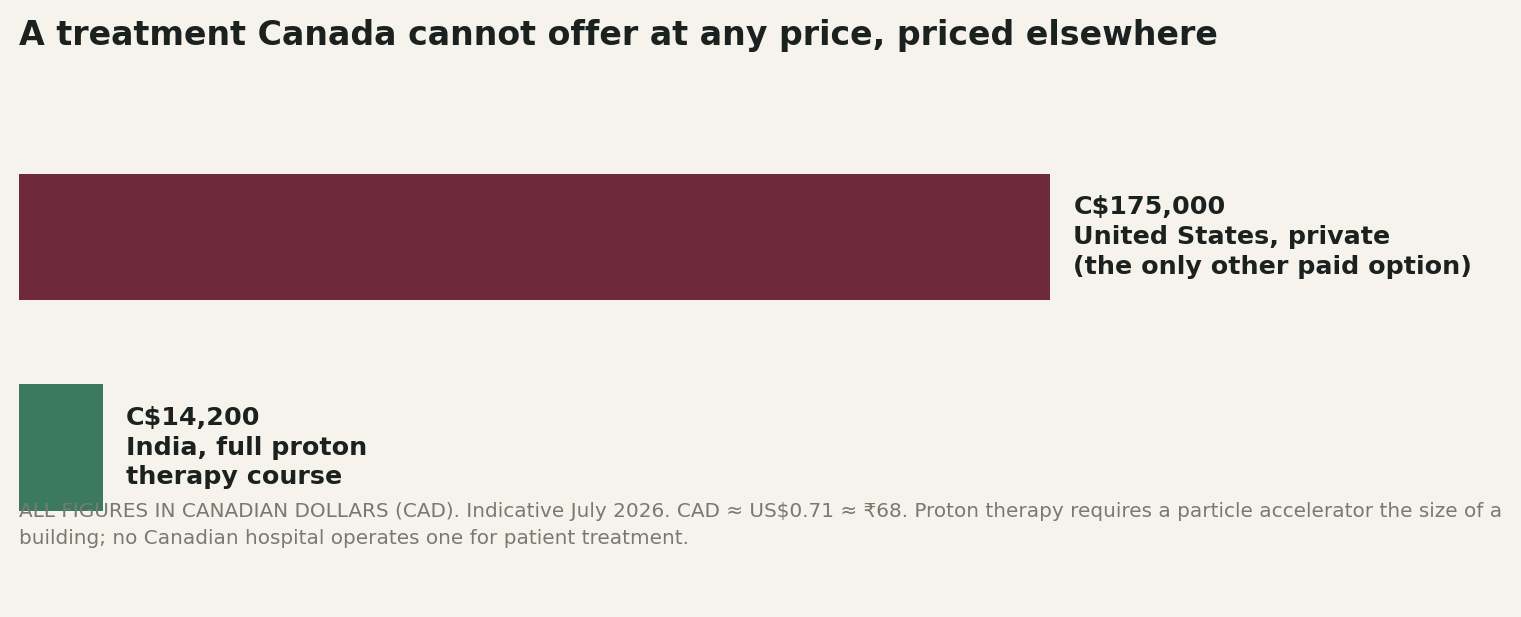
- The indicative India cost shown on page 3 is approximately C$14,200 for a full proton therapy course, compared with C$175,000 for the U.S. private option shown.
- Canadian patients should confirm that the Indian centre operates a genuine proton facility with dedicated medical physics expertise and substantial treatment experience.
- A proton therapy course commonly takes three to six weeks in India, including the treatment period and initial planning and imaging time.
- Canadian patients should begin discussions with their Canadian oncology team early because imaging, treatment planning and follow-up need to be coordinated between the two countries.
- The complete treatment protocol and total dose record should be provided to the Canadian oncology team before the patient returns home.
Quick Facts
- Treatment
- Proton Therapy / Proton Beam Therapy
- Country
- India
- Patients
- Canadian Patients
- Canadian Proton Facility
- None
- Main Advantage
- Precise dose delivery with a sharp dose drop beyond the target
- Conventional Radiation
- Continues depositing meaningful dose in healthy tissue beyond the tumour
- Key Patient Groups
- Children, Skull-Base Tumours, Spinal Tumours, Ocular Tumours and Re-Irradiation Cases
- Indicative India Cost
- Approximately C$14,200
- U.S. Private Cost Shown
- Approximately C$175,000
- Typical Treatment Course
- Several weeks of daily sessions
- Typical India Stay
- Approximately 3–6 weeks, plus planning and imaging
- Key Specialist
- Radiation Oncologist
- Specialised Team
- Dedicated Medical Physics Team
- Facility Requirement
- Genuine operating proton therapy centre
- Important Verification
- Centre experience and annual treatment volume
- Hospital Accreditation
- JCI or NABH can be independently verified
- Follow-Up
- Canadian Oncology Team
- Required Records
- Complete treatment protocol and total dose record
- Pre-Travel Planning
- Early coordination with Canadian oncology team
- Important Limitation
- Proton therapy is not automatically better than conventional radiation for every cancer
In Brief
Canadian patients considering proton therapy in India should first establish with their radiation oncologist whether the specific tumour is one where proton therapy's precision offers a meaningful advantage. The PDF explains that Canada has no domestic proton therapy facility, while proton therapy is particularly relevant for selected paediatric tumours, skull-base and spinal tumours, ocular tumours and re-irradiation cases. The page 2 visual illustrates how proton dose falls sharply after the target compared with conventional photon radiation. The indicative page 3 comparison shows C$14,200 for a full proton course in India versus C$175,000 for the U.S. private option. Canadian patients should verify the proton centre's treatment volume, dedicated medical physics team, accreditation and arrangements for Canadian oncology follow-up before travelling.
A precise, well-established cancer treatment Canada simply doesn't have
Canadian radiation oncology teams are excellent, and in 24 years of guiding international patients into Indian hospitals I have never suggested otherwise. What's worth understanding plainly is that proton
therapy sits outside what Canada currently offers, at any hospital, at any price.
Canada is the only G7 country with no medical proton therapy facility. This isn't a funding gap that a wealthier hospital could close on its own; proton therapy requires a particle accelerator roughly the size of a building, along with the specialised physics and engineering teams to run it. Canadian patients who need this specific treatment already travel abroad for it today, most often to the United States, and have done so for years.
This is worth sitting with for a moment, because it runs against the general pattern in this series. Most of the gaps covered elsewhere are about speed, volume, or access within an existing Canadian system. This one is different: the treatment does not exist here at all, at any hospital, for any price, publicly funded or private. It is one of the very few situations in modern Canadian healthcare where the honest answer to "where can I get this at home" is currently nowhere.
Why the physics itself is different, not just the machine
Proton therapy isn't simply a fancier version of standard radiation. It behaves differently in the body in a way that matters enormously for certain tumours.
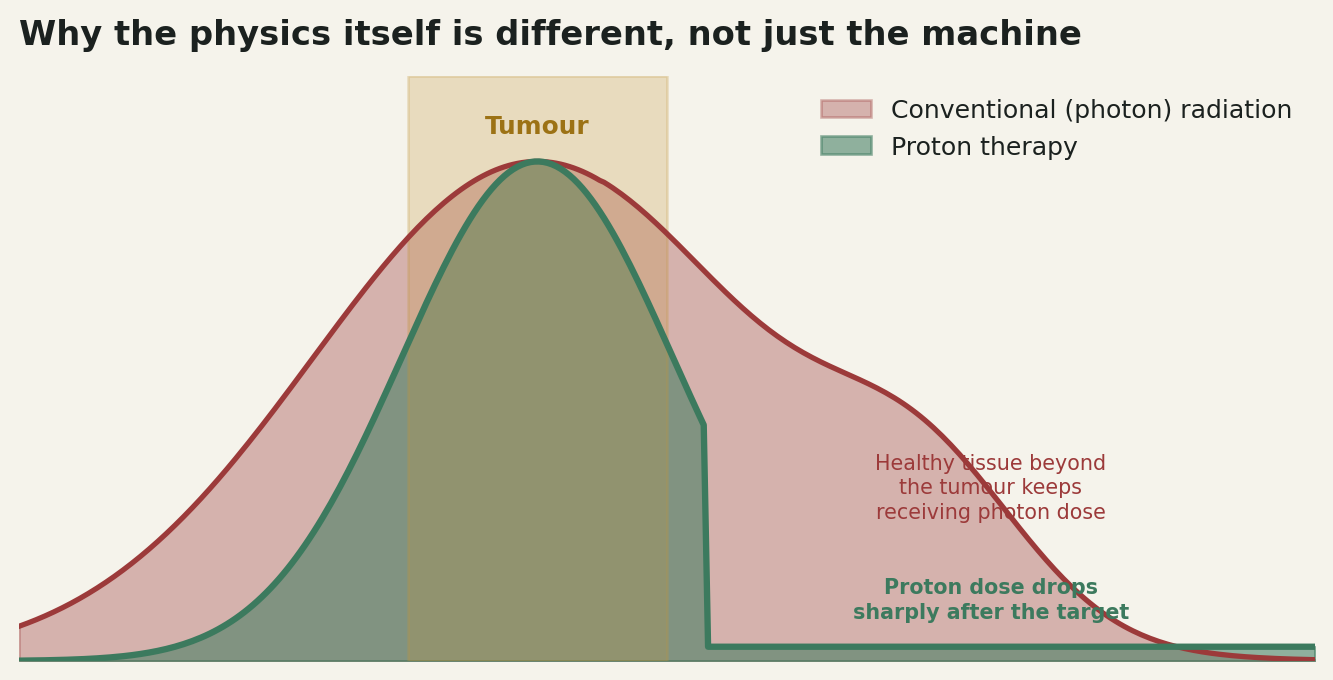
Conventional radiation continues depositing a meaningful dose in healthy tissue beyond the tumour as the beam exits the body. Proton beams, because of how the particles lose energy, deposit most of their dose precisely at a chosen depth and then drop off sharply, sparing tissue beyond the target almost entirely. This is the entire reason proton therapy is worth understanding, and it's a genuine, well-documented physical property, not a marketing distinction.
Where this precision matters most
Proton therapy isn't the right choice for every cancer; conventional radiation remains excellent and appropriate for the great majority of cases. Its real value concentrates in specific, well-defined situations.
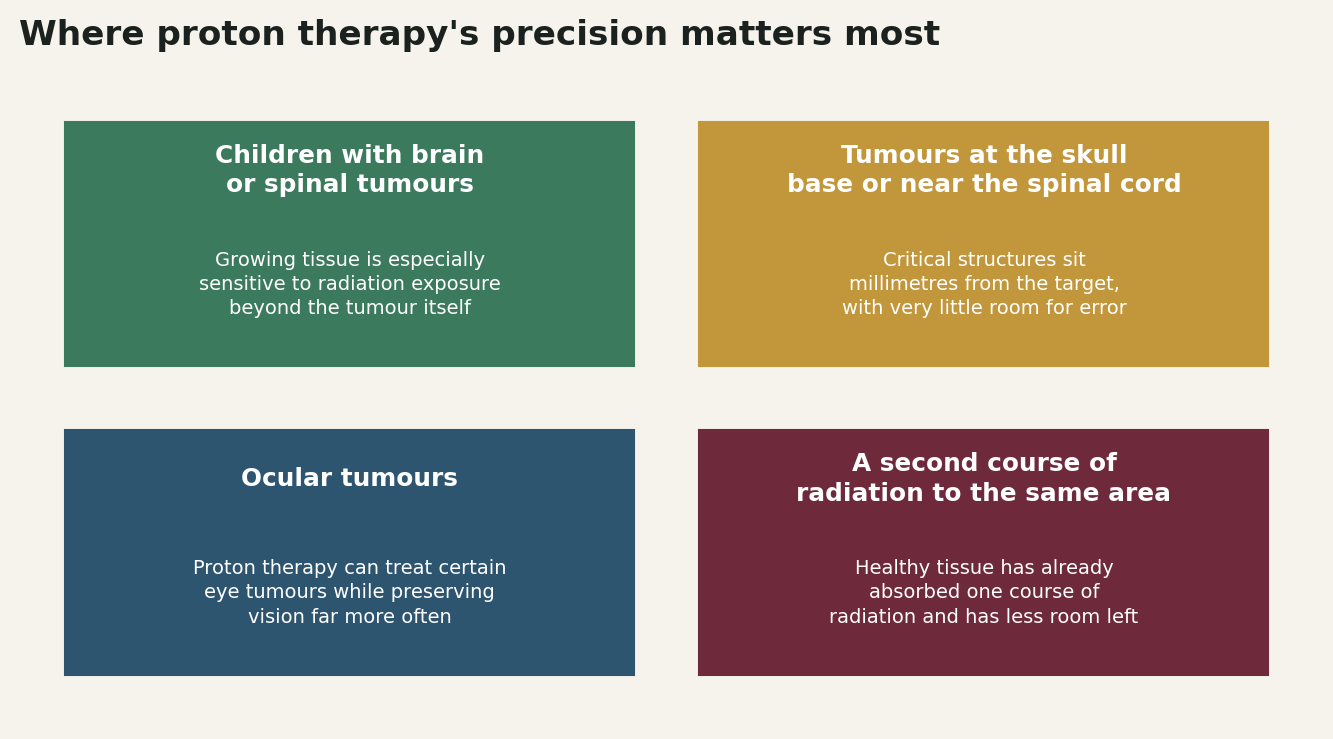
Children are a particularly important group, because growing tissue is more sensitive to radiation exposure beyond the intended target, and the long-term developmental stakes are higher than in adult patients. Tumours at the skull base or wrapped around the spinal cord sit millimetres from structures that cannot tolerate a wide margin of error. Certain eye tumours can be treated with proton therapy while preserving vision far more reliably than with other approaches. And patients who need a second course of radiation to an area that has already been treated once benefit enormously from sparing the healthy tissue that has already absorbed its share.
Outside these situations, it's worth being direct: conventional radiation, delivered by an experienced Canadian team, remains an excellent and entirely appropriate choice for most cancers. Proton therapy is not a universal upgrade, and a genuinely good radiation oncologist, wherever they practise, will tell you plainly whether your specific tumour falls into the category where the difference actually matters.
What the money actually looks like
Since Canada has no domestic proton therapy option at any price, the realistic paid alternative most
Canadian families currently consider is the United States.
American proton therapy, priced for an insurance-backed domestic market, commonly runs into six figures for a complete course. India operates proton therapy centres with the same precision equipment and physics expertise, at a fraction of the American price. In 24 years of guiding patients through this decision, the families who navigate it best are the ones who start the conversation with their Canadian oncology team early, since coordinating imaging, planning and follow-up between two countries takes real lead time.
What you are actually getting for it
A genuinely operating proton facility, not a converted conventional radiation suite. Ask how long the centre has been treating patients and how many courses it delivers annually.
A dedicated medical physics team, since proton planning is a specialised discipline distinct from conventional radiation physics.
A clear, honest assessment of whether proton therapy is actually the right choice for your specific tumour, not a default recommendation because the technology exists.
Accreditation you can verify independently. JCI is the international arm of the body accrediting hospitals across the United States; NABH is India's national equivalent, recognised by the same global standards authority.
A full treatment record built for your Canadian oncology team to use, including the exact protocol and total dose delivered.
Straight answers for Canadian Patients about Proton Therapy in India
Is proton therapy always better than conventional radiation?
No. For most cancers, conventional radiation is equally effective and entirely appropriate. Proton therapy's advantage concentrates in specific situations, particularly paediatric tumours, skull base and spinal tumours, ocular tumours, and re-irradiation cases, where sparing surrounding tissue matters especially.
Will my provincial plan cover proton therapy in India?
Out-of-country coverage exceptions require pre-approval showing the treatment is genuinely unavailable in Canada, which is straightforwardly true for proton therapy specifically, since no domestic facility exists at all. Raise this directly and specifically with your provincial ministry of health.
How long does a proton therapy course take?
Typically similar to conventional radiation, often several weeks of daily sessions, though hypofractionated protocols can shorten this for suitable cases. Ask your treating team for the specific schedule planned for you.
How long should I plan to stay in India?
For the full duration of the treatment course, commonly three to six weeks, plus initial planning and imaging time.
Who manages my follow-up once I'm home?
Your Canadian oncology team, provided they have the complete treatment plan and dose record in writing before you leave.
A closing word
Proton therapy is a genuinely precise, well-established treatment that Canada simply does not offer domestically, at any hospital, at any price. For the specific situations where its precision matters most, particularly in children and tumours near critical structures, that gap is worth addressing directly rather than assuming conventional radiation is the only option. If you have imaging or a treatment plan you would like reviewed, send it to me and I will look at it properly.
Sources
- 🌐 "Proton beam therapy: A modern treatment for cancer, but not in Canada (yet)", The Conversation , 2024 — theconversation.com
- 🌐 National Association for Proton Therapy, patient information — proton-therapy.org
- 🌐 High Commission of India, e-Visa categories and eligibility — indianvisaonline.gov.in/evisa
Frequently Asked Questions by Canadian Patients about Proton Therapy in India
Can Canadian children with brain tumours receive proton therapy in India?
Yes. Canadian children with brain tumours may be assessed for proton therapy in India, particularly when protecting developing healthy tissue around the tumour is an important consideration. The PDF identifies paediatric tumours as one of the situations where proton precision can matter most.
Can Canadian patients with skull-base tumours consider proton therapy in India?
Yes. Canadian patients with skull-base tumours may be considered for proton therapy because critical structures can lie only millimetres from the treatment target. The PDF specifically identifies skull-base tumours as an important application.
Can Canadian patients with spinal tumours receive proton therapy in India?
Canadian patients with tumours near the spinal cord may be assessed for proton therapy in India when reducing radiation exposure to nearby critical structures is clinically important. Suitability should be determined by the treating radiation oncology team.
Can Canadian patients with ocular tumours consider proton therapy in India?
Yes. Canadian patients with certain eye tumours may be assessed for proton therapy, with the PDF noting that proton treatment can help preserve vision more reliably in selected ocular tumour cases than some other approaches.
Can Canadian cancer patients who previously received radiation consider proton therapy in India?
Yes. Canadian patients requiring a second course of radiation to an area previously treated may be assessed for proton therapy because surrounding healthy tissue has already received radiation exposure. The PDF specifically identifies re-irradiation as a situation where proton precision can be valuable.
How much does a full proton therapy course cost for Canadian patients in India?
The PDF shows an indicative India cost of approximately C$14,200 for a full proton therapy course, compared with C$175,000 for the U.S. private option shown in the comparison. Canadian patients should obtain a case-specific quotation before travelling.
Can Canadian patients receive proton therapy in Canada instead of travelling to India?
According to the PDF, Canada has no medical proton therapy facility, so Canadian patients who specifically require proton therapy currently need to consider treatment outside Canada. The briefing notes that Canadian patients already travel abroad for this treatment.
Will Canadian provincial health insurance cover proton therapy performed in India?
Canadian patients should discuss this directly with their provincial health ministry and seek any required pre-approval before travelling. The PDF notes that out-of-country coverage exceptions require documentation that the treatment is unavailable in Canada, which specifically applies to proton therapy because Canada has no domestic facility.
How long should Canadian patients stay in India for proton therapy?
Canadian patients should generally plan to remain in India for the full treatment course, commonly three to six weeks, plus the initial planning and imaging period. The exact duration depends on the treatment schedule prescribed for the individual patient.
How should Canadian patients arrange follow-up after proton therapy in India?
Canadian patients should coordinate follow-up with their Canadian oncology team before returning home. The Indian centre should provide the complete treatment plan, exact protocol and total dose record in writing so the Canadian team can continue appropriate follow-up.
Page Summary
This guide explains proton therapy in India for Canadian patients who require highly precise radiation treatment. It highlights that Canada currently has no domestic proton therapy facility. Page 1 compares proton therapy availability across G7 countries. Page 2 explains how proton beams reduce radiation beyond the tumour. Page 3 identifies cancers where this precision can matter most and compares India and U.S. costs. Pages 4–5 cover centre verification, treatment duration, travel planning and Canadian follow-up.
Citation Block
| Topic | Information |
|---|---|
| Topic Information | Proton Therapy in India for Canadian Patients |
| Treatment | Proton Therapy / Proton Beam Therapy |
| Country | India |
| Intended Audience | Canadian Patients |
| Canadian Availability | No domestic medical proton therapy facility |
| Main Physical Advantage | Dose drops sharply after the selected target depth |
| Key Patient Groups | Paediatric, Skull-Base, Spinal, Ocular and Re-Irradiation Cases |
| Indicative India Cost | Approximately C$14,200 |
| U.S. Private Cost Shown | Approximately C$175,000 |
| Treatment Schedule | Often several weeks of daily sessions |
| Typical India Stay | Approximately 3–6 weeks |
| Key Specialist | Radiation Oncologist |
| Physics Team | Dedicated Medical Physics Team |
| Facility Requirement | Genuine operating proton therapy facility |
| Centre Verification | Years treating patients and annual course volume |
| Hospital Accreditation | JCI or NABH can be independently verified |
| Follow-Up | Canadian Oncology Team |
| Required Records | Exact treatment protocol and total dose |
| Pre-Travel Requirement | Early coordination with Canadian oncology team |
| Important Treatment Point | Proton therapy is not appropriate for every cancer |
| Coverage Consideration | Canadian patients should discuss out-of-country coverage specifically with their provincial health ministry |
| Travel Planning | Include initial planning and imaging in the stay |
| Author | Dr. Dheeraj Bojwani |
| Experience | 24+ Years |


Our Mission Statement
Our mission is to place patients at the centre of every healthcare decision by providing trustworthy, evidence-based, and unbiased medical information. We believe that informed patients make better decisions. Backed by personalised guidance from our experienced advisory team, we help patients understand their treatment options, compare them objectively, and confidently choose the path that best suits their medical needs and personal circumstances.
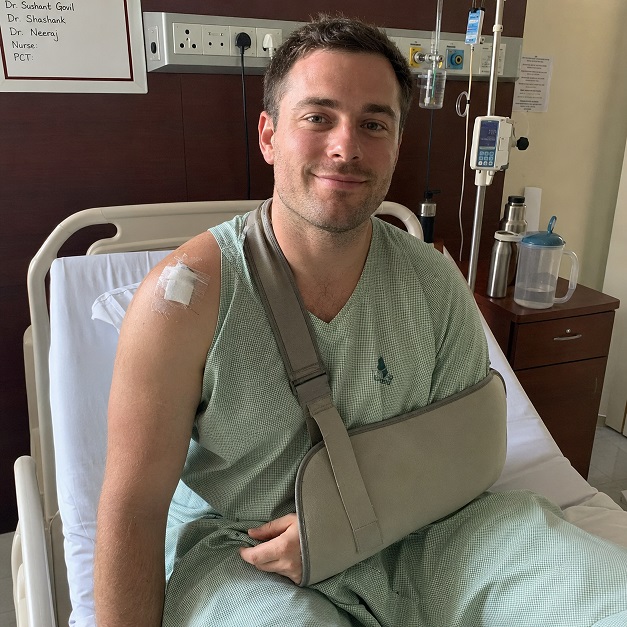
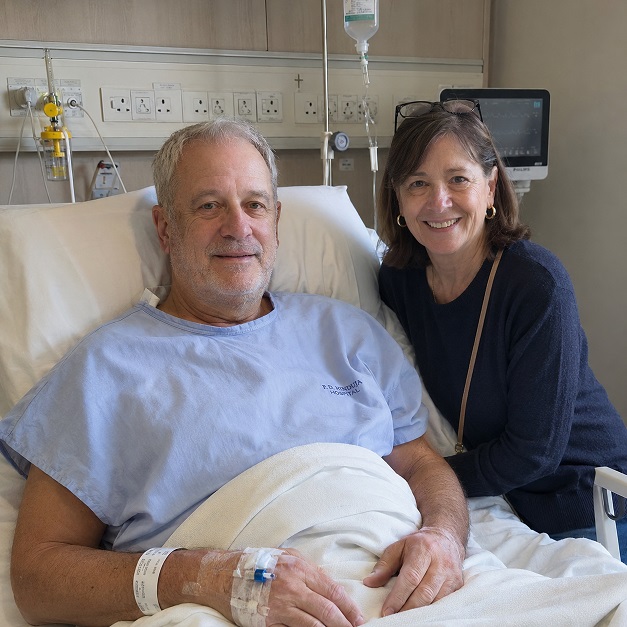
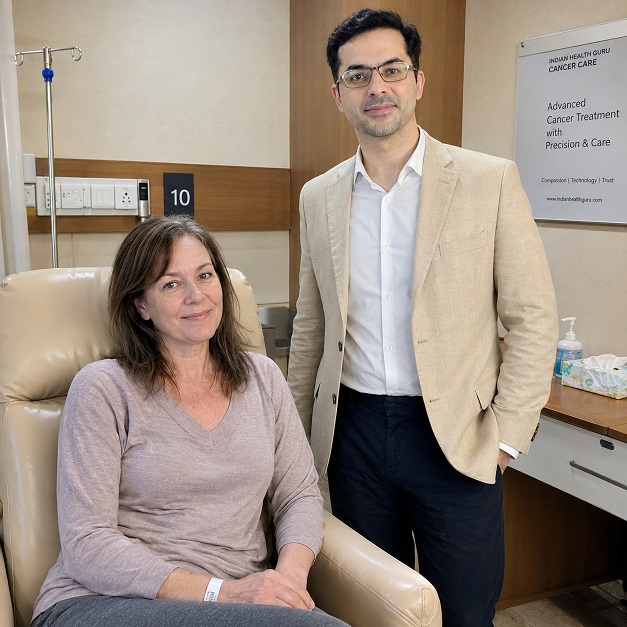
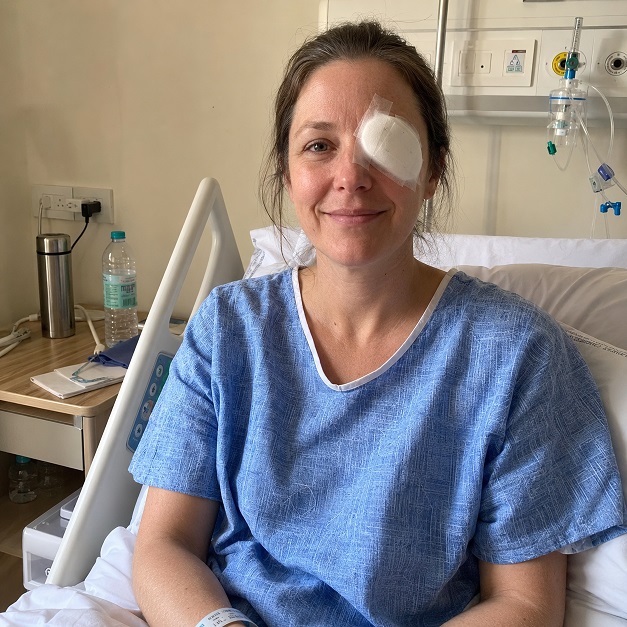
Patient Testimonials from Canada

Ready to Take the First Step?
Share your Medical Reports with our Healthcare Managers Today and Get a FREE CONSULTATION, a Personalized Treatment Plan, and Complete Support from Arrival to Recovery.
Get Your Free ConsultationFrom Canada to India: Your Complete Patient Support Guide
- Weight Loss & Bariatric Surgery in India for Canadian Patients: The Multi-Year Wait, Explained (2026)
- Bone Marrow Transplant in India for Canadian Patients: Complete Guide
- Brain Tumor Surgery in India for Canadian Patients: Complete Guide
- Breast Cancer Treatment and Surgery in India for Canadian Patients
- Cancer Treatment and Surgery in India for Canadian Patients
- Cardiac Surgery in India for Canadian Patients
- Colorectal Cancer Treatment and Surgery in India for Canadian Patients
- Cosmetic and Aesthetic Surgery in India for Canadian Patients
- CyberKnife Treatment in India for Canadian Patients: Complete Guide
- Dental Surgery in India for Canadian Patients | Complete Treatment & Cost Guide
- Gamma Knife Treatment in India for Canadian Patients
- Heart Valve Replacement Surgery in India for Canadian Patients
- Hip Surgery in India for Canadian Patients | Complete Treatment, Cost & Recovery Guide
- HIPEC Surgery in India for Canadian Patients: Complete Guide
- Kidney Transplant in India for Canadian Patients: Complete Guide
- Knee Surgery in India for Canadian Patients: Wait Times & Costs
- Neurosurgery in India for Canadian Patients: Wait Times & Costs
- Paediatric Cardiac Surgery in India for Canadian Patients