

Scoliosis and Spine Deformity Correction in India for Canadian Patients
From teenagers to growing children to adults, modern deformity correction is one of the genuine success stories in spine surgery. This guide covers the full range of who it serves, and how to choose a team confidently.
A 52-year-old office manager in Kelowna, BC, with degenerative scoliosis that developed slowly over two decades. A 15-year-old in Winnipeg with a curve caught on a routine physical. A father in Regina researching growing rods for his six-year-old daughter. Three very different patients, all served well by the same field of medicine, and all facing the same practical question: where should this correction actually happen, and by whom.
Read This Before Anything Else in This Document
This briefing is not written for cauda equina symptoms, acute neurological deterioration, or a rapidly progressing deformity with new weakness or bladder or bowel changes. Those situations require emergency assessment in Canada immediately. What follows concerns stable, well-defined deformity, whether in a growing child, a neuromuscular condition, or an adult, where there is genuine time to choose carefully and the outcomes, done well, are consistently excellent.
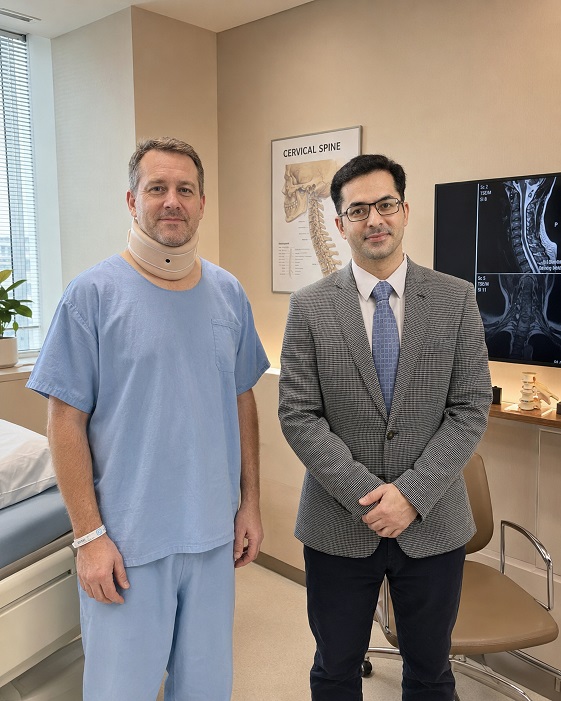
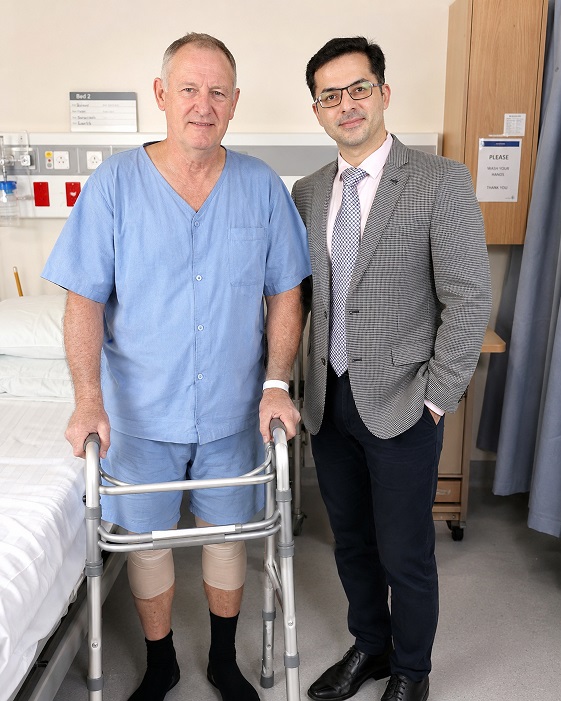
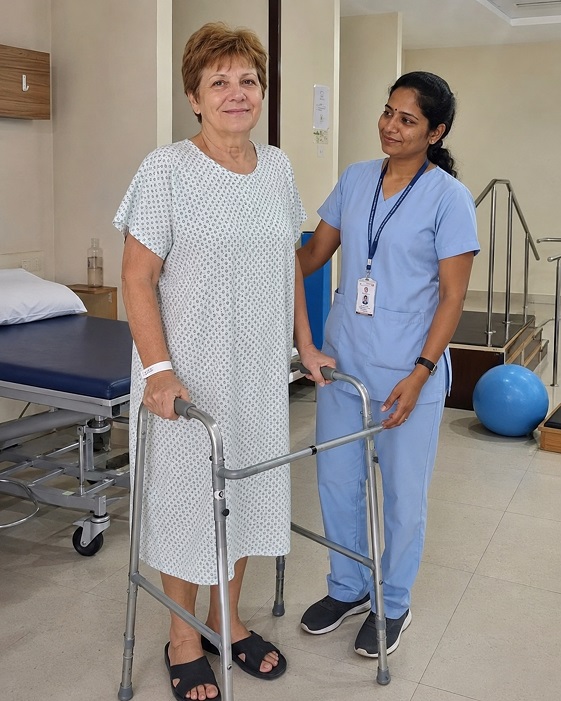
Healing Journeys of Canadian Patients
Key Takeaways
- Modern scoliosis and spinal deformity correction can benefit teenagers, growing children, adults and patients with neuromuscular conditions. The guide describes adolescent idiopathic scoliosis as the most common presentation, while early-onset scoliosis can be treated with growth-friendly techniques.
- The page 2 visual highlights four major patient groups: teenagers with adolescent idiopathic scoliosis, growing children with early-onset scoliosis, adults with degenerative deformity, and children or adults with cerebral palsy or related neuromuscular conditions.
- Experience is an important factor in complex deformity surgery. The page 2 chart illustrates that higher-volume deformity centres generally achieve greater curve correction, reinforcing the importance of asking about the surgeon's specific deformity-correction volume, rather than relying on general spine-surgery experience.
- For young children with early-onset scoliosis, growth-friendly surgery using traditional or magnetically controlled growing rods can control the curve while allowing the spine to continue growing. Scheduled lengthening procedures are generally performed approximately every six to seven months, followed by definitive fusion at skeletal maturity.
- The guide emphasizes that complex deformity surgery requires continuous intraoperative neuromonitoring, a dedicated deformity team, experienced anaesthesia and ICU support. These should be confirmed before travelling.
- The page 4 cost comparison shows substantially lower indicative costs in India than in US private care. Clearly stated figures include approximately C$23,500 for adult degenerative multi-level fusion, C$4,200 for a growing-rod single lengthening and C$29,500 for complex revision/vertebral column resection in India.
- The guide recommends choosing a centre based on matching the patient's specific curve type and severity with a team that has genuine experience in similar deformity cases, rather than selecting primarily on price.
- Patients should obtain six important details in writing before travelling, including surgeon-specific volume, continuous neuromonitoring, planned spinal levels and procedure, expected correction, an itemised price and a pre-arranged Canadian follow-up plan.
Quick Facts
- Treatment
- Scoliosis and Spine Deformity Correction
- Country
- India
- Patients
- Canadian Patients
- Specialty
- Spine Deformity Surgery
- Patient Groups
- Teenagers, Growing Children, Adults and Neuromuscular Patients
- Common Condition
- Adolescent Idiopathic Scoliosis
- Childhood Treatment
- Growth-Friendly Surgery With Growing Rods
- Growing-Rod Lengthening
- Approximately Every 6–7 Months
- Final Treatment
- Definitive Fusion at Skeletal Maturity
- Key Safety Measure
- Continuous Intraoperative Neuromonitoring
- Adult Treatment
- Deformity Correction and Multi-Level Fusion
- Hospital Selection
- Verifiable JCI or NABH Accreditation
- Follow-Up
- Named Canadian Specialist and Imaging Schedule
- Important Principle
- Match the Curve Type With the Right Deformity Team
In Brief
Scoliosis and spinal deformity correction is a technically demanding field in which matching the patient's specific deformity to an experienced team is central to achieving a durable correction. For children, the treatment decision also needs to account for remaining growth, while complex adult cases require dedicated deformity, anaesthesia and ICU expertise. Continuous intraoperative neuromonitoring and a clearly documented Canadian follow-up plan should be confirmed before treatment abroad.
Scoliosis and spine deformity correction serves a wider range of patients than most people expect
Canadian spine surgeons do excellent work, and in 24 years of guiding international patients into Indian hospitals I have never suggested otherwise. Modern deformity correction is one of the genuine success stories in spine surgery — done well, it reliably restores alignment, relieves pain, and in growing children preserves the ability to keep growing normally. This guide is written to help you understand the full range of who benefits, and how to choose a team confidently, whichever category you fall into.
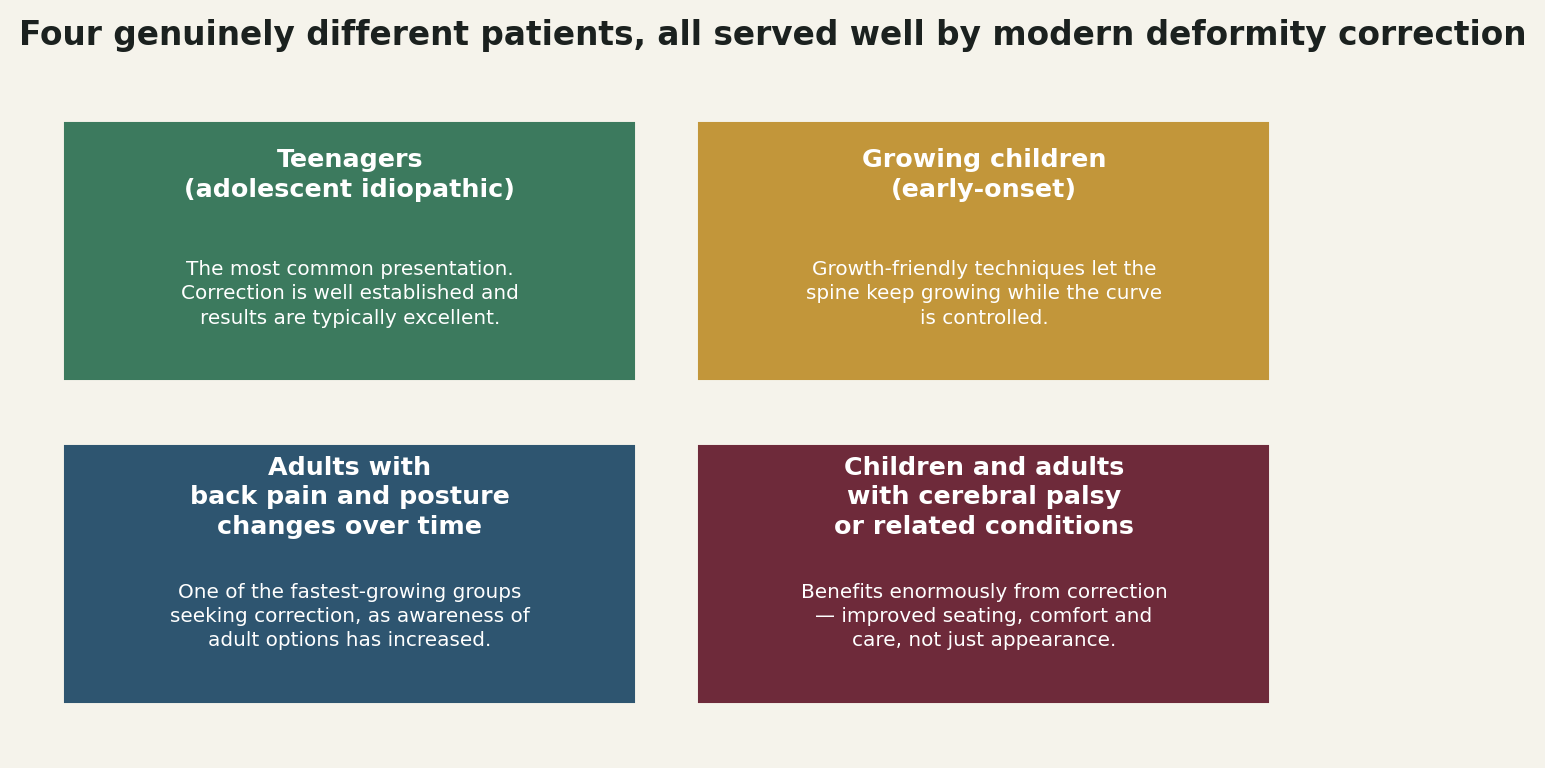
Adolescent idiopathic scoliosis, the most common presentation, has some of the best-established outcomes in the field. Early-onset scoliosis in young children is managed with growth-friendly techniques specifically designed to correct the curve while letting the spine keep growing. Adult degenerative deformity is one of the fastest-growing groups seeking correction, as more adults have become aware that meaningful improvement is available later in life than many assume. And correction for children and adults with cerebral palsy or related neuromuscular conditions genuinely transforms daily comfort, seating and care, well beyond the curve itself.
Why experience matters, and what it actually buys you
Deformity correction is a technically demanding field, and the good news is that the relationship between experience and outcome runs strongly in the patient's favour: teams that do this work often tend to achieve more complete, more durable correction.
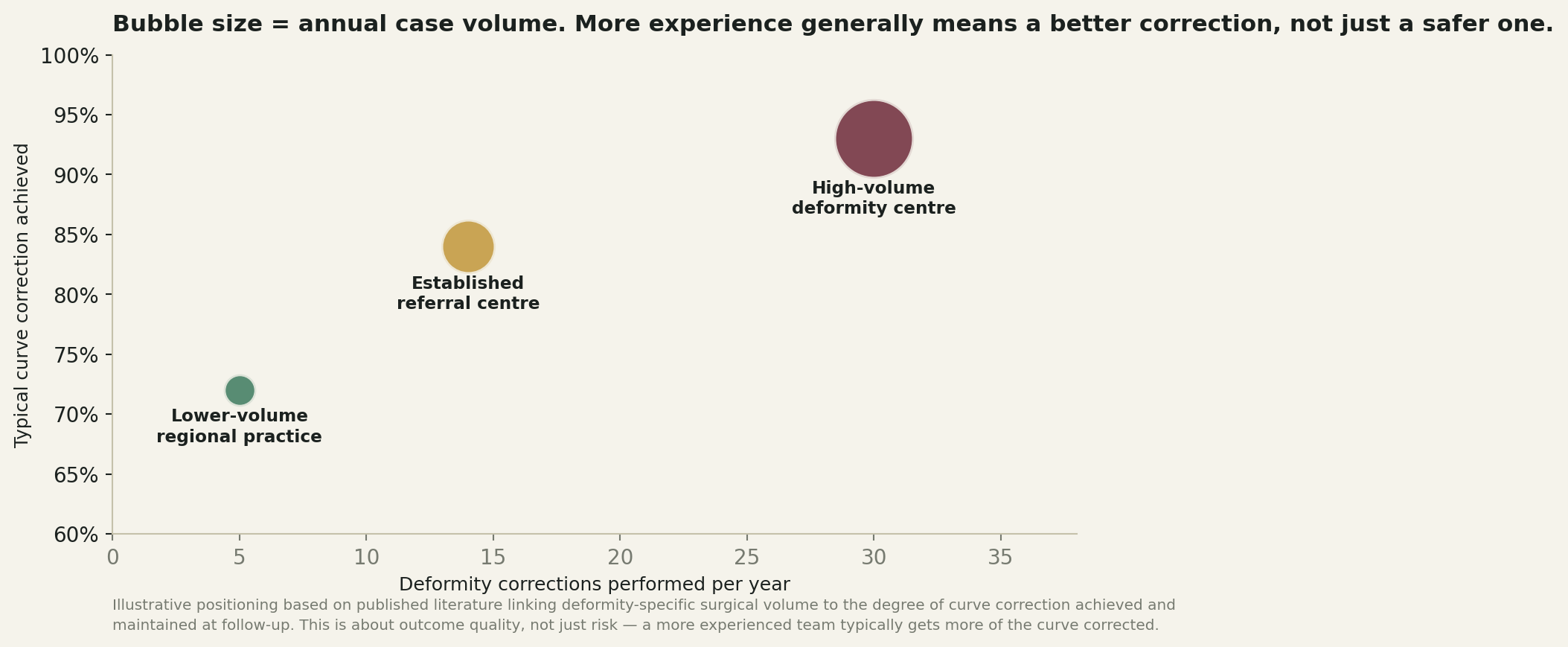
This is worth framing positively rather than as a warning: a team that performs deformity correction routinely, using continuous intraoperative neuromonitoring and a genuine multidisciplinary approach, is simply better positioned to achieve the correction you are hoping for. Ask directly for the surgeon's annual volume in deformity correction specifically, and ask how many cases similar to yours, in curve type and severity, they have performed recently — not as a safety checklist, but because it is a genuine predictor of how good your result will be.
For a growing child, correction and growth happen together
Early-onset scoliosis in a young child is one of the more remarkable areas of modern spine surgery, because it solves a problem that once seemed unsolvable: how do you correct a curve without stopping a child's spine from growing?
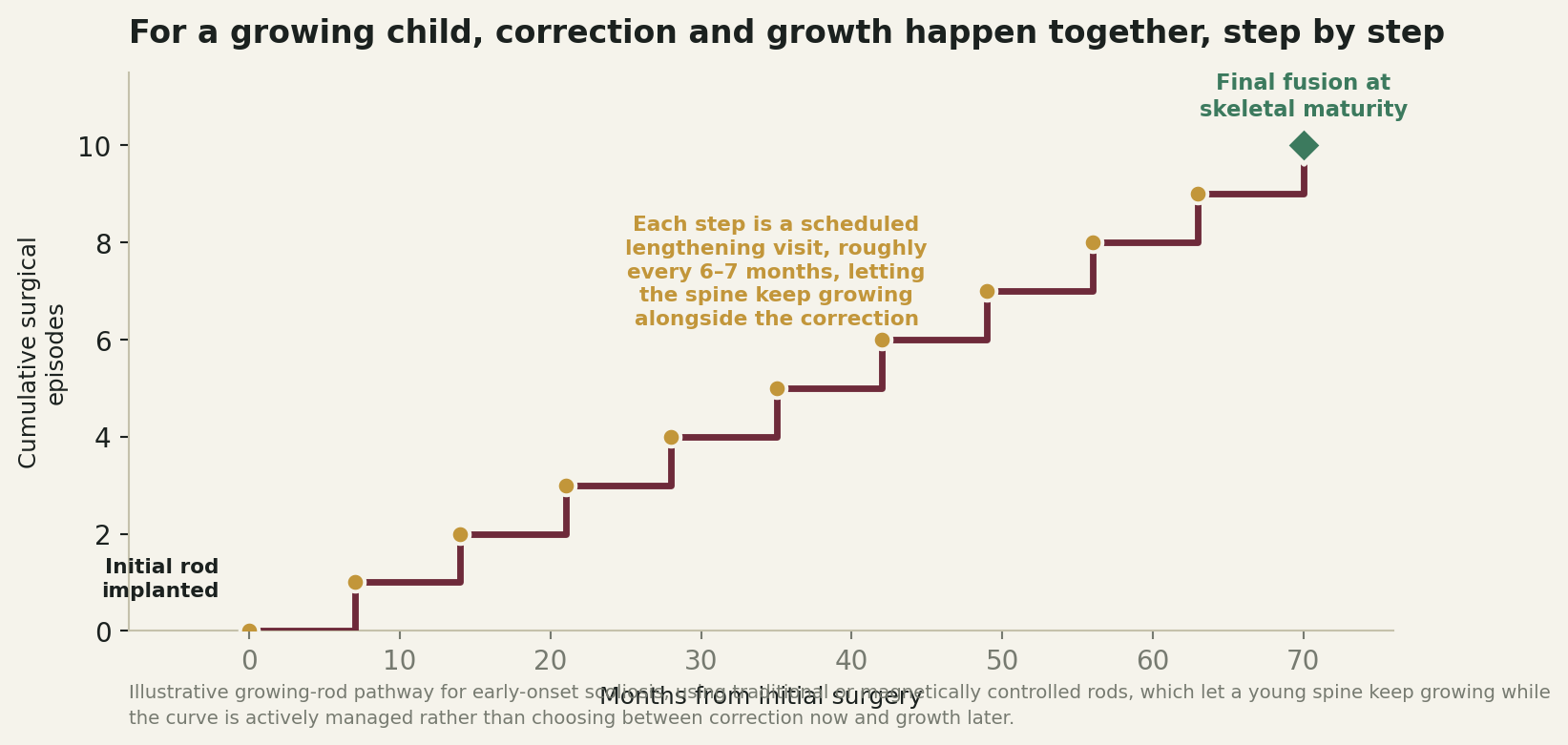
Growth-friendly surgery, using traditional or magnetically controlled growing rods, achieves exactly this: a programme of scheduled lengthening procedures roughly every six to seven months, allowing the spine to keep growing throughout childhood, followed by a final definitive fusion once the child reaches skeletal maturity. It is a genuine, well-established solution, and families considering it should feel confident asking their chosen centre how they manage the programme over its full multi-year course, from the first implant through to the final fusion.
What the money actually looks like
Complex spinal deformity surgery is not something Canada's small private surgical sector offers; it requires dedicated deformity teams, continuous intraoperative neuromonitoring, and an ICU capable of managing longer procedures. For a patient or family exploring options beyond their current team, the realistic paid alternative is the United States rather than a domestic private clinic.
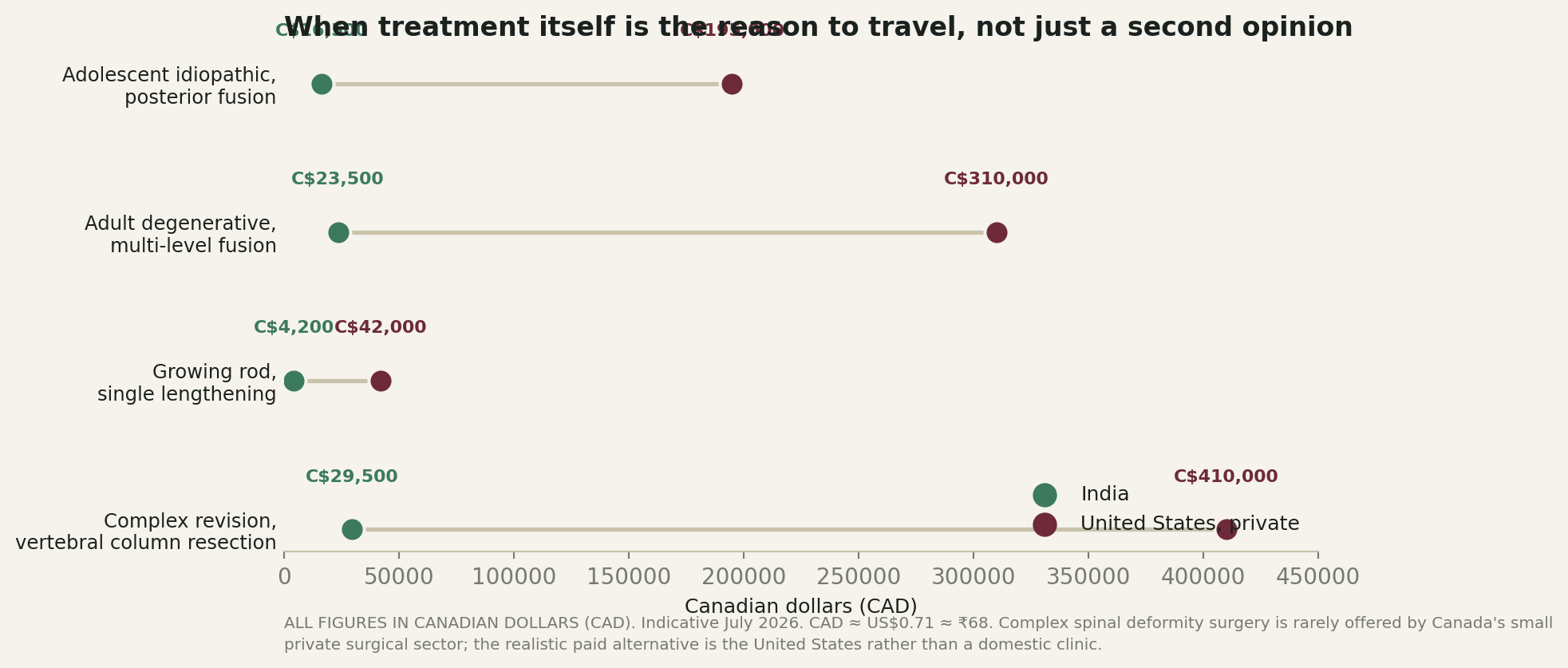
American deformity surgery, priced for an insurance-backed domestic market, commonly runs into six figures for complex adult cases. India's major spine deformity centres perform this work at high volume, with continuous neuromonitoring and dedicated teams as standard, at a fraction of the American price. In 24 years of guiding patients through this decision, the families and patients who do best are the ones who match their specific curve type to a team with real, matching experience — and then let the cost comparison make the decision an easy one.
What you are actually getting for it
Genuine, checkable volume in your specific deformity type, not spine surgery volume in general.
Continuous intraoperative neuromonitoring as standard practice, the international safety benchmark for this field.
A multidisciplinary team, including anaesthesia and ICU experienced specifically with deformity cases, rather than adapted from general spine surgery.
Accreditation you can verify independently. JCI is the international arm of the body accrediting hospitals across the United States; NABH is India's national equivalent, recognised by the same global standards authority.
A discharge record built for your Canadian team to use, including the exact levels fused, instrumentation used, and a specific long-term surveillance plan.
Six Things to Have in Writing Before You FLY
1. The surgeon's annual volume in your specific deformity type, not general spine surgery.
2. Confirmation of continuous intraoperative neuromonitoring, as standard for your procedure.
3. The exact levels and procedure planned, including whether osteotomy is anticipated.
4. The typical degree of correction the unit achieves for patients with a curve similar to yours.
5. An itemised, all-inclusive price, naming ICU days assumed and the cost of exceeding them.
6. Your Canadian follow-up, already agreed: a named specialist and a surveillance imaging schedule.
Straight answers for Canadian Patients about Scoliosis and Spine Deformity Correction in India
I have new leg weakness or bladder changes with my curve. Does this apply to me?
No. These are emergency symptoms requiring immediate assessment in a Canadian emergency department. This briefing concerns stable, non-urgent deformity.
Is scoliosis correction generally successful?
Yes. Modern deformity correction, performed by an experienced team, reliably achieves substantial, durable correction across adolescent, adult and neuromuscular presentations, and is one of the more consistently successful fields in spine surgery.
Will my provincial plan reimburse surgery performed in India?
Almost never. Out-of-country coverage exceptions require pre-approval showing the procedure is genuinely unavailable in Canada within a medically acceptable time.
Is my child a candidate for growing rods, or should we wait for a single fusion?
This depends on age, remaining growth, and curve severity, and should be decided by a paediatric deformity specialist directly, weighing how much growth potential remains.
How long should I plan to stay in India?
Around four to five weeks for a major fusion, on a changeable ticket, following a documented fit-to-fly assessment.
A closing word
Scoliosis and spinal deformity correction is one of the genuine success stories in modern spine surgery, serving teenagers, growing children, adults and patients with neuromuscular conditions with consistently strong outcomes. Match your specific curve type to a team with real, matching experience, insist on continuous neuromonitoring as standard, and the arithmetic on cost and quality both work in your favour. If you would like a second opinion on your imaging, send it to me and I will look at it properly.
Sources
- 🌐 Mass General Brigham, "How to Manage Adult Scoliosis" — massgeneralbrigham.org
- 🌐 "Surgical outcomes and complication rates in severe scoliosis: a systematic review", SICOT-J, 2025 — sicot-j.org
- 🌐 "Two stage posterior surgery using temporary Magnetically Controlled Growing Rod for severe and rigid Adolescent Idiopathic Scoliosis" — ncbi.nlm.nih.gov/PMC12718158
- 🌐 High Commission of India, e-Visa categories and eligibility — indianvisaonline.gov.in/evisa
Frequently Asked Questions by Canadian Patients about Scoliosis and Spine Deformity Correction in India
Who can benefit from scoliosis and spinal deformity correction?
The guide covers teenagers with adolescent idiopathic scoliosis, young children with early-onset scoliosis, adults with degenerative deformity and patients with cerebral palsy or related neuromuscular conditions.
Why is surgeon experience important in scoliosis surgery?
Deformity correction is technically demanding. The guide recommends asking for the surgeon's annual volume in deformity correction and experience with cases similar to the patient's curve type and severity.
What are growing rods used for?
Growing rods are used for selected children with early-onset scoliosis. They help control the curve while allowing the child's spine to continue growing before definitive fusion at skeletal maturity.
How often are growing rods lengthened?
The guide describes scheduled lengthening procedures approximately every six to seven months, depending on the treatment programme and the child's needs.
Is continuous neuromonitoring important during deformity surgery?
Yes. The guide specifically recommends continuous intraoperative neuromonitoring as a standard safety measure for complex deformity procedures.
How much can scoliosis surgery cost in India?
The PDF gives indicative costs including approximately C$23,500 for adult degenerative multi-level fusion, C$4,200 for a single growing-rod lengthening and C$29,500 for complex revision/vertebral column resection.
What should I ask the surgeon before travelling to India?
Ask for the surgeon's specific deformity volume, confirmation of continuous neuromonitoring, the exact planned procedure and spinal levels, expected correction and a detailed treatment plan.
How long should Canadian patients stay in India after major fusion surgery?
The guide recommends planning for approximately four to five weeks for a major fusion, with a changeable ticket and documented fit-to-fly assessment.
When should scoliosis symptoms be treated as an emergency?
New leg weakness or bladder or bowel changes require immediate emergency assessment in Canada. The guide is intended for stable, non-urgent spinal deformity rather than acute neurological deterioration.
Page Summary
This guide explains scoliosis and spinal deformity correction in India for Canadian patients across different age groups and clinical presentations. It covers adolescent idiopathic scoliosis, early-onset scoliosis, adult degenerative deformity and neuromuscular conditions. The guide emphasizes procedure-specific surgeon experience, continuous intraoperative neuromonitoring and multidisciplinary deformity care. It also explains growing-rod treatment for children, provides indicative India–US cost comparisons, and recommends obtaining detailed treatment, pricing and Canadian follow-up information in writing before travelling.
Citation Block
| Topic | Information |
|---|---|
| Topic | Scoliosis and Spine Deformity Correction in India for Canadian Patients |
| Treatment | Scoliosis / Spine Deformity Correction |
| Country | India |
| Intended Audience | Canadian Patients |
| Specialty | Spine Deformity Surgery |
| Patient Groups | Teenagers, Growing Children, Adults and Neuromuscular Patients |
| Common Condition | Adolescent Idiopathic Scoliosis |
| Childhood Treatment | Growth-Friendly Growing Rod Surgery |
| Lengthening Interval | Approximately 6–7 Months |
| Adult Treatment | Multi-Level Deformity Fusion |
| Complex Treatment | Revision / Vertebral Column Resection |
| Key Selection Factor | Matching Curve Type With Relevant Experience |
| Author | Dr. Dheeraj Bojwani |
| Experience | 24+ Years |

Our Mission Statement
Our mission is to place patients at the centre of every healthcare decision by providing trustworthy, evidence-based, and unbiased medical information. We believe that informed patients make better decisions. Backed by personalised guidance from our experienced advisory team, we help patients understand their treatment options, compare them objectively, and confidently choose the path that best suits their medical needs and personal circumstances.
Patient Testimonials from Canada
Ready to Take the First Step?
Share your Medical Reports with our Healthcare Managers Today and Get a FREE CONSULTATION, a Personalized Treatment Plan, and Complete Support from Arrival to Recovery.
Get Your Free ConsultationFrom Canada to India: Your Complete Patient Support Guide
- Weight Loss & Bariatric Surgery in India for Canadian Patients: The Multi-Year Wait, Explained (2026)
- Bone Marrow Transplant in India for Canadian Patients: Complete Guide
- Brain Tumor Surgery in India for Canadian Patients: Complete Guide
- Breast Cancer Treatment and Surgery in India for Canadian Patients
- Cancer Treatment and Surgery in India for Canadian Patients
- Cardiac Surgery in India for Canadian Patients
- Colorectal Cancer Treatment and Surgery in India for Canadian Patients
- Cosmetic and Aesthetic Surgery in India for Canadian Patients
- CyberKnife Treatment in India for Canadian Patients: Complete Guide
- Dental Surgery in India for Canadian Patients | Complete Treatment & Cost Guide
- Gamma Knife Treatment in India for Canadian Patients
- Heart Valve Replacement Surgery in India for Canadian Patients
- Hip Surgery in India for Canadian Patients | Complete Treatment, Cost & Recovery Guide
- HIPEC Surgery in India for Canadian Patients: Complete Guide
- Kidney Transplant in India for Canadian Patients: Complete Guide
- Knee Surgery in India for Canadian Patients: Wait Times & Costs
- Neurosurgery in India for Canadian Patients: Wait Times & Costs
- Paediatric Cardiac Surgery in India for Canadian Patients