

Shoulder Surgery in India for Canadian Patients
Shoulder wear is a normal part of getting older, and modern surgery, from arthroscopic repair to joint replacement, treats it reliably. This guide covers the full range of conditions and options.
A 61-year-old in Victoria, BC, who golfed regularly until a rotator cuff tear made every swing painful. His imaging shows exactly what would be expected for his age. His physiotherapist has helped, but not enough, and his surgeon has confirmed arthroscopic repair is a reasonable next step. This isn't a dramatic story. It's an extremely common one, with a well-established, minimally invasive answer.
Healing Journeys of Canadian Patients
Key Takeaways
- Shoulder problems become increasingly common with age, and many rotator cuff tears found on imaging cause no symptoms and do not require surgery.
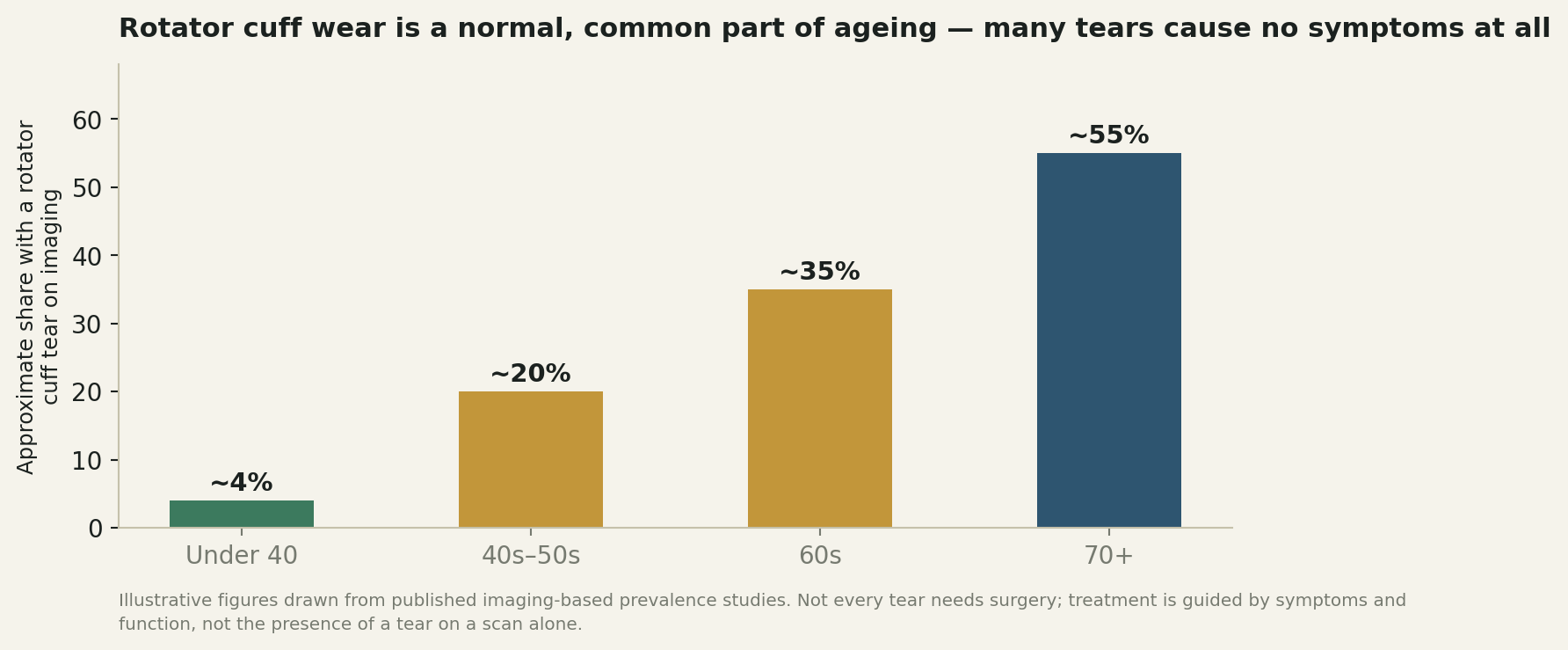
- The page 1 chart shows approximate rotator cuff tear prevalence of ~4% under 40, ~20% in the 40s–50s, ~35% in the 60s and ~55% at 70+.
- Modern shoulder surgery covers rotator cuff tears, labral and SLAP tears, arthritis requiring total replacement and rotator cuff arthropathy requiring reverse replacement.
- Arthroscopic surgery uses small incisions and a camera, generally causing less muscle disruption and allowing a more comfortable recovery than traditional open surgery.
- The page 3 cost chart shows indicative India prices of C$4,800 for arthroscopic rotator cuff repair, C$4,200 for arthroscopic labral repair, C$9,800 for total shoulder replacement and C$11,500 for reverse shoulder replacement.
- The same chart compares these with U.S. private costs of approximately C$38,000, C$32,000, C$68,000 and C$78,000, respectively.
- Total shoulder replacement generally requires a functioning rotator cuff, while reverse replacement is designed for patients whose rotator cuff is too damaged to support a conventional replacement.
- Canadian patients should match their specific diagnosis to a surgeon with genuine, checkable volume in that exact shoulder procedure rather than relying only on general orthopaedic experience.
- The PDF recommends approximately 1–2 weeks in India for arthroscopic repair and 2–3 weeks for shoulder replacement, followed by rehabilitation with a Canadian surgeon or physiotherapist.
Quick Facts
- Treatment
- Shoulder Surgery
- Country
- India
- Patients
- Canadian Patients
- Main Procedures
- Rotator Cuff Repair, Labral Repair, Total Shoulder Replacement and Reverse Shoulder Replacement
- Rotator Cuff Tear Prevalence Under 40
- Approximately 4% on imaging
- Rotator Cuff Tear Prevalence at 70+
- Approximately 55% on imaging
- Arthroscopic Rotator Cuff Repair – India
- Approximately C$4,800
- Arthroscopic Labral Repair – India
- Approximately C$4,200
- Total Shoulder Replacement – India
- Approximately C$9,800
- Reverse Shoulder Replacement – India
- Approximately C$11,500
- U.S. Rotator Cuff Repair
- Approximately C$38,000
- U.S. Labral Repair
- Approximately C$32,000
- U.S. Total Shoulder Replacement
- Approximately C$68,000
- U.S. Reverse Shoulder Replacement
- Approximately C$78,000
- Arthroscopic Repair Stay
- Approximately 1–2 weeks
- Shoulder Replacement Stay
- Approximately 2–3 weeks
- Key Specialist
- Orthopaedic Shoulder Surgeon
- Preferred Technique
- Arthroscopy where appropriate
- Total Replacement Requirement
- Functioning rotator cuff
- Reverse Replacement
- Used when the rotator cuff is too damaged for conventional replacement
- Hospital Accreditation
- JCI or NABH can be independently verified
- Follow-Up
- Canadian Surgeon or Physiotherapist
- Required Records
- Exact repair or implant details and rehabilitation plan
In Brief
Canadian patients considering shoulder surgery in India should first determine whether their symptoms and functional limitations actually justify surgery, because a tear seen on an MRI does not automatically require an operation. The PDF covers arthroscopic rotator cuff and labral repair, total shoulder replacement for arthritis and reverse replacement when the rotator cuff is too damaged for a conventional implant. The page 1 chart illustrates how rotator cuff tears become more common with age, while page 3 compares indicative India and U.S. costs across four major procedures. Canadian patients should verify the surgeon's specific procedure volume, appropriate arthroscopic or replacement technique, hospital accreditation, exact implant or repair details and a rehabilitation plan for their Canadian care team.
Shoulder wear is a normal part of getting older, and surgery for it is well established
Canadian orthopaedic surgeons do excellent work, and in 24 years of guiding international patients into Indian hospitals I have never suggested otherwise. It's worth starting with how common shoulder problems
actually are, because the numbers are genuinely reassuring rather than alarming.
Rotator cuff wear becomes progressively more common with age, showing up on imaging in a majority of people over seventy. Many of these tears cause no symptoms at all and never need treatment. When a tear does cause pain or limited function, arthroscopic repair is a well-established, minimally invasive procedure with a strong track record.
This is worth understanding before ever looking at a scan report with alarm. A shoulder MRI showing a tear, on its own, isn't a diagnosis requiring surgery; it's a description of something extremely common at your stage of life. The decision to operate should always be driven by how the shoulder is actually functioning day to day, not by the presence of a finding on paper.
The range of shoulder conditions modern surgery treats well
"Shoulder surgery" covers more ground than most people expect, and understanding the range helps match the right procedure to the right problem.
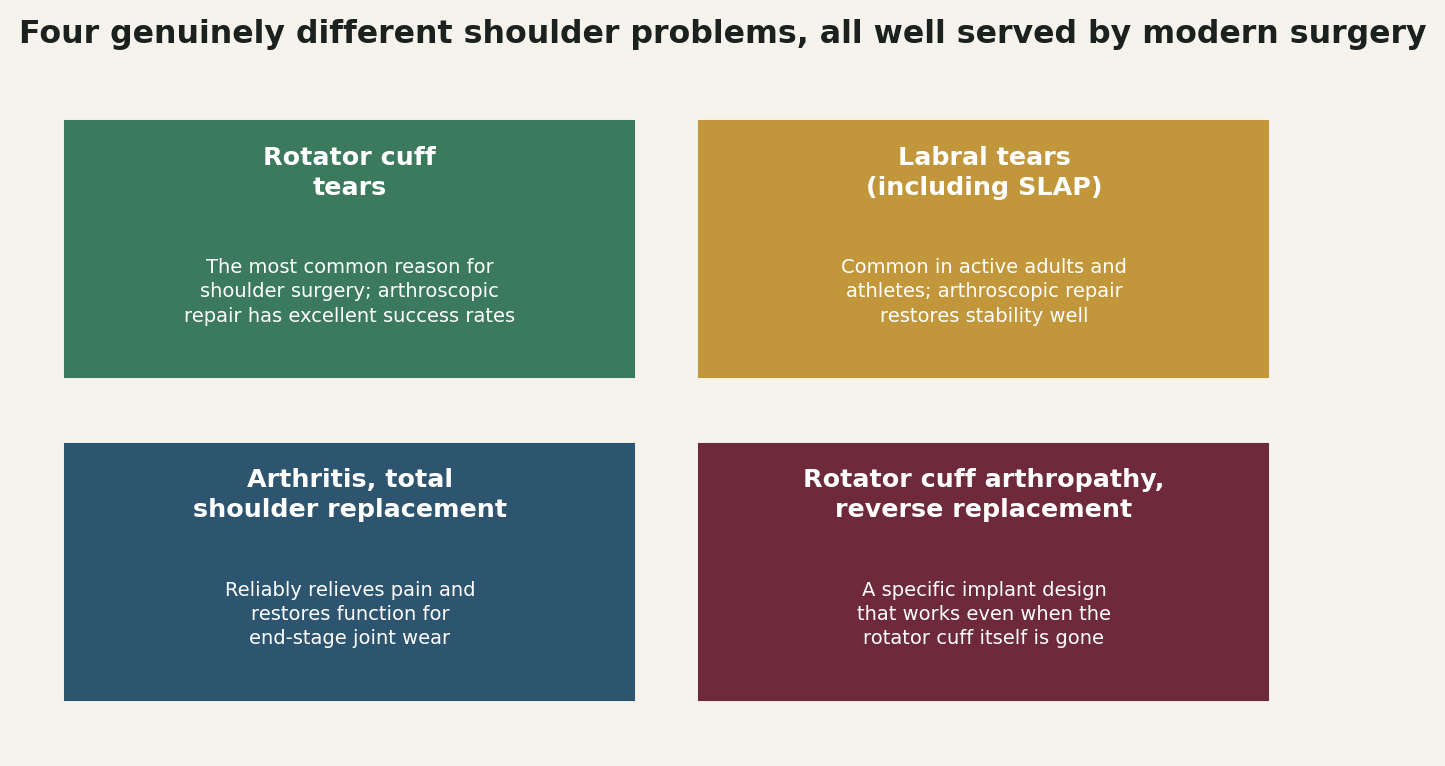
Rotator cuff tears are the most common reason for shoulder surgery, and arthroscopic repair achieves excellent outcomes for most patients. Labral tears, including SLAP tears, are common in active adults and athletes, and arthroscopic repair restores joint stability reliably. Shoulder arthritis is treated with total shoulder replacement, relieving pain and restoring function much as hip and knee replacement do. And for patients whose rotator cuff is too damaged to support a conventional replacement, reverse total shoulder replacement, a specific implant design that changes the joint's mechanics, works even when the rotator cuff itself is gone.
Why arthroscopic technique has become the default
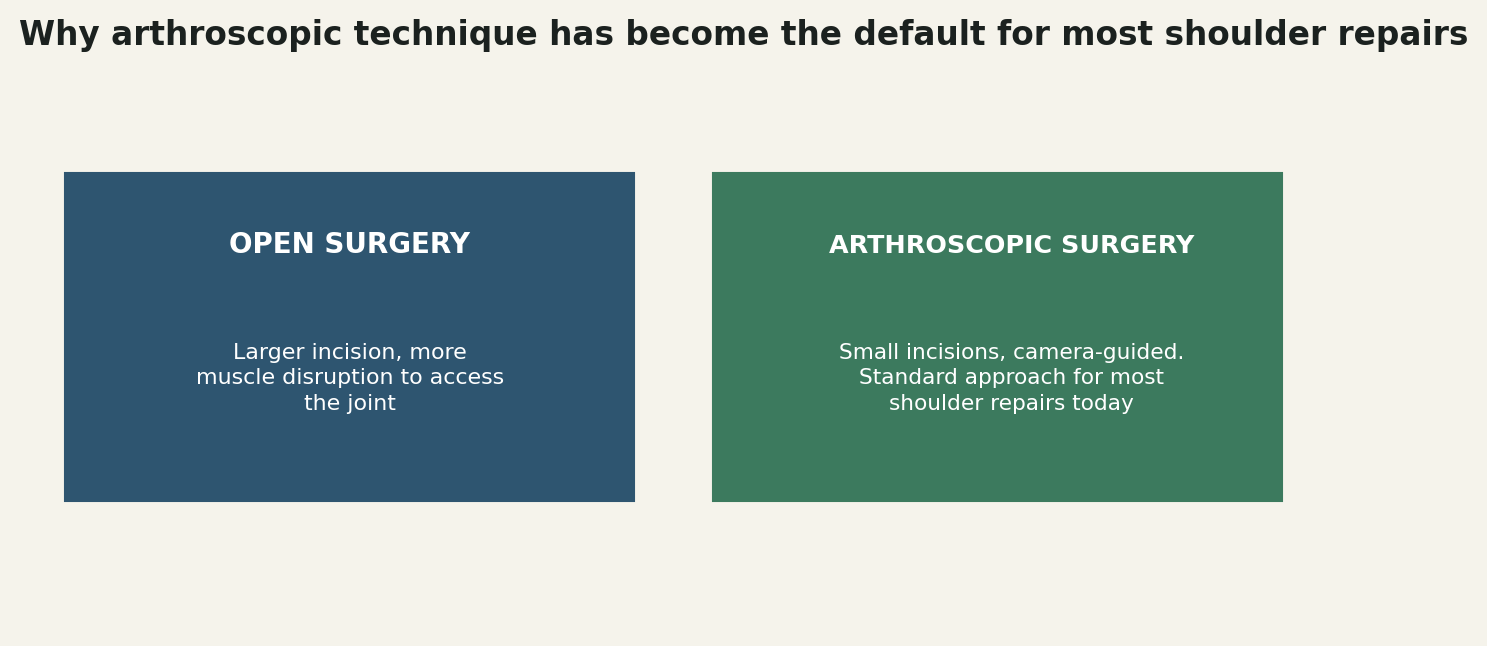
Most shoulder repairs today are performed arthroscopically, using small incisions and a camera to guide the procedure, rather than the larger, more disruptive open approach once standard. This generally means less muscle disruption, a more comfortable recovery, and a faster return to normal activity, which is exactly why it has become the default for rotator cuff and labral repair specifically.
Larger, more complex tears, and joint replacement procedures, sometimes still call for a more traditional approach, or a hybrid technique combining both. A surgeon experienced across the full range will recommend the right technique for your specific tear pattern rather than defaulting to one method regardless of what your shoulder actually needs.
What the money actually looks like
Shoulder replacement in particular is rarely offered by Canada's small private surgical sector, which typically lacks the joint-specific implant range and volume that complex cases benefit from. For patients seeking a faster path or a surgeon with high volume in a specific procedure, the realistic paid alternative is
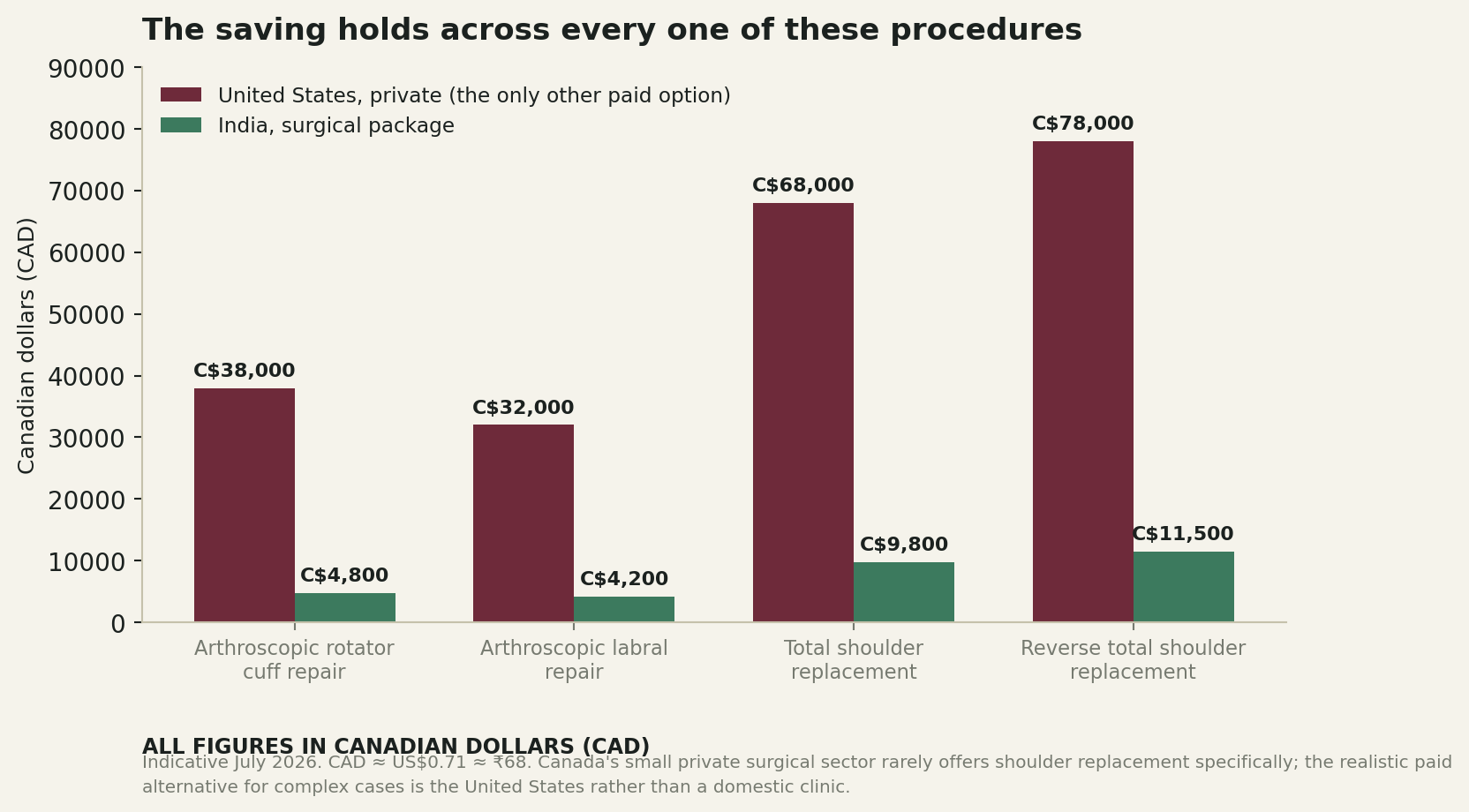
the United States rather than a domestic private clinic.
American shoulder surgery, priced for an insurance-backed domestic market, runs well into five figures for replacement procedures. India's major orthopaedic centres perform the full range of shoulder surgery at high volume, at a fraction of the American price. In 24 years of guiding patients through this decision, matching your specific diagnosis, rotator cuff repair, labral repair, or replacement, to a surgeon with real volume in that exact procedure matters more than any other single factor.
What you are actually getting for it
Genuine, checkable volume in your specific procedure, not general orthopaedic surgery.
Arthroscopic technique as standard, where appropriate for your condition.
Access to reverse shoulder replacement where rotator cuff arthropathy makes conventional replacement inappropriate.
Accreditation you can verify independently. JCI is the international arm of the body accrediting hospitals across the United States; NABH is India's national equivalent, recognised by the same global standards authority.
A discharge record built for your Canadian surgeon or physiotherapist to use, including the exact repair or implant details and a specific rehabilitation plan.
Straight answers for Canadian Patients about Shoulder Surgery in India
My scan shows a rotator cuff tear but I'm not in much pain. Do I need surgery?
Not necessarily. Many tears, particularly in older adults, cause no symptoms and don't require treatment. Surgery is generally guided by symptoms and function, not the presence of a tear alone.
Will my provincial plan reimburse shoulder surgery performed in India?
Almost never. Out-of-country coverage exceptions require pre-approval showing the procedure is genuinely unavailable in Canada within a medically acceptable time.
What's the difference between total and reverse shoulder replacement?
Total shoulder replacement mimics the joint's normal anatomy and requires a functioning rotator cuff. Reverse replacement changes the joint's mechanics specifically to work when the rotator cuff is too damaged to support a conventional implant.
How long should I plan to stay in India?
Around one to two weeks for arthroscopic repair, or two to three weeks for shoulder replacement, following a documented fit-to-fly assessment.
Who manages my rehabilitation once I'm home?
Your Canadian surgeon or physiotherapist, provided they have the full operative record and a specific rehabilitation plan in writing before you leave.
A closing word
Shoulder problems are common, and modern surgery, whether arthroscopic repair or joint replacement, offers well-established, reliable solutions across the full range of conditions. Match your specific diagnosis to a surgeon with real, checkable volume in that exact procedure, and the cost comparison works clearly in your favour. If you would like a second opinion on your imaging, send it to me and I will look at it properly.
Sources
- 🌐 American Academy of Orthopaedic Surgeons, "Rotator Cuff Tears" patient information — orthoinfo.aaos.org
- 🌐 American Academy of Orthopaedic Surgeons, "Shoulder Joint Replacement" patient information — orthoinfo.aaos.org
- 🌐 High Commission of India, e-Visa categories and eligibility — indianvisaonline.gov.in/evisa
Frequently Asked Questions by Canadian Patients about Shoulder Surgery in India
Do Canadian patients with a rotator cuff tear always need surgery?
No. Canadian patients may have a rotator cuff tear visible on MRI without needing surgery, particularly when symptoms are limited. The PDF states that treatment decisions should be based on pain and shoulder function rather than the scan finding alone.
Can Canadian patients with a symptomatic rotator cuff tear have arthroscopic repair in India?
Yes. Canadian patients with a symptomatic tear and appropriate surgical indication can be assessed for arthroscopic rotator cuff repair in India. The PDF describes arthroscopic repair as a well-established minimally invasive procedure.
How much does arthroscopic rotator cuff repair cost for Canadian patients in India?
The PDF shows an indicative India surgical package of approximately C$4,800, compared with approximately C$38,000 for the U.S. private option shown in the chart. Canadian patients should obtain a case-specific quotation before travelling.
Can Canadian patients with a labral or SLAP tear receive arthroscopic repair in India?
Yes. Canadian patients with appropriate labral or SLAP tears may be assessed for arthroscopic repair in India. The PDF notes that these injuries are common in active adults and athletes and that arthroscopic repair can restore joint stability.
How much does arthroscopic labral repair cost for Canadian patients in India?
The PDF gives an indicative India cost of approximately C$4,200 for arthroscopic labral repair, compared with approximately C$32,000 for the U.S. private option shown.
Can Canadian patients with shoulder arthritis receive total shoulder replacement in India?
Yes. Canadian patients with appropriate end-stage shoulder arthritis may be assessed for total shoulder replacement. The PDF explains that conventional total replacement is designed to restore normal joint mechanics and requires a functioning rotator cuff.
Can Canadian patients with severe rotator cuff damage receive reverse shoulder replacement in India?
Yes. Canadian patients whose rotator cuff is too damaged to support a conventional shoulder replacement may be assessed for reverse shoulder replacement. The PDF explains that reverse replacement changes the joint's mechanics to work despite severe rotator cuff damage.
How much does shoulder replacement cost for Canadian patients in India?
The PDF shows approximately C$9,800 for total shoulder replacement and C$11,500 for reverse shoulder replacement in India. Canadian patients should request an itemised quotation covering the procedure, implant and hospital-related costs.
How long should Canadian patients stay in India after shoulder surgery?
Canadian patients should generally plan for one to two weeks for arthroscopic repair and approximately two to three weeks for shoulder replacement, with travel following a documented fit-to-fly assessment.
How should Canadian patients continue shoulder rehabilitation after surgery in India?
Canadian patients should return with the complete operative record, including the exact repair or implant details and a specific rehabilitation plan. Their Canadian surgeon or physiotherapist can then continue rehabilitation and monitor recovery after they return home.
Page Summary
This guide explains shoulder surgery in India for Canadian patients, covering common repairs and shoulder replacement options. It highlights how rotator cuff tears become more common with age while many remain symptom-free. Page 1 presents the age-related prevalence of rotator cuff tears. Page 2 covers rotator cuff, labral, total and reverse shoulder procedures. Page 3 compares arthroscopic and open surgery and presents India–U.S. costs. Page 4 explains surgeon selection, replacement options, recovery and follow-up. Page 5 reinforces the importance of procedure-specific expertise and Canadian rehabilitation.
Citation Block
| Topic | Information |
|---|---|
| Topic Information | Shoulder Surgery in India for Canadian Patients |
| Treatment | Shoulder Surgery |
| Country | India |
| Intended Audience | Canadian Patients |
| Main Procedures | Rotator Cuff Repair, Labral Repair, Total and Reverse Shoulder Replacement |
| Rotator Cuff Tears Under 40 | ~4% on imaging |
| Rotator Cuff Tears in 40s–50s | ~20% on imaging |
| Rotator Cuff Tears in 60s | ~35% on imaging |
| Rotator Cuff Tears at 70+ | ~55% on imaging |
| India Rotator Cuff Repair | Approximately C$4,800 |
| India Labral Repair | Approximately C$4,200 |
| India Total Shoulder Replacement | Approximately C$9,800 |
| India Reverse Shoulder Replacement | Approximately C$11,500 |
| U.S. Rotator Cuff Repair | Approximately C$38,000 |
| U.S. Labral Repair | Approximately C$32,000 |
| U.S. Total Shoulder Replacement | Approximately C$68,000 |
| U.S. Reverse Replacement | Approximately C$78,000 |
| Arthroscopic Repair Stay | Approximately 1–2 weeks |
| Replacement Stay | Approximately 2–3 weeks |
| Key Specialist | Orthopaedic Shoulder Surgeon |
| Important Experience | Genuine, checkable volume in the exact procedure |
| Surgical Technique | Arthroscopic where appropriate |
| Total Replacement | Requires a functioning rotator cuff |
| Reverse Replacement | Designed for severe rotator cuff damage |
| Hospital Accreditation | JCI or NABH can be independently verified |
| Follow-Up | Canadian Surgeon or Physiotherapist |
| Required Records | Exact repair/implant details and rehabilitation plan |
| Pre-Travel Check | Confirm diagnosis, procedure, surgeon volume and itemised costs |
| Travel Clearance | Documented fit-to-fly assessment |
| Author | Dr. Dheeraj Bojwani |
| Experience | 24+ Years |


Our Mission Statement
Our mission is to place patients at the centre of every healthcare decision by providing trustworthy, evidence-based, and unbiased medical information. We believe that informed patients make better decisions. Backed by personalised guidance from our experienced advisory team, we help patients understand their treatment options, compare them objectively, and confidently choose the path that best suits their medical needs and personal circumstances.
Patient Testimonials from Canada

Ready to Take the First Step?
Share your Medical Reports with our Healthcare Managers Today and Get a FREE CONSULTATION, a Personalized Treatment Plan, and Complete Support from Arrival to Recovery.
Get Your Free ConsultationFrom Canada to India: Your Complete Patient Support Guide
- Weight Loss & Bariatric Surgery in India for Canadian Patients: The Multi-Year Wait, Explained (2026)
- Bone Marrow Transplant in India for Canadian Patients: Complete Guide
- Brain Tumor Surgery in India for Canadian Patients: Complete Guide
- Breast Cancer Treatment and Surgery in India for Canadian Patients
- Cancer Treatment and Surgery in India for Canadian Patients
- Cardiac Surgery in India for Canadian Patients
- Colorectal Cancer Treatment and Surgery in India for Canadian Patients
- Cosmetic and Aesthetic Surgery in India for Canadian Patients
- CyberKnife Treatment in India for Canadian Patients: Complete Guide
- Dental Surgery in India for Canadian Patients | Complete Treatment & Cost Guide
- Gamma Knife Treatment in India for Canadian Patients
- Heart Valve Replacement Surgery in India for Canadian Patients
- Hip Surgery in India for Canadian Patients | Complete Treatment, Cost & Recovery Guide
- HIPEC Surgery in India for Canadian Patients: Complete Guide
- Kidney Transplant in India for Canadian Patients: Complete Guide
- Knee Surgery in India for Canadian Patients: Wait Times & Costs
- Neurosurgery in India for Canadian Patients: Wait Times & Costs
- Paediatric Cardiac Surgery in India for Canadian Patients